- The paper demonstrates that extremely small center-of-mass offsets (as little as 0.2% of particle length) markedly alter sedimentation behavior.
- It utilizes precision 3D printing and controlled density modifications to experimentally and numerically map bifurcation sequences in helical ribbons.
- It identifies an alignment bifurcation surface in 3D parameter space, transitioning dynamics from complex multi-attractor regimes to a unique stable orientation.
Bifurcation Structure in Sedimentation of Helical Particles under Stokes Flow
Introduction and Unified Perspective
This manuscript investigates the sedimentation dynamics of non-spherical particles in Stokes flow, specifically emphasizing the translation-rotation coupling inherent to helical geometries (2604.03193). The central thesis introduces a parameterization of sedimentation dynamics via the displacement between the center of force and the center of mobility, denoted by r. Leveraging experimental and computational evaluation of helical ribbons, the study characterizes the dynamical regimes and identifies bifurcations from complex orientation dynamics to a single attracting state as the offset magnitude increases. The methodology includes precise 3D printing and addition of metal spheres to create controlled density shifts, permitting exploration throughout the 3D center-of-force parameter space.
Extreme Sensitivity to Center of Mass Offsets
The spatial trajectories of nearly identical helical ribbons with minute offsets in the center of mass reveal dramatic differences in sedimentation behavior, even for perturbations as small as 0.2% of the particle length. Long-time dynamics can be immediate or delayed over hundreds of body lengths, highlighting sedimentation dynamics' acute sensitivity to geometric imperfections.
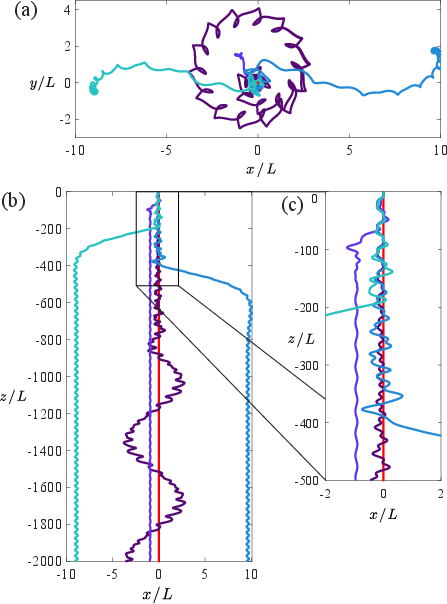
Figure 1: Spatial trajectories of five helical ribbons with identical shape and initial orientation, showing the impact of tiny center of mass offsets ($0.002L$) on the sedimentation path.
This sensitivity implicates that outcomes for typical manufactured particles may diverge substantially from those predicted for idealized, highly symmetric shapes.
Symmetry Analysis and the Cocentered Reference Particle
A comprehensive symmetry analysis is performed, examining the role of parity-time reversal (PT) symmetry in constraining the orientation dynamics. For cocentered particles—where center of force and center of mobility coincide—three PT symmetry planes restrict the evolution, resulting in closed orbits in orientation space rather than eventual convergence.
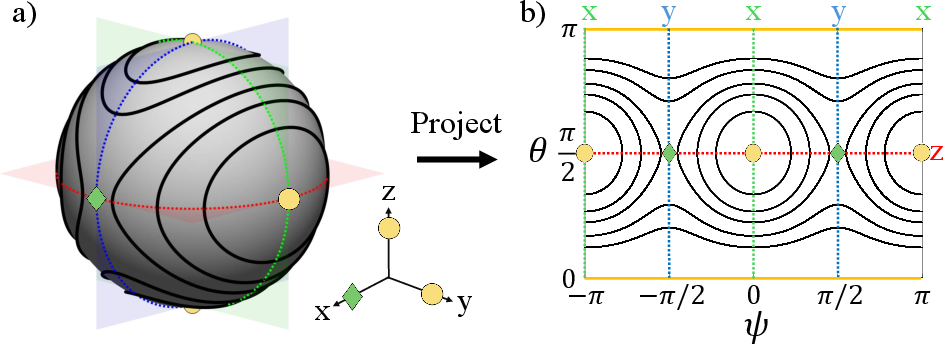
Figure 2: Orientation dynamics for a cocentered particle, with PT symmetry planes labeled and fixed points classified as centers (yellow) and saddles (green).
The eigenbasis of the translation-rotation coupling tensor (bm) is fundamental. Cocentered particles display four classes: null, isotropic, axisymmetric, and triaxial. For triaxial helical ribbons, six fixed points (four centers, two saddles) are guaranteed by topological constraints.
Experimental and Numerical Characterization of Bifurcations
The study systematically displaces the center of mass along principal axes (minor, major, intermediate) and records the ensuing bifurcation sequence:
- Minor and major axis offsets produce a "6-to-2" saddle-node bifurcation: four fixed points annihilate, yielding two spirals (one attracting, one repelling) and greatly simplified dynamics.
- Intermediate axis offsets generate a more intricate bifurcation involving transformation of centers to nodes and nodes to saddles, preserving topological index.
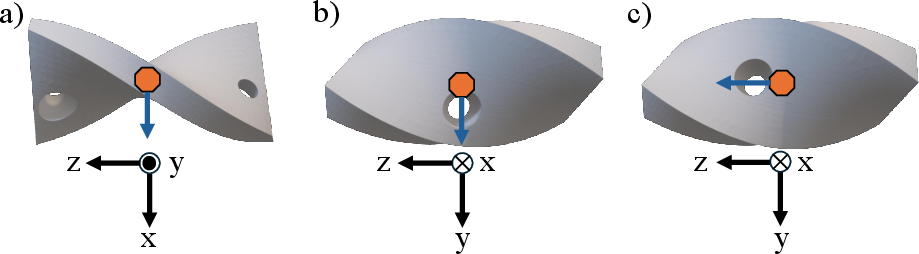
Figure 3: Helical ribbons with fabricated holes to enable center of mass offsets along principal axes, facilitating systematic experimental study of bifurcations.
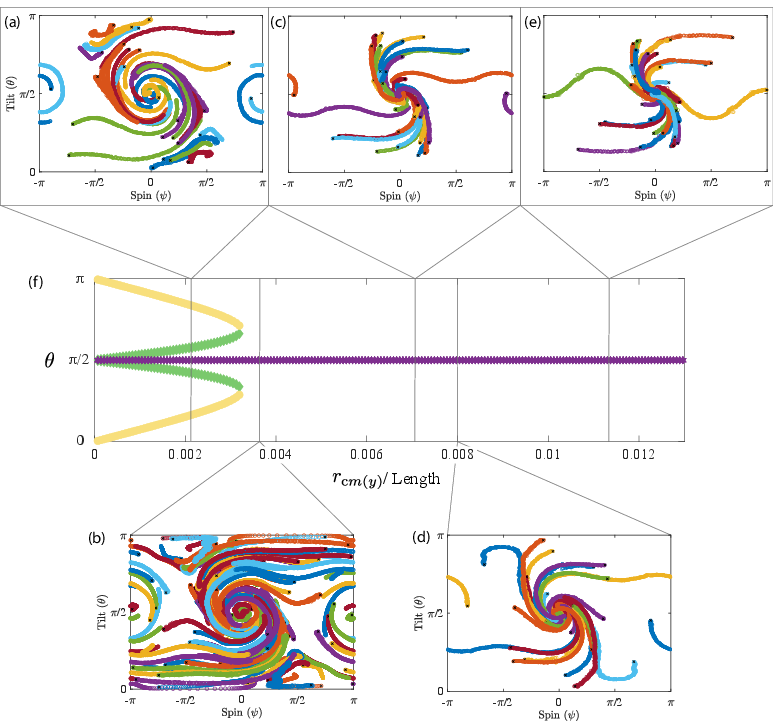
Figure 4: Experimental orientation phase diagrams and numerically computed bifurcation diagram as the center of mass is offset along the minor axis, revealing bifurcation thresholds for transition to spiral dynamics.
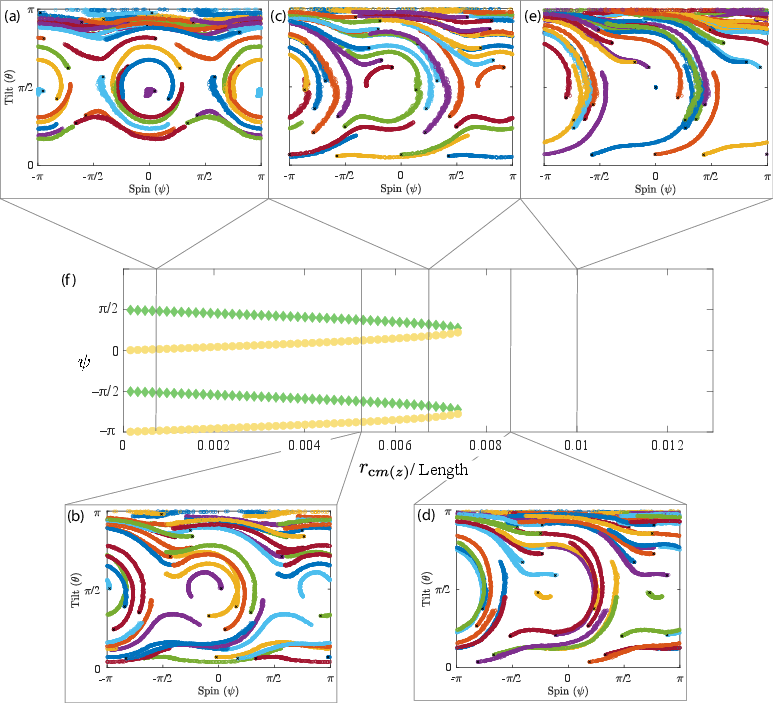
Figure 5: Analogous phase space and bifurcation diagram for major axis offsets, demonstrating increased critical offset compared to the minor axis due to eigenvalue structure.
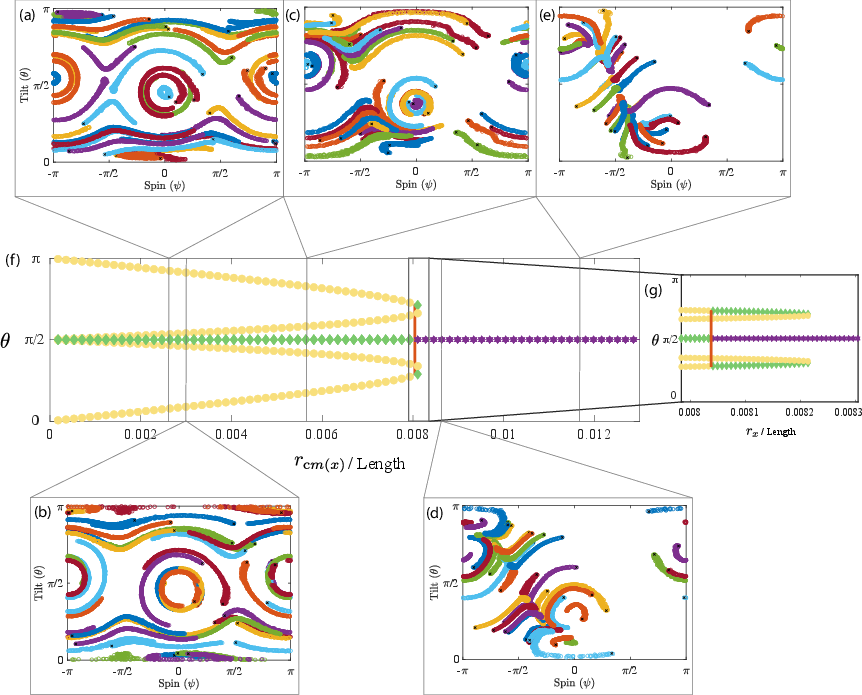
Figure 6: Experimental phase diagrams and bifurcation structure for intermediate axis offsets, highlighting the forbidden center-center annihilation and necessary line of nodes bifurcation.
The critical offset magnitude for bifurcation is typically less than 1% of the particle size, validating the claim of "extreme sensitivity" to density inhomogeneity. The bifurcation occurs at a length scale set by ∣bm∣/∣c∣.
The Alignment Bifurcation Surface and Complex Dynamics
Numerical exploration reveals a bifurcation surface in the 3D parameter space of center of force offsets. This surface separates complex, multi-attractor dynamics from eventual alignment to a unique stable orientation.
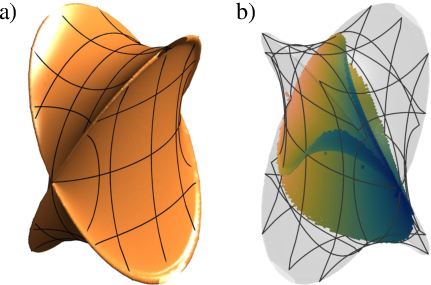
Figure 7: The "alignment bifurcation surface" in center of mass offset parameter space—outside of which only two fixed points survive and particles sediment with a single stable orientation.
Within the surface, additional bifurcations arise: Hopf bifurcations, homoclinic bifurcations, and the emergence of limit cycles. There exist regions with fixed-point swapping and complex limit cycle structure, especially near lower-dimensional cusps in the parameter space.
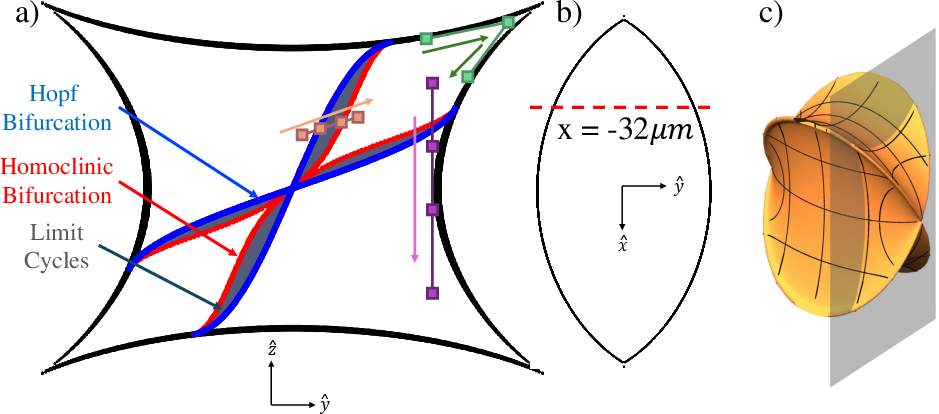
Figure 8: Schematic map of dynamical regimes in a slice of the bifurcation surface; limit cycles (gray), Hopf (blue), homoclinic (red), and protocols for experimental study (color-coded squares).
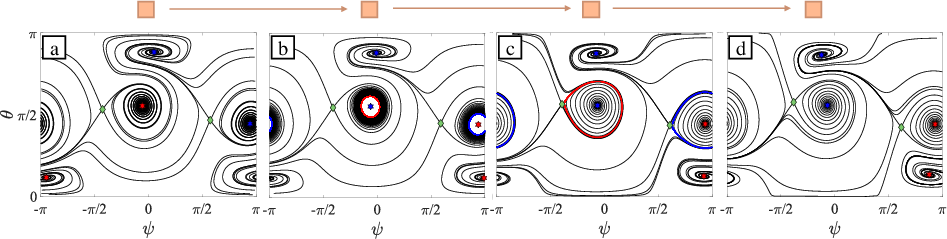
Figure 9: Example trajectory through the tan sequence of points in Figure 8, exhibiting Hopf and homoclinic bifurcations, with corresponding stable and unstable limit cycles.
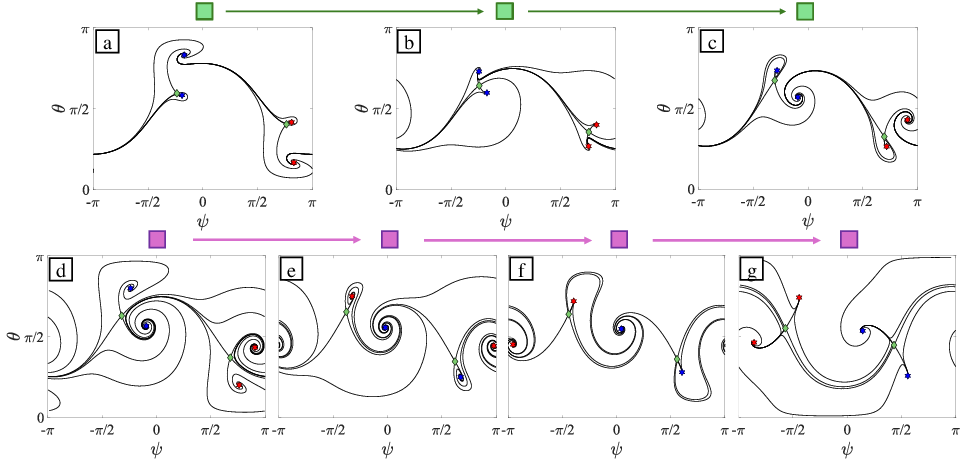
Figure 10: Trajectories along green and purple points in Figure 8, revealing cusp-driven swaps and transformations among attracting and repelling spirals and nodes.
These results highlight that even within a narrow tolerance in mass distribution, a diverse range of sedimentation dynamics may be realized, providing a practical route for engineering desired response via density modification.
Theoretical Implications, Practical Relevance, and Future Directions
This framework resolves key conceptual ambiguities in the role of shape vs. mass distribution for translation-rotation coupling. Notably, chirality per se is not required for translational-rotational coupling; rather, geometric constraints—particularly symmetry of bm and its relation to c—determine the class of cocentered particle and the available dynamical regimes. The sharp sensitivity to perturbation suggests that biological and synthetic active matter can exploit density control for orientation actuation.
The findings have direct implications for:
- Hydrodynamic sorting and separation of chiral particles [marcos_separation_2009]
- Optimization of microscale propulsion and swimmer design [keaveny_optimization_2013, walker_optimal_2015]
- Characterization and control of sedimentation dynamics in fabricated colloids, fibers, and engineered microstructures [doi_sedimentation_2005, palusa_sedimentation_2018, glotzer_anisotropy_2007]
- Design of microfluidic sorting platforms based on orientation-dependent sedimentation
Future work should extend analysis to geometries where the eigenframes of bm and c are non-aligned, e.g., bent disks and multi-symmetry axis particles. Additionally, more comprehensive exploration of the surfaces and cusps in the alignment bifurcation parameter space, including topological transitions induced by material inhomogeneity, is warranted.
Conclusion
The paper rigorously elucidates the bifurcation structure of low-Re sedimentation dynamics for helical and non-symmetric particles, demonstrating that a minute center-of-mass offset drives transitions from complex, non-convergent phase space dynamics to unique orientation stability. By constructing the mathematical and experimental foundation for the alignment bifurcation surface, this research provides an actionable blueprint for controlling particle sedimentation via shape and density distribution. The dependence of orientation convergence on initial conditions remains critical for practical applications, particularly when considering precision manufacturing and microfluidic environments. The methodology enables targeted design of synthetic particles, and the theoretical framework anticipates further exploration in active matter, colloidal engineering, and sediment transport models.