- The paper’s main contribution is extracting Hume’s three conditions—experiential grounding, structured retrieval, and vivacity transfer—and showing their abstraction in modern models.
- It demonstrates that while Bayesian formalization preserves numerical updating, it omits the qualitative aspects vital to genuine causal judgment.
- The study highlights implications for AI design, suggesting that re-incorporating Humean phenomenology could enhance robust causal reasoning.
Introduction
Yiling Wu's "Hume's Representational Conditions for Causal Judgment: What Bayesian Formalization Abstracted Away" (2604.03387) advances a systematic reading of Hume’s psychology of causal judgment and traces how core representational prerequisites of his framework were progressively abstracted away in subsequent Bayesian and predictive processing models. Wu identifies three necessary representational conditions from Hume’s texts—experiential grounding, structured retrieval, and vivacity transfer—and scrutinizes how each was treated or omitted in the progression from Hume’s original theory to modern statistical and computational cognitive science paradigms. The analysis further clarifies the architectural gap between Humean psychological models and contemporary AI/LLM architectures, which instantiate statistical updating without satisfying Hume’s representational requirements.
Hume’s Representational Architecture
Hume’s epistemology distinguishes impressions from ideas, positing the Copy Principle such that every idea must be traceable to a prior sensory or reflective impression. This principle ensures experiential grounding, preventing the mind from operating on “empty” ideas without empirical content. Hume further imposes architectural structure by differentiating between memory and imagination, establishing that associative operations occur not over a flat collection but over a hierarchically organized ensemble, encompassing mechanisms such as the revival set for abstract ideas. This provides the basis of structured retrieval, ensuring that categorical judgments, including causal attribution, summon relevant exemplars and counterexamples contextually rather than via mere pairwise association.
This dual-layer representational schema is depicted in Figure 1, which distinguishes fast, nonconceptual inference layers from slower, conceptually saturated judgment layers. The latter levels enable reflective operations, including the abstraction over instances required for general causal judgments.
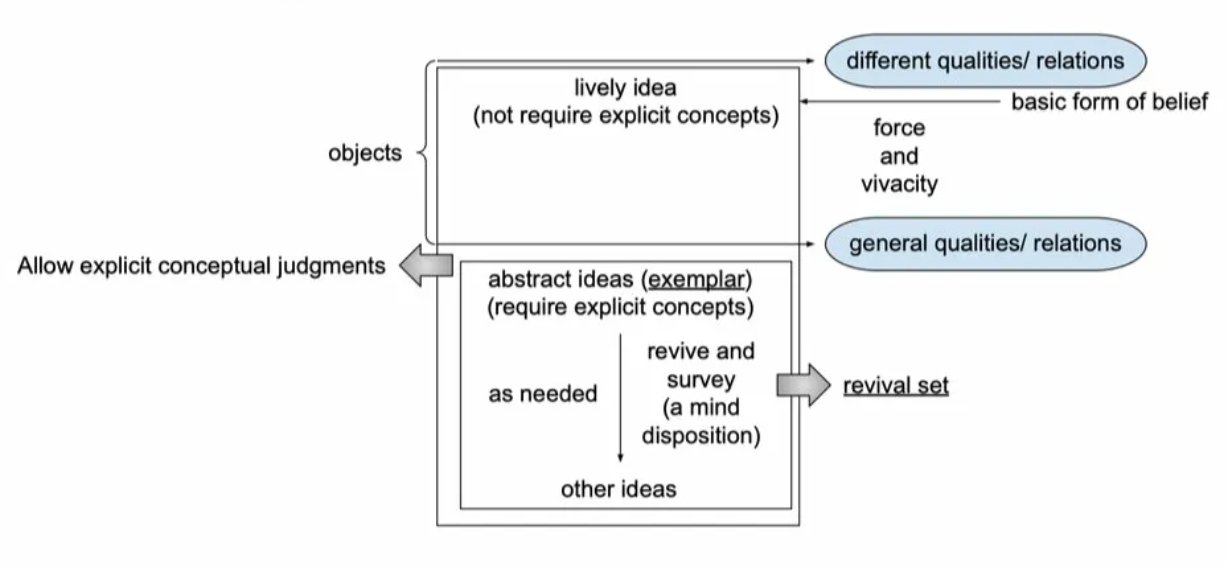
Figure 1: Hume's dual-layer model of mental representation, illustrating inference-level processing distinguished from judgment-level processing built atop abstract ideas and revival sets.
The Three Representational Conditions for Causal Judgment
Wu formalizes three representational conditions, each essential in Hume’s account of how the mind transitions from observation to belief in causation:
- Experiential Grounding (RC-1): All ideas must be reducible to impressions derived from genuine experience; there are no free-floating symbolic entities as possible objects of inference. When evaluating the claim "fire causes burning," both terms refer to concepts with a root in direct perception.
- Structured Retrieval (RC-2): The mind’s associative operations occur over a hierarchically organized system (exemplar/abstract idea with an associated revival set), enabling it to retrieve, compare, and assemble relevant particular instances, especially in adjudicating generalizations or evaluating counterexamples.
- Vivacity Transfer (RC-3): The inferential transition from impression to idea is accompanied by a qualitative “vivacity” shift—belief is not merely assigning a probability but is marked by a subjective sense of conviction, arising from the transfer of force and vivacity onto the associated idea. This mechanism is distinct from incremental updating and produces a mental state that is action-guiding and phenomenologically robust.
The schematic pathway connecting these conditions is detailed in Figure 2, demonstrating the flow from perception, through custom/habit, to the formation of belief, with vivacity transfer as a functional core.
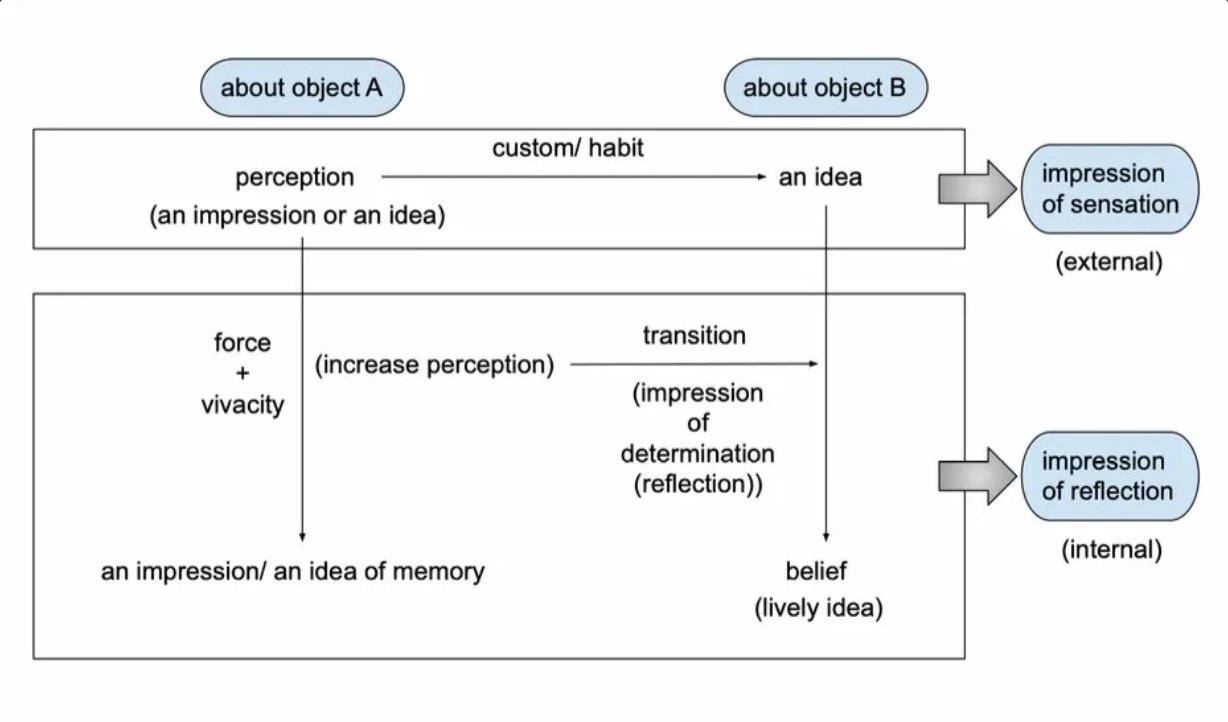
Figure 2: Hume's account of causal inference, from perception to custom/habit to belief, including the impression of determination supporting RC-3.
Hume’s key move is that the "impression of determination" (that underlies the idea of necessary connection) is not derived from external observation but from internal reflective processes unique to the mind’s operation—a distinction elaborated in Figure 3.
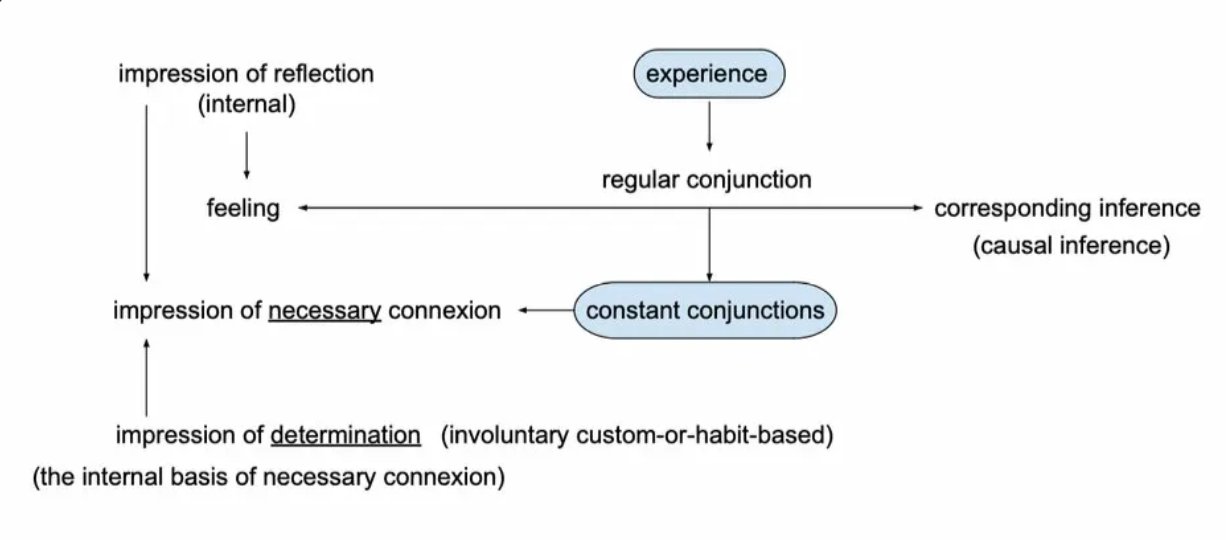
Figure 3: The rise of the idea of necessary connection through internal impressions of determination, illustrating the requirement for systems able to differentiate external and internal states (RC-3).
The Fate of Representational Conditions in Bayesian and Predictive Processing Frameworks
Wu’s central theoretical claim is that, as the Humean structure is formalized into Bayesian epistemology and further instantiated as predictive processing, the updating mechanism—the central insight of Hume’s model—is preserved, but the three representational conditions are successively abstracted away.
Abstraction at the Bayesian Level
Bayesian epistemology and its cognitive science successors recast causal updating as probability conditionalization over arbitrary hypothesis spaces. The updating mechanism’s structure is retained (evidence modifying prior into posterior according to Bayes’ rule), but:
- RC-1 is lost: Hypothesis spaces are mathematical, unconstrained by experiential derivation; a Bayesian agent “believes” in arbitrary constructs, as utility requires.
- RC-2 is lost: Hypotheses are collectively updated, not selectively recalled through complex associative patterns; retrieval is flat, not structured.
- RC-3 is lost: Moving from prior to posterior is an alteration of numeric value, not affective or convictional force. There is no subjective vivacity, nor any phenomenology of belief.
Partial Restoration and Ongoing Abstraction in Predictive Processing
Predictive processing rekindles some aspects of structural organization (RC-2) through hierarchical, generative models. These architectures allow certain analogues to structured retrieval—i.e., predictions are generated and corrected through a system with internal levels and dependencies. However:
- RC-1 remains absent: Hierarchies can be specified or learned without direct grounding in first-person sensory experience.
- RC-3 remains absent: Precision weighting and prediction error lack a phenomenological correlate to Humean vivacity.
- RC-2 is partially instantiated: Structural analogues exist, but retrieval remains mechanistic, not conceptually organized after the Humean fashion.
Notably, some embodied or enactive models of predictive processing (e.g., Friston’s active inference) attempt to address RC-1 by rooting model updating in agent-environment engagement, but the analogy to experiential grounding does not fully capture the restriction imposed by Hume’s copy principle.
LLMs as Illustrative Exception
LLMs exemplify architectures that instantiate the stochastic, updating structure that descends from Hume but utterly lack his representational conditions. They adjust parameters based on aggregate statistical structure, uninformed by:
- RC-1: There is no sensory or experiential grounding; tokens are text-derived and arbitrary with respect to the agent’s own experience.
- RC-2: Retrieval is attention-weighted recombination, devoid of structured, concept-bound revival sets or context-sensitive counterexample recall.
- RC-3: Outputs are ranked by likelihood, not vividness; there is no qualitative “belief,” only maximization of predictive accuracy.
This diagnostic clarity highlights those aspects of cognition that were implicit theoretical commitments for Hume but which become visible, and challengeable, only in computationally implemented systems.
Implications and Prospects
The implications of this analysis are both methodological and conceptual. On the theoretical side, Wu demonstrates that contemporary computational models—despite their efficacy in modeling and predicting human behavior—do not directly instantiate the psychological architecture Hume attributed to causal cognition. As a result, theorists should be cautious in identifying statistical belief-updating with genuinely humanlike causal judgment, lest key architectural and phenomenological underpinnings be neglected.
Practically, the analysis suggests that further progress in modeling human causal cognition (and, potentially, in achieving robust causal reasoning in AI) may demand either architectural design that mirrors Hume’s representational constraints or a principled rationale for why abstraction away from them leaves inference intact. Particularly, the lack of mechanisms analogous to vivacity transfer and structured revival sets in LLMs may underwrite recent empirical findings regarding their causal reasoning limitations.
Wu’s work ultimately calls for renewed attention to representational prerequisites—potentially pointing to the need for models that are more than simply data-driven or probabilistically updated, but which actively instantiate phenomenological, categorical, and experiential components.
Conclusion
Wu systematically extracts and defends three representational conditions required for causal judgment in Humean psychology, elaborates how these have been systematically abstracted out of Bayesian and predictive processing formalisms, and illustrates the consequences of their absence in contemporary LLMs. The essay offers a clear conceptual taxonomy for distinguishing mere updating from genuine causal understanding and identifies representational gaps critical for both theoretical understanding and the practical advancement of artificial intelligence. Future research in AI and cognitive architecture will need to grapple with whether and how to reincorporate these Humean conditions to approach genuine causal judgment.

