- The paper introduces a nonperturbative Maxwell-Liouville approach that accurately isolates many-body double-quantum coherence signals.
- It reveals that molecular anharmonicity resurrects genuine DQC peaks, with amplitude enhancement over two orders of magnitude compared to the harmonic limit.
- The study establishes a universal two-photon matching rule (ΔB + 4J = ΩR) and a detailed phase diagram for tuning nonlinear polaritonic responses.
Universal Scaling and Many-Body Resurrection of Polaritonic Double-Quantum Coherences
Introduction
The nonlinear optical response of strongly coupled light–matter systems, specifically molecular polaritons, provides a unique platform for controlling and probing collective quantum phenomena in condensed-phase photonics. The paper "Universal Scaling and Many-Body Resurrection of Polaritonic Double-Quantum Coherences" (2604.03423) addresses the theoretical and computational challenges associated with isolating genuine many-body signals within the nonlinear regime, especially in the presence of collective delocalization and strong cavity-mediated effects. This work introduces an exact, nonperturbative Maxwell-Liouville approach that rigorously quantifies the interplay between intrinsic molecular anharmonicity, excitonic coupling, and cavity-induced delocalization in the manifestation of double-quantum coherence (DQC) signals.
Theoretical Framework and Methodology
Traditional descriptions based on the Tavis-Cummings model and mean-field theories are fundamentally inadequate in the strong coupling regime for nonlinear spectroscopy, failing to account for higher-order excitonic effects and genuine many-body correlations. In this study, the nonlinear optical response is computed within a semiclassical Maxwell-Liouville framework, explicitly including the two-exciton manifold and local site basis interactions (i.e., with full account for Jij couplings and site-resolved anharmonicity ΔB). The light-matter interaction is propagated self-consistently in real space and time, circumventing the rotating-wave and mean-field approximations.
Crucially, the authors develop a time-domain field-subtraction protocol to isolate nonlinear pump-probe interactions and extract pure DQC contributions, removing population-modulation artifacts that otherwise obscure genuine many-body effects.
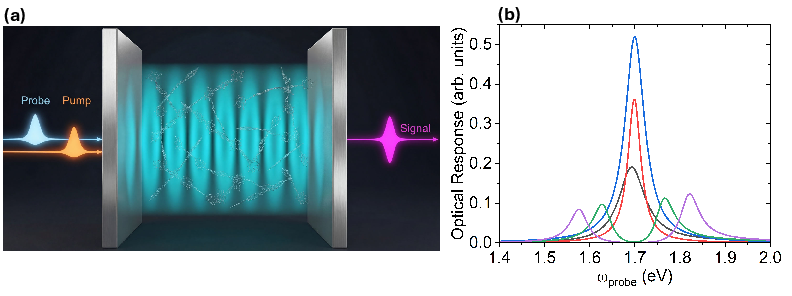
Figure 1: Schematic of heterodyne detection and demonstration of cavity-induced Rabi splitting in the linear response.
Spectral Starvation and the Harmonic Limit
In the absence of intrinsic molecular anharmonicity (ΔB=0), the cavity-forced system is shown to approach a perfectly harmonic regime where the macroscopic third-order nonlinear response is subject to destructive interference, yielding near-complete cancellation (termed "spectral starvation"). The 2D heterodyne spectra under these conditions show only residual, artifactual peaks located at harmonic sum frequencies of the polariton branches, reflecting population modulation rather than genuine two-exciton dynamics.
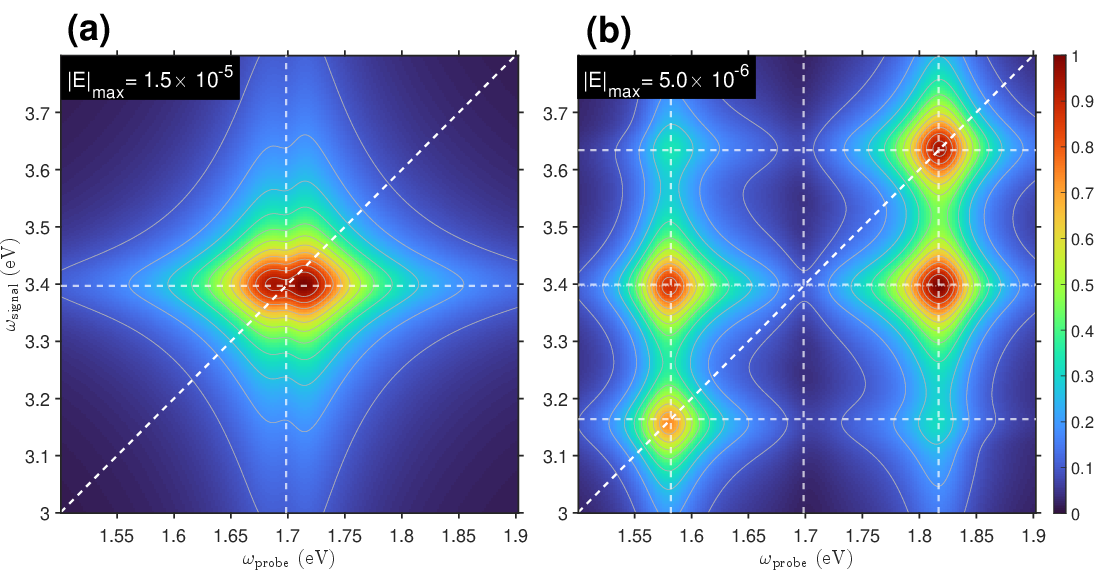
Figure 2: Attenuation of nonlinear response in the harmonic regime, with cavity-induced delocalization eliminating genuine DQC signatures.
The spectral starvation effect is robust against changes in molecular density and is fundamentally a consequence of the delocalized nature of polaritonic eigenstates in the cavity, which suppresses local two-exciton correlations needed for DQC processes.
Many-Body Resurrection via Molecular Anharmonicity
Upon the systematic introduction of molecular anharmonicity (ΔB>0), the system exhibits the emergence—"resurrection"—of a bona fide many-body DQC resonance. This feature spectrally migrates with ΔB and is manifest as a genuine nonlinear peak in the 2D spectra, with amplitude enhancement exceeding two orders of magnitude compared to the starved harmonic limit. The migration and resurrection of the DQC are unambiguously separated from single-exciton population artifacts by the field subtraction protocol and the inclusion of the two-exciton manifold.
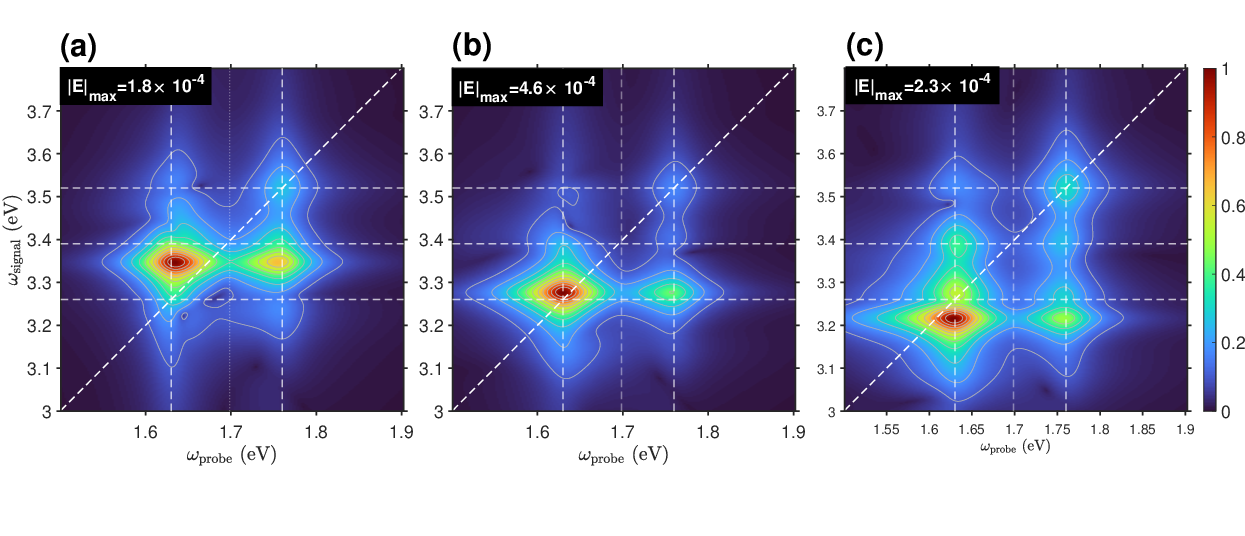
Figure 3: Anharmonicity-driven migration and emergence of a genuine double-quantum coherence peak, demonstrating the many-body resurrection.
The optimum DQC resonance occurs at a strict two-photon matching rule:
ΔB+4J=ΩR
where ΩR is the macroscopic Rabi splitting, and J is the excitonic intersite coupling. This universal resonance condition ensures photons couple optimally to the protected lower-polariton state and subsequently to the localized biexciton manifold, maximizing the DQC response and its spatial delocalization.
Scaling Behavior and Universal Phase Diagram
An in-depth analysis of the DQC amplitude scaling with respect to J, ΔB, and ΔB0 reveals profound differences between H-aggregate (ΔB1), J-aggregate (ΔB2), and monomeric systems (ΔB3). J-aggregates, characterized by negative ΔB4, uniquely support the isolation and protection of the collective many-body DQC state below the two-exciton continuum, suppressing dephasing and spatial fragmentation.
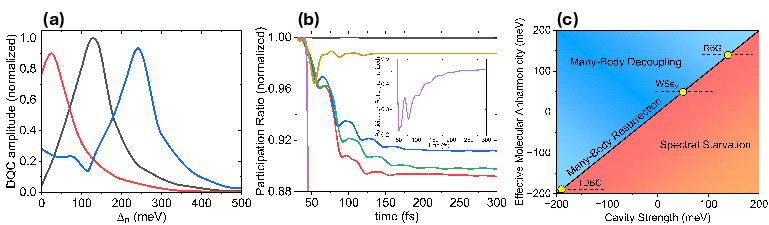
Figure 4: (a) DQC amplitude scaling for different aggregate types; (b) time-resolved participation ratio, quantifying collective spatial delocalization; (c) universal phase diagram dividing regimes of starvation, localization, and many-body resurrection.
The participation ratio, a measure of spatial coherence, reaches unity at the many-body resonance, signifying a DQC delocalized over the whole ensemble. At critical values (ΔB5), J-aggregates exhibit a collapse of spatial coherence—identified as a molecular localization trap—while H-aggregates cannot achieve robust delocalization, resulting in rapid dephasing.
The phase diagram synthesizes these findings, delineating regions of harmonic spectral starvation, many-body decoupling, and the optimal many-body resurrection line (ΔB6) as the target for robust nonlinear response.
Implications and Future Directions
The results establish rigorous design principles for the control and optimization of nonlinear polaritonic responses in complex molecular assemblies. The findings have direct implications for the engineering of robust nonlinearities in organic cavities, with J-aggregate systems emerging as prime candidates for enhancing and protecting quantum coherence against spatial disorder and dephasing.
The universal scaling law serves as a predictive guideline for selecting combinations of material parameters and cavity tuning to target maximum DQC response in vibrational or excitonic polaritonic chemistry, affecting ultrafast energy transfer, photochemistry, and optically driven collective phenomena.
Future developments should extend the fully correlated Maxwell-Liouville approach to more complex environments, incorporate disorder and dissipative effects explicitly, and investigate quantum dynamical control strategies at the phase boundary, potentially enabling programmable many-body quantum photonic devices.
Conclusion
This work provides a comprehensive resolution to the competition between collective harmonicity and microscopic many-body molecular interactions in strongly coupled molecular polariton systems. By rigorously establishing the universality of the two-photon matching rule and the precise microscopic conditions for many-body DQC resurrection, the study sets the stage for deterministic control of nonlinear quantum optics in microcavities, with broad implications for quantum technology, polaritonic chemistry, and ultrafast spectroscopy (2604.03423).