- The paper presents HEDGE, a heterogeneous ensemble framework that integrates diverse training routes and backbone architectures to achieve a balanced accuracy of up to 98.3% on standard benchmarks.
- It employs a logit-space fusion with dual-gating to dynamically weigh outputs from multiple branches, ensuring resilience against JPEG compression, resizing, and other real-world perturbations.
- Experimental validation demonstrates HEDGE's state-of-the-art performance across standard, in-the-wild, and chain-degraded datasets, providing robust detection of synthesized images.
HEDGE: A Heterogeneous Ensemble for Robust AI-Generated Image Detection
Motivation and Problem Statement
The proliferation of AI-generated content (AIGC) has driven significant advances in image realism, diversity, and accessibility. However, reliable detection of synthesized images remains highly challenging, particularly in the context of the rapidly evolving generative model landscape and the prevalence of real-world distortions from post-processing and social media dissemination. Previous AIGC detectors struggle with robustness and generalization, particularly when limited to frequency-domain artifacts, fixed backbone architectures, or closed-set assumptions about generative models. These weaknesses manifest acutely under realistic perturbations, unseen generator families, and compound degradations.
This work introduces HEDGE, an ensemble detection framework that explicitly incorporates heterogeneity across training regimes, input resolution, and backbone architecture. The design targets the core limitations of prior work: the inability of monolithic detectors to generalize across the high-dimensional distribution shift space present in deployment, and the over-reliance on fragile or superficial cues.
Methodology
HEDGE is operationalized as a three-route heterogeneous ensemble with logit-space fusion and dual-gating refinement. The framework is schematized in Figure 1.
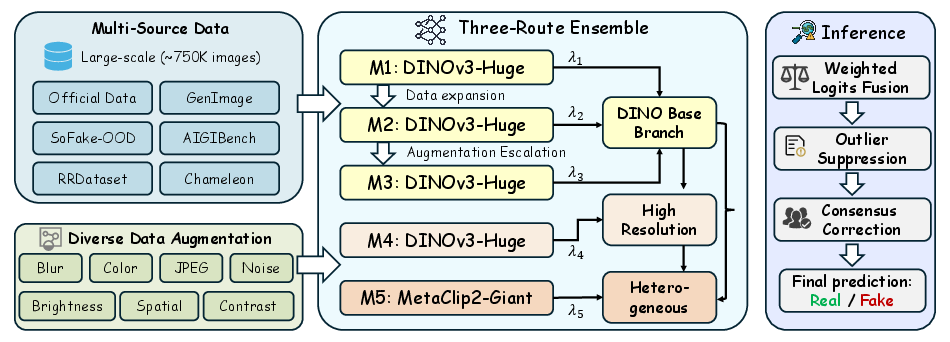
Figure 1: The three-route HEDGE framework—progressive DINOv3-based training (Route A), high-resolution cue extraction (Route B), and MetaCLIP2-based backbone heterogeneity (Route C)—with logit-space fusion and dual-gating for robust AIGC image detection.
Route A: Progressive Data and Augmentation Diversity
Route A comprises three DINOv3-Huge detectors constructed via staged continuation training:
- Stage 1: Base training on competition data, SoFake-OOD, and RRDataset for broad generator and degradation coverage.
- Stage 2: Expanded with Chameleon, GenImage, and AIGIBench, capturing a wider breadth of generator families and distributional shift.
- Stage 3: Distortion hardening using intensified augmentation (e.g., strong blur, compression, color, and noise perturbations).
All models are end-to-end fine-tuned with two-layer MLP heads. This progression ensures a spectrum of detectors, each with distinct robustness and generalization profiles. Their inclusion in the ensemble enhances collective performance over any single checkpoint.
Route B: Multi-Scale Forensic Feature Integration
Route B employs a high-resolution DINOv3-Huge branch, operating at 448×448 input size (versus 256×256 for Route A), to capture fine-grained statistical traces and infeasible-to-recover textural artifacts suppressed by aggressive downsampling.
Route C introduces backbone diversity using MetaCLIP2-Giant, leveraging contrastive image-text representations orthogonal to DINOv3's self-supervised visual priors. Partial fine-tuning (last two backbone blocks and LayerNorms) with Focal Loss ensures less overfitting and heightened attention to hard-to-classify samples.
Logit-Space Weighted Fusion with Dual-Gating
Branch outputs are fused in the logit space (rather than post-softmax), which preserves informative discrepancies between models and enables dynamic weighting. The fusion is governed by hierarchical weights: within Route A, the base detector dominates; between routes, DINOv3 routes collectively have greater influence than MetaCLIP2.
A lightweight dual-gating mechanism mitigates two systematic error modes:
- Gate-1: Suppresses outlier decisions from the high-resolution branch if contradicted by the consensus of the remaining routes.
- Gate-2: Corrects majority-dominated errors where both Route B and Route C agree with high confidence against the DINOv3 majority.
Experimental Validation
HEDGE's efficacy is established via comprehensive evaluation on standard, in-the-wild, and chain-degradation benchmarks.
Standard and In-the-Wild Benchmarks
On five standard datasets (e.g., GenImage, DRCT-2M, Synthbuster), HEDGE achieves a mean Balanced Accuracy (B.Acc) of 98.3%, outperforming MIRROR (the next best) by 3.1 points. Crucially, the method maintains extremely high robustness under JPEG compression and spatial resizing, with B.Acc, J.Rob, and R.Rob all within 0.6 points of each other—strong evidence that it avoids reliance on brittle, low-level cues.
For in-the-wild datasets (e.g., Chameleon, BFree-Online, WildRF), which incorporate realistic generator pipelines and platform-induced distortions, HEDGE delivers a new state-of-the-art, with an average B.Acc of 96.8% (+5.6 versus MIRROR). It remains effective even on unseen social media propagation settings.
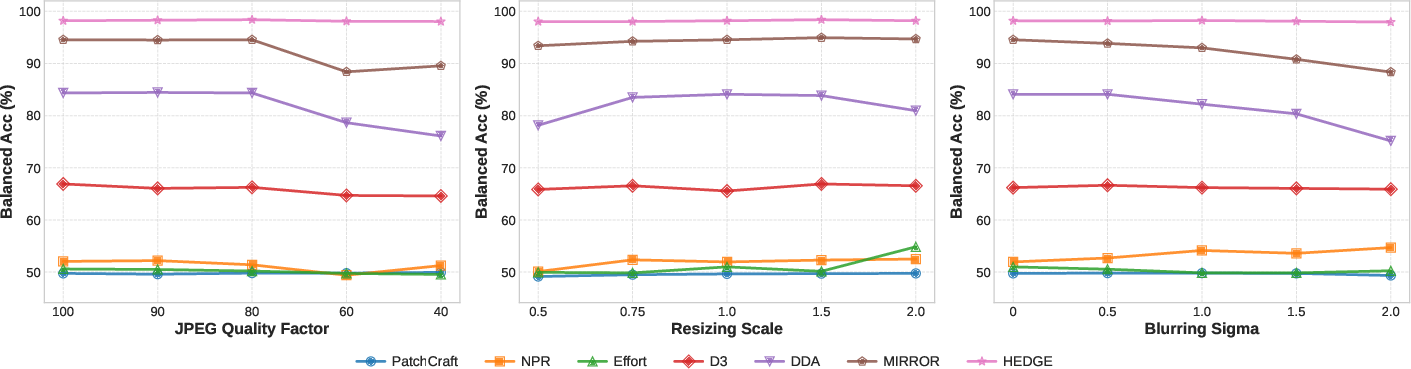
Figure 2: HEDGE’s B.Acc remains near-constant under JPEG, resize, and Gaussian blur perturbations (HiRes-50K), demonstrating stability not matched by prior detectors.
Chain Degradation Robustness
When tested on chain-degraded RealChain, simulating severe multistage post-processing, HEDGE achieves B.Acc of 93.2% (versus 84.2% for REM and often below 55% for other artifact-oriented methods), thanks to the ensemble’s diversity and distortion-hardened training, outperforming all baselines by significant margins.
Feature Representations
t-SNE visualizations of DINOv3 (Route A) features reveal consistently sharpened class separation across both seen and unseen datasets, highlighting the discriminative power of HEDGE's learned representation space.
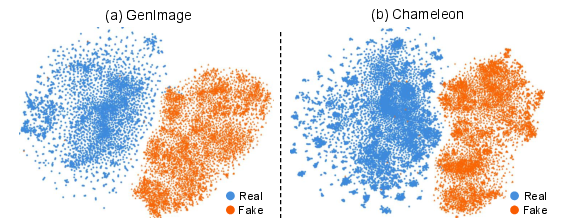
Figure 3: t-SNE plots confirm that fine-tuned DINOv3 features in HEDGE cluster real and fake images effectively, even across challenging test sets.
Ablation Studies
Incremental assembly of the full ensemble and gating mechanism demonstrates clear additive benefits, with dual-gating providing the most substantial F1 improvement among clean and degraded samples. Logit-space weighted fusion is superior to probability averaging and majority voting, underscoring the importance of information-rich fusion strategies in heterogeneous ensembles.
Implications and Future Directions
HEDGE significantly advances the practical robustness of AI-generated image detection by operationalizing structured heterogeneity in ensemble design. By integrating diverse training sources, scale spaces, and pre-training objectives, it ensures coverage across the distributional axes where prior detectors fail. The logit-space fusion and dual-gating mechanism enable not only superior overall performance but resilience against correlated errors and common environmental perturbations.
Practically, this translates to a deployable system that maintains detection confidence across evolving generation techniques and realistic image degradations, essential for forensics, content moderation, and regulatory compliance at scale.
From a theoretical perspective, the framework exemplifies the utility of heterogeneity and route-wise error decorrelation as central design principles for robust AIGC detection. The methodology is extensible: future systems could expand backbone diversity (e.g., by including vision transformers or multi-modal pathways), pursue finer granularity with local patch-based detectors, or adapt fusion mechanics to operate with cross-modal or adversarially trained routes.
Current limitations include reduced performance on local-inpainting-based manipulations, which suggests a need for global–local hybridization and uncertainty modeling in further work. As generator architectures and manipulation tasks continue to proliferate, such ensemble methods can scale in complexity, ultimately forming a backbone for multi-modal and interpretable forensic pipelines.
Conclusion
HEDGE establishes a new state-of-the-art for robust, real-world AI-generated image detection by matching—across heterogeneous axes— the diversity and complexity of the modern AIGC landscape. It provides not only high accuracy under ideal benchmarks but also exhibits remarkable invariance to extreme degradations and distribution shifts. This work demonstrates both the necessity and efficacy of structured ensemble heterogeneity, offering a blueprint for future forensics research and robust industrial AIGC authenticity solutions.

