- The paper presents a novel lattice simulation framework that fully captures nonlinear and non-Gaussian dynamics of scalar fields during inflation.
- It shows that standard semi-analytic methods break down, with lattice results revealing order-of-magnitude enhancements and altered spectral shapes.
- The work provides robust insights into inflationary dynamics and primordial black hole formation, emphasizing the need for nonperturbative numerical approaches.
Lattice Simulations of Scalar-Induced Gravitational Waves from Inflation
Introduction and Context
The stochastic gravitational-wave (GW) backgrounds sourced by scalar-induced gravitational waves (SIGWs) represent a frontier probe of early-universe dynamics, particularly on scales unobservable by the cosmic microwave background (CMB) or large-scale structure (LSS). Enhanced scalar power at small scales—often motivated by scenarios leading to significant primordial black hole (PBH) production—can yield observationally relevant GW backgrounds, especially in the nano- to milli-Hz regime accessible to pulsar timing arrays (PTAs) and next-generation interferometers. However, the standard semi-analytical approach to computing SIGWs is based on second-order perturbative calculations with Gaussian initial conditions for scalar perturbations and linear evolution of the scalar sector. When amplification due to, e.g., a transient ultra-slow-roll (USR) phase occurs, scalar dynamics can become highly nonlinear and non-Gaussian, thus invalidating these standard predictions.
"Lattice simulations of scalar-induced gravitational waves from inflation" (2604.03628) presents a comprehensive numerical framework that tackles these limitations by directly simulating inflaton dynamics and associated GW production on the lattice, allowing for fully nonlinear evolution and the unavoidable emergence of non-Gaussian statistics.
Overview of Numerical Pipeline
The approach is divided into two principal stages. First, the inflaton field is evolved nonlinearly during the inflationary era, including the entire SR–USR–SR transition, assembling a nonperturbative realization of the curvature perturbation ζ(x) via a lattice-based δN method. Second, these super-horizon fluctuations are translated into the Newtonian potential Φ as the universe enters the post-reheating, radiation-dominated epoch. The post-inflationary (linear) Bardeen evolution is then simulated for horizon re-entry, computing the GW tensor response sourced by scalars at second order, but crucially with the non-Gaussian, nonperturbative inflationary field as input.
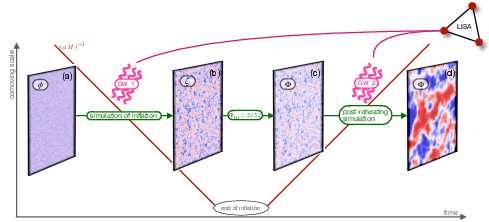
Figure 1: Schematic of the simulation pipeline, from initial inflaton fluctuations, through nonlinear evolution and curvature perturbation extraction, to the GW signals at and after horizon re-entry.
This methodology enables detailed analysis of scenarios where intrinsic nonlinearity and non-Gaussianity are strong, such as in long-duration USR phases that significantly enhance Pζ and, consequently, the GW spectrum.
Inflationary Model Space and Scalar Spectrum
The simulated inflationary models are constructed to admit a transient USR phase, allowing precise control over duration ΔN, as well as parameters governing the transitions (e.g., ηII and ηIII). Different parameter choices correspond to Wands-duality, attractive, or repulsive self-interaction regimes for the inflaton, each with distinct signatures in both the power spectrum and the emerging non-Gaussianities.
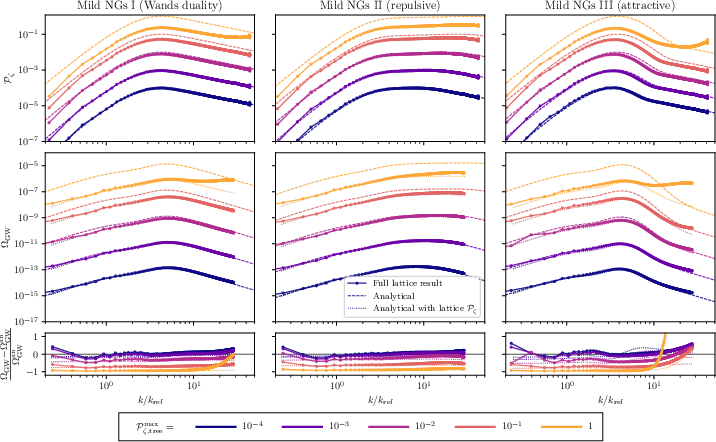
Figure 2: Curvature power spectra from lattice simulations, contrasting nonlinear versus perturbative predictions.
In cases with mild non-Gaussianity, the inflaton velocity and field statistics remain close to linear expectations. For large non-Gaussianity, lattice results deviate sharply. Notably, strong backreaction and mode trapping—where spatial patches become stuck near local minima of the potential—produce a distinctive, often multi-peak structure in the ϕ and ζ PDFs.
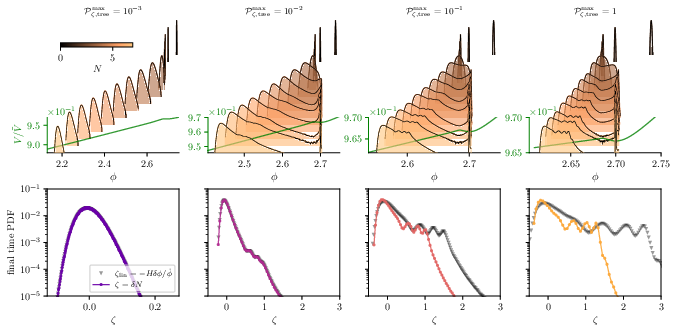
Figure 3: Evolution of the one-point PDF of the inflaton and curvature perturbation, illustrating the emergence of multi-modal structure due to trapping in the large-NG case.
SIGW Power Spectrum: Lattice vs. Semi-Analytic Predictions
A key result is the breakdown of the standard semi-analytical SIGW calculation whenever non-Gaussianity or inflationary backreaction become significant. In the mildly non-Gaussian regime, discrepancies with the semi-analytical result are at the O(1) level and confined mostly to the UV part of the spectrum. The source of discrepancy can be disentangled by using lattice-derived scalar spectra as input to the semi-analytic formula: the difference between this and the full lattice SIGW computation quantifies the impact of non-Gaussian source statistics.
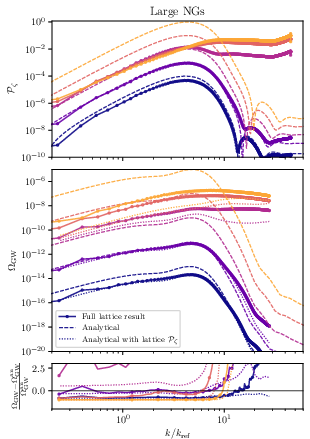
Figure 4: GW spectra from lattice (solid), semi-analytic with linear spectrum input (dashed), and semi-analytic with lattice spectrum input (dotted); fractional residuals in the lower panel expose the breakdown of standard predictions for large δN0.
In contrast, in the large non-Gaussianity regime, the semi-analytical method fails to capture both the amplitude and the spectral shape of SIGWs, even qualitatively. Lattice simulations reveal an order-of-magnitude enhancement of the GW spectrum, accompanied by a dramatic change in spectral morphology, such as plateaus or multiple peaks associated with mode trapping and delayed horizon exit in trapped regions.
For example, with δN1, IR suppression and UV plateau formation are observed, directly connected to non-linear field interactions and trapping. For δN2, the breakdown of the semi-analytic approach is total—the lattice spectra are enhanced by δN3 in amplitude at all scales.
Origin and Interpretation of Non-Gaussian Effects
The lattice framework provides a direct window into the formation of non-Gaussian features and their physical origin. The emergence of oscillatory, multi-peak PDFs in the field and curvature perturbations corresponds to domains in field space that escape or are trapped by local potential features, with each peak representing regions with differing 'delay' in reentering the standard inflationary trajectory. These features, inaccessible to perturbative expansion or simple non-Gaussian templates (e.g., local δN4), are robustly captured by direct nonlinear simulation.
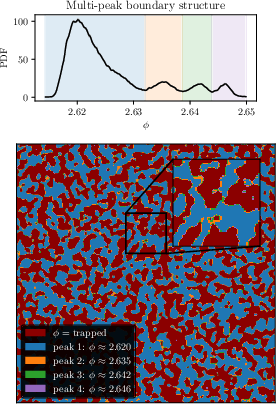
Figure 5: (Top) Final-time PDF showing multi-peak structure; (Bottom) 2D snapshot color-coding different dynamical regions associated with the PDF peaks.
An intriguing observation is the connection between the spacing of PDF peaks and extreme value statistics in the number of independent patches, suggesting a statistical rather than model-specific mechanism for multi-modal PDF formation in strongly nonlinear regimes.
Numerical Robustness and Convergence
Rigorous convergence tests are performed with respect to spatial resolution and box size on the lattice, confirming the stability of the power spectra and PDF features to these numerical settings. The code publicly released by the authors enables community validation and application to a wide range of inflationary scenarios.
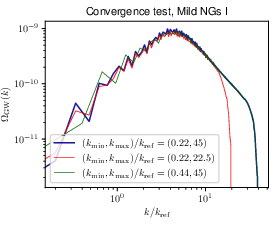
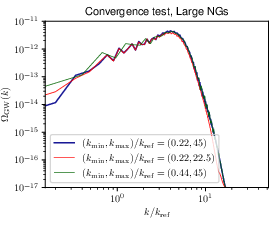
Figure 6: Convergence of GW power spectra with respect to UV and IR lattice parameters for both mild and large NG cases.
Implications and Future Directions
This work demonstrates that reliable predictions of SIGWs require nonperturbative treatment of both the inflationary scalar sector and the subsequent evolution leading to GW emission. The results underscore that naive application of analytical formulae, even with higher-order corrections or non-Gaussian templates, is insufficient when the scalar sector reaches significant amplification or exhibits strong nonlinearities.
A practical implication is the substantial theoretical uncertainty in interpreting GW backgrounds, such as those potentially observed by PTAs, as evidence of PBH formation or specific inflationary mechanisms. If observational data points toward GW backgrounds with characteristics only reproducible with large non-Gaussianity or trapping dynamics, only nonperturbative simulations like those presented in this work will be able to robustly link signal features to underlying inflationary physics.
On the methodological side, future developments outlined include:
- Extending nonlinear evolution to the post-inflationary era, especially when the gravitational potential approaches δN5.
- More general inflationary scenarios, including multifield or feature-rich potentials.
- Higher-order treatment of the tensor perturbation source term.
- Statistical mapping from numerical PDFs to observational signatures, incorporating hydrodynamical evolution or relativistic corrections.
Conclusion
The detailed lattice simulations presented in "Lattice simulations of scalar-induced gravitational waves from inflation" provide an essential advance in SIGW prediction reliability, particularly in parameter regimes relevant for PBH dark matter and small-scale structure constraints. When scalar perturbations are enhanced strongly enough to be observationally relevant, intrinsic non-Gaussianity and nonlinear dynamics can invalidate perturbative predictions, with order-of-magnitude consequences for the GW spectrum amplitude and shape. This imposes a requirement for first-principles numerical control for any meaningful interpretation of small-scale GW signals as windows on inflationary microphysics or PBH phenomenology. The open-source release of the code and datasets ensures the reproducibility and extensibility of these results within the community.
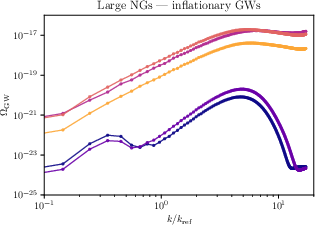
Figure 7: Inflationary GW power spectrum from the lattice in the large non-Gaussianity regime. Although subdominant to the post-reheating component, it is directly resolvable in nonlinear simulations.