- The paper introduces a novel pipeline that employs hierarchical clustering of hair strands and cards to achieve compact, strand-level hair reconstruction.
- It leverages a generative parametric prior (PERM) and shared Gaussian appearance codebooks, yielding a 4× speedup in strand generation and over 200× reduction in memory usage.
- The method provides high-fidelity rendering that enables realistic dynamic simulations of complex hairstyles, outperforming baselines like GaussianHaircut.
Compact Gaussian Hair Reconstruction via Hierarchical Card Clustering
Introduction
The paper "CGHair: Compact Gaussian Hair Reconstruction with Card Clustering" (2604.03716) introduces a pipeline for high-fidelity, memory-efficient hair reconstruction using a hierarchical clustering and encoding framework integrated with a 3D Gaussian Splatting (3DGS) renderer. The method leverages the structural and visual regularity observed in human hair, clustering reconstructed strands into representative hair cards and further grouping these cards into clusters that share a compact Gaussian appearance codebook. This approach achieves substantial reductions in storage and computation, delivering strand-level geometric and appearance detail with a memory footprint up to 200-fold smaller than recent baselines.
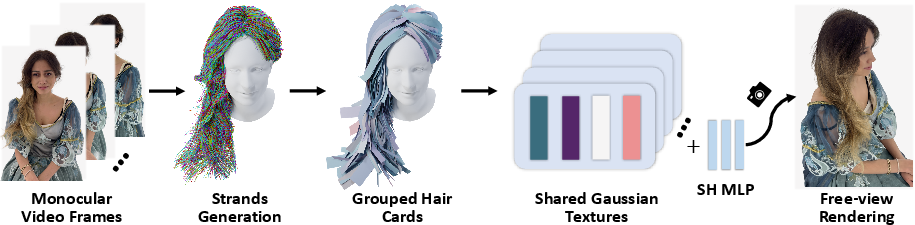
Figure 1: Full pipeline—monocular video frames are processed through efficient strand generation, hair card clustering, and shared Gaussian codebook assignment for scalable appearance modeling.
Pipeline Overview
The pipeline comprises four main stages:
- Strand Generation: Hair strands are reconstructed from multi-view imagery using a generative prior-accelerated method. The key innovation is leveraging a parametric model (PERM), which encodes global hairstyle structure and local strand variability as latent textures on the scalp mesh. Decoding these textures produces high-fidelity strand geometry efficiently, offering a 4× speedup relative to previous approaches.
- Hair Card Construction: Strands are clustered based on pointwise geometry. Each cluster forms a guide strand, which is used to construct a hair card via polygonal strip mesh generation, reducing geometric redundancy and facilitating compact geometric encoding.
- Texture Generation and Card Grouping: Each hair card is associated with a 2D strand texture, computed via an optimized inverse mapping from 3D strands to the card’s UV space. Cards with similar textures are further clustered into groups, each of which is assigned a shared Gaussian appearance codebook.
- Shared Gaussian Appearance Model: For each card group, a latent codebook parametrizes the view-dependent appearance (SH coefficients) of all strands. These compact features are upsampled via a lightweight, global MLP to the required per-Gaussian appearance parameters for rendering.
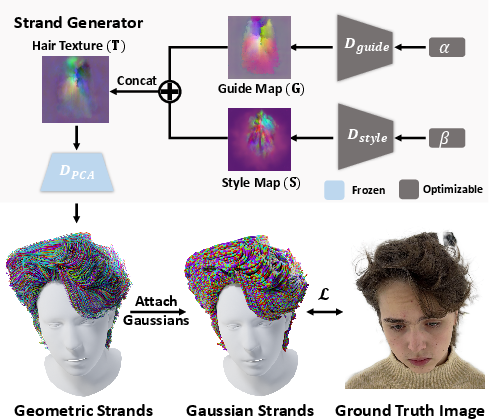
Figure 2: The strand generation pipeline leverages a learned parametric geometric prior (PERM) and image-based optimization to efficiently reconstruct strand geometry with cylindrical Gaussian primitives.
Methodological Details
Efficient Prior-Driven Strand Generation
The use of the PERM parametric model introduces a robust structural prior, enabling the system to bypass expensive optimization or diffusion regularization typically needed to enforce physically plausible hair geometries. The strands are represented as latent codes in a UV texture map parameterized on the scalp, decoded into 3D geometry via a cascade of pretrained decoders.
Optimization proceeds jointly over the latent codes, decoder parameters, and spherical harmonics for appearance, with multi-view photometric and orientation supervision. Each segment of a decoded strand is assigned a cylindrical Gaussian, supporting differentiable rendering and efficient subsequent grouping and compression.
Geometric and Appearance Compression via Card Clustering
Clustering is performed hierarchically—first, strands are grouped by geometric similarity, then bundled into cards via a constrained fitting process. Within each card, strands are projected to derive dense, anti-aliased 2D strand textures.
Cards are then represented by these textures in feature space; further k-means clustering yields card groups. For each group, a shared codebook is assigned wherein each code represents a compact latent embedding of view-dependent appearance properties.
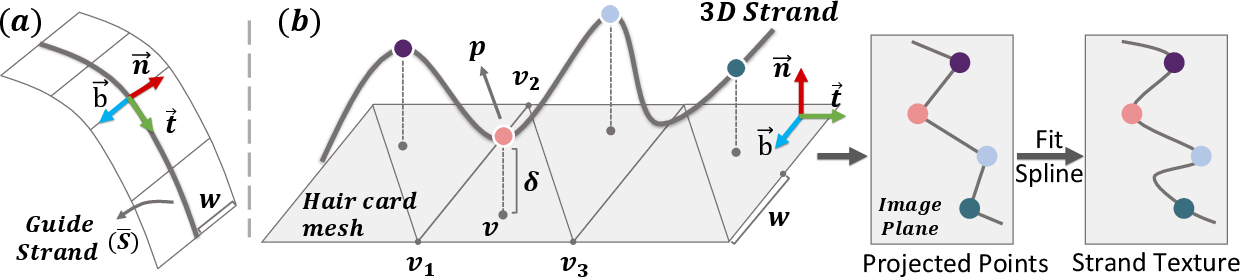
Figure 3: (a) Hair card geometry derived from clustered strands; (b) Generation of 2D strand textures for each hair card enables compact and smooth geometry encoding.
Compact Latent Appearance Decoding
To assign SH parameters efficiently, each strand (via its card group) is associated with a codebook vector using a Gumbel Softmax, yielding a soft assignment and thus a shared latent feature. A lightweight global MLP decodes these embeddings into per-Gaussian spherical harmonics—reducing parameterization overhead from 100k–1M unique SH sets to as few as 10 codebook entries of 64 dimensions each.
End-to-end training is performed with classic multi-view photometric loss terms, alpha regularization, segmentation mask losses, and strand orientation losses.

Figure 4: CGHair attains high geometric fidelity and over 4× speedup in strand reconstruction compared with GaussianHaircut, while offering a fully automatic pipeline.
Experimental Evaluation
Evaluation covers real and synthetic datasets (GaussianHair, MonoHair, and H3DS). Compared to GaussianHaircut and GaussianHair, CGHair produces smoother, more complete strand-level reconstructions and superior appearance modeling for complex hairstyles, including wisps and boundary details. Importantly, CGHair achieves rendering quality competitive with GaussianHair but with >200× reduction in memory usage for appearance features.
Ablation studies confirm that:
- Removing card-based clustering or the latent codebook degrades both compression and fidelity.
- The pipeline maintains fidelity with as few as 10 shared features of 64 dimensions per codebook, demonstrating significant redundancy in prior methods.
- Strand generation via the PERM prior is essential; direct latent optimization or single-feature pipelines perform worse by a considerable margin.
Quantitative metrics (PSNR, SSIM, LPIPS) and end-to-end runtime (2.7–5 hours)—versus 8–15 hours for baselines—further underscore the practical efficiency of the approach.
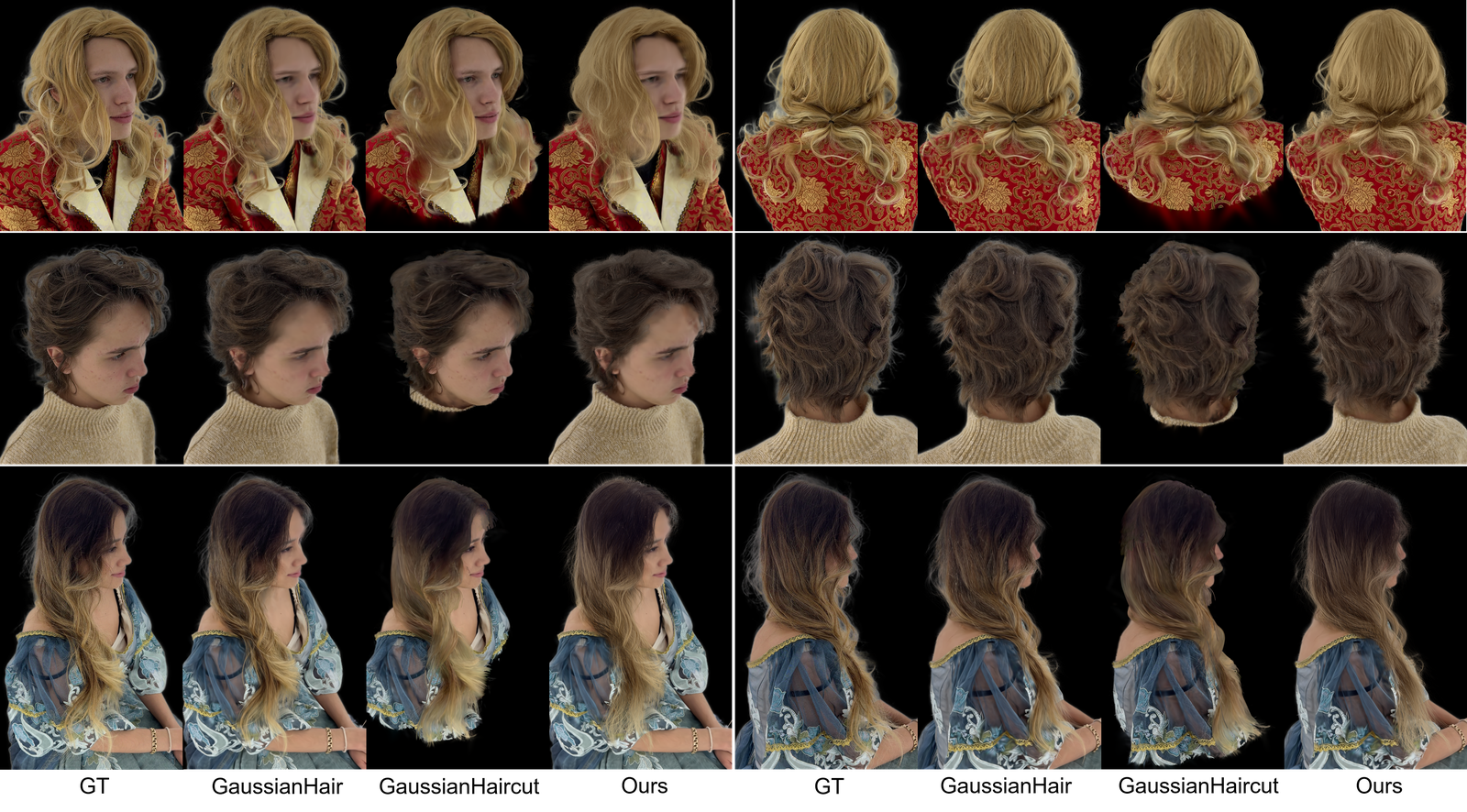
Figure 5: CGHair yields comparable or superior novel-view rendering on challenging real-world hairstyles compared with GaussianHair and GaussianHaircut, with dramatically reduced parameter count.
Dynamic Simulation and Animation
Because CGHair maintains explicit strand-level representations, it admits animation and physical simulation within CG engines. The modularity of card and strand-level encoding supports direct integration with dynamic simulation frameworks, an essential requirement for production-quality avatars and character assets.
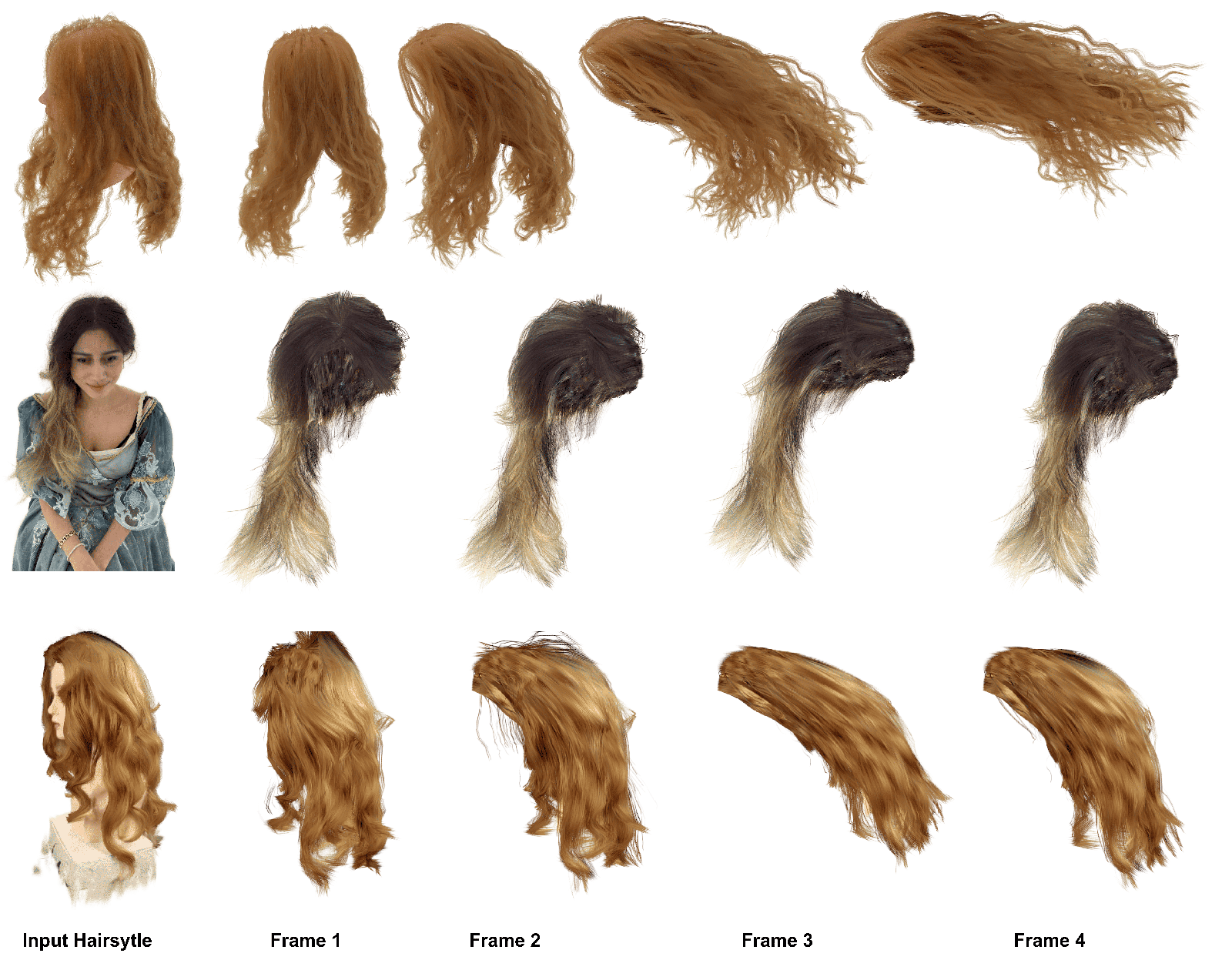
Figure 6: Explicit strand representations enable physically plausible dynamic hair simulations—here showing examples across synthetic and real hairstyles.
Discussion and Limitations
While CGHair advances the compressibility and scalability of strand-level hair modeling:
- It inherits limitations of image-based approaches: extremely complex, occluded, or tightly braided hair remains challenging due to a lack of observable structural priors.
- The static, hard-coded card clustering could be further improved with differentiable or dynamically optimized clustering strategies.
- Slight losses in high-frequency appearance detail are possible due to shared encoding; the trade-off between compactness and visual fidelity warrants further exploration.
Integration with dynamic data capture and improved priors for challenging hair types (e.g., afro-textured or braided) constitute promising future directions.
Conclusion
CGHair provides an efficient, fully automatic pipeline for compact, high-fidelity hair reconstruction from multi-view inputs. Through hierarchical strand and card clustering, shared latent codebooks, and integration with the 3DGS renderer, the method achieves strong performance in both geometric and appearance metrics with orders-of-magnitude improvements in memory and computational efficiency. The approach sets a new standard for practical, scalable, and animatable hair asset generation in neural scene representations and photorealistic avatar reconstruction.