- The paper demonstrates that side-chain functionalization in MOF-5 triggers a collapse of the phonon gas model, shifting thermal transport from a particle-like to a diffusive, glass-like regime.
- It employs neuroevolution machine-learning potentials with D3 corrections to achieve near-DFT accuracy and observes a 70% reduction in lattice thermal conductivity.
- The findings enable programmable design of ultralow thermal conductivity materials, offering new pathways for advanced thermal management and thermoelectric applications.
Introduction
This work presents a comprehensive study of thermal transport in metal-organic frameworks (MOFs), focusing on the transition from crystalline to glass-like behavior induced by precise structural engineering. The study systematically investigates the effect of grafting flexible alkoxy side chains onto the archetypal MOF-5, revealing the associated collapse of the phonon gas model and the emergence of a temperature-independent, diffusive transport regime.
System Architecture and Validation of Machine-Learned Potentials
The authors construct a series of MOF-5 derivatives with increasing alkoxy side-chain length (denoted as C2–C5), covalently bonded to each organic linker. The pristine MOF-5 (C0) serves as the reference structure. Atomistic models for each system are validated via neuroevolution machine-learning potentials (NEP), further augmented with D3 dispersion corrections, delivering near-DFT-level accuracy for energies, forces, and stresses.
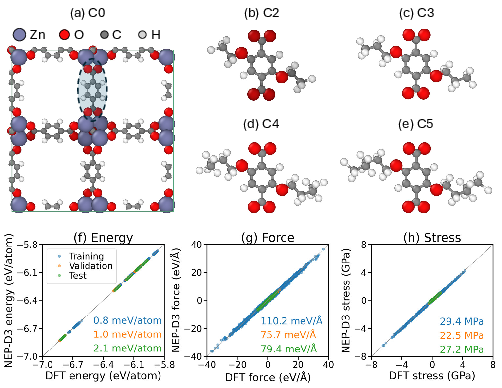
Figure 1: Atomistic structure evolution from pristine MOF-5 to side-chain-functionalized derivatives C2–C5; NEP-D3 model benchmarks showing parity with reference DFT.
Suppression of Lattice Thermal Conductivity via Side-Chain Engineering
At 300 K, pristine MOF-5 exhibits a lattice thermal conductivity (LTC) of 0.72 W m−1 K−1. Introduction of alkoxy side chains (C2–C5) suppresses LTC by approximately 70% down to 0.2 W m−1 K−1. This dramatic reduction directly stems from the truncation of long-mean-free-path (MFP) phonon propagation channels: whereas C0 supports phonon MFPs exceeding 100 nm, functionalized frameworks restrict MFPs to the ∼10 nm scale. Length-dependent transport further reveals that ballistic-to-diffusive crossover, extended to microns in C0, collapses to the nanometer regime post functionalization.
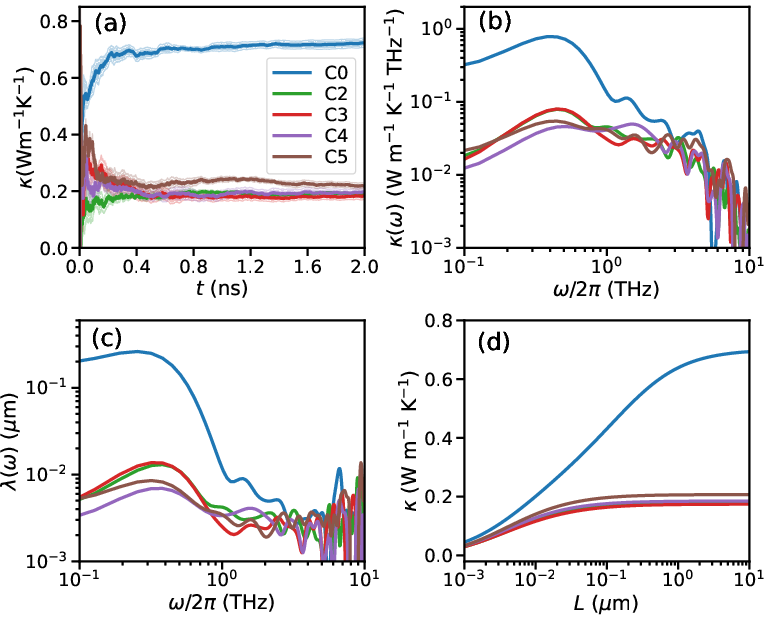
Figure 2: Suppression of LTC, spectral thermal conductivity, and collapse of phonon MFPs in functionalized MOFs.
Structural Control of the Particle-Wave Transition in Phonon Transport
Thermal conductivity in C0 demonstrates the canonical Peierls T−1.37 decay due to Umklapp-limited transport. In contrast, all functionalized variants (C2–C5) exhibit nearly temperature-independent LTC across 200–500 K, consistent with a glass-like plateau. This effect strengthens with increasing side-chain length. Spectral decomposition shows that, in functionalized MOFs, low-frequency thermal transport becomes completely insensitive to temperature, and at high T, spectral conductivity in C5 paradoxically increases, indicating the dominance of wave-like tunneling over particle transport.
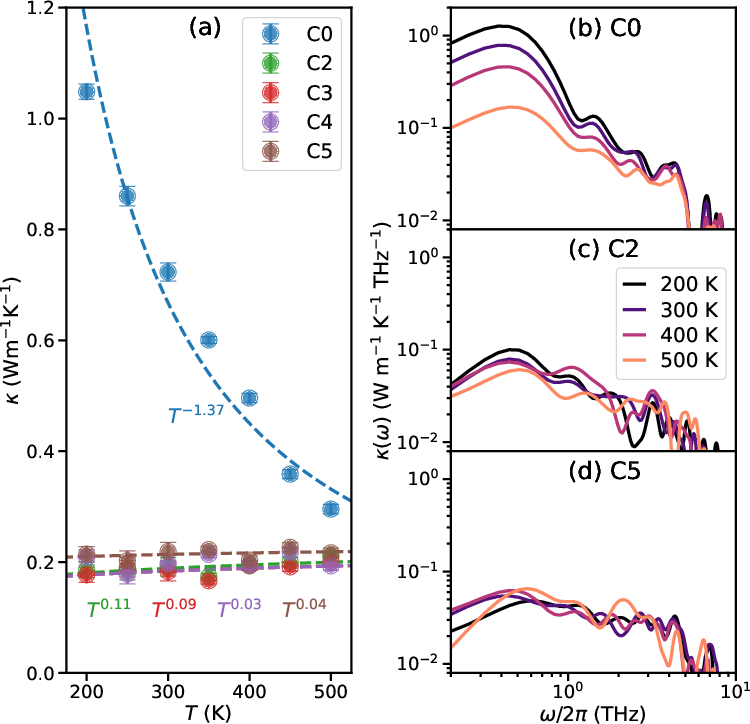
Figure 3: Transition from a temperature-dependent crystalline regime to temperature-invariant, glass-like LTC as side-chain length increases.
Microscopic Origin: Resonant Hybridization and Overdamping
SED analysis demonstrates that flexible side chains induce extreme broadening and blurring of vibrational spectra, with phonon lifetimes sharply constrained by the Ioffe-Regel and Wigner limits. In pristine C0, dispersive acoustic branches persist, with lifetimes showing clear thermal degradation. In C2 (and longer chains), most modes transition to the coherent tunneling regime or become overdamped, and their lifetimes become temperature-invariant at the minimum bound, confirming the complete breakdown of the classical quasiparticle picture.
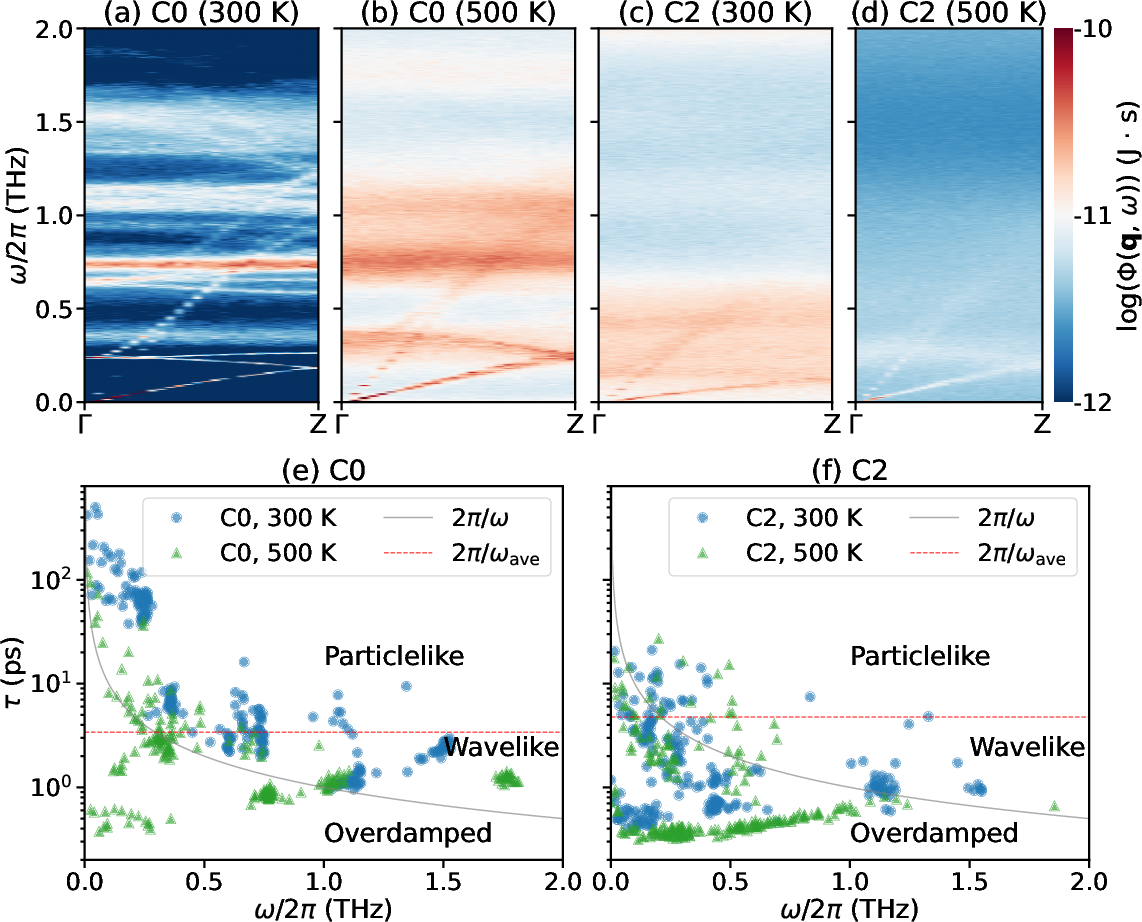
Figure 4: Collapse of SED dispersions and phonon lifetimes to the minimum (Ioffe-Regel/Wigner) limits upon side-chain functionalization.
Real-Space Manifestation: Hybridized Modes and Dynamic Disorder
Lattice dynamics reveal that the side chains generate ultra-dense, flat optical modes at low frequency, resonantly hybridizing with heat-carrying acoustic modes and producing avoided crossings. The group velocity of these hybridized bands is suppressed by nearly an order of magnitude. Visualizations of vibrational eigenvectors demonstrate strong localization of vibrational energy onto the side chains. Real-space projected trajectories further show that in functionalized MOFs, the pore volume becomes saturated by the large-amplitude, dynamic disorder of side chains, inducing steric congestion that annihilates the periodic potential landscape required for phonon propagation.
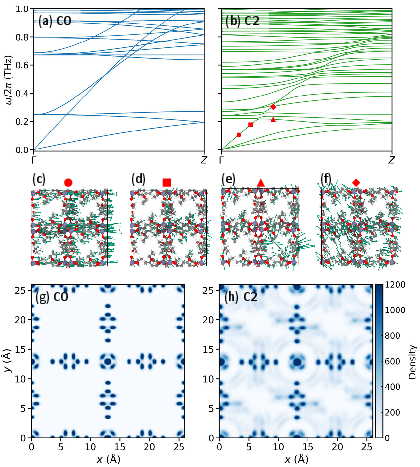
Figure 5: Generation of ultra-flat, hybridized vibrational bands; dynamic trajectories in functionalized MOFs reveal severe atomic crowding and disorder.
Implications and Future Directions
This study establishes methods for driving crystalline solids into extreme diffusive, glass-like transport without global lattice disruption through molecular-level functionalization. By leveraging local resonant hybridization and steric crowding, MOFs with tailored LTCs can be rationally designed while maintaining crystalline order. This programmability opens broad avenues in the design of ultralow thermal conductivity materials for applications in advanced thermal management and thermoelectric conversion.
Future directions may comprise expanding this design framework to other crystallographically versatile hybrid materials, the use of multiscale modeling for capturing disorder-induced transport, and exploiting additional dynamic motifs (e.g., flexible linkers, rotors, or responsive guests) to achieve even finer control of particle-wave thermal transport crossovers.
Conclusion
Structural engineering via side-chain functionalization in MOFs is shown to induce a robust crossover from crystalline, particle-like thermal transport to an exclusively diffusive, wave-like regime. This is mediated by the collapse of LTC, drastic truncation of MFPs, and the breakdown of phonon lifetime scaling. The approach provides a programmable platform for decoupling lattice architecture from thermal transport, with significant implications for phonon engineering, metamaterial design, and the realization of crystalline solids with fundamentally amorphous-like transport properties.
Reference: "Structurally Triggered Breakdown of the Phonon Gas Model in Crystalline Metal-Organic Frameworks" (2604.03783).