- The paper demonstrates that a three-step Hamiltonian protocol generates unitary k-designs for all k, rigorously matching the Haar value.
- It establishes that two-step protocols fall short for k > 1 by imposing unsolvable energy-index constraints, supported by both analytical and numerical evidence.
- The research reveals significant experimental advantages by reducing the required filter window and control complexity for generating quantum randomness.
Three Hamiltonians for Unitary k-Designs in Temporal Ensembles: An Expert Summary
The paper "Three Hamiltonians are Sufficient for Unitary k-Design in Temporal Ensemble" (2604.04205) provides a rigorous theoretical framework and supporting numerics to demonstrate that the quenched temporal evolution protocol comprising three fixed, independently-sampled chaotic Hamiltonians suffices to generate a unitary k-design for general k, under minimal external control. It further establishes the quantitative inadequacy of two-step protocols for k>1 and analyzes filter-window scaling and finite-size effects, providing foundational insight for both quantum information and experimental realizations.
Motivation and Background
Random unitaries are fundamental across quantum information, from benchmarking to quantum tomography and cryptography. Exact Haar-random unitaries are inaccessible experimentally, so proxies such as unitary k-designs are essential—they reproduce the first k moments of the Haar measure and provide a controlled route to randomness benchmarks. Standard methods to generate designs typically require deep random circuits, frequent parameter modulation, or many stroboscopic layers, posing significant experimental challenges. Therefore, identifying minimal protocols that approximate Haar-uniformity with drastically reduced external control is a critical open problem.
The paper systematically analyzes protocols where only the evolution times are randomized, while the sequence of Hamiltonians is fixed per experiment ("quenched temporal ensembles"). It focuses on two-step (2SP) and three-step (3SP) protocols:
- 2SP (V(t1,t2)=e−iH2t2e−iH1t1): Fixed H1,H2, times t1,t2 drawn independently per experiment.
- 3SP (k0): Fixed k1, all k2 sampled independently.
The distance to a unitary k3-design is quantified via the k4-th frame potential (FP):
k5
A protocol forms a k6-design iff k7. The authors demonstrate, both analytically and numerically, that time averaging in 2SP imposes energy-index matching constraints in the FP that are insufficient for forming higher-order designs, while the additional random phase from the third quench in 3SP dramatically eliminates surplus permutation freedoms in the FP, achieving the Haar value.
Analytical Results
For Gaussian Unitary Ensemble (GUE) Hamiltonians, the exact statistical structure of the 2SP and 3SP FPs is rigorously derived and shown to exhibit the following properties:
- 2SP: For flat overlap matrices, k8 for k9 (non-Haar). More generally, for random GUE Hamiltonians, the FP scales combinatorially above the Haar value, as proven using leading-order Weingarten calculus.
- 3SP: The additional quench in 3SP synchronizes all permutation indices in the FP, leaving only a single surviving permutation and yielding k0 in the large-k1 limit—precisely the expected Haar result.
Numerical Evidence
Numerics reinforce theoretical claims: for GUE, cSYK, and random spin models, 2SP FPs remain above k2, while 3SP converges to k3 for all k4 tested, even for moderate Hilbert space dimensions. The magnitude of the filter window k5 required for finite-k6 corrections to fall below a fixed threshold is reduced by orders of magnitude for 3SP compared to 2SP.
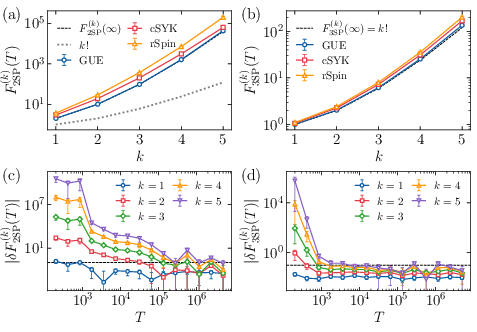
Figure 1: Numerical frame potentials for 2SP and 3SP under GUE and cSYK dynamics, highlighting the convergence of 3SP to the Haar value (k7) for all k8 and delayed convergence for 2SP.
Finite-Time Filter Effects and Scaling
The protocol's main practical limitation is finite k9 (time window for sampling evolution), which introduces filter leakage and causes off-diagonal energy terms to survive in the FP calculation. Theoretical bounds (proved via Weingarten calculus) establish:
- 2SP leakage error: k0
- 3SP leakage error: k1
where k2 is the averaged off-diagonal filter weight, scaling as k3 for ensembles with mean level spacing k4. Thus, for comparable accuracy, 3SP requires a filter window k5 shorter by a factor scaling polynomially in k6 relative to 2SP. This scaling advantage is manifested in numerics presented for both GUE and physical models.
Implications and Future Developments
This work establishes that three Hamiltonian quenches, with only temporal randomness, generically suffice for k7-design generation for arbitrary k8 in strongly chaotic regimes, fundamentally reducing hardware and control demands. Practical implications include:
- Experimental Realizability: 3SP protocols are feasible with existing noisy intermediate-scale quantum (NISQ) platforms, including cSYK, dipolar spin models, and cold atomic systems. Realizations may enhance randomized benchmarking, quantum advantage demonstrations, and robust tomography.
- Time-Window Optimization: Precise error analysis enables optimization of time-distribution sampling; future work could explore further reduction of required k9 or adapt protocols for non-chaotic (weakly chaotic/integrable) regimes.
- Hybrid Approaches: The formalism enables analysis of hybrid protocols combining time and Hamiltonian randomization, opening paths toward scalable, resource-frugal approximate randomness generation in large-scale quantum devices.
- Cross-Pollination With Quantum Tomography: Connections to thrifty shadow estimation and classical shadow tomography schemes suggest protocol complexity analysis may boost the efficiency of quantum state learning algorithms.
The paper raises several open questions: scaling of the minimal quench count with system size, robustness to realistic lab errors, and characterization in mixed (non-chaotic) dynamics, to be addressed in ongoing research.
Conclusion
This work provides a mathematically rigorous, numerically corroborated answer to the outstanding question of minimal Hamiltonian requirements for generic unitary k>10-design generation under temporal randomization. It demonstrates the insufficiency of two-step protocols and establishes three-step quenched temporal evolution as both necessary and sufficient for universal design formation in chaotic quantum systems. These results lay a foundation for experimentally tractable, low-control implementations of quantum information protocols requiring high degrees of randomness, and they open compelling new directions in both theory and experiment.