Analytic Non-Gaussian Confidence Boundary Method for Chance-Constrained Trajectory Control
Published 5 Apr 2026 in math.OC | (2604.04304v1)
Abstract: Standard chance constrained control algorithms typically rely on the assumption that uncertainties in vehicle states obey Gaussian statistics. Highly nonlinear systems tend to disrupt Gaussianity, challenging standard chance-constrained control methods. This paper develops a non-Gaussian confidence boundary parameterization technique for such cases where the problem departs appreciably from the Gaussian assumption. The approach is to consider the true confidence boundary as a perturbation of the one predicted from covariance, deriving perturbed boundary geometry from computed higher-order statistical moments. Applying this technique to so-called "banana-shaped distributions" (found e.g. in orbital mechanics problems) enables a simple parameterization of the confidence boundary using the skew and kurtosis tensors. The method is then applied to an impulsive stochastic spacecraft maneuver targeting problem in two-body dynamics. An algorithmic implementation outperforms a standard linear covariance-based approach in computing control parameters satisfying certain probabilistic bounds on the non-Gaussian distribution.
The paper introduces an innovative method that incorporates skewness and kurtosis to analytically parameterize non-Gaussian confidence boundaries for chance-constrained trajectory control.
It employs the conjugate unscented transform to propagate higher-order moments, significantly improving constraint satisfaction rates from 92.2% to 98.3% in spacecraft maneuvers.
The approach offers enhanced computational efficiency and robustness over traditional Gaussian methods, making it ideal for safety-critical, nonlinear trajectory optimization.
Analytic Boundaries for Non-Gaussian Chance-Constrained Trajectory Optimization
Introduction and Motivation
Chance-constrained trajectory control, which seeks to enforce probabilistic guarantees on a system's path, is foundational in safety-critical applications such as spacecraft maneuvering, robotics, and autonomous vehicles. Traditional approaches overwhelmingly assume that state uncertainties propagate as Gaussian processes, thus permitting the convenient use of mean and covariance for the deterministic reformulation of probabilistic constraints. However, in nonlinear and high-dimensional dynamics—especially in astrodynamics where long time horizons and sparse updates yield pronounced deviations from Gaussianity—this assumption is routinely invalidated. The paper "Analytic Non-Gaussian Confidence Boundary Method for Chance-Constrained Trajectory Control" (2604.04304) addresses this critical gap by presenting an analytic method to parametrize confidence boundaries for non-Gaussian uncertainty, with application to spacecraft trajectory optimization in the nonlinear setting.
Problem Formulation and Limitations of Gaussian Approximations
The problem of interest involves a stochastic, nonlinear, discrete-time control system with state vector x∈Rn governed by dynamics xl+1=ϕ(xl+Bul). Control objectives jointly minimize an objective function while satisfying chance constraints of the form Pr(xl∈Sl,j)≥1−δl,j. When the state propagation departs from Gaussianity, the classical “ellipsoidal” confidence region defined by mean and covariance fails to represent the actual geometry of the reachability set, leading to either excessive conservatism or violation of constraints. Moreover, standard remedies such as Gaussian mixture modeling [boone_cdc] are computationally untenable for fast onboard guidance.
Analytic Confidence Boundaries via Higher-Order Moments
The proposed method constructs confidence boundaries for weakly non-Gaussian distributions by treating deviations from Gaussianity as perturbations on the baseline covariance geometry. The core innovation is the systematic use of skewness (third-order moments) and kurtosis (fourth-order moments) to analytically parameterize deformations of Gaussian ellipses.
Confidence Boundary Parameterization:
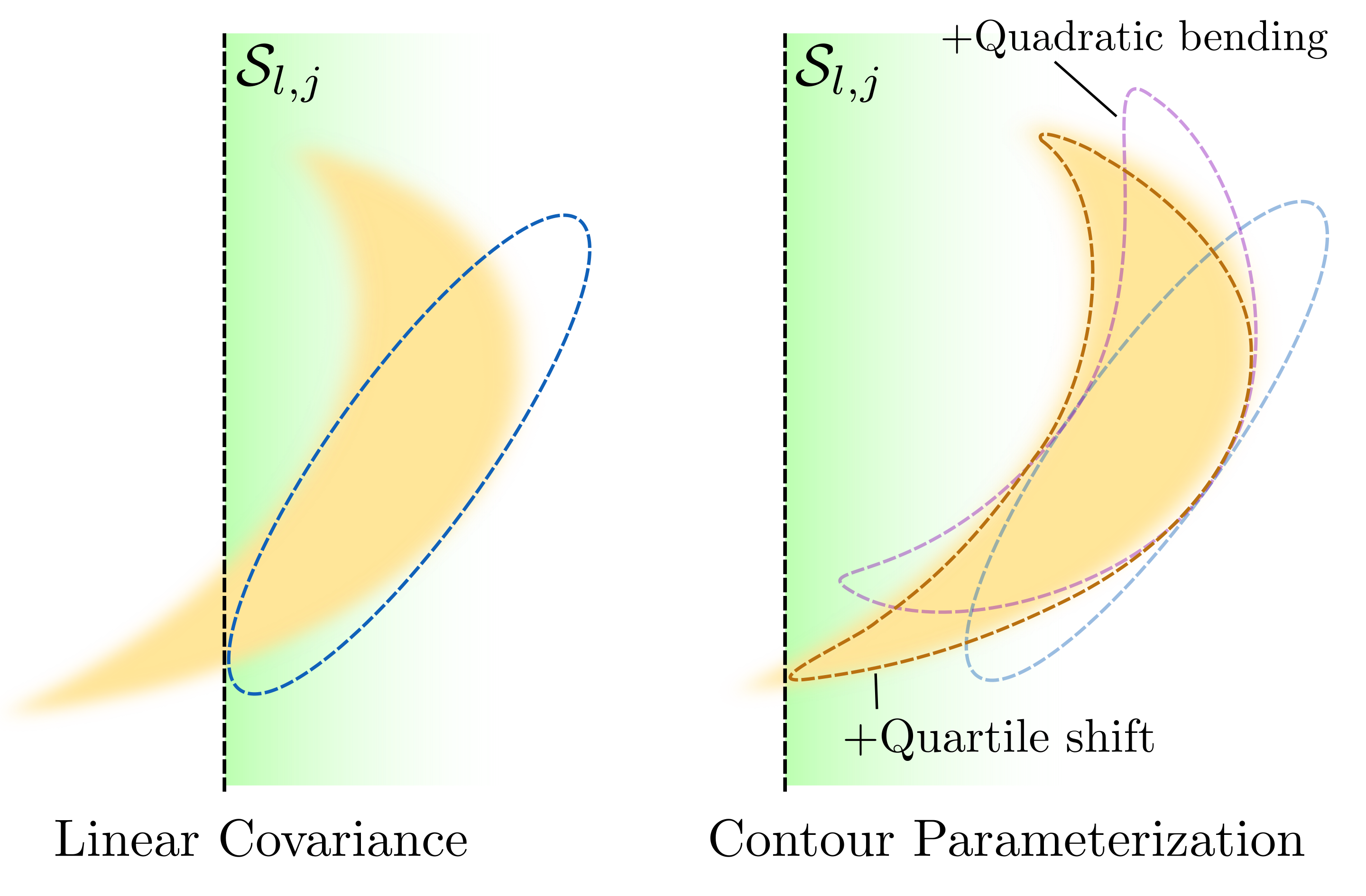
In 2D principal coordinates (u,v): the Gaussian boundary parameterization is modified to include
(i) quadratic bending of the contour to capture “banana-shaped” distributions
(ii) Cornish-Fisher expansion terms to include long-axis (quartile) asymmetry due to skewness
Figure 1: Depiction of deformed non-Gaussian chance constraints induced by higher-order moments, including characteristic “banana” bending and asymmetry.
Explicitly, for principal axes u,v, the non-Gaussian boundary is
where α and c(k) are computed directly from third and fourth-order moment tensors through least-squares and Cornish-Fisher analyses.
Moment Computation and Propagation
Efficient, deterministic computation of higher-order moments is enabled by the conjugate unscented transform (CUT) [CUT_ACC], which accurately propagates central moments through nonlinear dynamics without requiring Monte Carlo simulation. This approach enables the analytic boundary to be evaluated rapidly for use in optimization-based guidance algorithms.
Application to Spacecraft Maneuver Targeting
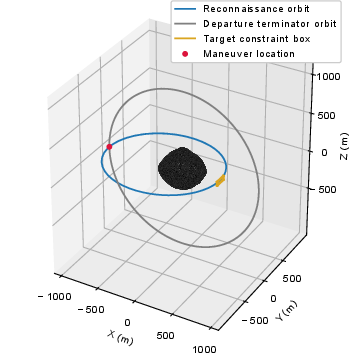
The technique is demonstrated in a high-nonlinearity two-body spacecraft maneuver: planning an impulsive trajectory about a small asteroid such that, after 1.5 orbits with significant initial state uncertainty, the terminal position distribution remains within a box constraint to prescribed probability.
Figure 2: Asteroid maneuver targeting scenario illustrating intended and uncertain trajectory evolution.
The method is tested against the classical linear covariance-based approach and evaluated through large-sample Monte Carlo trials. The analytic non-Gaussian boundary is directly enforced in the trajectory optimization routine, and the computed control is compared to that derived from a Gaussian assumption.
Numerical Results
Monte Carlo evaluation demonstrates that the non-Gaussian analytic boundary substantially improves true chance constraint satisfaction. Specifically:
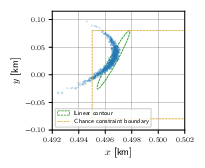
For the linearized Gaussian method, only 92.2% of the propagated samples satisfied all imposed constraints.
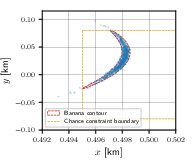
For the non-Gaussian boundary, 98.3% of samples were constraint-satisfying, with each individual constraint satisfied at the prescribed 99% risk threshold.
Figure 3: Monte Carlo results using traditional linear covariance ellipse-based chance constraints; misalignment with true distribution evident.
Figure 4: Monte Carlo results using the banana contour chance constraints; the analytic boundary conforms tightly to the non-Gaussian distribution.
The analytic method incurs a lower computational burden than mixture-based approaches and does not require iterative sampling or costly numerical risk allocation.
Theoretical and Practical Implications
From a theoretical standpoint, the presented method generalizes the mapping between probabilistic path constraints and deterministic constraints to the non-Gaussian case using only finite moment information. Practically, this enables onboard trajectory planning algorithms to quickly and accurately account for the true uncertainty geometry in highly nonlinear flows—critical for long-horizon spacecraft guidance, planetary landers, and any autonomous system subject to strong state-dependent nonlinearities.
Future directions outlined include:
Improving the computational approach to identifying the worst-case constraint-violating points on complex non-convex contours
Refining probability allocation in the analytic method
Extending to scenarios with multiple, time-varying chance constraints and higher-dimensional moment propagation
Conclusion
The analytic non-Gaussian confidence boundary technique directly addresses the core limitation of Gaussian-based chance-constrained control in nonlinear domains. By embedding skewness and kurtosis information into an explicit parameterization of probability boundaries, the method combines accuracy, interpretability, and computational efficiency. Empirical results in asteroid targeting scenarios substantiate its utility for real-time, robust trajectory optimization where conventional covariance methods are inadequate. This advance positions the approach as a generalizable and practical tool for stochastic control in nonlinear, safety-critical applications.