- The paper presents a spherical relaxation of the Kuramoto model to derive exact solutions for synchronization and glass transitions in noisy oscillator networks.
- It employs dynamical mean-field theory and cavity methods to analyze both ferromagnetic and fully random interactions under a global spherical constraint.
- The study finds that even minimal frequency heterogeneity suppresses finite-temperature glass phases, leading instead to critical slowing down and zero-temperature glassiness.
Solvable Spherical Model of Noisy Coupled Oscillators with Fully Random Interactions
Introduction
The paper "A solvable model of noisy coupled oscillators with fully random interactions" (2604.04404) investigates the interplay of disorder, noise, and frequency heterogeneity in large ensembles of coupled oscillators. Leveraging a spherical relaxation of the classical Kuramoto model, the work rigorously delineates the equilibrium and non-equilibrium statistical mechanics of oscillator networks with both deterministic and random couplings under a global constraint. The analytical tractability afforded by the spherical constraint enables an in-depth exploration of synchronization, ergodicity breaking, and glassy phenomena in systems with quenched interaction disorder and distributed natural frequencies.
The system under analysis generalizes the Kuramoto model by representing each oscillator i via a complex amplitude zi, subject to a global spherical constraint ∑i=1N∣zi∣2=N. The local equations of motion incorporate three elements: distributed frequencies Ωi, a symmetric coupling matrix Jij, and thermal white noise ξi.
The dynamical equations thus read
z˙i=−μzi+iΩizi+j=1∑NJijzj+ξi,
where the Lagrange multiplier μ is determined self-consistently from the global constraint. This approach relaxes the nonlinear local constraint ∣zi∣=1 of the classical Kuramoto model, rendering the system exactly solvable by dynamical mean-field theory (DMFT) and cavity methods.
Ferromagnetic Interactions: Synchronization Transition
In the fully ferromagnetic case (Jij=K/N), the spherical model recapitulates the standard mean-field synchronization behavior. For a Cauchy distribution of frequencies with width zi0 and thermal noise of strength zi1, the model exhibits a continuous synchronization transition at zi2. For zi3, the order parameter zi4 acquires a nonzero expectation value, indicating a coherent, synchronized phase.
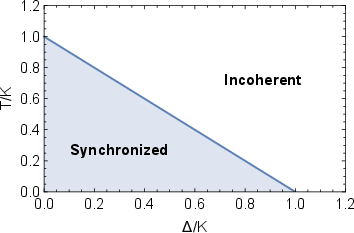
Figure 1: Phase diagram of the spherical model with ferromagnetic interactions. The filled and unfilled regions denote the synchronized and incoherent phases, respectively.
The result is consistent with and generalizes previous mean-field analyses of noisy Kuramoto models with homogenous couplings. The analytical solution leverages the structure of the Cauchy distribution, simplifying the disorder average required for self-consistent determination of the order parameter.
Fully Random Interactions: Glass Transition Analysis
The central analytical advance of this work is the solution of the model with fully random symmetric couplings drawn from a Gaussian ensemble. Utilizing the cavity method and DMFT, the paper derives closed equations for the dynamical response and correlation functions. These self-consistent equations yield the frequency-resolved spectral properties and ergodicity criteria.
A key finding is the qualitative distinction between the monodisperse (zi5) and polydisperse (zi6) cases:
- Monodisperse regime (zi7): The model reduces to the spherical Sherrington-Kirkpatrick (SK) spin glass, realizing a finite-temperature spin-glass transition at zi8.
- Polydisperse regime (zi9): The finite-temperature glass transition is suppressed entirely. The paper proves analytically that any nonzero frequency disorder induces infrared divergences in the low-frequency spectrum of the correlation function, which preclude spontaneous replica symmetry breaking at ∑i=1N∣zi∣2=N0.
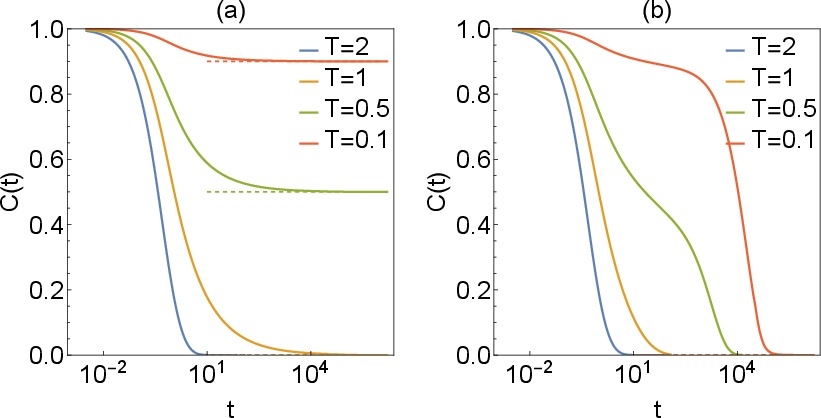
Figure 2: Time correlation functions for (a) ∑i=1N∣zi∣2=N1 and (b) ∑i=1N∣zi∣2=N2 at several temperatures. For ∑i=1N∣zi∣2=N3, the correlation approaches a nonzero plateau below ∑i=1N∣zi∣2=N4; for ∑i=1N∣zi∣2=N5, all correlations decay to zero.
Dynamical Slowdown and Zero-Temperature Glassy Phase
Although a finite-temperature glass phase is absent for ∑i=1N∣zi∣2=N6, the model retains strong signatures of slow, glass-like dynamics at low temperature and small frequency dispersion. The time-integrated correlation function ∑i=1N∣zi∣2=N7, which sets the characteristic relaxation scale, diverges as ∑i=1N∣zi∣2=N8 or ∑i=1N∣zi∣2=N9, indicating critical slowing down.
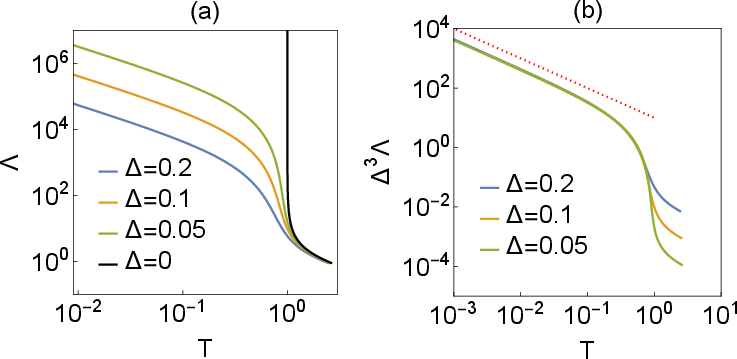 *Figure 3: (a) Ωi0 for Ωi1 and various Ωi2. For Ωi3, Ωi4 diverges at Ωi5, while for Ωi6, it diverges only as Ωi7. (b) Scaling plot showing Ωi8. *
Furthermore, the late-time decay of the correlation function admits scaling collapse when times are rescaled by Ωi9, reinforcing the emergent criticality in the vicinity of the monodisperse point.
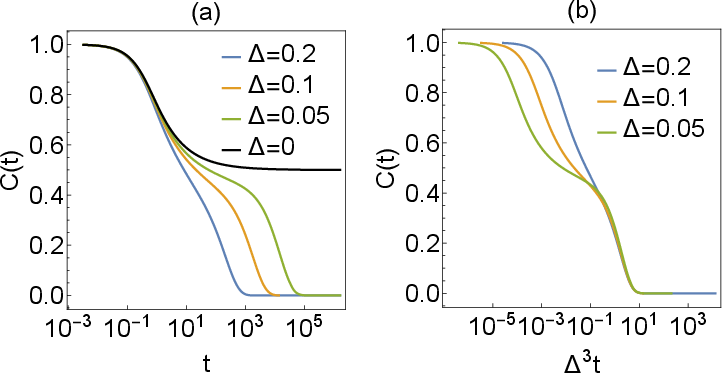
Figure 4: (a) Correlation functions for various Jij0 at Jij1 and Jij2. (b) Scaling plot showing collapse of late-time curves under rescaling by Jij3.
At strictly zero temperature (Jij4), the spherical model admits a residual frozen phase for arbitrary Jij5, a feature attributed to the quasi-linear nature of spherical dynamics. This is a marked contrast with generic nonlinear oscillator dynamics, where local nonlinearities are expected to destabilize such order at finite dispersion.
Universality with Respect to Frequency Distribution
The suppression of the glass transition for any finite frequency dispersion is demonstrated to be universal for all symmetric Jij6 with finite variance. Detailed analysis of the low-frequency properties of the DMFT equations shows that only the singular monodisperse case (Jij7) supports a finite-temperature glass phase. Asymmetric distributions similarly lead to the absence of ergodicity breaking via a weakened singularity, which nonetheless remains sufficient to preclude a transition.
Implications and Future Directions
The spherical model provides a rigorous platform to assess the robustness of glassy phases against non-equilibrium perturbations in oscillator networks. The findings underline that frequency heterogeneity (even infinitesimal) destabilizes the equilibrium glass phase, reflecting a structural incompatibility between quenched frequency disorder and collective freezing under global constraints. In a broader context, this aligns with prior results in nonequilibrium spin-glass models, where perturbations—such as asymmetric couplings or nonconservative drive—generically suppress glassy order except at zero noise [crisanti1987].
Practically, these results imply that glassy dynamics in realistic oscillator systems (with frequency heterogeneity) occurs only as a slowing down, not as a true ergodicity breaking at finite temperature. The presence of zero-temperature glassiness in the spherical approximation should be interpreted conservatively; it almost surely does not persist once nonlinear local dynamics are restored, suggesting the need for further work incorporating nonlinear terms and investigating corresponding dynamical mean-field extensions.
There are several open problems and directions associated with this framework:
- Nonlinear dynamics: Assessing the stability of the residual glassy phase once local nonlinearities are reinstated.
- Weak-coupling and strong-dispersion regimes: Exploring the breakdown of spherical results and the onset of chaotic or algebraically decaying correlations observed in numerical simulations of the fully disordered Kuramoto model.
- Extensions beyond symmetry: Analyzing non-symmetric (e.g., nonreciprocal) coupling matrices and their effect on dynamical transitions and aging.
A detailed understanding in these regimes would inform not only the theoretical physics of complex networks but also applications ranging from neuronal assemblies to engineered oscillator hardware.
Conclusion
By introducing and solving a solvable spherical model of coupled oscillators with quenched disorder and distributed natural frequencies, this work establishes that frequency heterogeneity generically eliminates the finite-temperature spin-glass phase, confining glassiness to strictly zero temperature within the spherical framework (2604.04404). The analytical results are robust for a wide range of frequency distributions, underscoring the fragility of collective freezing to non-equilibrium perturbations. These insights refine the theoretical landscape of nonequilibrium statistical mechanics for oscillator networks and motivate future exploration of genuinely nonlinear regimes where new dynamical phenomena may arise.