- The paper demonstrates that hybrid digital-analog architectures synergize native hardware interactions with gate-based controls to reduce error accumulation and circuit depth.
- The paper highlights experimental validations across trapped ions, superconducting circuits, and Rydberg atoms, underscoring improved scalability and performance.
- The paper outlines future directions including advanced error-correction methods and integration with quantum machine learning to enhance quantum advantage.
Digital-Analog Quantum Simulation and Computing: Synthesis and Perspectives
Introduction
The manuscript "Digital-Analog Quantum Simulation and Computing: A Perspective on Past and Future Developments" (2604.04438) provides a rigorous analysis of the emergence, formalization, and current status of digital-analog quantum technologies (DAQT) in quantum simulation and computing. It contextualizes DAQT as a hybrid paradigm synthesizing canonical digital (gate-based) and analog (Hamiltonian evolution-based) paradigms. The author systematically reviews theoretical foundations, experimental realizations, mathematical considerations around quantum advantage, and the trajectory of DAQT toward scalable, potentially universal quantum computation.
Digital, Analog, and Digital-Analog Paradigms
Quantum computational models have historically followed two dichotomous paths: digital quantum computation operates via universal sets of single- and two-qubit gates, while analog quantum computation leverages engineered many-body Hamiltonian dynamics to simulate physical processes. The former is theoretically universal but faces practical challenges—primarily error accumulation and the overhead of error correction—which have made large-scale digital quantum computation impractical given current technology. The latter is experimentally scalable, especially in tractable quantum systems (superconducting circuits, trapped ions, Rydberg atoms), but lacks universality due to its platform- and interaction-specific nature.
The DAQT paradigm, first formalized in the last decade, integrates large analog evolution blocks (exploiting native interactions and thus inherent experimental scalability) with digital gates (enabling programmability and universality). This synthesis allows complex, nontrivial quantum computations with reduced circuit depth, leveraging both native Hamiltonian resources and the modular versatility of digital control. Importantly, DAQT subsumes both traditional models as limiting cases and, by virtue of this inclusion, inherits universality when equipped with a universal gate set.
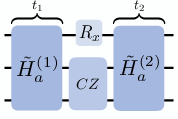
Figure 1: A digital-analog quantum computation protocol employing single-qubit rotations, two-qubit controlled gates, and tunable analog evolution blocks governed by native Hamiltonians.
Digital-Analog Quantum Simulation: Motivation and Historical Evolution
Early quantum simulators were motivated by Feynman's insight that generic quantum systems are intractable for classical simulation due to exponential Hilbert space growth. Initially, universal digital simulation using Lie-Trotter-Suzuki decompositions faced unfavorable scaling due to gate errors. Conversely, analog simulators suffered from limited model expressivity. The DAQT architecture, motivated by both these limitations, targets efficient simulation of many-body quantum systems by interleaving high-fidelity analog blocks (e.g., Ising, XY, or Heisenberg models naturally present in hardware) with digital controls.
The 2011–2018 period saw significant DAQT proposals, first for trapped ion systems (enabling simulation of relativistic models such as the Dirac equation and quantum field theories with nontrivial fermionic content) and subsequently extending to superconducting circuits and Rydberg platforms. Analyses established that DAQT can reproduce hard quantum models with polynomially reduced error accumulation and circuit depth. Theoretical proposals transitioned rapidly into experimentation once experimentalists realized the practical ceiling of purely digital gate-based implementations in noisy intermediate-scale quantum (NISQ) devices.
Quantum Computing and Machine Learning with DAQT
Subsequent research formalized the universality of DAQT for quantum computation. Starting from native analog interactions (e.g., Ising or XY-type Hamiltonians) and supplementing these with comprehensive single-qubit control, DAQT protocols can efficiently generate a universal set of quantum operations. Rigorous proof (see [4] and [9] in the paper) demonstrates that analog evolutions do not restrict computational universality and, furthermore, can enhance error robustness and computational resource efficiency given extant quantum hardware constraints.
Recent analysis also extends DAQT concepts to quantum machine learning architectures. Hybrid protocols, where variational circuits or quantum neural networks interleave analog blocks with digital updates, afford expressivity and may mitigate the barren plateau problem prominent in purely digital quantum learning models.
Quantum Advantage and Error Correction in DAQT
Recent theoretical works rigorously assess the potential for quantum advantage within DAQT architectures. For configurations involving a large-scale analog block (such as a transverse-field Ising interaction), supplemented by digital gates and followed by projective measurements, it is shown that such hybrid evolutions enable quantum speedups unreachable by classical algorithms. Specifically, [8] asserts that quantum supremacy tests are possible with contemporary quantum annealers and other devices equipped for hybrid DAQ evolution, substantiating the practical relevance of this paradigm for near-term quantum advantage.
Additionally, mathematical frameworks for DAQT incorporating both qubits (digital) and quantum oscillators (analog) have been constructed, establishing instruction set architectures and abstract machine models tailored for DAQT. These integrative models provide feasible pathways for both error correction (by leveraging oscillator encodings such as GKP states) and efficient quantum algorithm realization in hybrid qubit-oscillator systems ([9]).
Experimental Landscape: Trapped Ions, Superconducting Circuits, and Rydberg Atoms
DAQT is not only a theoretically robust paradigm but has also been empirically validated across all major quantum hardware platforms.
Trapped Ions
Pioneering work in Innsbruck, Duke University, and Tsinghua exploited DAQT in trapped-ion chains, achieving complex quantum simulations (including relativistic and many-body models) on registers involving tens of ions. Notable experiments have demonstrated scalable entanglement and implemented nontrivial Ising models using hybrid protocols.
Superconducting Circuits
Superconducting circuits, developed to high maturity in Google Quantum AI and D-Wave systems, have enabled implementations of DAQT protocols combining global analog interactions with selective digital controls. These experiments, involving 50+ qubit arrays, have demonstrated many-body thermalization, criticality, and analog-digital annealing with performance surpassing what would be expected from purely digital decomposition at current error rates.
Cold/Rydberg Atoms
Perhaps most surprisingly, Rydberg atom arrays have come to the forefront, with experiments supporting controllable dynamics of more than 100 qubits using digital-analog protocols—previously unobtainable due to the low fidelities of two-qubit gates in these systems. Efforts at Harvard, startups like QuEra and Pasqal, and groups pioneering digital-analog variational quantum eigensolvers point to the scalability and versatility of DAQT for simulating condensed-matter and quantum field theory models.
Implications and Future Directions
The DAQT paradigm is positioned as the pragmatic alternative for achieving nontrivial quantum computation and simulation in the NISQ-to-post-NISQ era. Its ability to leverage native hardware resources while maintaining programmability primes it for medium-term quantum advantage even before full error-corrected quantum computation becomes feasible. The convergence of DAQT with advances in hybrid analog-digital error correction strategies and its successful integration into machine learning protocols suggest that DAQT will remain central to the practical deployment of quantum technologies.
Future developments are expected to include:
- Extension of DAQT methodologies to larger system sizes and higher-fidelity devices
- Novel mathematical frameworks for further optimizing DAQT resource allocation and error scaling
- Greater integration with continuous-variable quantum information processing, especially using hybrid oscillator-qubit systems
- Deployment of DAQT architectures for quantum chemistry, material science, and HEP model exploration beyond digital capabilities
Conclusion
This perspective systematically elucidates that DAQT is not merely a compromise between digital and analog quantum computing but a resource-efficient superstructure subsuming both. Its demonstrated scalability, universality, and empirical performance position it as a critical paradigm for quantum information science in the foreseeable future. As quantum hardware matures, DAQT is likely to bridge the current gap toward truly universal, error-corrected quantum computation.

