- The paper demonstrates that, unlike in 2D, the 3D Ising model exhibits a single percolation transition at criticality, where both majority and minority spin clusters become percolating simultaneously.
- The paper employs large-scale Monte Carlo simulations and analytical results from the complete graph model to extract finite-size scaling exponents and fractal dimensions, confirming a novel universality class.
- The paper reveals that 2D layers embedded in the 3D critical bulk display unique percolation thresholds and modified critical exponents, emphasizing the impact of bulk-layer correlations.
Percolation Transitions in the Three-Dimensional Ising Model
Introduction and Context
The study provides a comprehensive numerical and theoretical investigation of percolation transitions for geometric spin clusters in the three-dimensional (3D) Ising model, extending the geometric perspective that has illuminated critical phenomena in lower dimensions. Recent results in two dimensions demonstrated the existence of two distinct percolation transitions for geometric spin clusters as the bond-occupation probability p is varied on critical Ising configurations. This work interrogates whether this phenomenon persists in three dimensions, as well as on layered subsystems embedded in a higher-dimensional critical environment.
Phase Diagrams and Bulk Percolation Structure
Through large-scale Monte Carlo simulations and theoretical results on the complete graph (CG), the study establishes that, in contrast to the two-dimensional scenario, the 3D Ising model exhibits only a single percolation transition along the Ising critical line, regardless of whether the percolation and lattice coordination numbers coincide. Explicitly, configurations display a direct transition from the disordered (DO) phase to a phase in which both majority- and minority-spin clusters percolate (BP), with no intermediate region where only the majority spins percolate at criticality.
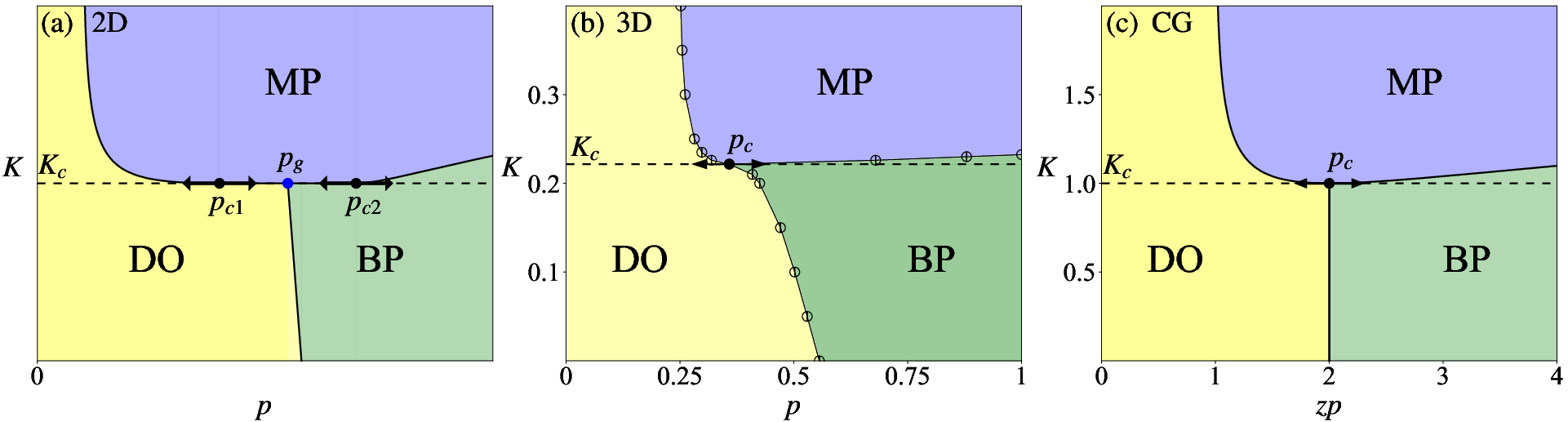
Figure 1: Schematic phase diagrams for percolation in the Ising model, contrasting the two consecutive percolation transitions in 2D (left), the single transition in 3D (middle), and the mean-field-like complete graph scenario (right).
The data compellingly show that, for d>2, geometric clusters undergo a sole percolation transition at K=Kc, a result corroborated by analytic treatment on the CG. For K=Kc, the structure in the (K,p) plane bifurcates, resembling uncorrelated percolation, with thresholds for majority and minority clusters appearing only off-criticality. These findings resolve long-standing questions regarding dimensional dependence and universality of geometric transitions in the Ising model.
Layered Systems: Percolation in Embedded 2D Slices
The investigation proceeds to analyze percolation properties on two-dimensional layers ("slices") embedded within the 3D Ising bulk. The layer inherits critical correlations from the bulk, leading to nontrivial modifications of percolation behavior that contrast with both standard 2D percolation and fully decoupled scenarios.

Figure 2: Phase diagrams for the 3D Ising model's layered percolation with different in-plane coordination numbers zp=4,6,24, showing no transition for zp=4, emergent criticality at pc=1 for zp=6, and a reduced threshold for zp=24.
Notably, for nearest-neighbor connectivity (d>20), no percolation transition appears in the physical regime d>21 along the 3D bulk critical line; only for longer-range percolation neighborhoods (d>22) does a threshold emerge, with exact results attainable for d>23 by virtue of a self-matching property analogous to site percolation on the triangular lattice.

Figure 4: Finite-size scaling of the percolation threshold using the critical polynomial d>24 for varying d>25, illustrating the emergence (or absence) of crossing points across system sizes.
Critical Exponents and Universality Classes
The study delivers precise finite-size scaling (FSS) analyses to extract the renormalization-group (RG) exponent along the d>26 axis and fractal properties of the percolating clusters on the layer. For d>27, the measured exponents are:
- RG exponent along d>28: d>29
- Fractal dimension of the largest cluster: K=Kc0
- Hull dimension: K=Kc1
- Minimal path dimension: K=Kc2
These values deviate substantially from standard 2D percolation exponents (e.g., K=Kc3), indicating that the correlated background fundamentally alters the universality class.
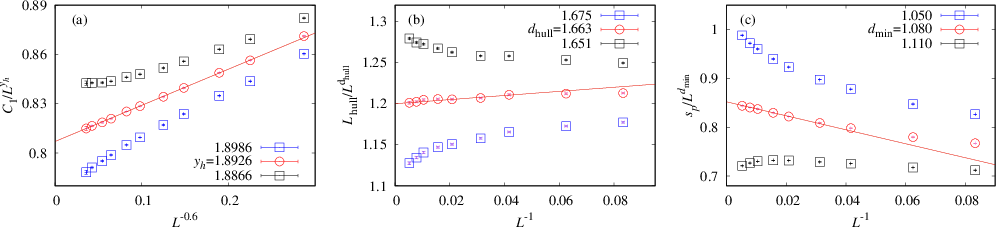
Figure 3: Scaling plots for the size of the largest cluster, hull, and shortest path on the K=Kc4 critical layer, showing fractal properties characteristic of a distinct universality class.
Implications and Theoretical Significance
This body of work clarifies the geometric critical behavior of Ising models in and above the upper critical dimension for geometric clusters (K=Kc5), refuting the hypothesis that the sequence of geometric transitions observed in 2D persists generically. The demonstration that only one percolation transition is present at criticality for K=Kc6 is a strong result, with analytic support from the infinite-dimensional limit, and consolidates the understanding of geometric cluster percolation as fundamentally dimension-dependent.
On layered subsystems, the results prove that long-range correlations from the 3D bulk can stabilize new universality classes for cluster percolation in 2D geometries. The strong modification of exponents precludes direct mappings to standard 2D percolation or Ising transition universality, revealing the critical influence of bulk-layer correlations. This is highly relevant for the study of surface criticality, interfacial phenomena, and the geometric structure of correlated systems.
Prospects for Future Study
Open avenues include analytical treatment of the layered percolation universality class using field theory or RG approaches adapted to embedded geometries with critical backgrounds. Investigating higher-dimensional generalizations, anisotropic interactions, or the effect of quenched disorder may yield further insight into the relation between bulk correlations and geometric criticality. These results also motivate analogous studies in other lattice models and for systems with competing orders.
Conclusion
The analysis establishes that, contrary to the 2D case, the 3D Ising model supports only a single percolation transition for geometric clusters at criticality, with this behavior persisting in the infinite-dimensional limit. For 2D layers embedded in the 3D critical bulk, percolation transitions exist only for sufficiently long-range processes and manifest distinctive, nonstandard critical exponents, signifying a novel universality class. The results significantly strengthen the theoretical understanding of geometric and percolative phenomena in correlated spin systems and provide a rigorous foundation for further studies at the interface of geometry and criticality.