- The paper introduces IA-VAE, which mitigates the amortization gap by modulating encoder parameters with a hypernetwork for improved posterior approximations.
- By using blockwise parameter modulation, the method achieves enhanced ELBO performance and parameter efficiency, using fewer encoder parameters than standard VAEs.
- Empirical evaluations on synthetic and real-world datasets demonstrate that IA-VAE outperforms baselines in inference fidelity while reducing computational overhead with a single forward pass.
Instance-Adaptive Parametrization for Amortized Variational Inference
Introduction
Amortized variational inference (AVI) is central to latent variable modeling, notably in the context of deep generative models such as VAEs. By leveraging a parameterized inference network to approximate posterior distributions for each observation, AVI achieves significant scalability at the expense of input-specific optimality. This structural tradeoff introduces the amortization gap, limiting both posterior accuracy and generative performance. The paper "Instance-Adaptive Parametrization for Amortized Variational Inference" (2604.06796) introduces the Instance-Adaptive Variational Autoencoder (IA-VAE), an architecture that combines a hypernetwork-based modulation of encoder parameters with standard AVI. The result is an inference framework that achieves input-dependent adaptation using a single forward pass, improving posterior approximations and parameter efficiency over standard methods.
Methodological Framework
The IA-VAE modifies the conventional VAE inference architecture by equipping the encoder with a hypernetwork that generates instance-specific parameter modulations. Specifically, for input x, encoder parameters are modulated as
ϕ(x;ψ)=ϕAVI+h(x;ψ)
where ϕAVI are global shared parameters and h is a hypernetwork parameterized by ψ. This input-dependent augmentation expands the effective variational family, enabling the inference mapping to adapt flexibly to each observation, thus mitigating the amortization gap that arises when using a single global encoder.
Theoretical analysis in the paper demonstrates the inclusion QAVI⊆QIA-VAE, establishing that the IA-VAE can represent any variational distribution expressible by the baseline VAE, but with additional expressive power for input-adaptive variations. Importantly, the approach retains the amortized inference efficiency of a single forward pass and does not require iterative input-specific refinement or changes to the standard ELBO objective.
Blockwise parameter modulation is used for scalability: the hypernetwork generates adjustments in blocks (e.g., per layer or per column for convolutional/fully-connected layers), allowing for instance-specific variability without significant parameter overhead.
Empirical Evaluation
The experimental analysis is performed on both synthetic and real-world image datasets. The synthetic regime uses data for which the true generative process is available, enabling direct evaluation of posterior accuracy. The real-world setting includes standard benchmarks: MNIST, Fashion-MNIST, and OMNIGLOT.
Synthetic Data: Posterior Accuracy and Modality Adaptation
On the synthetic dataset, IA-VAE demonstrates substantial improvement in both ELBO and posterior approximation metrics over baseline VAEs. Visualizations provide further evidence of improved posterior fitting:
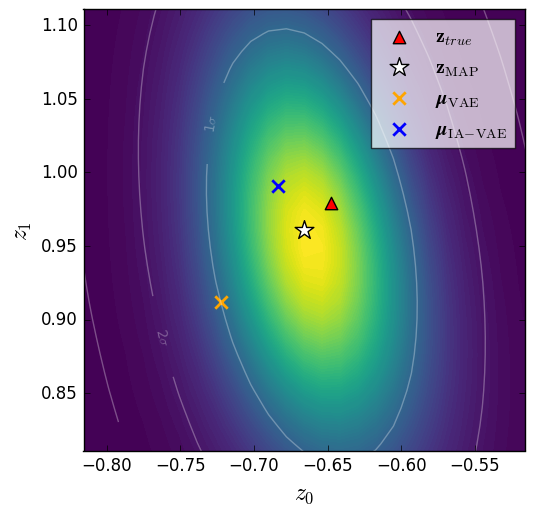
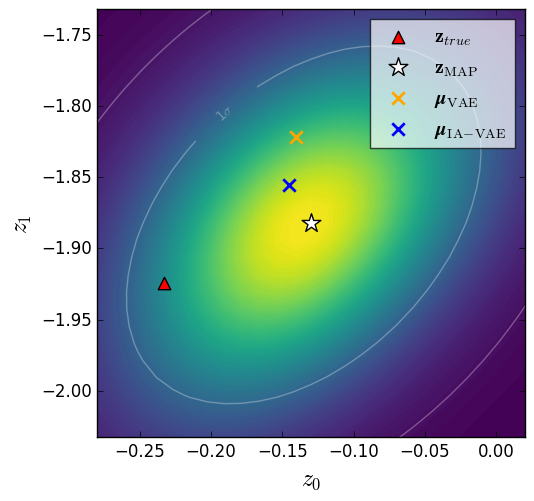
Figure 2: Posterior density in latent space for synthetic observations; IA-VAE posterior means align closely with the true mode, outperforming standard VAE.
MAE and likelihood ratio analyses show that IA-VAE posterior means concentrate in high-density regions of the true posterior, revealing a marked reduction in amortization gap. The improvements are robust to random initialization and not due to hypernetwork-induced overfitting.
Parameter Efficiency
The parameter efficiency analysis demonstrates that IA-VAE can match or exceed the ELBO of significantly larger baseline VAEs, using approximately 40% fewer parameters for similar ELBO scores in the synthetic setting:
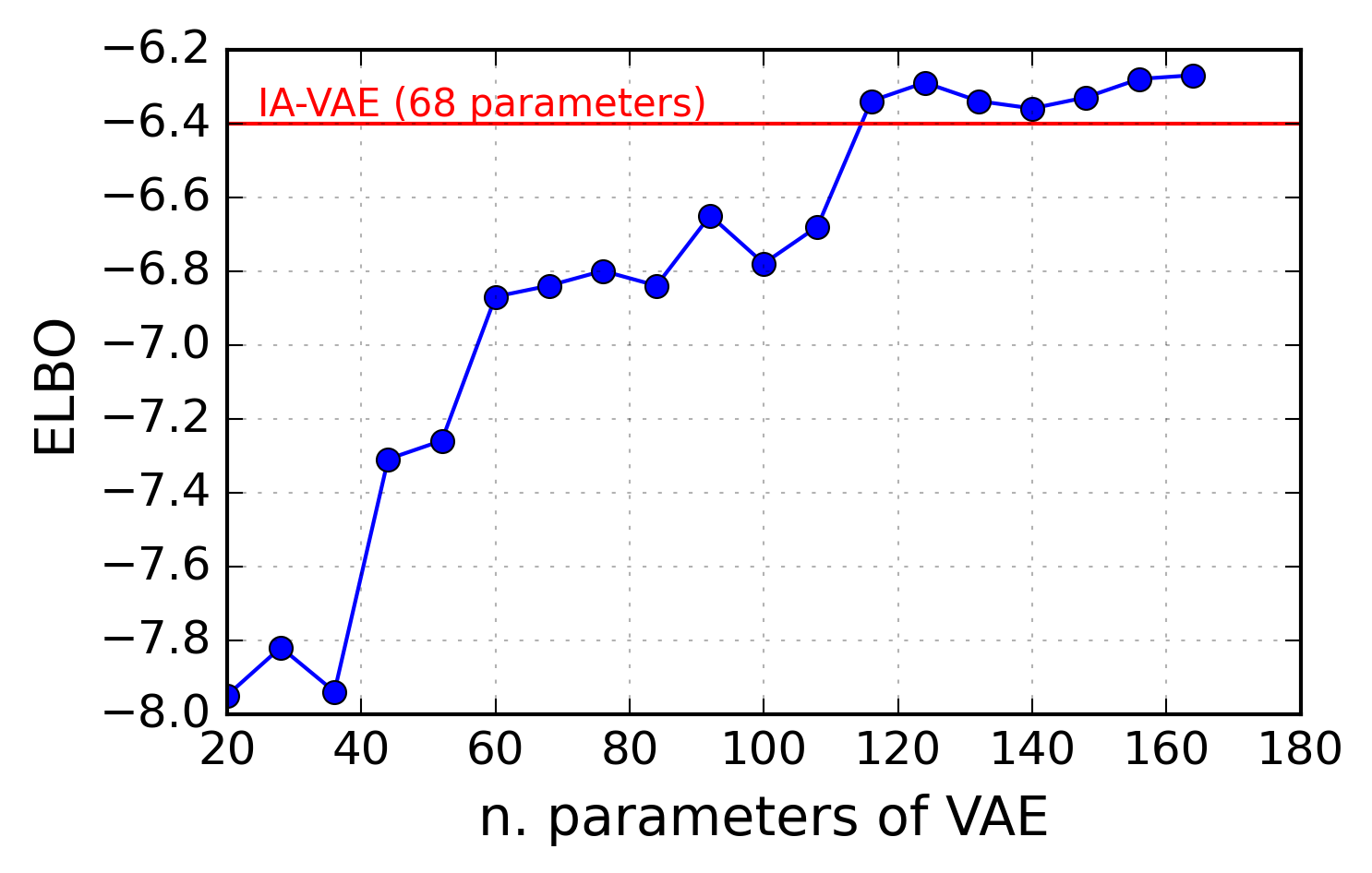
Figure 4: IA-VAE achieves a superior ELBO with markedly fewer encoder parameters compared to standard VAEs, indicating higher parameter efficiency.
This finding rules out the explanation that improvements are exclusively due to increased network capacity, highlighting the structural benefits of instance-adaptive parameterization.
Real-World Image Reconstruction
On held-out test sets of MNIST, Fashion-MNIST, and OMNIGLOT, IA-VAE consistently outperforms standard VAEs in terms of ELBO, with differences confirmed statistically significant via hypothesis testing. Reconstructions further indicate that the approach preserves generative reliability.
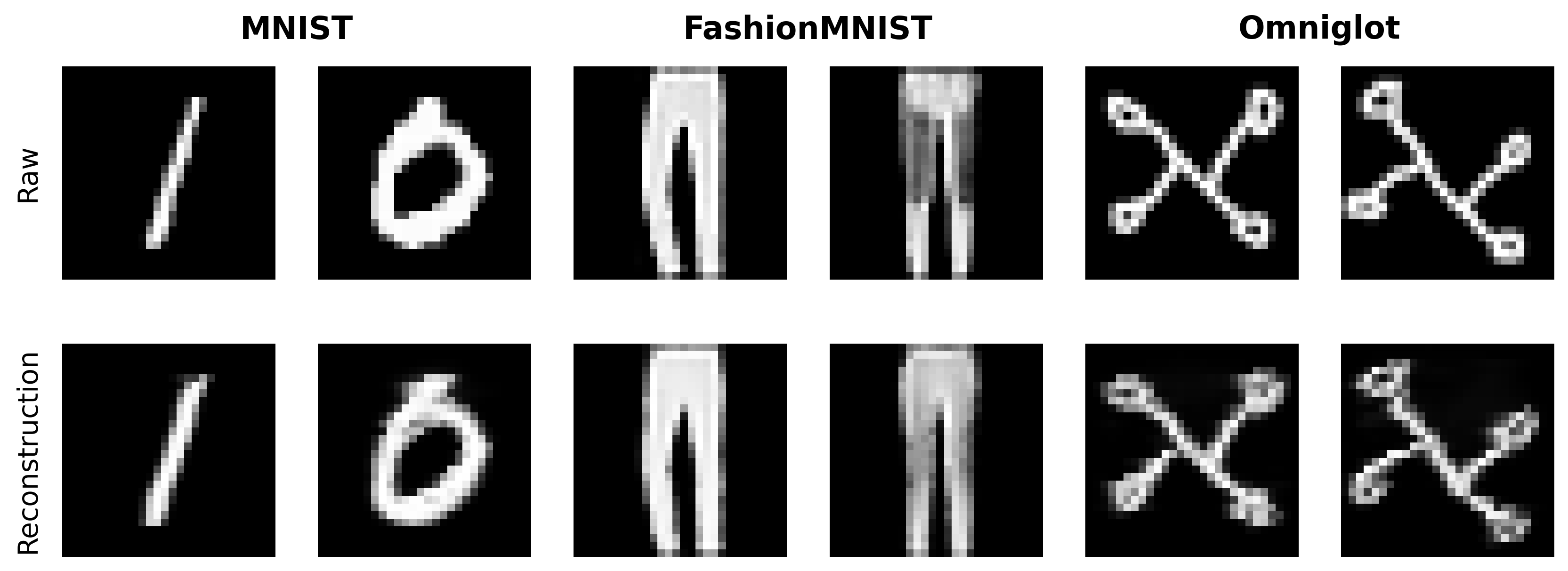
Figure 6: Reconstructions for MNIST, Fashion-MNIST, and OMNIGLOT; IA-VAE faithfully recovers salient data features across all datasets.
Implications and Future Perspectives
The IA-VAE establishes that hypernetwork-driven, instance-adaptive parameterization yields superior variational inference compared to global-parameter amortization. Contrary to conventional approaches that mitigate the amortization gap using computationally expensive iterative refinement, IA-VAE sidesteps the need for such steps, attaining better inference fidelity and efficiency in a single forward pass. The approach sets a precedent for parameter-efficient, flexible inference in deep generative models.
Practically, this has direct relevance for large-scale applications in domains where inference optimality is critical and computational budget is constrained, including high-dimensional generative modeling, anomaly detection, and biomedical data analysis. Theoretically, IA-VAE’s mechanism can be positioned as a regularization strategy, enhancing model adaptability without engendering overfitting.
From a broader perspective, IA-VAE’s hypernetwork-based instantiation of conditional parameter generation connects naturally to research on meta-learning, continual learning, and explainable ML. Given the modular form of its instance-specific adaptation, extensions are plausible for semi-supervised, non-iid, or online learning scenarios. Moreover, the explicit exposure of inference parameter modulations may support developments in interpretable inference, such as tracing decision rationales within XAI paradigms.
Other anticipated directions include adaptation to disentangled representation learning, where input-adaptive modulation could facilitate more granular factorized representations and improved generalization. The approach is compatible with hybrid-structured and hierarchical latent models and may inform the evolution of scalable, expressive approximate Bayesian inference mechanisms in both supervised and unsupervised deep learning.
Conclusion
Instance-adaptive amortized inference, operationalized in the IA-VAE framework, demonstrably improves posterior approximation and model efficiency by leveraging hypernetwork-generated parameter modulations. The method is robust, statistically validated, and requires minimal computational overhead relative to standard AVI protocols. Its generalizability and compatibility with current deep generative architectures suggest broad applicability. IA-VAE opens a path toward more flexible, efficient, and interpretable inference in high-capacity generative modeling systems, with substantive practical and theoretical ramifications for future AI research and deployment.