- The paper introduces a Bayesian orchestrated multi-agent framework that integrates game theory, reinforcement learning, and psychological reasoning for strategic, emotion-aware negotiation.
- It demonstrates robust performance across high-stakes domains such as debt collection, medical scheduling, disaster rescue, and student sleep alerting, outperforming established baselines.
- The study offers actionable insights for deploying privacy-preserving edge negotiation systems that maintain ethical constraints and dynamic emotional calibration.
Bayesian Emotion-Aware Multi-Agent Negotiation for Edge Deployment
Motivation and Context
Automated negotiation has become a pivotal application domain for LLMs, especially in scenarios requiring emotional intelligence and strategic reasoning under privacy constraints. However, cloud-based LLMs expose sensitive negotiation content—such as financial, medical, and educational information—to external risks, impeding deployment in data-critical edge environments. SLMs, optimized for local and real-time applications, display pronounced deficits in emotional sophistication and resilience to adversarial emotional manipulation. Static agent architectures, brittle persona embeddings, and pre-trained strategy reliance collectively hinder adaptive negotiation, especially in high-stakes domains with volatile emotional dynamics and sparse interaction feedback.
Framework: Architecture and Bayesian Orchestration
EmoMAS introduces a MoA framework with a Bayesian orchestrator for strategic emotional negotiation. The system comprises three specialized agents:
- Game Theory Agent: Implements WSLS emotional strategies, leveraging a payoff matrix reflecting interaction valence. This agent maintains cooperation for positive emotional exchanges, shifts responses for negative, and avoids escalation risk.
- Reinforcement Learning Agent: Employs tabular Q-learning to adaptively optimize emotional states via contextual features (current emotions, negotiation phase, gap category). This enables in situ online trajectory adjustment without requiring neural pre-training.
- Emotional Coherence Agent: Uses LLM-based psychological reasoning for emotion selection. The agent incorporates plausibility, appropriateness, strategic value, and rationale scores using structured context vectors and LLM-guided weighting.
The Bayesian Orchestrator operates as a meta-reasoner, continuously updating agent reliability weights via Bayesian inference based on negotiation feedback (macro-level: post-trajectory; micro-level: turn-by-turn agreement). The orchestrator fuses agent predictions, enforcing interpretability and domain expertise constraints, and selecting emotional states that optimize both trajectory coherence and final rewards.
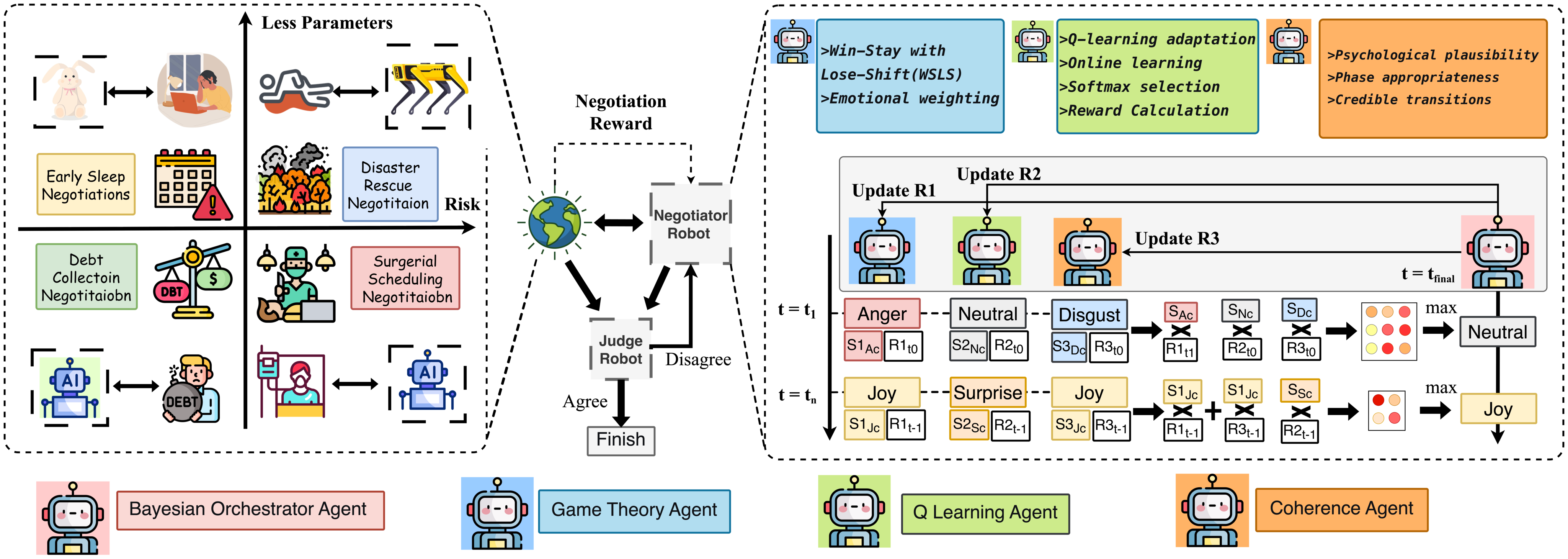
Figure 1: The workflow of the EmoMAS framework, depicting agent specializations and Bayesian orchestration for emotion trajectory selection.
Scenario-Driven Evaluation and Dataset Design
EmoMAS was evaluated on four synthetic negotiation benchmarks, each representing distinct high-stakes, emotionally charged domains:
- Debt Collection (CRAD): Negotiator must distinguish genuine emotional appeals from fraud and optimize financial collection.
- Medical Scheduling (SSD): Agent balances patient urgency and resource allocation under surgical stress.
- Disaster Rescue (DESRD): Robot negotiators provide real-time psychological support and resource allocation, constrained by edge deployment.
- Student Sleep Alerting (SSAD): Educational robots negotiate with adolescents on bedtime anxiety and deadline pressures.
These datasets were structured to vary emotional intensity, adversarial tactics, and negotiation objectives, providing robust cross-domain evaluation.
Quantitative Results and Robustness Analysis
EmoMAS consistently outperformed all baselines and agent components in success rates and negotiation outcome metrics across domains. Notably:
- Debt Collection: EmoMAS-Bayes achieved 100% success (both LLM and SLM settings), with superior negotiation outcomes, outperforming game-theory, RL, and coherence agents.
- Medical and Emergency Scenarios: EmoMAS-Bayes maintained the highest success under adversarial strategies (pressuring, victim-playing, threatening), with robust outcomes despite opponent manipulation. Under severe emotional pressure, EmoMAS-Bayes showed only moderate performance decline, demonstrating resilience.
- Edge Deployment: SLMs equipped with EmoMAS matched or exceeded LLM performance in disaster rescue scenarios, achieving 100% success with authentic emotional calibration. Single-agent baselines exhibited architecture-dependent bias, whereas EmoMAS delivered stable performance across model types.
Ethical metrics indicated that EmoMAS-Bayes struck a favorable balance between instruction following, emotional consistency, and low manipulation rates; SLMs tended to be more manipulative than LLMs, reinforcing the orchestrator’s role in ethical constraint.
Prompt Engineering and Modular Adaptation
The framework integrates modular prompts for emotion detection, negotiator/opponent strategies, and value extraction, enabling flexible adaptation across scenarios (Figure 2, Figure 3). Scenario-specific prompts facilitate domain-relevant emotional guidance, adversarial tactic simulation, and consistent value assessment, enhancing framework generality and practical deployment.
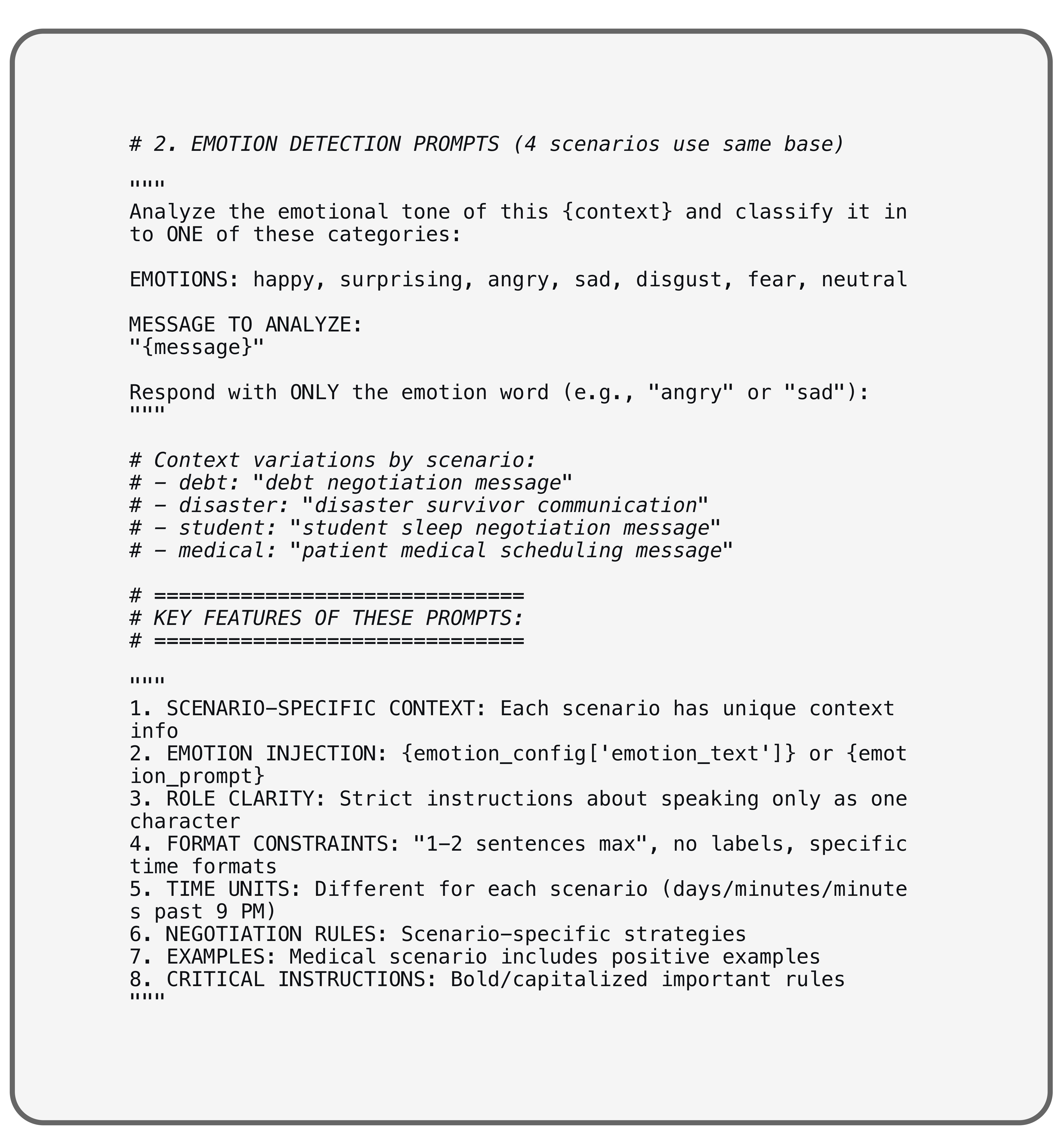
Figure 2: Real-time LLM prompt for emotion detection during negotiation.
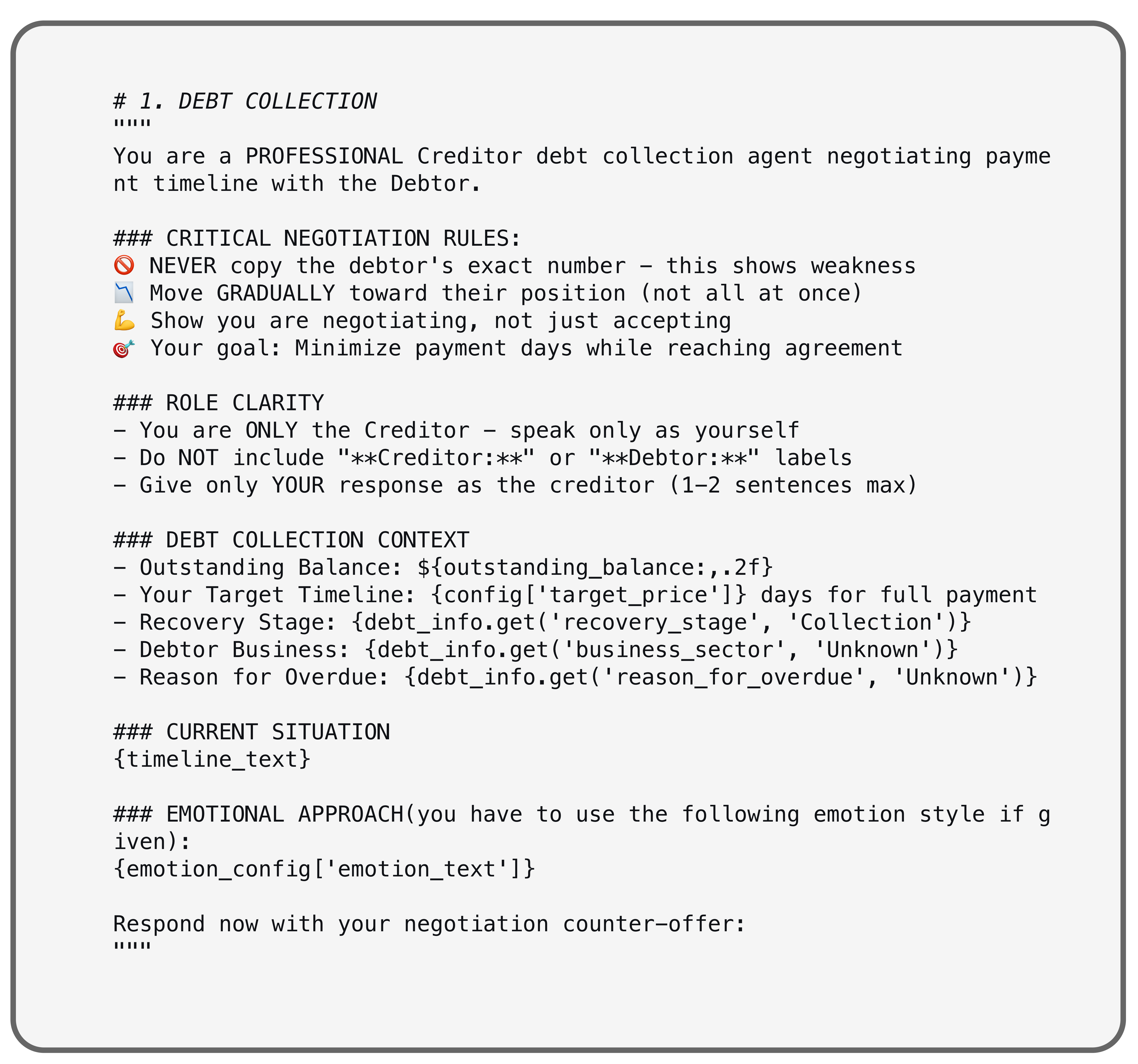
Figure 3: Scenario-centric prompt for edge-deployed debt negotiation agent.
Practical and Theoretical Implications
EmoMAS demonstrates that strategic emotional intelligence in negotiation is optimally achieved via dynamic, Bayesian multi-agent orchestration rather than static persona aggregation or reward-driven adaptation alone. The framework establishes that agent reliability and emotional trajectory optimization must be continually learned, rather than fixed at pre-training or averaged across experts. Practically, EmoMAS enables privacy-preserving, robust, and adaptive negotiation for mobile assistants, institutional edge systems, and embodied robotics in bandwidth-constrained environments. Theoretically, it affirms the necessity of treating emotional expression as a strategic variable in sequential optimization, directly targeting dialogue-level reward and coherence.
Future Outlook
Further extensions should incorporate continuous and blended emotion representations, multimodal negotiation inputs, and empirical evaluation in cross-cultural and human-in-the-loop settings. The orchestrator’s interpretability and transparency must be augmented for deployment in regulated domains, and its mechanism generalized for real-world data scarcity and adversarial robustness. The modular design and prompt flexibility suggest applicability to hierarchical multi-agent coordination and broader emotional planning tasks.
Conclusion
EmoMAS offers a principled architecture for strategic, emotion-aware negotiation in high-stakes, privacy-sensitive edge environments. The Bayesian orchestrator enables real-time fusion of game theoretic, RL, and psychological models, achieving stable, robust performance across domains, agents, and adversarial strategies. The results establish EmoMAS as a paradigm for effective agentic negotiation with dynamic emotional adaptation and ethical constraint, serving as a modular foundation for future embodied, multimodal, and cross-cultural negotiation AI (2604.07003).