- The paper introduces a generalized Kuramoto model with arbitrary higher-order interactions to analyze the first synchronization time using both analytical and numerical approaches.
- It demonstrates that while strong pairwise coupling accelerates synchronization (scaling as ε1⁻¹), adding higher-order interactions can non-monotonically speed up or slow down the process.
- Extensive numerical validation on large networks corroborates the analytical predictions, revealing phase transitions, hysteresis, and regime-sensitive dynamical behaviors.
Higher-Order Interactions and the First Synchronization Time in Kuramoto Oscillator Networks
Introduction
The paper "On the role of higher-order interactions towards first synchronization time" (2604.07707) presents a rigorous investigation into the impact of higher-order interactions on the transient synchronization dynamics of complex networks modeled by generalized Kuramoto oscillators. Although the role of pairwise connections in collective behavior is extensively studied, the inclusion of interactions involving three or more nodes (triadic, quartic, etc.) fundamentally alters both the structural and dynamical properties of such networks. The main focus here is the first synchronization time (FST)—the time required for the global order parameter to approach the steady-state, a metric critical in understanding transient phenomena in real-world systems such as neural assemblies, drone swarms, and power grids.
The authors generalize the Kuramoto model to include arbitrary interaction order d, resulting in a system described by:
dtdϕi=ωi+Nϵ1j1=1∑Nsin(ϕj1−ϕi)+Ndϵdj1,…,jd=1∑Nsin(dϕjd−k=1∑d−1ϕjk−ϕi)
Here, ϵ1 is the pairwise interaction strength and ϵd the strength of the d-order hyperedge; the natural frequencies are Cauchy-distributed. Using the Ott–Antonsen reduction, the dynamics of the order parameter r(t) are derived, and the FST is defined as the earliest time τ for which r(τ) enters a close neighborhood of the steady-state rss, i.e., r(τ)=rss−δ.
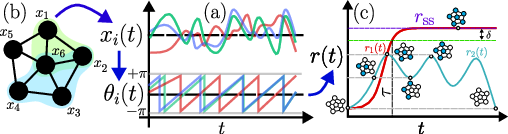
Figure 1: Schematic overview of oscillatory dynamics and network interaction architecture, including pairwise and higher-order connections, and the global order parameter evolution.
The analytical expression for dtdϕi=ωi+Nϵ1j1=1∑Nsin(ϕj1−ϕi)+Ndϵdj1,…,jd=1∑Nsin(dϕjd−k=1∑d−1ϕjk−ϕi)0 is obtained as an integral over the order parameter squared dtdϕi=ωi+Nϵ1j1=1∑Nsin(ϕj1−ϕi)+Ndϵdj1,…,jd=1∑Nsin(dϕjd−k=1∑d−1ϕjk−ϕi)1, which, depending on the values of dtdϕi=ωi+Nϵ1j1=1∑Nsin(ϕj1−ϕi)+Ndϵdj1,…,jd=1∑Nsin(dϕjd−k=1∑d−1ϕjk−ϕi)2 and dtdϕi=ωi+Nϵ1j1=1∑Nsin(ϕj1−ϕi)+Ndϵdj1,…,jd=1∑Nsin(dϕjd−k=1∑d−1ϕjk−ϕi)3, can be simplified and is numerically tractable. Critically, for large dtdϕi=ωi+Nϵ1j1=1∑Nsin(ϕj1−ϕi)+Ndϵdj1,…,jd=1∑Nsin(dϕjd−k=1∑d−1ϕjk−ϕi)4, the FST scales as dtdϕi=ωi+Nϵ1j1=1∑Nsin(ϕj1−ϕi)+Ndϵdj1,…,jd=1∑Nsin(dϕjd−k=1∑d−1ϕjk−ϕi)5, independent of interaction order, while for large dtdϕi=ωi+Nϵ1j1=1∑Nsin(ϕj1−ϕi)+Ndϵdj1,…,jd=1∑Nsin(dϕjd−k=1∑d−1ϕjk−ϕi)6, it asymptotically recovers the pairwise value due to vanishing influence at low dtdϕi=ωi+Nϵ1j1=1∑Nsin(ϕj1−ϕi)+Ndϵdj1,…,jd=1∑Nsin(dϕjd−k=1∑d−1ϕjk−ϕi)7.
Numerical Validation and Parameter Dependence
Validation of the analytical approach is performed on networks of dtdϕi=ωi+Nϵ1j1=1∑Nsin(ϕj1−ϕi)+Ndϵdj1,…,jd=1∑Nsin(dϕjd−k=1∑d−1ϕjk−ϕi)8 oscillators, with detailed time-series and statistical analysis of dtdϕi=ωi+Nϵ1j1=1∑Nsin(ϕj1−ϕi)+Ndϵdj1,…,jd=1∑Nsin(dϕjd−k=1∑d−1ϕjk−ϕi)9, its median trajectory (over multiple realizations), and the theoretical Ott–Antonsen reduction. Robust agreement is established between numerics and theoretical prediction of the FST across diverse regimes.
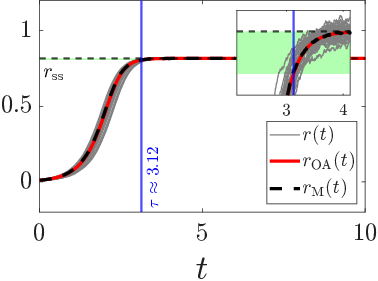
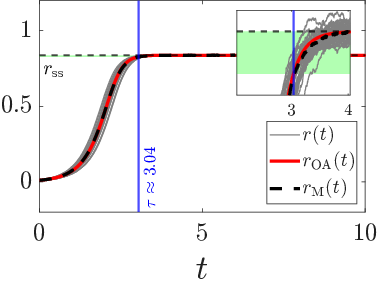
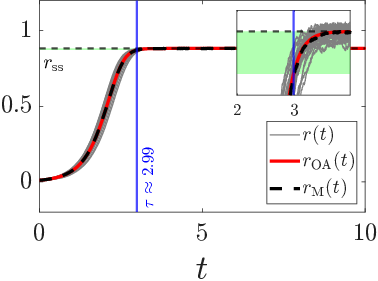
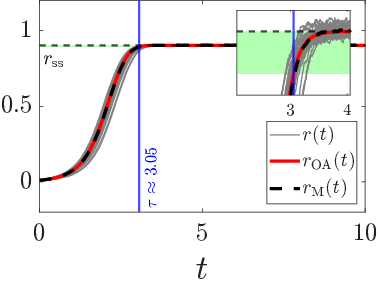
Figure 2: Temporal trajectories of the order parameter for various interaction configurations, depicting convergence to steady-state and FST demarcation.
Varying ϵ10 with fixed higher-order interaction strength shows a monotonic decrease in ϵ11, confirming the ϵ12 scaling. Variation of ϵ13 with fixed ϵ14 is non-monotonic: for low ϵ15, increasing ϵ16 accelerates synchronization, while for high ϵ17, FST becomes insensitive to ϵ18.
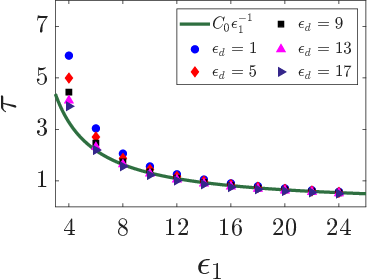
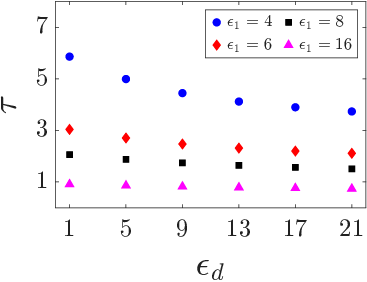
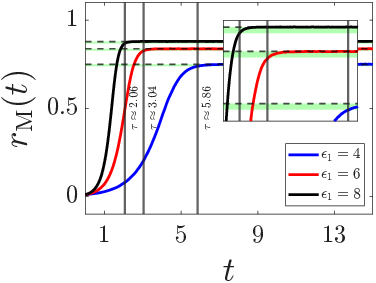
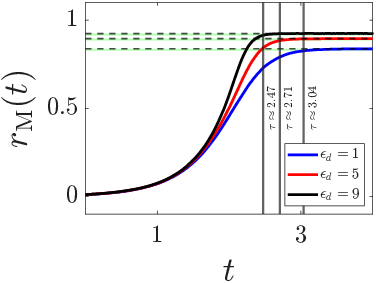
Figure 3: Functional dependence of FST on pairwise and higher-order coupling strengths, confirming theoretical scaling predictions.
The most notable result concerns the dependence on interaction order ϵ19: transitioning from pairwise (ϵd0) to triadic (ϵd1) connectivity yields a faster FST, but further increasing ϵd2 (quartic, pentadic, etc.) imposes a monotonic delay, and for certain parameter combinations, synchronization becomes slower than the pairwise case.
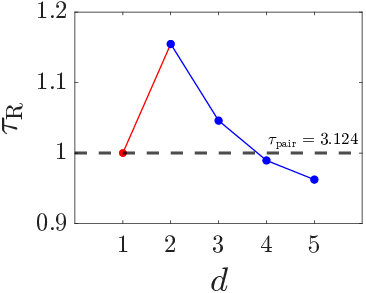
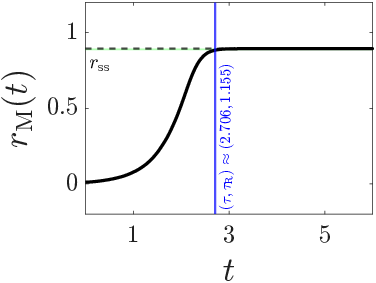
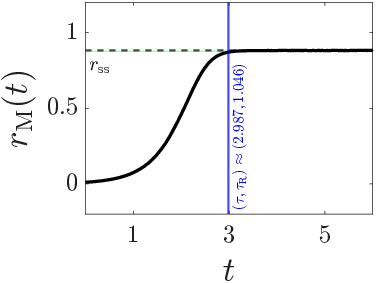
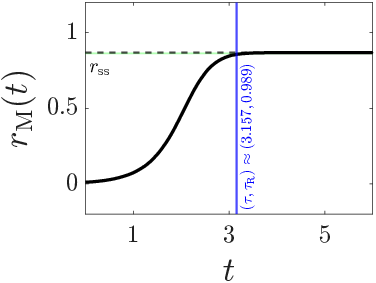
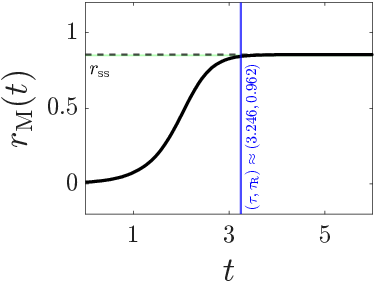
Figure 4: Ratio of FST between higher-order and pairwise cases as interaction order varies, exposing non-monotonic and regime-dependent behavior.
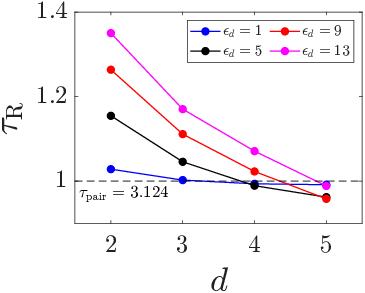
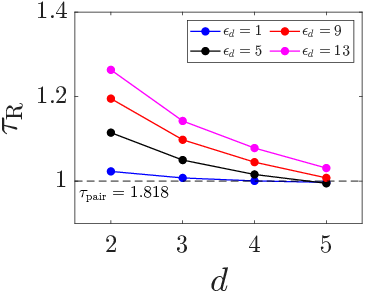
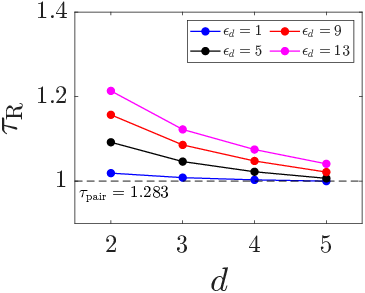
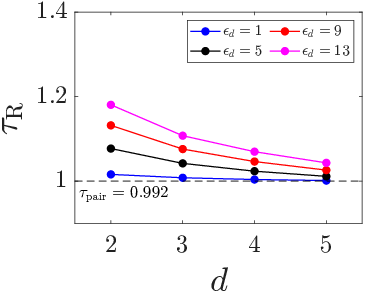
Figure 5: Time evolution of order parameter under various interaction orders, illustrating the crossover between accelerated and delayed synchronization.
Phase Transition Phenomena and Robustness
Beyond transient synchronization, the study quantifies phase transitions in the model. Depending on ϵd3, the network exhibits both continuous and explosive (abrupt) synchronization transitions, with hysteresis and bistable regimes for sufficiently strong higher-order coupling. The steady-state ϵd4 is strongly sensitive to ϵd5, ϵd6, and ϵd7, with explosive transitions characterized by sharp thresholds and hysteresis loops.
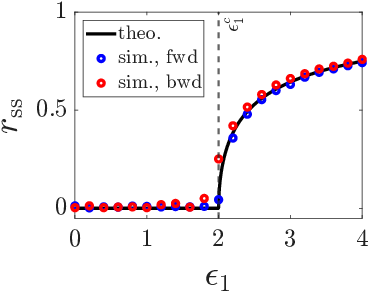
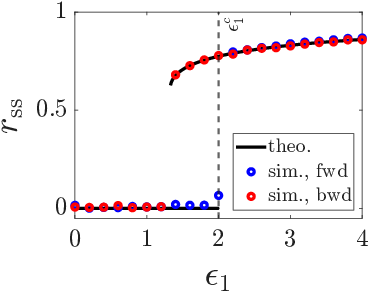
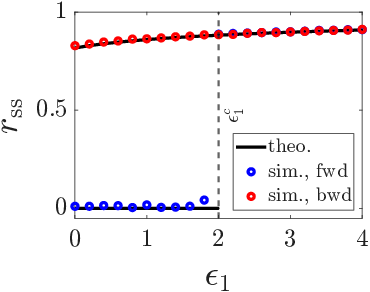
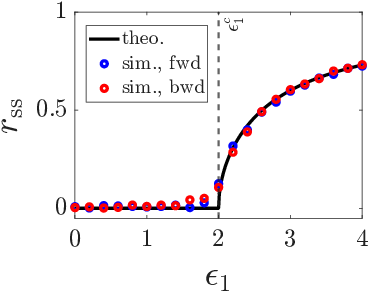
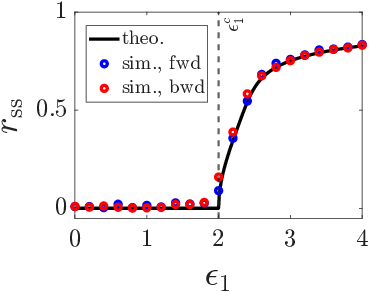
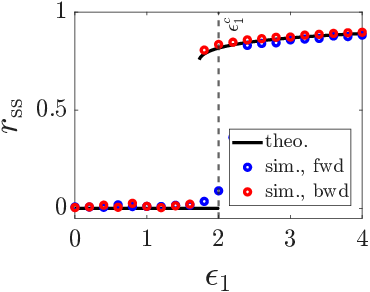
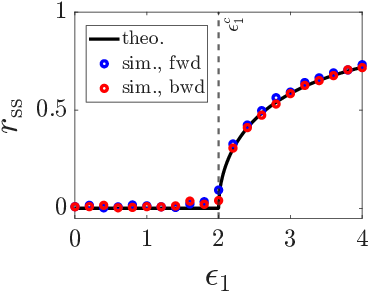
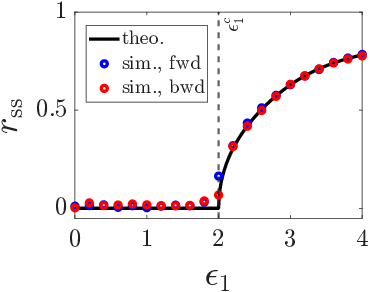
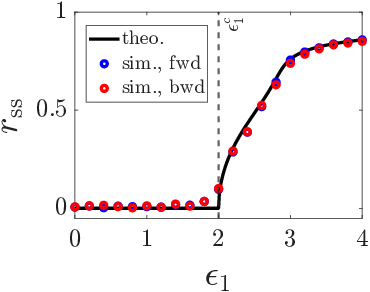
Figure 6: Steady-state order parameter as a function of interaction strength and order, showing critical points and qualitative transition types.
Robustness analysis confirms the qualitative behavior of FST under reasonable variation of initial conditions, confirming analytical predictions even when the initial ϵd8 changes by orders of magnitude.
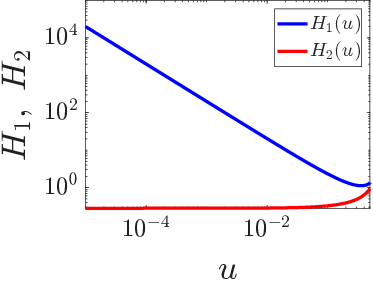
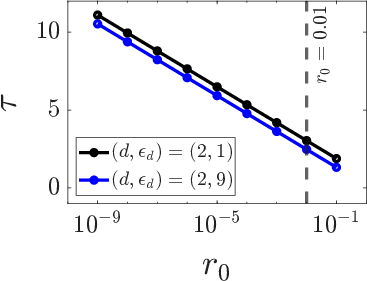
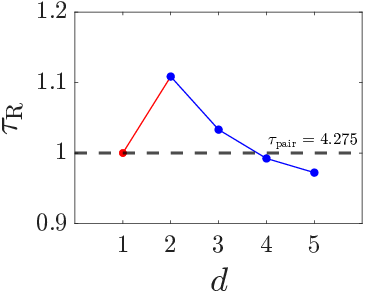
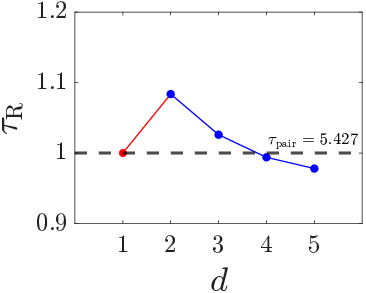
Figure 7: Analytical and numerical integrand behavior underpinning FST calculation and dependence on initial order parameter.
Implications and Future Directions
The findings delineate concrete implications for systems where synchronization speed is a design or pathological concern. Specifically:
- Neural Systems: The results highlight parameter regimes where higher-order synaptic or functional connectivity can accelerate or delay transitions such as seizure onset, supporting mechanistic modeling in epilepsy [jirsa2014nature; bougou2025mesoscale].
- Engineering Networks: The ability to tune interaction order offers algorithmic strategies for controlling swarm synchronization, power-grid stability, and distributed systems, especially when rapid convergence is required [chen2024fast].
- Ecological and Social Dynamics: Higher-order effects are central to community stability and rapid contagion phenomena, and the non-monotonicity in synchronization speed may provide actionable levers in intervention and policy design [grilli2017higher; wang2020social].
- Algorithmic Control: The non-linear and regime-sensitive dependence of FST on interaction order suggests potential for adaptive topologies and control protocols featuring dynamically reconfigurable hyperedges.
Future research may extend this framework to stochastic dynamics, adaptive interaction order, and real-world network topology, moving beyond the mean-field setting considered in this study. Integrating pairwise and higher-order structural motifs, along with external forcing and delays, could yield richer transient dynamics relevant to both biological and artificial systems.
Conclusion
This paper establishes authoritative evidence of the profoundly non-trivial role higher-order interactions play in the transient synchronization dynamics of oscillator networks. The analytical and numerical results show that while increased coupling strength universally shortens the FST, the effect of increasing interaction order is highly regime-dependent and can accelerate or delay synchronization relative to the classic pairwise case. These insights furnish critical guidance for theoretical modeling and practical engineering of networked systems where the timescale of collective behavior is a central concern.