- The paper proposes a minimax adversarial training scheme (RIA) that generates label invariant augmentations to counteract ERM collapse in graph learning.
- It formalizes graph data using a structural causal model that distinctly separates causal and spurious features, ensuring robustness under covariate shifts.
- RIA demonstrates improved out-of-distribution performance, with empirical gains up to 2.7% accuracy on benchmarks like CMNIST and SST2.
Adversarial Label Invariant Graph Data Augmentations for Out-of-Distribution Generalization
Motivation and Background
The paper "Adversarial Label Invariant Graph Data Augmentations for Out-of-Distribution Generalization" (2604.08404) addresses the core problem of out-of-distribution (OoD) generalization in graph-based machine learning under covariate shift. In practical scenarios, the distribution of test data often diverges from the training data due to environment-driven covariate changes, while the underlying concept distribution remains stable. Standard Empirical Risk Minimization (ERM) approaches perform suboptimally in this setting due to their inability to extrapolate beyond the support of the training environments. Existing OoD generalization methods, though theoretically motivated by causality and invariance, frequently collapse to ERM solutions, particularly when the number of distinct training environments is small, which is typical for graph data.
The paper proposes a solution that systematically constructs novel, adversarially hard, but label invariant environments through data augmentation. This process aims to counteract ERM collapse and improve the robustness and generalization of learned representations.
Causal Data Generation Framework for Graphs
The authors formalize graph data as being generated by a Markovian Structural Causal Model (SCM), capturing both causal and spurious factors across heterogeneous environments. Each environment is indexed by an exogenous variable E, which determines both the topology and node attributes of graphs through distinct causal (XC,AC) and spurious (XS,AS) components. These are joined (e.g., concatenation for features, additive mask for adjacency) to form the observed graph. The ground-truth label is a deterministic function applied to the causal subgraph only, ensuring that interventions solely on the spurious components leave the label unchanged.

Figure 1: (a) Causal graph depicting environment-indexed data generation, (b) Attributed graph showing concatenation of causal/spurious attributes and edges.
This construction explicitly separates variation relevant for the prediction task (causal) from confounders or shortcuts (spurious), and enables rigorous reasoning about invariance and interventions for label-invariant data augmentation.
Adversarial Label Invariant Data Augmentation
To circumvent ERM collapse, the method adversarially generates novel environments by augmenting only the spurious components, carefully maintaining label invariance. Specifically, the paper defines label invariant augmentations as any transformation a applied to the data for which f(a(X))=f(X) holds with respect to the ground-truth labeling function f. For graph-structured data, this can be operationalized by masking or perturbing spurious node features or edges, guided by the causal model.
The key technical innovation is to search for data augmentations that maximize the learner's loss (adversarial), while ensuring the label is unchanged, effectively simulating hard counterfactual distributions within the space of plausible (but unobserved) test environments.
The RIA Algorithm: Minimax Optimization for OoD Robustness
The proposed Regularization for Invariance with Adversarial training (RIA) algorithm formulates a minimax game: The loss is minimized over the learner parameters and maximized over a distribution of label-invariant data augmentations. The maximization seeks adversarial augmentations that are label invariant but maximally degrade current model performance, thereby preventing the model from overfitting to training support and encouraging the development of invariant features.
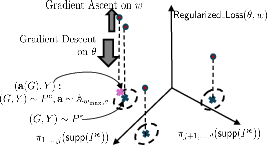
Figure 2: Geometric view of the RIA minimax optimization landscape, showing alternation between search for maximally hard augmentations and learner optimization.
Practically, RIA alternates stochastic gradient ascent on augmentation parameters (implemented as a mask generator GNN) and gradient descent on model parameters, with a joint regularization that can encompass existing OoD generalization penalties (e.g., IRM, VREx, RICE losses).
Empirical Verification and Analysis
Empirical evaluation is provided on both synthetic and real-world datasets (e.g., CMNIST, SST2, Motif, AMotif, synthetic additive spurious attribute graphs), benchmarking RIA against baselines such as ERM, IRM, VREx, RICE, and augmentation methods like Mixup and DropEdge. The datasets are designed to manifest covariate shifts via perturbations in structural/topological or feature-based spurious attributes while holding the causal relationship fixed.
Numerical results indicate that RIA systematically achieves top or near-top OoD test accuracy across domains, especially excelling on covariate shift benchmarks where other invariant methods collapse to ERM-like solutions. The ablation studies demonstrate that RIA can enhance the generalization of any underlying invariant objective by escaping ERM solutions, with improvements up to 2.7% accuracy on select datasets.
A critical experimental result is the direct visualization of the ERM collapse effect: IRM and VREx closely track ERM and fail to penalize spurious correlations when training environments lack diversity, while RIA-optimized variants diverge from this failure mode, dramatically reducing OoD test error.
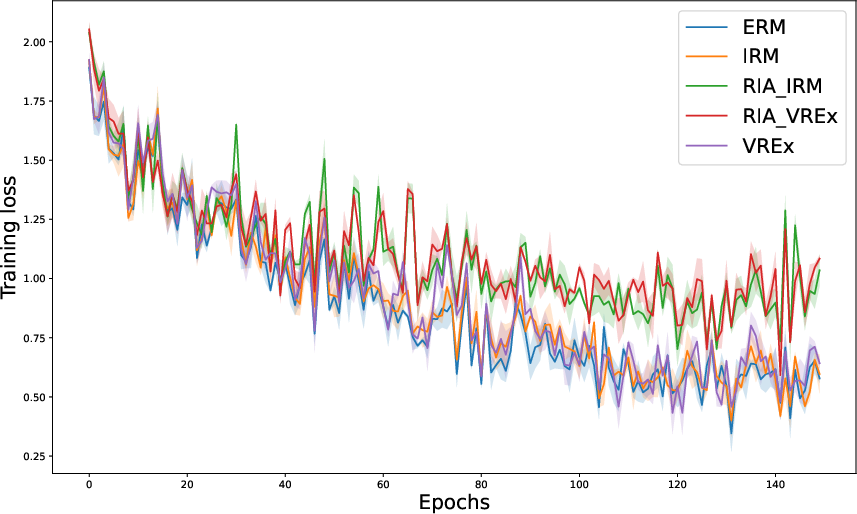
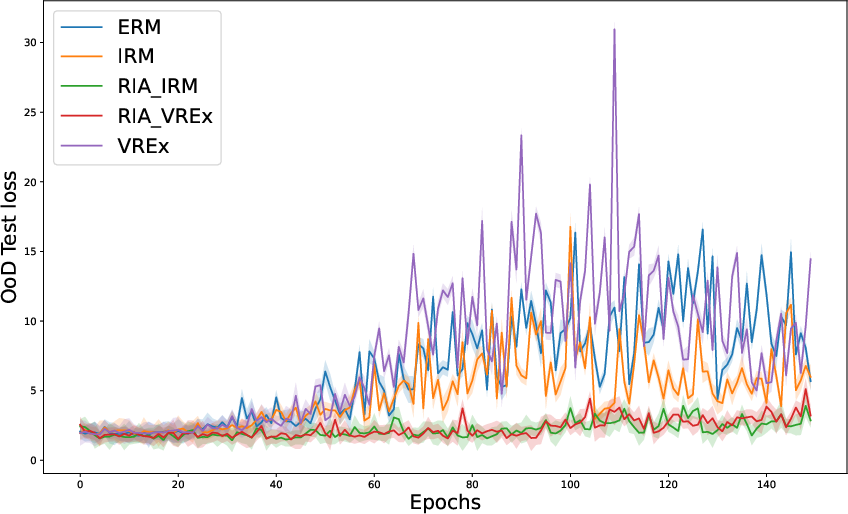
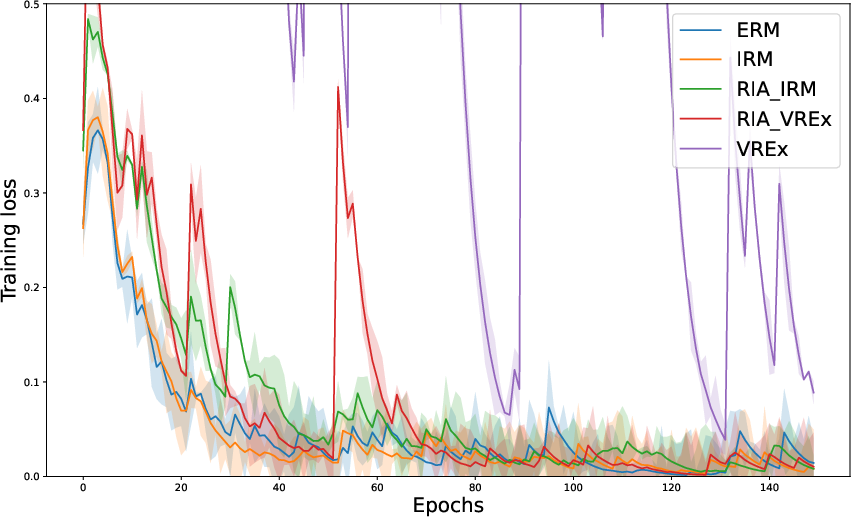
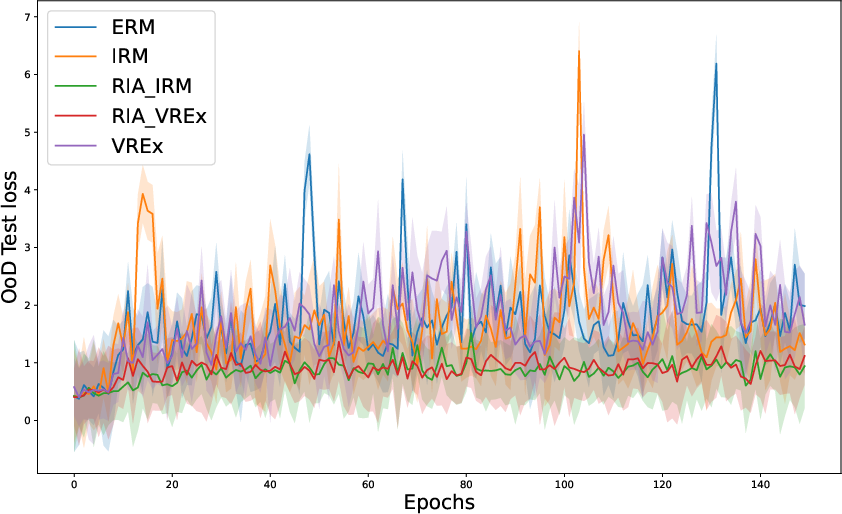
Figure 3: RIA prevents ERM collapse, leading to improved OoD loss on CMNIST and SST2 compared to constrained optimization methods (IRM, VREx).
Theoretical Implications
The formulation of RIA as a minimax problem over all possible label-invariant augmentations, constrained by the SCM, ensures that the solution is robust to worst-case environment shifts not represented in the training set. The paper proves that the risk under RIA always upper bounds the ERM and constrained invariant risk, explicitly demonstrating the escape from ERM collapse. The geometric interpretation and Q-learning analogy further clarify how adversarial exploration in the augmentation space facilitates robustness.
Practical and Future Implications
RIA is highly generalizable due to its black-box nature: the only requirement on augmentations is label invariance. While demonstrated on graphs, the method extends naturally to other domains (e.g., images, text—if one can disentangle causal/spurious sources). The approach requires only an efficient approximation to the maximization over augmentations, typically implemented via learned stochastic masks. The authors note challenges regarding selecting the diversity and magnitude of augmentations to avoid over-correction, highlighting directions for hyperparameter tuning and potential for adaptive regularization/augmentation schedules.
Theoretically, RIA reaffirms the necessity of adversarial interventions to probe the true invariance of learned predictors, contributing to the ongoing dialogue regarding the sufficiency of current invariant learning methods for real-world OoD robustness. Practically, such strategies are essential for deploying reliable graph-based systems in domains where distribution shift is prevalent and the costs of test-time failure are high (e.g., biomedical, financial networks).
Conclusion
The paper introduces a principled algorithm for generating adversarial, label-invariant augmentations in graph data, rigorously preventing ERM collapse and substantially improving OoD generalization. By formalizing the causal structure and leveraging minimax optimization, it advances both the theoretical understanding and practical toolkit for robust graph representation learning, with strong implications for generalization theory and real-world deployment under distribution shift.