- The paper proposes a constructive heuristic that leverages lexicographic priorities and capability scarcity to optimize spontaneous volunteer assignments.
- It employs rules based on priority, time, and workload to achieve near-optimal task coverage with median optimality gaps ≤1% and 3% for primary objectives.
- The approach delivers a 28× runtime speedup over exact MIP models, enabling its use in real-time disaster response operations.
Priority-Driven Constructive Heuristic for Spontaneous Volunteer Assignment in Disaster Response
Introduction and Problem Context
The coordination of spontaneous volunteers (SVs) in large-scale disaster response operations presents a workforce assignment and scheduling problem characterized by pronounced uncertainty, operational constraints, and lexicographically ordered priorities. Unlike affiliated volunteers, SVs arrive independently, possess heterogeneous capabilities, and exhibit unpredictable availability. The integration and assignment of SVs must respect strict operational constraints on compatibility, working time, precedence, and spatial considerations, while prioritizing high-urgency tasks under severe time pressure.
The paper addresses the Spontaneous Volunteer Coordination Problem (SVCP) by exploiting its structure—specifically, lexicographic priorities, capability scarcity, and workload balancing—through the development of a highly scalable constructive heuristic. This approach is motivated by the computational intractability of solving large-scale, rolling-horizon mixed-integer programming (MIP) models in dynamic disaster environments. The proposed method is rigorously evaluated on empirically grounded scenarios derived from historical disaster events, with a focus on real-time applicability.
The SVCP is modeled as a lexicographically ordered multi-objective MIP. The decision variables describe assignments of SVs to activities over discrete time periods, subject to availability, skill compatibility, and operational constraints. The objectives, evaluated in lex order, reflect operational priorities:
- Maximizing assignments to the highest-priority tasks.
- Maximizing time-weighted coverage of activities, prioritizing early intervention.
- Minimizing inter- and intra-priority workload imbalances to promote equitable resource allocation.
The constraints encode single-assignment per time slot, assignment stability, travel/setup durations, minimum and maximum working durations, compatibility, and non-preemption. Capability scarcity is quantified, and balancing factors enforce required workload ratios across prioritized classes.
Heuristic Design and Algorithmic Architecture
The proposed priority-driven constructive heuristic encapsulates the SVCP model structure in an efficient decision pipeline, as shown in Figure 1.
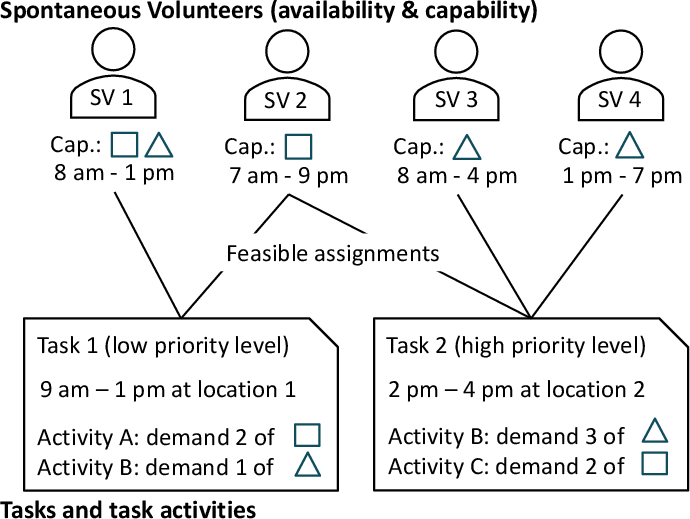
Figure 1: Illustrative example of the spontaneous volunteer coordination problem, showing capabilities, time windows, and task priorities.
The algorithm proceeds iteratively, exploiting:
- Priority Rule: Restricts assignment focus to the highest active priority class, guaranteeing lexicographic preservation of operational urgency.
- Time Rule: Within the top class, selects activity-time pairs with the earliest feasible time slot, thus favoring early-stage coverage.
- Workload Rule: Among eligible activities, picks those with the minimal weighted workload, ensuring convergence towards target workload ratios and workload balancing.
- Scarcity Preprocessing: Volunteers are pre-sorted by a capability scarcity score, emphasizing the preservation of rare capabilities for critical activities.
Candidate assignments are validated through efficient feasibility checks encompassing all temporal, spatial, and capability constraints, and maximal contiguous feasible intervals are determined. The process repeats until all activity-time demands are either met or infeasible.
Computational Study and Results
The heuristic is benchmarked against state-of-the-art exact MIP optimization, solved with Gurobi under a rolling-horizon paradigm. The evaluation leverages a large-scale, stochastic scenario suite with up to 10,000 SVs, 4,000+ activity–time pairs, and dynamic arrivals over 24–33 hour scenarios.
Key performance metrics include:
- Solution Quality: For primary lexicographic objectives (priority coverage and time-weighted coverage), median relative optimality gaps are ≤1% and ≤3%, respectively, across 3,200 instances, as evidenced in Figure 2.

Figure 2: Median relative gaps for primary objectives across 3,200 simulated SVCP instances, highlighting high-fidelity approximation by the heuristic.
- Workload Balancing: Gap magnitudes for workload objectives are larger, particularly in early rolling-horizon instances where feasible assignment regions are tightly constrained. However, gaps diminish as the scenario advances and pool size grows.
- Runtime and Scalability: The heuristic demonstrates a median speedup of 28× over the exact approach (Figure 3), and never exceeds the operational 30-minute decision limit, even as the MIP solver routinely violates operational time constraints in >60% of instances.
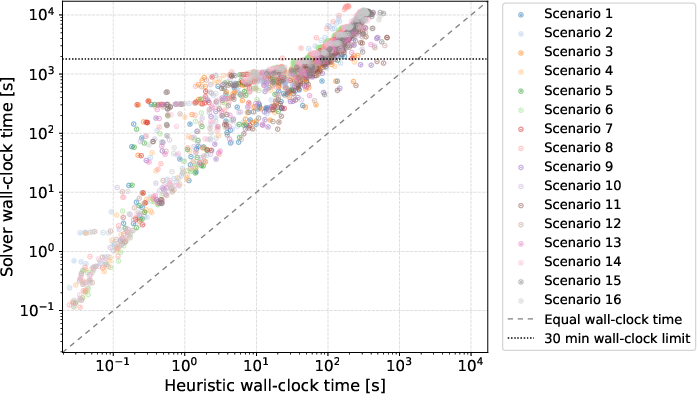
Figure 3: Runtime comparison (seconds, log scale) between the exact optimization and heuristic; heuristic always executes within operational limits.
- Runtime–Quality Trade-Off: For the main workload balancing objective, most instances show relative quality losses <20% at sub-4-minute runtimes, as summarized in Figure 4.
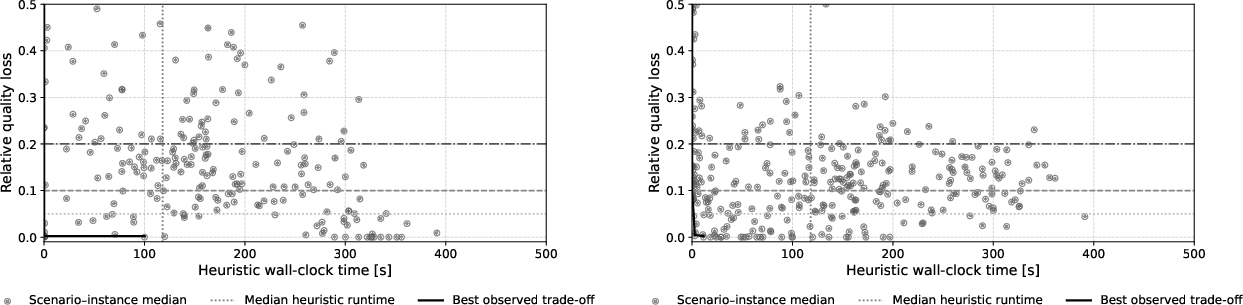
Figure 4: Pareto frontier of runtime–quality trade-off for workload balancing (Objective 3) among scenario–instance pairs.
Algorithmic and Practical Implications
The experimental results reveal several critical insights:
- Lexicographic priorities and capability scarcity can be efficiently harnessed to drastically reduce computational overhead without sacrificing performance on operationally critical objectives.
- Workload balancing is more sensitive to assignment space flexibility, but the heuristic rapidly adapts as SV pools expand.
- Scalability is dominated by linear factors in the number of SVs and activity–time combinations, in line with theoretical analysis. The heuristic is well-suited for deployment in rolling-horizon, real-time support systems.
- The operational relevance extends directly to crisis operations where computational resources and decision windows are severely constrained, and repeated large-scale re-optimization is infeasible.
Theoretical Advances and Prospects for AI-Driven Disaster Planning
This research establishes that constructive, structure-aware heuristics can preserve high-priority operational performance in complex, resource-constrained scheduling domains where combinatorial explosion renders exact methods impractical. The explicit integration of lexicographic priorities and scarcity measures supplies a universal paradigm for other hierarchical multi-resource assignment problems. The method's design—embedding multi-objective structures directly into construction heuristics—resonates with anticipated AI trends toward modular, interpretable, and rapidly reconfigurable decision modules for dynamic environments.
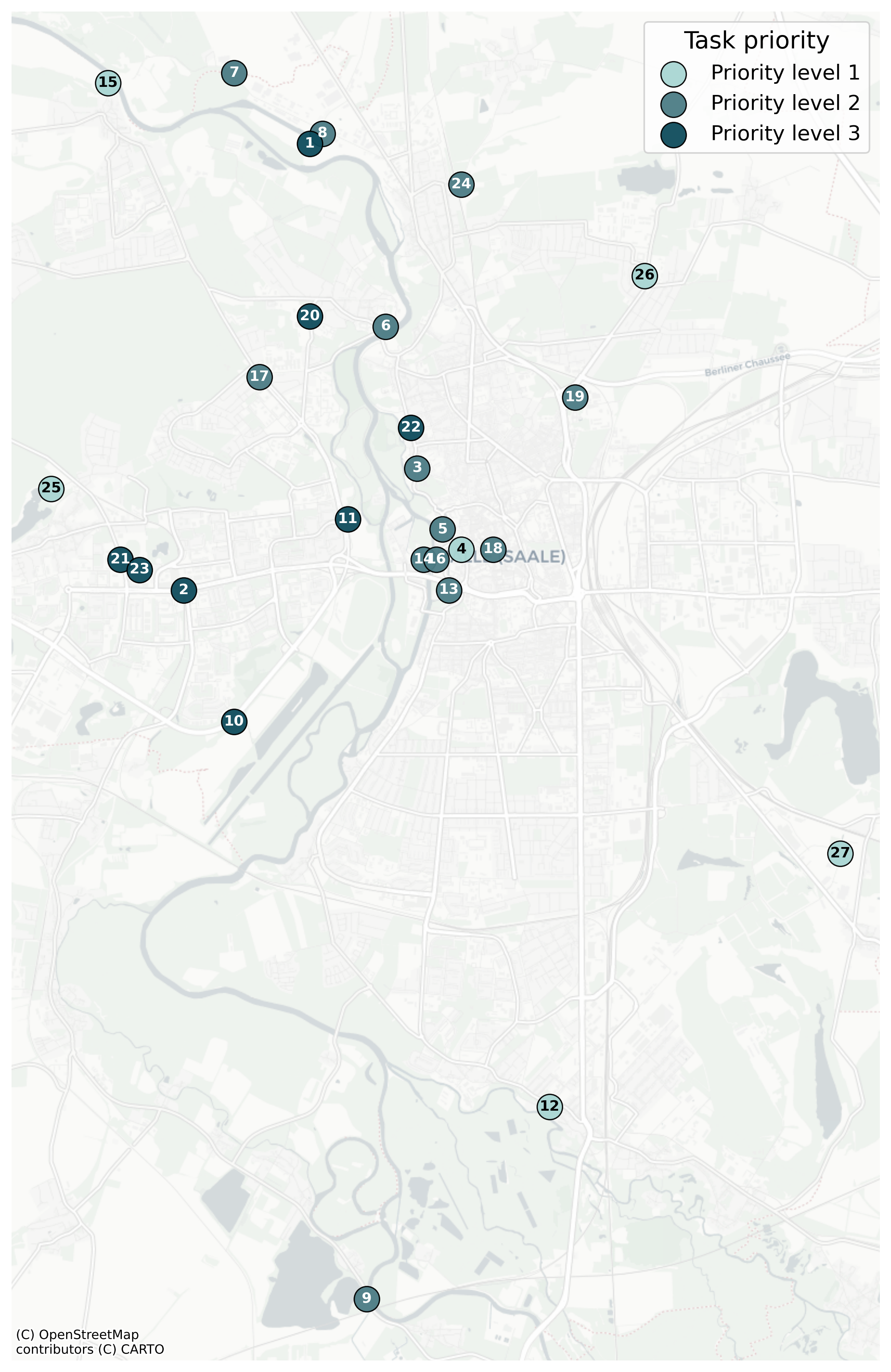
Figure 5: Spatial distribution of tasks with color-coded priority, demonstrating the complexity of spatial, temporal, and workload balancing constraints in SVCP instances.
Future extensions should encompass multi-coordinator systems, decentralized optimization, hybrid (metaheuristic–exact) strategies, and online learning-augmented assignment, with explicit stochastic treatment for arrivals and uncertain operational demands. Distributed decision architectures and federated heuristic improvements are promising avenues—especially as real-time disaster support infrastructure becomes increasingly digitized and interoperable.
Conclusion
The paper demonstrates that a problem-specific, priority-driven constructive heuristic, which exploits lexicographic order and resource scarcity, achieves near-optimal performance on critical objectives at a fraction of the computational cost of state-of-the-art optimization. The results advocate for the deployment of structure-exploiting heuristics as real-time decision support in dynamically evolving, large-scale disaster response operations, and suggest future hybridizations with learning and decentralized protocols for further gains in scalability and robustness.
Reference:
"A priority-driven constructive heuristic for assigning and scheduling spontaneous volunteers in disaster response" (2604.09218)