- The paper demonstrates that reducing thermal lattice fluctuations strongly enhances HHG yield by mitigating phonon-induced electron decoherence.
- The methodology combines temperature-dependent experiments with first-principles DFT and semiconductor Bloch simulations to quantify ultrafast dephasing times.
- The study reports that the 11th harmonic yield drops to 25% at 140 K, directly linking phonon populations to femtosecond electron coherence loss.
Probing Lattice Fluctuations via Solid-State High-Harmonic Spectroscopy
Introduction
Solid-state high-harmonic generation (HHG) has evolved into a powerful probe for ultrafast electron dynamics, providing access to strong-field driven carrier processes in crystalline solids. Unlike the gas-phase, the solid-state HHG process is inherently influenced by a structured, many-body background – in particular, the lattice and its collective vibrations. While prior HHG studies have addressed carrier scattering, phase transitions, and topological phenomena, the explicit influence of thermal lattice fluctuations has remained unresolved. The work "Probing lattice fluctuations using solid-state high-harmonic spectroscopy" (2604.10304) directly investigates this by leveraging Re6Se8Cl2 superatomic semiconductors, which facilitate systematic control over lattice fluctuations due to their well-behaved low-energy phonon modes and absence of structural phase transitions across broad temperature ranges. Through a combination of temperature-dependent HHG measurements and first-principles theory, the study elucidates the direct impact of thermal lattice fluctuations and associated electronic dephasing on the coherent emission of high harmonics.
The choice of Re6Se8Cl2 is pivotal, as its superatomic layered architecture supports pronounced and tunable lattice fluctuations at energies relevant to ultrafast electronics. The material consists of van der Waals-coupled layers built from Re6-centered clusters encapsulated in an Se80 cube, the clusters being covalently bonded in-plane and terminated with Cl out-of-plane, leading to robust, thermally-driven collective phononic dynamics.
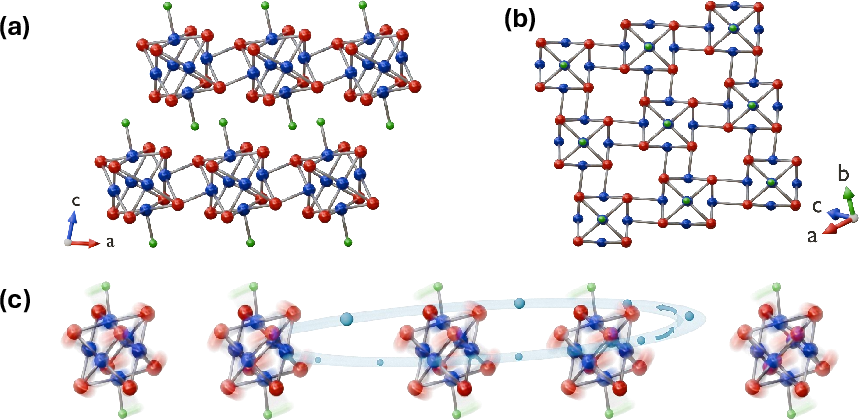
Figure 1: Crystal structure and thermal lattice fluctuations in Re81Se82Cl83; dynamic disorder from lattice vibrations directly impacts laser-driven electrons and their HHG response.
At room temperature, the strong population of optical phonons produces significant atomic-scale disturbances, which scatter traversing electron-hole pairs excited by an intense laser field. Upon cooling, these phonons are depopulated sequentially based on their energy, ultimately resulting in a regime where lattice dynamical disorder is largely quenched.
Experimental Probing of Thermal Lattice Fluctuations via HHG
By subjecting Re84Se85Cl86 to mid-infrared HHG experiments across 7–280 K, the study demonstrates a highly nonlinear sensitivity of the harmonic yield to temperature. Four notable observations emerge:
- Monotonic enhancement of harmonics on cooling: All measured high harmonics from 5th to 11th order show an increasing yield as temperature decreases.
- Abrupt intensity upturn: Below 8750 K, an abrupt increase is seen in the harmonic yield, coinciding with the near-complete depopulation of low-energy optical phonons.
- Higher-order harmonics exhibit stronger sensitivity: The magnitude of yield enhancement at low temperature grows with harmonic order, consistent with increased sensitivity of extended carrier trajectories to lattice disorder.
- Yield increase is decoupled from bandgap changes and absorption: Changes in reflection and bandgap at low temperature are ruled out as primary causes, directly implicating reduced lattice scattering.
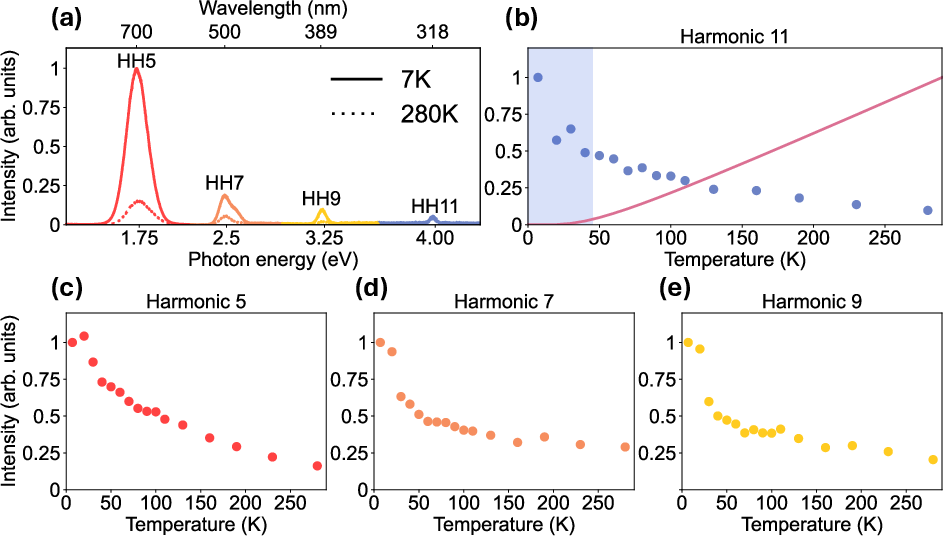
Figure 2: The high-harmonic response in Re88Se89Cl20 exhibits an abrupt increase as thermal population of representative optical phonons vanishes; higher orders show stronger effects.
The close correspondence between the phonon depopulation (as calculated for a representative 2.6 THz optical phonon) and the upturn in HHG argues for a phonon-mediated decoherence mechanism that dominates over other possible dephasing channels.
First-Principles Theory: Connection to Electronic Dephasing
To interrogate the microscopic origin of temperature-dependent HHG, the study employs ab initio DFT calculations for ground-state bandstructure and momenta, integrating these into time-dependent semiconductor Bloch equation (SBE) simulations. Statistically sampled lattice configurations, generated via displacements along the relevant low-energy optical phonon eigenvectors, model the effect of incoherent thermal phonons.
This approach justifies "frozen-phonon" sampling given the time-scale separation between electron dynamics and phonon motion. Ensemble averaging is critical, as lattice-induced phase noise generates partial destructive interference, strongly attenuating the coherent HHG output.
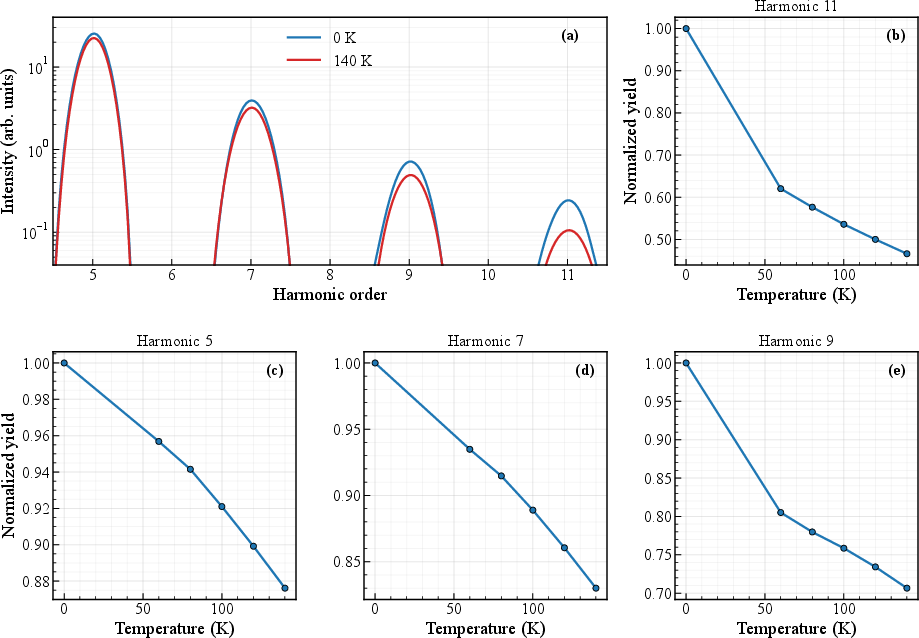
Figure 3: Theoretical calculations confirm the experimental suppression of high-harmonic yields at elevated temperatures; ensemble decoherence dominates the trend.
The theory quantitatively mirrors the experimental trend: higher temperatures (equivalent to larger phonon amplitudes and greater lattice disorder) result in a monotonic suppression of all high harmonics, with the strongest effect for the highest orders. Critically, the comparison demonstrates that the impact of thermal fluctuations is best described by an effective, temperature-dependent electronic dephasing time 21.
Quantification and Implications of Thermal Dephasing
Phenomenological exploration of the SBE simulations with variable 22 in the absence of lattice distortions directly links the decrease in HHG yield at high temperature to a faster dephasing rate 23. The work determines that at 140 K the 11th harmonic yield drops to 25% of its low-T value, corresponding to 24 fs, while at 25 K, 26 extends to 27 20 fs. This constitutes a direct, quantifiable mapping between phonon-induced lattice disorder and ultrafast loss of electron-hole coherence.
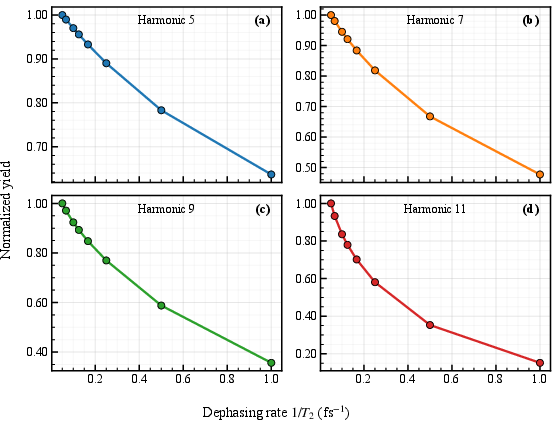
Figure 4: High-harmonic output is highly sensitive to changes in the electronic dephasing rate, especially for higher-order harmonics, confirming the decoherence mechanism.
The study makes a critical claim: the effective dephasing times commonly introduced on phenomenological grounds in theoretical descriptions of solid-state HHG can be physically attributed, in strongly coupled materials, to thermal lattice fluctuations—even at modestly low temperatures. This stands in contrast to previous assumptions in which electron-electron scattering was presumed dominant and often invoked in the absence of direct evidence.
Broader Impact and Future Applications
The results here establish a clear, quantifiable link between ultrafast electronic decoherence and thermal phonon populations in solids. This connection holds considerable ramifications:
- Ultrafast optical control: By manipulating temperature or lattice fluctuations (via strain or coherent phonon excitation), the dephasing landscape and, correspondingly, the nonlinear light-matter response can be engineered.
- Materials design for strong-field physics: As superatomic crystals offer extensive tunability of their vibrational spectra through atomic substitution and cluster design, they provide a materials-science pathway to control dephasing rates and HHG efficiency for next-generation optoelectronic and lightwave electronic devices.
- All-optical ultrafast probes of decoherence: The demonstrated sensitivity of HHG to thermally-driven disorder enables new spectroscopic techniques to access nonequilibrium lattice dynamics and carrier-phonon coupling in condensed matter.
Anticipated future directions include the real-time measurement of few-femtosecond 28 using advanced attosecond or multi-dimensional HHG spectroscopy, extension to low-dimensional and topological systems, and quantitative mapping of dephasing contributions from other many-body interactions.
Conclusion
This work advances the field of solid-state strong-field spectroscopy by explicitly connecting the efficiency of coherent HHG in Re29Se60Cl61 to thermal lattice fluctuations and associated dephasing. Through comprehensive experimental and theoretical approaches, the study establishes that the dominant source of femtosecond electronic decoherence at finite temperature is scattering from thermally occupied phonons. The reconstructed temperature-dependent 62 values bridge the gap between empirical phenomenology and physical origin of dephasing in HHG theory. Looking forward, this insight opens new strategies for engineering ultrafast electron dynamics and coherent light-matter interactions in complex materials by active control of their vibrational environments.