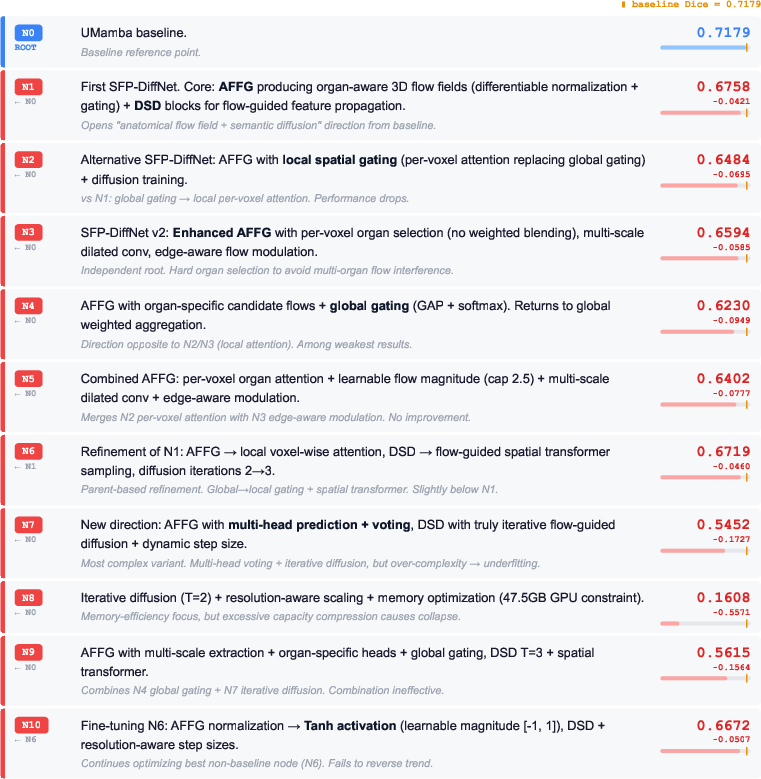
- The paper demonstrates that autonomous, domain-scale research in medical image segmentation is achievable using Camyla’s integrated QWBE, LRM, and DDF mechanisms.
- It employs a modular pipeline with CamylaNet, targeted proposal generation, and ablation studies, yielding a mean Dice improvement of +1.89 pp and a 77.4% success rate.
- The study addresses challenges such as proposal drift and context overload, establishing a scalable blueprint for autonomous research in complex scientific domains.
Autonomous Medical Imaging Research with Camyla: Achieving Domain-Scale Zero-Intervention Experimentation
Introduction and Motivation
The work "Camyla: Scaling Autonomous Research in Medical Image Segmentation" (2604.10696) addresses the core challenge of moving from narrow, prompt-driven automated model selection (AutoML/NAS) to fully autonomous, domain-wide scientific research in medical image segmentation. Camyla is designed as a system that autonomously generates literature-grounded research proposals, implements experiments, performs ablation studies, and synthesizes complete manuscripts—all with strict zero human intervention, at the scale of 31 diverse datasets.
Key issues in existing agent frameworks include proposal drift, knowledge retention degradation, and incremental-fix traps—failure patterns well-documented in prior agentic research environments. Camyla's architecture is structured to mitigate these via three coupled mechanisms: Quality-Weighted Branch Exploration (QWBE), Layered Reflective Memory (LRM), and Divergent Diagnostic Feedback (DDF). Evaluation is performed on CamylaBench, a curated contamination-free benchmark drawn from datasets only publicly released in 2025, ensuring the absence of memorization or overfitting.
System Architecture and Methodological Innovations
Camyla's pipeline (Figure 1 in the original text) comprises four main stages: baseline establishment, experimental discovery, ablation verification, and automated manuscript generation. The orchestration is strictly modular, leveraging domain-specific infrastructure:
- CamylaNet: Provides a minimal agent-executable three-function interface for medical image segmentation, abstracting data preparation, training, and evaluation while allowing the agent to define arbitrary architectures. This decouples infrastructure from scientific innovation, central to enabling open-ended discovery.
- Proposal Generation: Camyla utilizes multi-agent reasoning to extract unresolved architectural challenges from recent literature, with thematic diversity enforced via negative constraint lists and a best-of-N tournament for proposal selection. Proposals are grounded, non-generic, and encode the integration plan, module definitions, and anticipated contributions.
- Coupled Long-Horizon Mechanisms:
Quantitative Benchmarks and Empirical Outcomes
Camyla's evaluation spanned two independent full-benchmark runs (one with DeepSeek V3.2, one with Claude Sonnet 4.6 for proposal generation). Key metrics and claims include:
- Success Rate: Camyla exceeded the best tuned baseline (including nnU-Net, U-Mamba, STU-Net) on 22/31 and 18/31 datasets respectively. The union of both runs covers 24/31 (77.4%), with 100% pipeline completion and zero proposal drift. Both claim statistical significance (binomial, p<0.015 for the stronger run).
- Aggregate Performance: Mean Dice improvement is +1.89 pp over baseline (DeepSeek run), with improvements on both volumetric (3D) and 2D imaging tasks.
- Comparison to Automated Baselines: Camyla outperforms AutoNNUNet, DiNTS, and AutoSeg3D on aggregate Dice and, crucially, demonstrates the ability to generate non-trivial architectural innovations not contained in the search space of conventional NAS/AutoML solutions.
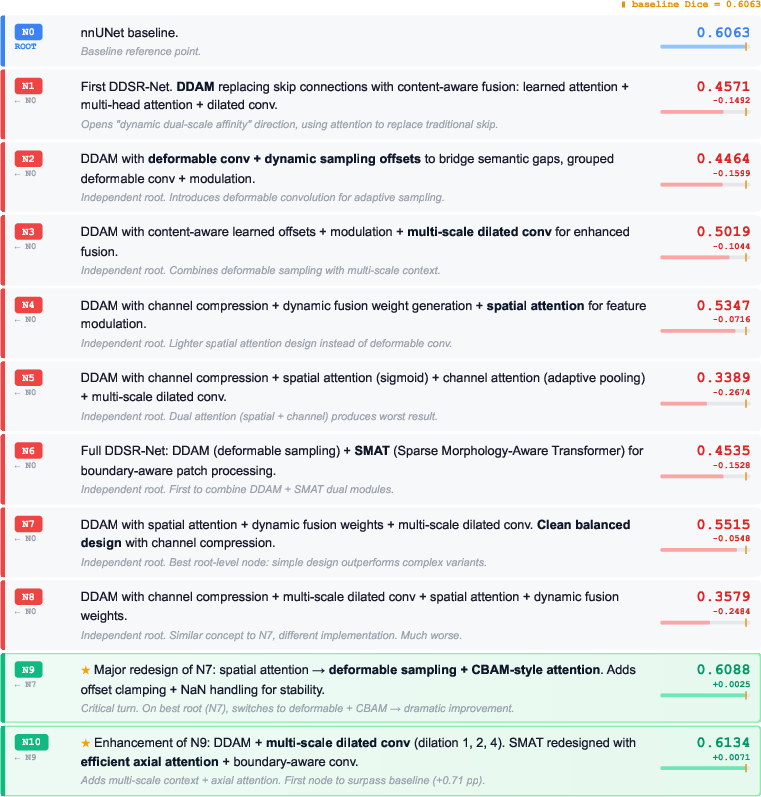
Figure 4: Trajectory for Dataset 3 (PNPC, Proposal 2: DDSR-Net)—after eight root DDAM branches all fail, QWBE shifts resource allocation. N9's architectural pivot yields the first baseline-surpassing result; continued refinement in N10 demonstrates focused exploitation enabled by QWBE and DDF.
- Agent Baselines: Camyla greatly exceeds open-ended research agents (autoresearch, AI Scientist) in both task completion and win rate. These agents exhibit 46–69% completion rates and high proposal drift ratios, underlying the necessity for domain-specific infrastructure.
- Manuscript Quality: Generated manuscripts are reviewed (by human experts, AI, and full-manuscript agentic review). Senior reviewers rate Camyla's manuscripts at the T1/T2 venue threshold; model raters score them on par with top-tier (T1) publications.
Analysis of Search Dynamics and Failure Cases
Camyla's ablation studies precisely delineate the function of each core mechanism:
- QWBE: Removal results in wasted computational cycles on poor branches and delayed first successes.
- LRM: Eliminating context compression sharply reduces cycle-over-cycle improvement and impairs the system’s ability to transfer high-level experimental knowledge.
- DDF: Reverting to single-point feedback inhibits escape from incremental-fix traps and local optima, evidenced by trajectory regressions in datasets requiring non-trivial architectural pivots.
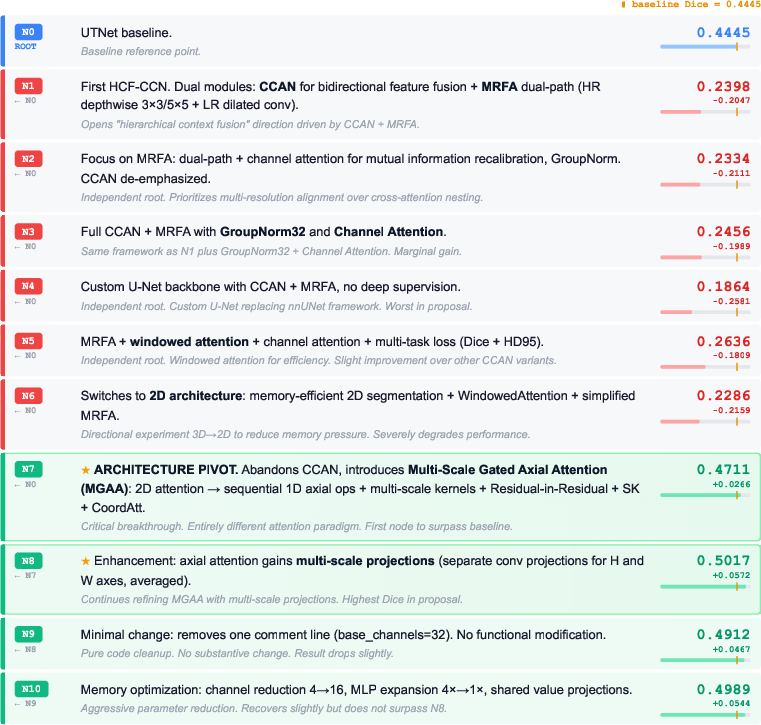
Figure 6: For Dataset 9 (BTXRD), DDF triggers a shift to multi-scale gated axial attention (MGAA), producing a step-change in Dice and boundary accuracy—a non-incremental architectural discovery that exemplifies the theoretical value of diagnostic diversity.
Failure analysis highlights two systemic limits: (1) persisting strong baselines with little improvement headroom (e.g., Dataset 13, 96.2% baseline Dice), and (2) multiclass tasks with high heterogeneity obstruct uniform architectural improvements (Dataset 2, MRE-BSA).
Theoretical and Practical Implications
Camyla demonstrates that domain-specific research infrastructure (e.g., CamylaNet-style functionally minimal, robust execution substrates) is as critical as LLM capability for field-scale autonomous research. The system's approach directly counters the brittleness and unreliability of vanilla LLM-agent research paradigms, establishing that agent completion rate and proposal fidelity can reach 100% when the search and feedback protocols are properly engineered.
The introduction and public release of CamylaTrace-232k enables reproducible study of agent-driven code evolution, incorporating over 230,000 timestamped events, and provides a foundation for future benchmarks of iterative scientific reasoning in agentic frameworks.
Theoretically, the explicit coupling of QWBE and DDF provides a blueprint transferrable to other domains where agentic search faces combinatorial explosion and local minima, as in de novo materials discovery or automated theorem proving.
Future Directions
Major next steps indicated in the work include:
- Extension to other scientific domains with mature, stable infrastructure (e.g., molecular design, reinforcement learning), with the hypothesis that the three-pronged orchestration structure generalizes.
- Expansion beyond LLM coding limitations to permit lower-level system interventions (e.g., custom CUDA kernels, non-standard loss implementations), potentially leveraging multi-agent code synthesis cascades and toolformer-style approaches.
- Strengthening manuscript evaluation towards proxy metrics more tightly correlated with genuine field impact, including acceptance in open peer-driven venues and domain-specific reproducibility challenges.
Conclusion
Camyla constitutes a significant advance towards true autonomous, domain-scale scientific research in medical image analysis. The integration of quality-aware resource allocation, reflective context management, and maximally diverse diagnostic feedback surpasses the methodological limitations of prior agentic and search-based automation. The resulting claim—that domain-scale autonomous research is achievable with current infrastructure and LLM capabilities, provided the correct orchestration design is applied—is robustly substantiated by the empirical and qualitative evidence presented.
The central methodological design—coupling QWBE, LRM, and DDF within a standardized, reliable computational substrate—establishes a template for scalable, reproducible, and robust autonomous scientific discovery, extensible to other complex research domains as domain-specific infrastructures mature.