Last Iterate Convergence of AdaGrad-Norm for Convex Non-Smooth Optimization
Published 12 Apr 2026 in math.OC | (2604.10728v1)
Abstract: We study the convergence of the last iterate (i.e., the $(N+1)$-th iterate) of the AdaGrad method. Although AdaGrad -- an adaptive subgradient method -- underpins a wide class of algorithms, most existing convergence analyses focus on averaged (or best) iterates. We derive worst-case upper bounds on the suboptimality of the final point and show that, with an optimally tuned stepsize parameter, the last iterate converges at the rate $O(1/N{1/4})$. We complement this guarantee with matching lower-bound constructions, proving that this rate is tight and that AdaGrad's last-iterate rate is strictly worse than the classical $O(1/N{1/2})$ rate for its averaged iterate. Technically, our analysis introduces an exponent parameter that captures the growth of the cumulative squared subgradients; combined with the last-iterate inequality of Zamani and Glineur (2025), this reduces the problem to bounding a particular series.
The paper establishes that the last-iterate suboptimality of AdaGrad-Norm decays at O(N^(-1/4)) with horizon-dependent stepsizes, revealing an inherent adaptivity penalty.
The paper derives matching upper and lower bounds by introducing a growth exponent δ for cumulative subgradients, and validates these findings through empirical error analysis.
The paper contrasts the slower last-iterate performance with averaged iterates and non-adaptive methods, emphasizing the need for horizon-aware adjustments in adaptive optimization.
Last Iterate Convergence of AdaGrad-Norm for Convex Non-Smooth Optimization
Introduction and Problem Formulation
This paper rigorously investigates the convergence rate of the last iterate of the AdaGrad-Norm (scalar AdaGrad) method for deterministic convex non-smooth optimization. While extensive literature addresses the averaged or best iterate convergence of AdaGrad-type methods, the last-iterate behavior—which aligns with typical practical usage—has remained insufficiently characterized, especially in adaptive scenarios without explicit horizon-dependent decay.
Formally, the focus is on minimizing a convex objective f over a closed convex set X under the assumption that all subgradients are G-bounded. The method under study is the projected AdaGrad-Norm algorithm with the standard adaptive stepsize:
hk=G2+∑i=1k∥gi∥2h,
with h typically set to depend on the total number of iterations N via h=R/Nγ. The convergence guarantee for the last iterate xN+1, as opposed to the canonical averaged iterate, is the main object of analysis.
Main Theoretical Results
Tight Upper and Lower Bounds
The principal upper bound established shows that when h=R/Nγ for any γ∈(0,1/2], the worst-case last-iterate suboptimality decays as
X0
The minimal rate is realized at X1, yielding X2 for the minimax-optimal worst-case decay. Notably, this is asymptotically slower than the X3 rate for the averaged iterate of (scalar) AdaGrad (2604.10728).
The architecture of the proof introduces an exponent X4 that quantifies the growth of the cumulative squared subgradients: X5, with X6. By parameterizing the trajectory this way and exploiting a refined last-iterate inequality [Zamani et al.], the analysis reduces to bounding a sum of the form
X7
over admissible sequences X8, culminating in tight asymptotics for the bound.
A matching lower bound is constructed: for any stepsize exponent X9, instances exist such that the last-iterate suboptimality cannot be improved beyond the stated rates, cementing the G0 bound as tight for horizon-dependent (non-decaying) AdaGrad stepsizes.
Figure: Empirical Verification
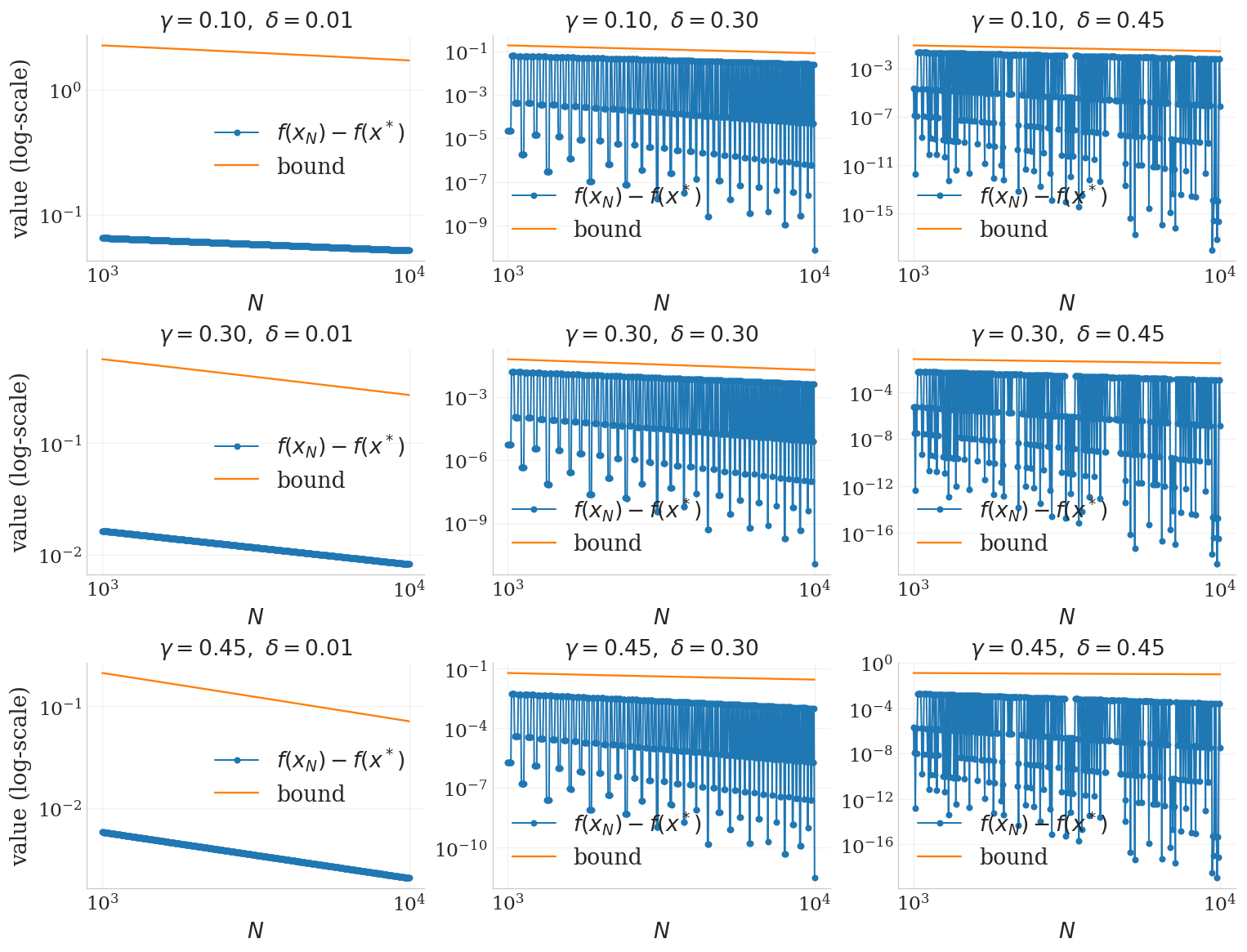
Figure 1: Empirical last-iterate error and the theoretical bound for AdaGrad with fixed values of G1 and various G2.
Empirical results in Figure 1 demonstrate that the theoretical bounds closely track the observed error curves for carefully controlled adversarial instances. The dependence of convergence rates on both the stepsize exponent G3 and the subgradient growth parameter G4 is quantitatively confirmed.
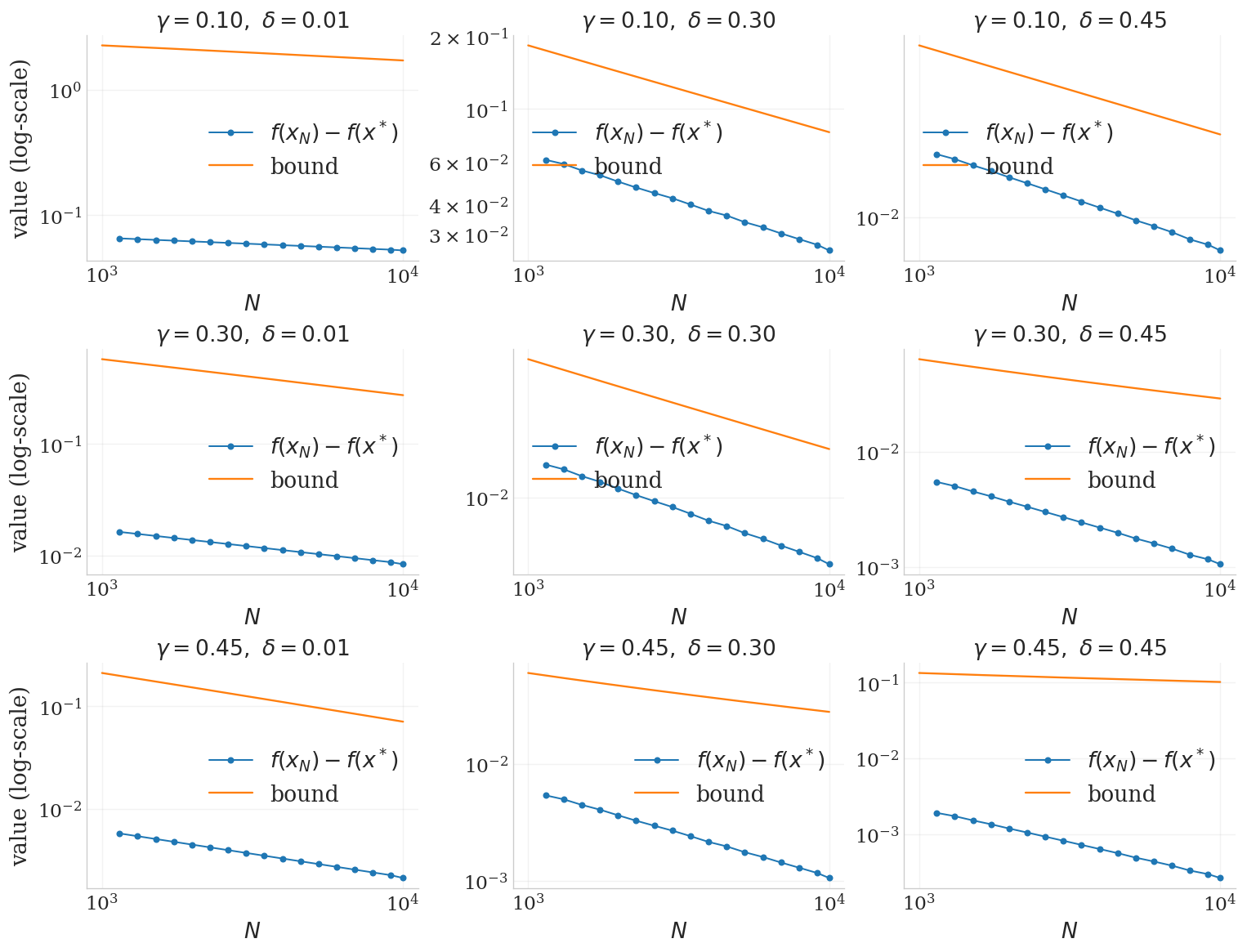
Figure 2: Empirical last-iterate error and theoretical bound with window maximum smoothing applied for visualization robustness.
The smoothing applied in Figure 2 (via window maxima) further clarifies the scaling behavior and enables accurate estimation of the convergence exponent, supporting the theoretical prediction. Detailed experiments corroborate that, as the exponent G5 varies, the empirical slopes align with their theoretical counterparts.
Comparative Perspective and Theoretical Implications
The analysis highlights a key distinction: even with optimal stepsize tuning, AdaGrad's last-iterate convergence for standard scalar rules remains strictly suboptimal compared to averaged versions—a contrast to horizon-dependent non-adaptive methods, which can achieve minimax rates for the last iterate with suitable step decay (e.g., linearly decreasing stepsizes yield G6).
Contrasting AdaGrad-Norm (scalar) with constant stepsize projected subgradient methods, one finds that even the latter admits a slightly faster G7 rate for the last iterate, up to log factors. Thus, adaptivity through standard AdaGrad-Norm, while yielding practical advantages, imparts a fundamental last-iterate penalty in the convex non-smooth regime.
The paper's technical apparatus—specifically, the introduction and exploitation of the G8 parameter—offers a new analytical device for quantifying adaptivity-induced effects in worst-case optimization literature. This framework generalizes to more intricate adaptive algorithms, potentially supporting more fine-grained lower and upper bound analyses for variants of AdaGrad, RMSProp, and Adam.
Practical Implications and Future Directions
Practically, the results suggest that, for applications requiring strong worst-case guarantees for the final iterate (rather than averages), standard AdaGrad-Norm—without further stepsize modifications—may be disadvantageous relative to either last-iterate-tuned non-adaptive schemes or averaged AdaGrad. This has direct implications for deployment in large-scale learning systems and underscores the need for horizon-aware or modified adaptive learning rates when last-iterate performance is critical.
Theory-oriented future work may address several open directions:
Extending the tight last-iterate analysis to the coordinate-wise (diagonal) AdaGrad setup.
Characterizing last-iterate rates in stochastic or smooth convex settings, with or without heavy-tailed gradient noise.
Investigating the interaction of adaptivity, horizon-dependence, and last-iterate performance for Adam, RMSProp, and related algorithms.
Conclusion
This paper delivers a comprehensive tight characterization of the last-iterate convergence behavior of AdaGrad-Norm in convex non-smooth optimization, demonstrating a sharp G9 minimax rate for horizon-dependent stepsizes. This result exposes a genuine adaptivity penalty inherent in the standard AdaGrad-Norm update when considering worst-case final-point guarantees, distinguishing it both from its averaged iterate counterpart and horizon-aware non-adaptive procedures. The technical approach, based on problem-dependent growth exponent analysis, offers a versatile foundation for future generalizations and analysis of related adaptive methods.