- The paper demonstrates that network homophily and local opinion-awareness critically modulate convergence and polarization in LLM-agent societies.
- The study employs an LLM-powered Opinion Dynamics framework to manipulate group-size imbalance and neighborhood context, revealing measurable persuasion biases.
- Empirical results reveal a consistent 'agreement drift' where agents favor upward opinion shifts, highlighting intrinsic model biases across different LLM architectures.
Opinion Dynamics and Network Effects in LLM-Agent Societies
Introduction
"Network Effects and Agreement Drift in LLM Debates" (2604.11312) systematically analyzes collective opinion dynamics among LLM-based agents interacting in complex social network topologies. The study specifically investigates how network homophily, group-size imbalance, and local neighborhood awareness modulate convergence, polarization, and susceptibility to directional opinion shifts—termed "agreement drift"—in populations of LLM agents. By bridging agent-based social simulation and rigorous network modeling, the work addresses critical methodological questions about the reliability and limits of using populations of LLMs as behavioral proxies for human systems in computational social science.
LLM-OD Framework: Simulation Architecture
The foundation of the study is an LLM-powered Opinion Dynamics (LLM-OD) framework in which populations of LLM agents are instantiated as nodes within networks with tunable topology, group assignment, and homophily. Each agent holds a discrete opinion on a 7-point Likert scale and interacts via pairwise debates with network neighbors. During each interaction, one agent (Opponent) attempts to persuade another (Discussant), who may accept (shift opinion toward Opponent), reject (shift further from Opponent), or ignore the argument. Debates update opinions incrementally (±1), and dynamics are tracked over multiple rounds.
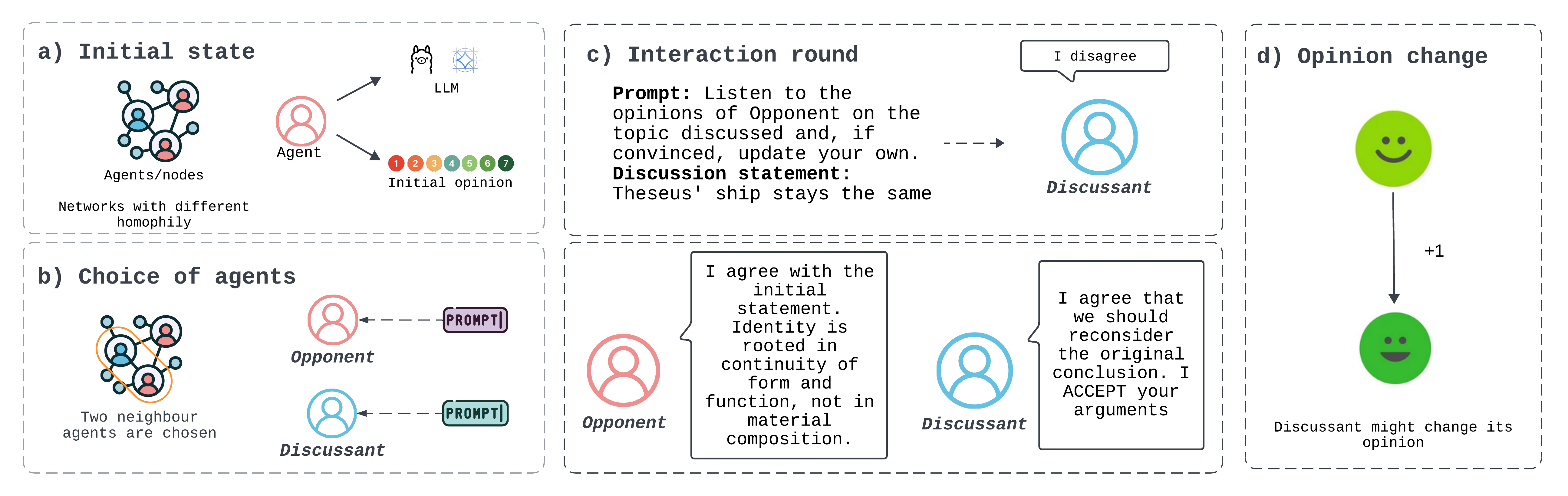
Figure 1: Schema of the LLM-OD simulation process, including population initialization, pairwise debate, and opinion update.
Key features and innovations of this framework include: (i) direct control over homophily via the BA-homophily process, (ii) precise manipulation of class size imbalance, (iii) explicit per-interaction debate protocol, and (iv) the ability to prompt with neighborhood local-opinion information. This design enables clean causal attribution of macro-level outcomes to specific structural or procedural drivers.
Experimental Protocol
The paper executes a matrix of experiments, systematically varying:
- Homophily: from full heterophily (h=0) to full homophily (h=1), controlling the tendency of agents to connect intra- or inter-group.
- Group Size Imbalance: Symmetric ($50/50$), moderately imbalanced ($70/30$), and strongly imbalanced ($90/10$) splits between disagreeing and agreeing opinion classes.
- Initial Opinion Alignment: Both majority/disagree and majority/agree settings are examined, including reversal runs.
- Neighborhood Awareness: Simulations where Discussants are informed of their neighbors’ current opinion distribution, replicating a social-awareness/peer-pressure condition.
Multiple LLM variants are compared, notably Llama-3 and Gemma-3B, to test for model-dependent behavioral regularities.
Main Empirical Findings
Homophily and Opinion Convergence
In balanced populations, with low to moderate homophily (0≤h≤0.75), the system rapidly—within $20$–$40$ steps—converges toward the positive end of the opinion spectrum, i.e., population-level agreement. This convergence accelerates as homophily decreases, since agents experience more cross-group exposure. By contrast, extreme homophily (h=1) enforces structural segregation, locking the population into persistent polarized states, absent consensus.
Group Imbalance: Disappearance and Entrenchment
When initial group-size imbalance is introduced, majority positions dominate rapidly, especially as imbalance increases. Minorities holding the opposite stance disappear quickly except with high homophily, which can temporarily maintain minority clusters. Crucially, reversal experiments—where the majority holds the negative stance—reveal asymmetric persistence: negative majorities are more resistant to conversion, and consensus is not always reached, unless homophily is low or the imbalance is extreme.
Neighborhood Awareness and Peer Pressure
Providing neighborhood opinion-distribution context in the prompts induces sharply faster convergence to moderate agreement and constrains full extremization. Neighborhood-aware agents more often stabilize at intermediate agreement than at extremal consensus, and the preservation of minority or neutral clusters is more robust across all homophily and imbalance conditions. Notably, even with strong homophily, neighborhood awareness enables previously segregated clusters to begin reconciling, in marked contrast to structurally trapped polarization without such context.
LLM Model Differences
Empirical comparison finds Gemma agents exhibit a stronger, intrinsic drift toward positive/agreeing opinions than Llama, regardless of network configuration. Upward (low-to-high) opinion shifts approach determinism, with high-opinion clusters rapidly stabilizing and resisting attrition; downward shifts are rare. This effect is even more pronounced under neighborhood awareness, revealing model-dependent persuasive asymmetries.
Agreement Drift: Micro-dynamics and Transition Probabilities
A crucial observation is the identification—across all settings—of agreement drift: pairwise persuasive interactions overwhelmingly favor shifts from lower to higher positions on the opinion scale over the reverse. Micro-level transition probability analysis shows that, regardless of initial conditions, Discussants are significantly more likely to move toward an Opponent's pro-statement position than to adopt skepticism.
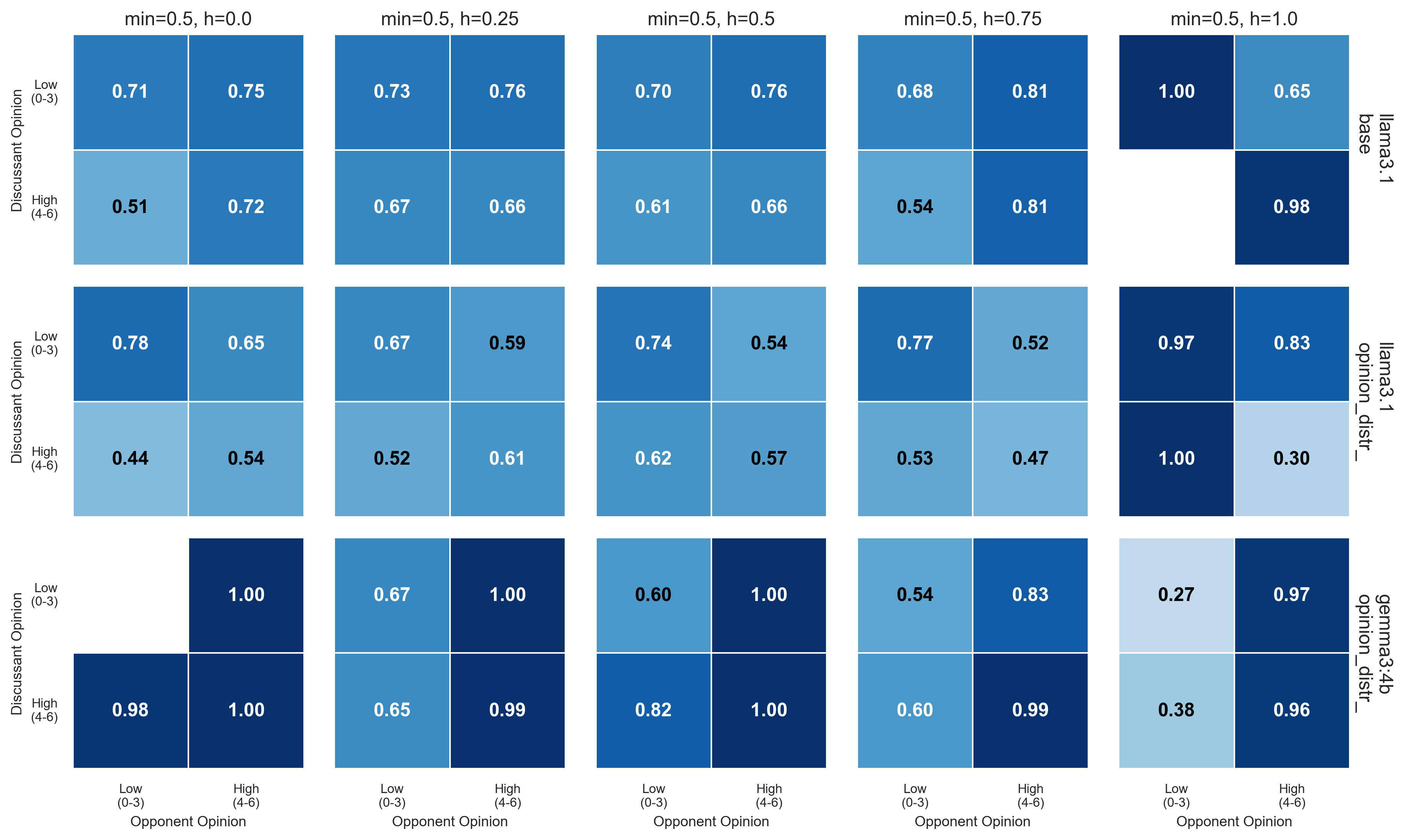
Figure 2: Conditional persuasion probability matrices in pairwise agent interactions across opinion states and model/homophily settings.
Faceted analysis further shows that neighborhood context modulates transition likelihoods: supportive neighborhood consensus increases (sometimes deterministically) upward transition rates; misaligned contexts have a mixed effect; and only under extreme homophily do transition probabilities strictly follow network-imposed segregation.
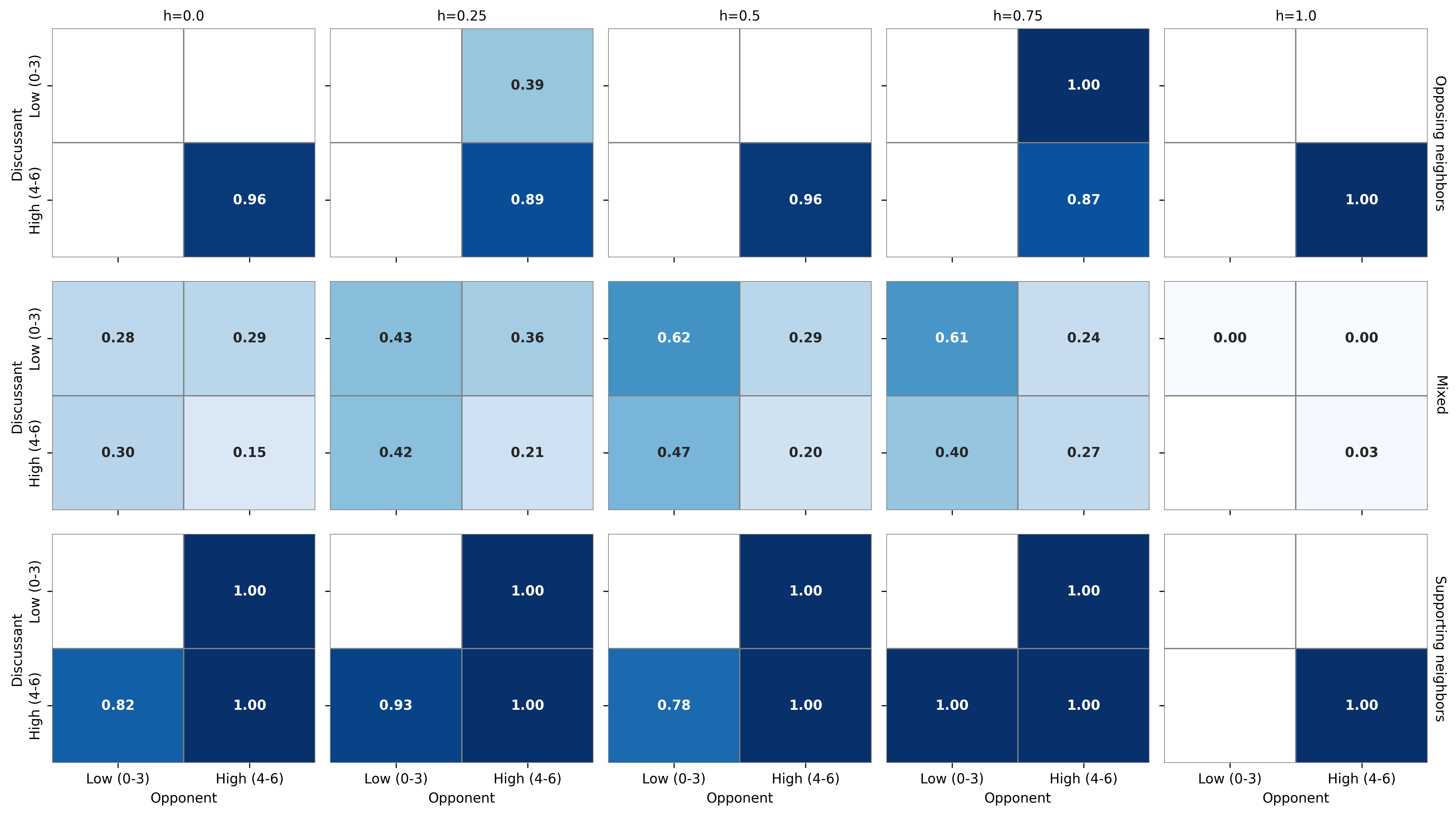
Figure 3: Statistically significant opinion transitions for Llama agents under different neighborhood compositions and homophily settings.
These findings are robust to model variant and are not artifacts of group size or exposure structure, demonstrating that agreement drift is a model-intrinsic and not solely structural effect.
Theoretical and Practical Implications
Methodological Considerations for LLM-Agent Social Simulation
One of the central claims, strongly supported by provided data, is that LLM-agent populations fundamentally differ from idealized human behavioral models in a key assumption: the micro-level social influence function is not directionally neutral, and is instead systematically biased toward statement agreement.
In classical opinion dynamics, network topology and initial condition typically dominate final outcomes; here, results are more nuanced because intrinsic model persuasion bias (agreement drift) can overwhelm or be suppressed by network and exposure structure. This highlights specific risks for naïve application of LLM populations as behavioral surrogates in computational social science and agent-based modeling—especially in contexts involving minority opinions or high-stakes policy simulation—since consensus or polarization is an emergent property of both agent and structure, not purely the latter.
Modeling Convergence, Sycophancy, and Attitudinal Asymmetry
Agreement drift is distinct from mere sycophancy (alignment for user approval or reward). It is a directional asymmetry in susceptibility to pro-statement opinions at the level of autonomous agent–agent interaction, not a function of external reward. This has implications for designing experiments intending to emulate more balanced human systems, as LLMs' internalized prior over agreement can mediate or bias the collective outcome.
Cross-Model Variability and Future AI Risks
Marked behavioral differences between LLM variants (Llama vs. Gemma) underscore the non-universality of agreement drift's magnitude and possibly even its existence, challenging the generalization of empirical findings and motivating systematic cross-model behavioral benchmarking. As LLM-based multi-agent systems and hybrid human-LLM collectives proliferate, the risk of artificial or algorithmically induced consensus—subtly distinct from human-like dynamics—becomes a theoretical and ethical issue, with consequences for information mediation and societal-scale AI influence.
Conclusion
This work delivers a comprehensive, quantitative dissection of opinion evolution in LLM-agent societies as shaped by network homophily, group imbalance, and local awareness. It establishes that directional agreement drift is a robust, model-intrinsic asymmetry that mediates both micro- and macro-level outcomes, modifies expected convergence and polarization dynamics, and interacts nontrivially with network structure. The findings necessitate careful disentanglement of agent-level interaction biases from macro-level structural effects when interpreting LLM-powered social simulations, both for social science inference and for the design of real-world AI systems involving synthetic agents.
Future research should explore opinion dynamics across wider LLM model landscapes and input domain varieties, as well as direct calibration against empirical human data, to clarify to what extent observed behaviors are model- and task-specific or generalizable traits of next-generation AI societies.