- The paper presents a SCR-based LiDAR relocalization pipeline that integrates yaw-invariant encoding and a point-wise reliability-aware loss to enhance robustness.
- It employs cylindrical projection and hierarchical cyclic convolutions to extract local-to-global geometric features while mitigating viewpoint variations.
- Benchmark results on Oxford RobotCar and NCLT datasets demonstrate significant accuracy improvements with sub-meter error and reliable performance under severe rotations.
LEADER: Learning Reliable Local-to-Global Correspondences for LiDAR Relocalization
Introduction and Problem Setting
LiDAR-based 6-DoF relocalization is pivotal for robotics and autonomous driving, particularly in GNSS-denied or -degraded outdoor scenarios. While existing learning-based direct regression solutions (APR) have alleviated the dependence on explicit global maps, they remain sensitive to scene geometry variation and are brittle in the presence of outliers and yaw changes. Scene Coordinate Regression (SCR) frameworks, leveraging RANSAC-based hypotheses testing, offer enhanced robustness but are still limited by the indiscriminate use of point correspondences and lack effective mechanisms to reject unreliable or degenerate scene elements.
Methodology Overview
LEADER introduces a SCR-based LiDAR relocalization pipeline that integrates a yaw-invariant geometric encoder with a point-wise reliability-aware loss, offering discriminative filtering of correspondences under severe viewpoint and geometric ambiguities.
The architecture comprises the following stages:
- Spatial Transformation: Input point clouds are horizontally rectified via ground plane estimation, followed by cylindrical projection. This normalizes viewpoint and encodes rotational (yaw) invariance at the representation level.
- Cyclic Sparse Convolution Encoder: Hierarchical, cyclic convolutions extract local-to-global geometric features with inherent yaw-robustness, mitigating boundary discontinuity from cylindrical projection via symmetric padding.
- Multihead Max Regressor: Extracted features are mapped via a multi-headed regression module to output global scene coordinates and an explicit reliability scalar per point.
- TRR Loss: During training, the Truncated Relative Reliability (TRR) loss re-weights per-point Euclidean losses based on learned reliability. At inference, only high-reliability correspondences are selected for RANSAC-based pose estimation.
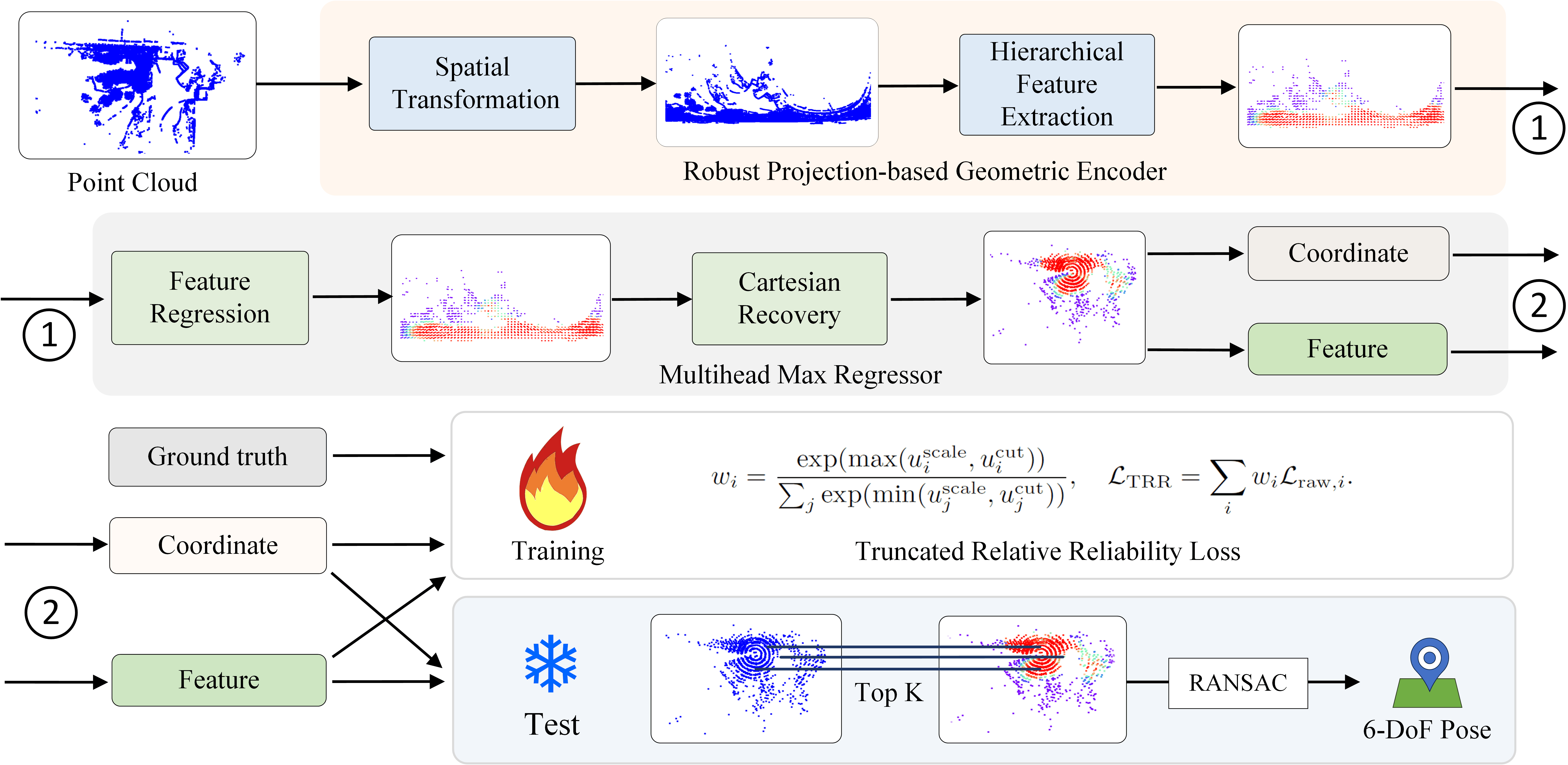
Figure 1: The LEADER pipeline: spatial transformation, hierarchical cyclic convolutional encoding, point-wise regression, TRR-based loss optimization, and RANSAC-based inference.
Robust Projection-based Geometric Encoding
The core innovation is the yaw-invariant encoding induced by cylindrical projection, shown to preserve local geometry across yaw perturbations by converting rotations in Cartesian space to translations in cylindrical coordinates. The hierarchical cyclic sparse convolution network addresses the artificial boundaries introduced by this projection and allows seamless local context aggregation even at 0∘/360∘ discontinuities.
Discriminative feature extraction is aided by a U-Net architecture with dilated cyclic convolutions at coarse scales, maximizing receptive field without compromising spatial resolution.
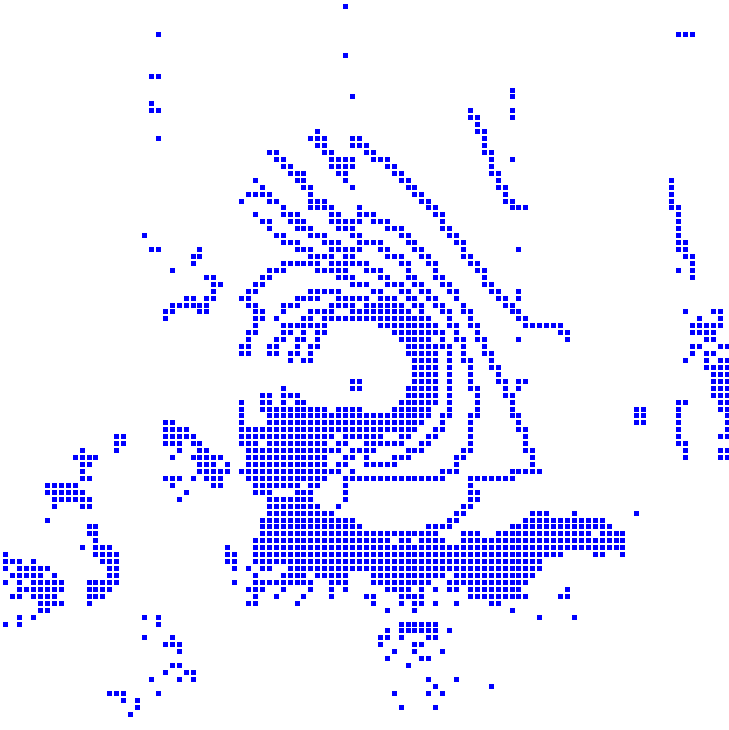
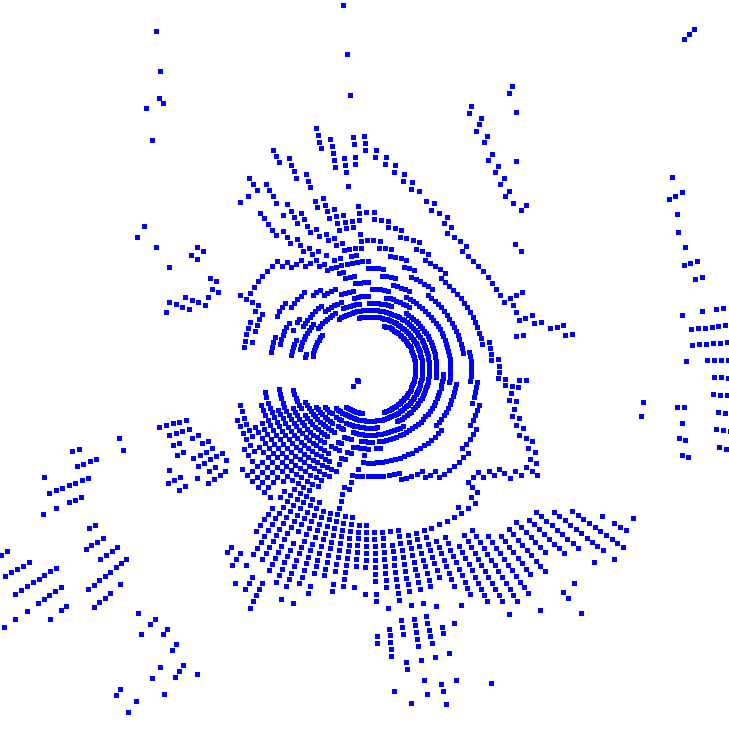
Figure 2: Point cloud density: left shows direct voxelization, right shows after spatial transformation and recovery, highlighting the density adaptation induced by cylindrical projection.
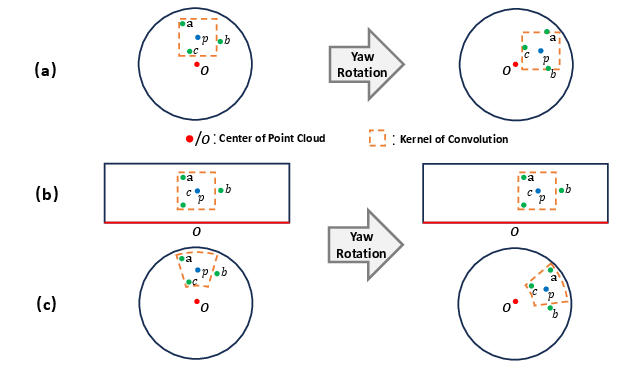
Figure 3: Cylindrical projection transforms original point cloud rotations into translations, enabling convolutional networks to achieve yaw-robust feature extraction.
Point-wise Reliability Estimation and TRR Loss
Standard SCR pipelines are susceptible to erroneous matches in degenerate or ambiguous regions. LEADER’s TRR loss imposes a softmax-based weighting of per-point losses, with learned reliability driving dynamic resource allocation. The arctangent-based normalization and gradient-aware truncation prevent both vanishing gradients and extreme focus on limited points. This balances emphasis on reliable samples without neglecting moderate-quality ones.
Per-point reliability scores allow pruning correspondences during inference, reducing influence from outliers and enforcing hypothesis selection on maximally informative structural cues.
Benchmarking and Results
LEADER is evaluated on the Quality-enhanced Oxford RobotCar and NCLT datasets, using standard metrics of mean position and orientation error.
Key findings:
- On Oxford, the mean position error is reduced to 0.63 m (↓24.1% vs. SOTA SCR; ↓66.1% vs. SOTA APR).
- On NCLT, LEADER achieves 0.31 m mean position error (↓73.9% vs. SOTA SCR; first to break 0.5 m barrier).
- Robustness to yaw: Error is invariant across random yaw perturbations, while competing methods’ errors degrade by an order of magnitude.
- Under degraded conditions (occlusion, dropout, noise, pitch/roll perturbation), LEADER maintains sub-meter accuracy.
- Real-time inference (46–48 ms/frame) on commodity hardware.
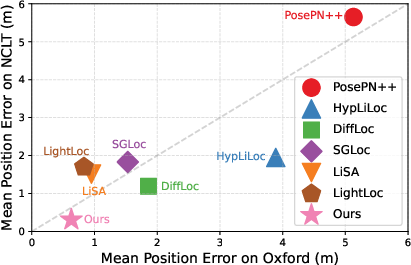
Figure 4: Mean position error comparisons on NCLT and Oxford dataset demonstrate LEADER’s strong accuracy advantage.
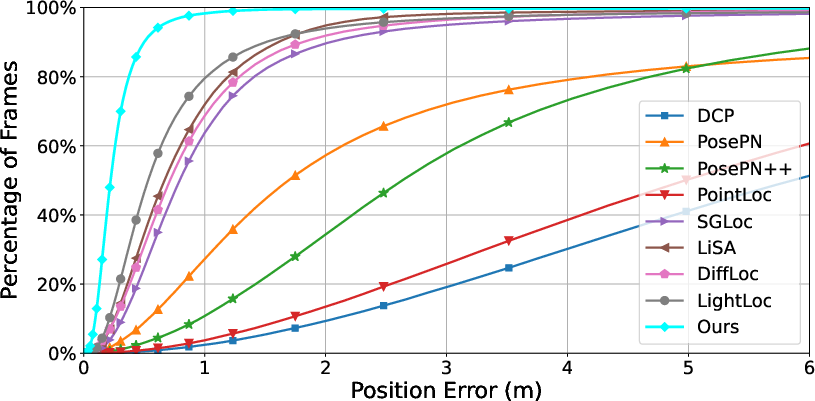
Figure 5: Cumulative distribution of position errors on NCLT: LEADER achieves >90% of frames within 0.5 m, highlighting consistency.

Figure 6: Visualization of reliability estimation: high reliability on stable structure (buildings, dense vegetation bases), low on ground and foliage.
Ablation Studies and Analytical Insights
Ablation analyses confirm:
- The RPGE module is necessary for yaw-invariance; disabling it results in order-of-magnitude position error increase under rotation.
- TRR enhances both learning (by focusing on reliable samples) and inference (via reliability-based RANSAC pruning). Training-only or test-only use yields less pronounced improvements.
- The cost of these modules is negligible in terms of compute and parameters.
TRR maintains a monotonic reliability-error relationship, ensuring the most confident correspondences yield low scene point errors.

Figure 7: TRR loss effect: the distribution shifts to more high-precision points, with outliers suppressed during inference.

Figure 8: Scene point error monotonically increases across lower reliability percentiles, confirming the reliability estimator's calibration.
Practical and Theoretical Implications
The LEADER architecture demonstrates that explicit geometric invariance (here, via cylindrical projection and cyclic convolutions) in feature encoding is highly effective in outdoor relocalization, especially under severe viewpoint variation and large-scale, degenerate urban scenes. The combination of reliability-aware loss and inference not only boosts performance but also improves consistency and robustness, reducing reliance on hand-crafted heuristics for correspondence selection.
Practically, LEADER’s low memory usage (no explicit 3D maps), real-time capability, and strong failure resistance render it directly deployable in autonomous navigation stacks where storage or bandwidth is constrained.
Theoretically, this work cements the utility of endowing SCR pipelines with internal, learnable uncertainty quantification at the correspondence level, opening possibilities for joint optimization with downstream tasks (e.g., mapping, loop closure, or multi-agent localization).
Future Research Directions
The current framework focuses on yaw as the primary axis of invariance, leveraging ground rectification to mitigate pitch/roll. Towards full SE(3) invariance, future work may seek end-to-end learning of arbitrary orientation robustness without assuming a ground plane, or exploit unsupervised domain adaptation for new environments with unseen dynamics.
Further, the approach could be generalized to multi-modal localization or tightly integrated with online SLAM systems for active scene structure disambiguation and self-correction in lifelong robot deployments.
Conclusion
LEADER introduces a principled, reliability-aware SCR framework for LiDAR relocalization, achieving state-of-the-art accuracy and robustness through geometrically grounded, yaw-invariant encoding and discriminative correspondence selection. Its demonstrated consistency, efficiency, and theoretical advances position it as a strong baseline for future global localization research and large-scale, real-world deployment scenarios.