- The paper demonstrates that CsCr₃Sb₅ under pressure exhibits three distinct transport anomalies (T1, T2, T3) linked to unconventional electronic ordering.
- It employs hydrostatic pressure experiments, in-plane resistivity, Hall effect measurements, and mobility spectrum analysis to reveal multiband carrier dynamics.
- Enhanced AHLE and high-mobility carriers observed suggest novel quantum phases, potentially advancing the understanding of superconductivity and correlated states.
Anomalous Magnetotransport in Pressure-tuned CsCr3Sb5: Evidence for Exotic Electronic Order
Context: Kagome Lattice Physics and CsCr3Sb5
Kagome metals, featuring flat bands, Dirac points, and van Hove singularities, provide a fertile ground for emergent quantum orders and correlated phenomena. In the AV3Sb5 family, intertwined density waves, electronic nematicity, and superconductivity have been intensively scrutinized, with anomalous Hall-like effects (AHLE) frequently attributed to broken time-reversal symmetry or Berry curvature. The recently synthesized isostructural compound CsCr3Sb5 exhibits its Fermi energy near the flat band, distinguishing it from CsV3Sb5 (with Fermi energy near vHs) and underscoring its strong electronic correlations. The resulting phase diagram for CsCr50Sb51 is notably rich, with pressure-induced superconductivity, non-Fermi-liquid transport, and multiple density-wave transitions.
Experimental Approach and Magnetotransport Signatures
Single crystals of CsCr52Sb53 were subjected to hydrostatic pressures (5~kbar, 19~kbar) and magnetotransport was characterized via in-plane resistivity and Hall effect measurements across wide temperature and field ranges. Three distinct transport anomalies were observed: two density-wave-like transitions at 54 and 55, and a less understood resistivity hump at 56~K.
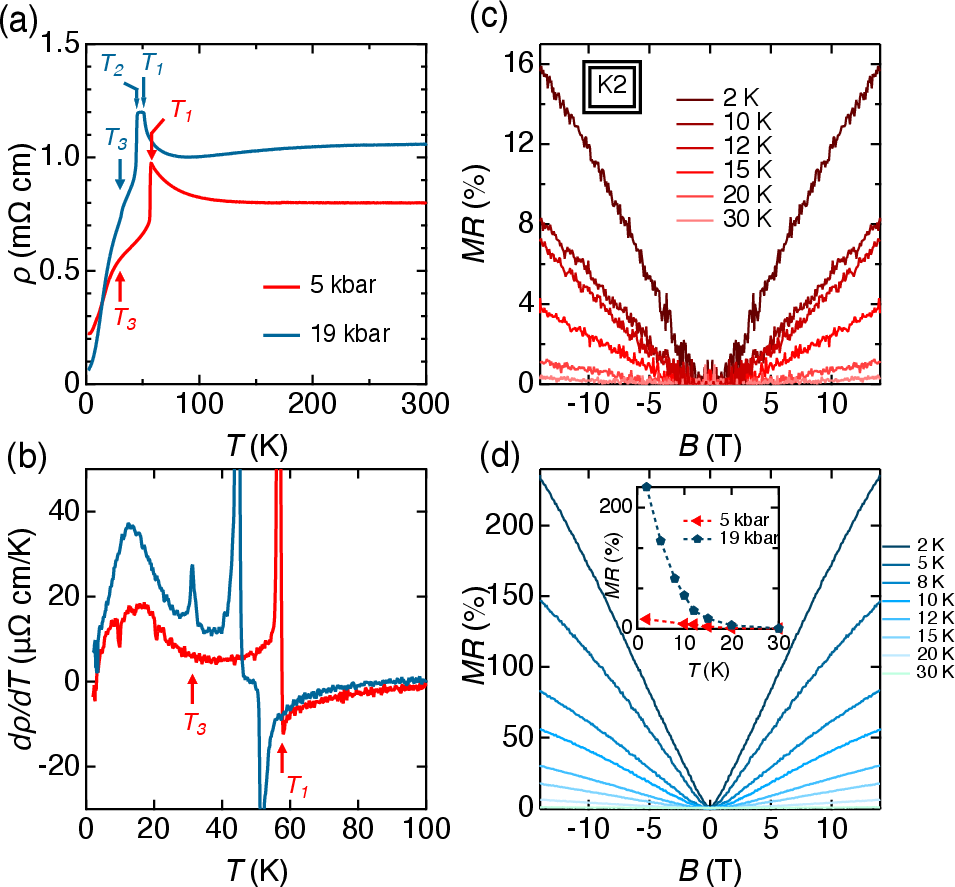
Figure 1: Temperature dependence of resistivity, its derivative, and magnetoresistance (MR) for CsCr57Sb58 at 5~kbar and 19~kbar, showing anomalies at 59, 30, and 31.
At 5~kbar, resistivity remains constant above 100~K but features a pronounced peak at 32 and a well-resolved hump at 33, with an inflection in 34. MR increases sub-linearly with field and reaches 16% at 2~K. Pressure increase to 19~kbar shifts 35 lower, introduces 36, and preserves the hump at 37. The low-temperature resistivity drops significantly (38 reduced by ~70%), and MR at 14~T grows to 230%, a 14-fold enhancement.
Hall Effect: Multiband Response and Anomalous Hall Features
Hall resistivity (39) exhibits temperature and field-dependent nonlinearities. Above 50, 51 is linear in 52, and 53 (Hall coefficient) becomes more negative with cooling, indicative of electron-like carriers. Cooling through 54 and towards 55 causes a sharp decrease and then a pronounced positive upturn in 56, eventually crossing zero and becoming hole-like at lowest temperatures. Below 57, 58 develops pronounced nonlinerity and AHLE, which are strongly pressure-enhanced.
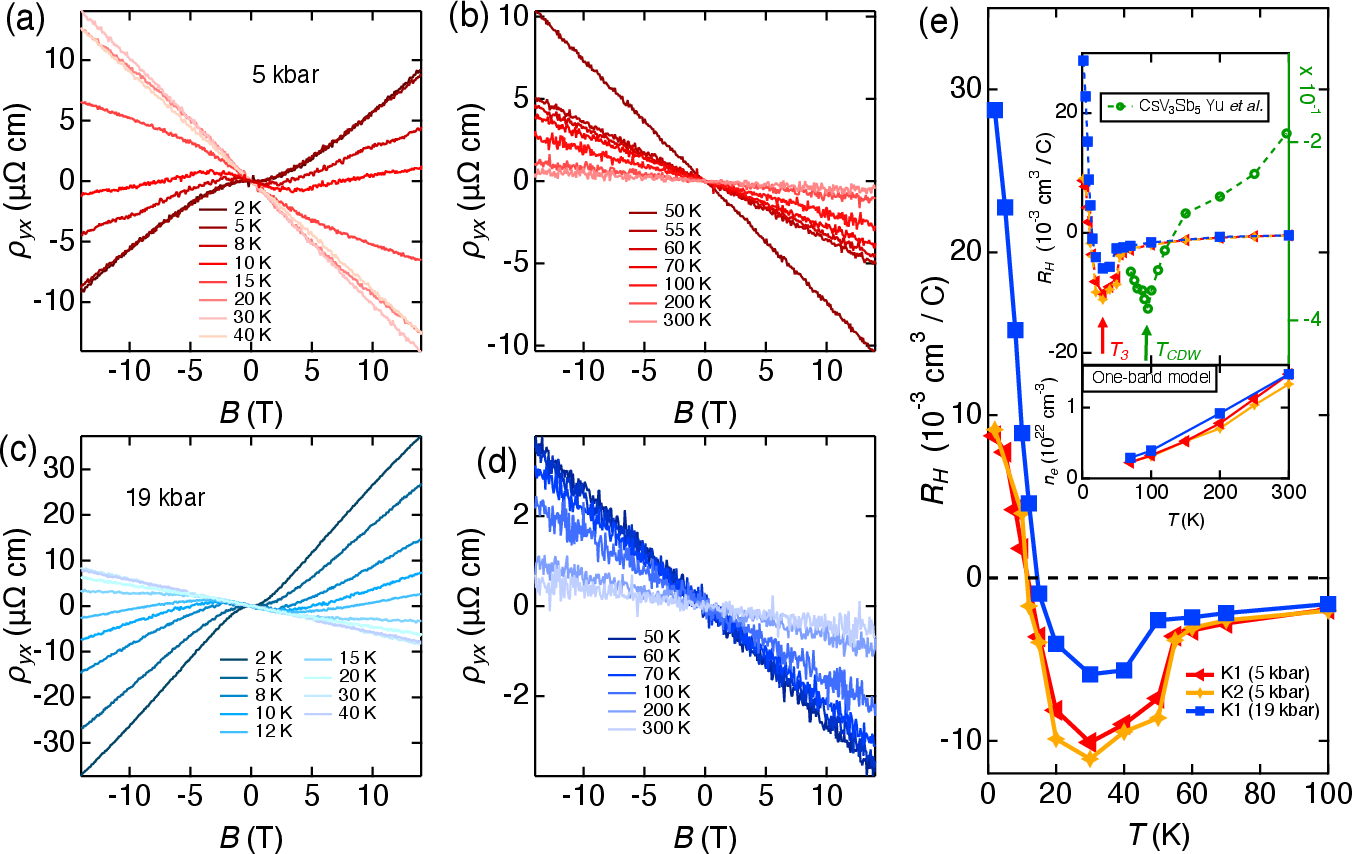
Figure 2: Hall resistivity vs. magnetic field and temperature dependence of 59 at different pressures, highlighting a sharp upturn coincident with 30, and comparison to CsV31Sb32.
The AHLE becomes particularly abrupt at 19~kbar, with stronger nonlinearity in 33. Analogous signatures in CsV34Sb35 below its CDW transition suggest a possible link to density wave ordering. The AHLE onset correlates precisely with 36, and its pressure dependence points to enhanced carrier mobility and multiband correlations.
Mobility Spectrum Analysis: Role of High-Mobility Carriers
To dissect the carrier contributions, mobility spectrum analysis (MSA) was employed on the magnetotransport data. The MSA reveals multiple carrier populations, with the high-pressure spectrum broadening and prominently featuring high-mobility carriers (37~cm38/Vs) below 39. Warming attenuates these carriers and weakens the AHLE, reinforcing their association.
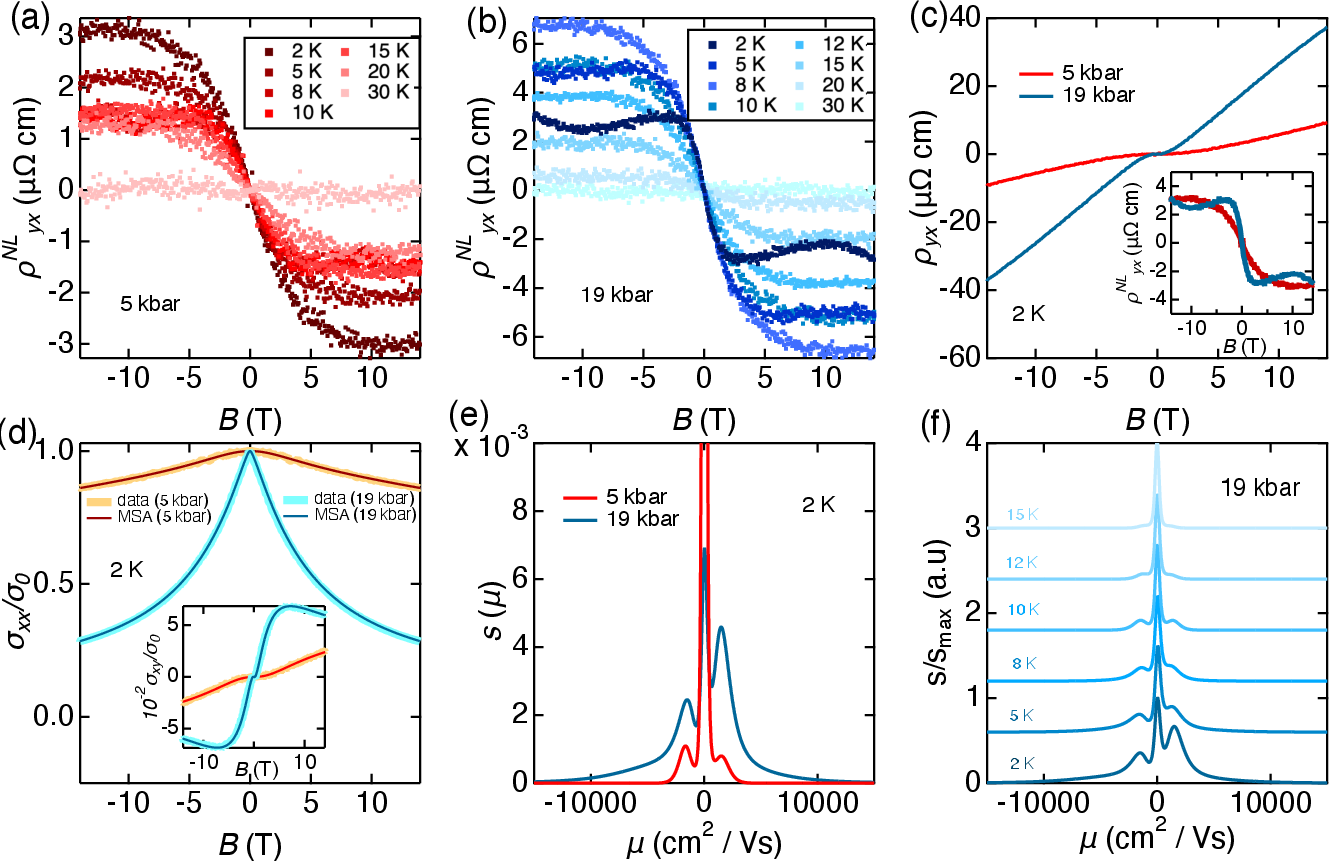
Figure 3: Extraction of nonlinear Hall components, comparison of Hall resistivity and conductivities, and mobility spectra at different pressures and temperatures, evidencing high-mobility carrier enhancement below 50.
These findings mirror the re-interpretation of AHLE in CsV51Sb52 as arising from tiny Fermi pockets with ultra-high mobility, rather than intrinsic anomalous Hall physics alone.
Microscopic Origins and Competing Hypotheses
While the enhanced AHLE and transport mechanisms strongly implicate high-mobility carriers and multiband effects, several other origins are considered—altermagnetic order yielding internal fields and TRS breaking, kagome lattice loop currents, and nonzero Berry curvature from topologically significant band structures. The precise interplay among these remains unresolved, and multifaceted future experiments are warranted to untangle their respective contributions.
Implications and Future Directions
The anomalous transport properties below 53 in CsCr54Sb55, especially under pressure, suggest the activation of exotic electronic orders and additional carrier channels with enhanced mobility. The robustness of 56 against pressure, its synchronous manifestation in resistivity, Hall coefficient, and AHLE, and its close resemblance to density wave-related phenomena in AV57Sb58 identify it as a central feature of the correlated phase diagram. These results advance understanding of Kagome metals as platforms for quantum criticality, unconventional transport, and symmetry-broken phases—
potentially relevant for engineering emergent superconductivity or topological quantum states. Theoretical modeling and complementary spectroscopic probes (e.g., ARPES, NMR, STM) will be critical for distinguishing the microscopic mechanisms and their effects on the Fermi surface topology.
Conclusion
A systematic pressure-tuned magnetotransport study of CsCr59Sb30 reveals unprecedented anomalous low-temperature behaviors intimately tied to the 31 anomaly. Enhanced AHLE, multiband response, and pressure-dependent high-mobility carrier spectra signal possible new electronic ordering. The linkage between 32 and unconventional transport points to nontrivial carrier dynamics and further enriches the phase diagram of Kagome metals. Ongoing investigations are essential to fully elucidate the origins and implications of these phenomena for correlated quantum matter (2604.13553).