- The paper's main contribution is the design of a novel weighted metric that ensures near-isometry, improving phase retrieval efficiency.
- It unifies Riemannian Gradient Descent and Wirtinger Flow to achieve linear convergence with optimal O(n) sample complexity for Gaussian measurements.
- Empirical results show WRGD's superior iteration efficiency and reduced computational latency compared to existing quadratic sensing methods.
Weighted Riemannian Optimization for Quadratic Equation Recovery from Gaussian Magnitude Measurements
The paper addresses generalized phase retrieval, wherein a complex signal x∈Cn is reconstructed from m phaseless quadratic measurements: yk=∣⟨ak,x⟩∣2, with ak being independent random measurement vectors. The problem is reformulated via the PhaseLift methodology, where the goal becomes recovering a rank-1 positive semidefinite matrix X=xx∗ from linear measurements: yk=⟨akak∗,X⟩.
The authors unify manifold-based canonical Riemannian Gradient Descent (RGD) and factorization-based Wirtinger Flow (WF) as gradient descent on the manifold M1 of Hermitian rank-1 matrices. Both canonical RGD and WF use different metrics and retraction operators, leading to only a stable, non-isometric embedding by A. This constrains the achievable convergence, as the condition number of the sensing operator restricted to the tangent space is strictly greater than 1.
Weighted Metric Design and Algorithmic Development
By analyzing E[⟨A(W1),A(W2)⟩] for tangent vectors W1,W2∈TZ, the authors derive a novel, computationally efficient weighted metric m0. This metric ensures near-isometry: m1. Under this metric, the condition number of the restricted sampling operator asymptotically approaches 1, permitting faster linear convergence.
The associated algorithm, Weighted Riemannian Gradient Descent (WRGD), operates on the manifold with the new metric and utilizes spectral initialization. The truncation variant, TWRGD, leverages adaptive measurement selection based on the current iterate and Gaussian statistics.
Recovery Guarantees and Convergence Behavior
The paper establishes stringent theoretical guarantees: for random complex Gaussian measurements, WRGD (initialized with the truncated spectral method) achieves linear convergence to the global minimum with a contraction factor arbitrarily close to zero, provided m2. This sample complexity matches lower bounds for phase retrieval.
Key supporting results include:
- New weighted metric enables restricted near-isometry for m3 on the tangent space.
- Uniform concentration lemmas for the random quadratic forms corroborate the tight condition number bounds.
- Recovery is guaranteed with high probability for m4 and initialization error m5, as shown in Theorem 1 and 3.
The empirical evaluation demonstrates substantial iteration and time improvements for TWRGD versus canonical RGD, TWF, and TAF across a variety of oversampling ratios (m6). The WRGD algorithm consistently achieves the lowest iteration counts and computational latency to reach a relative mean squared error (MSE) below m7 for m8. Even as m9, only WRGD's condition number approaches optimality; TWF remains the slowest due to its larger condition number.
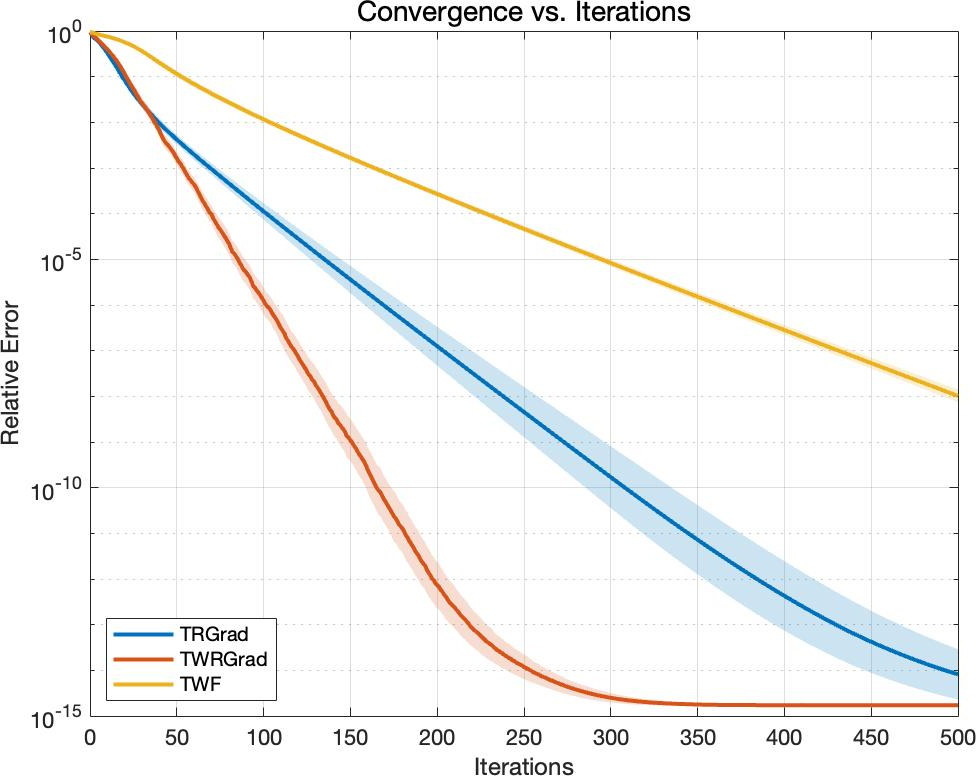
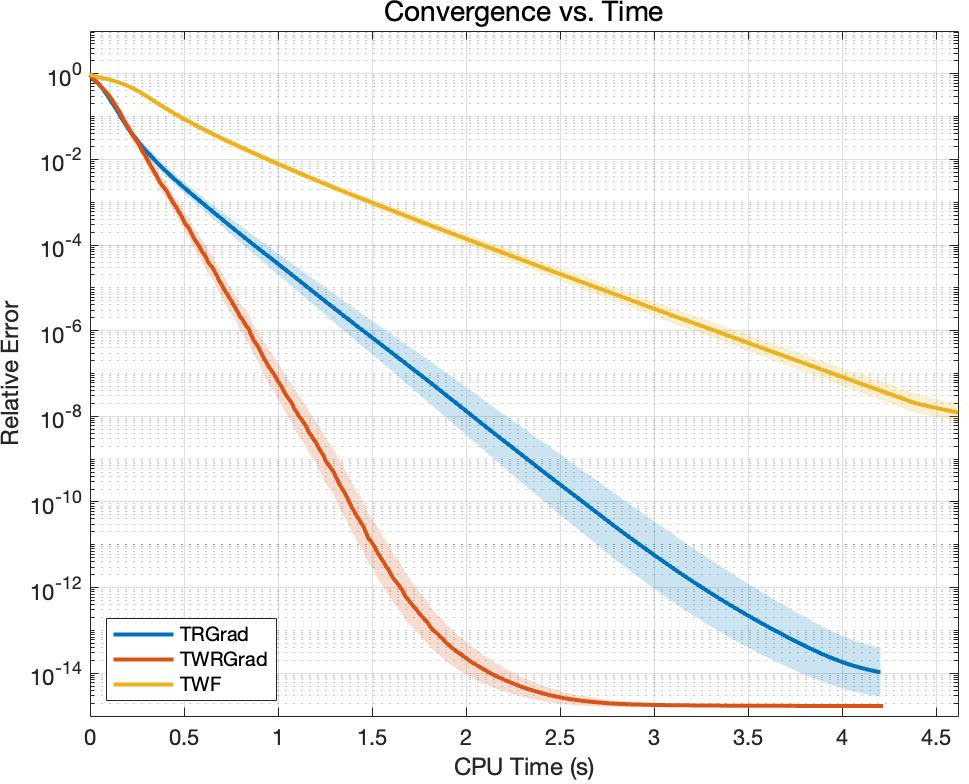
Figure 1: Relative MSE versus iteration count using: i) TWF; ii) TRGD; iii) TWRGD.
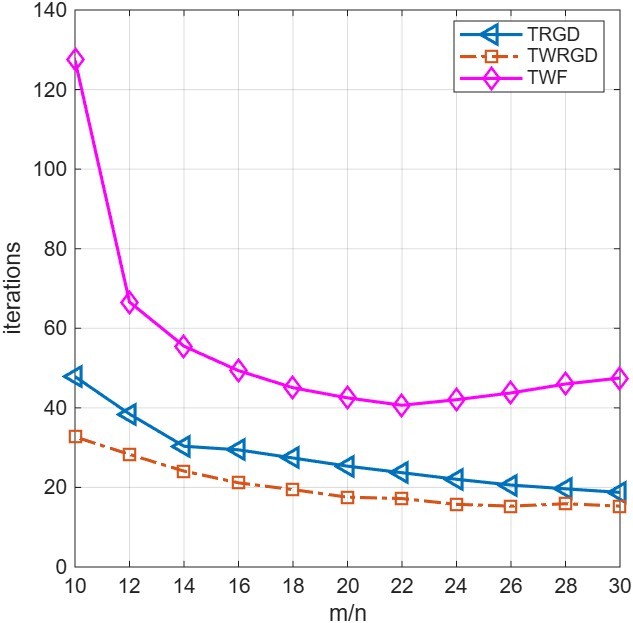
Figure 2: Iterations versus yk=∣⟨ak,x⟩∣20 using: i) TRGD; ii) TWRGD; iii) TWF.
Success rate analysis shows (Figure 3) that TWRGD and TRGD reliably recover signals with high probability for yk=∣⟨ak,x⟩∣21, exceeding the performance of TWF and nearly matching TAF.
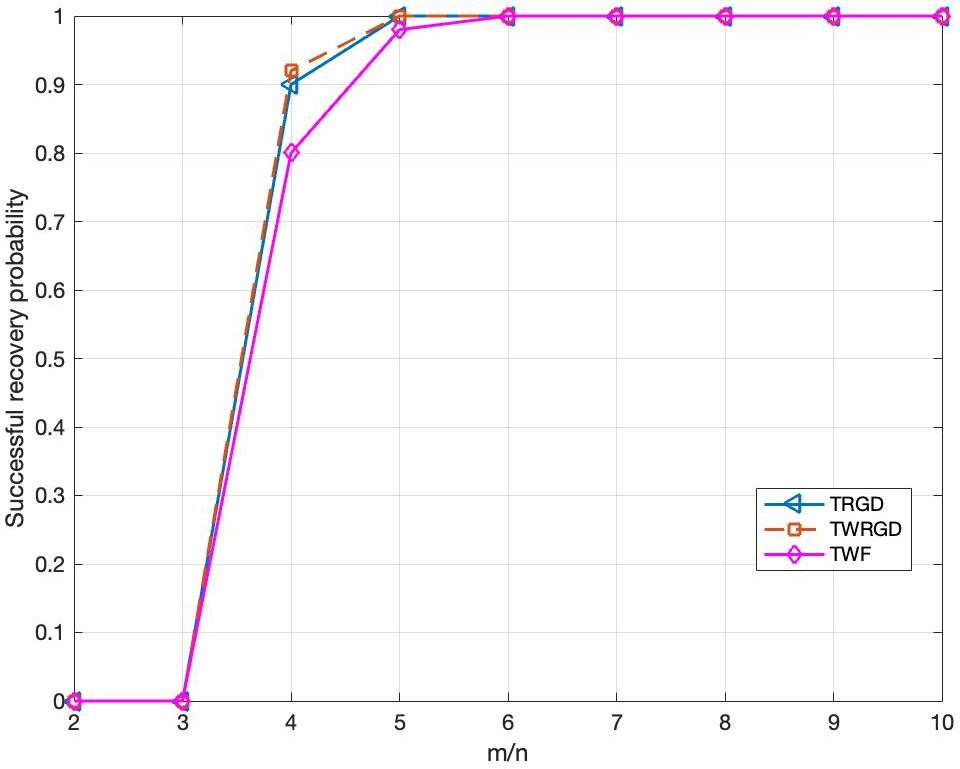
Figure 3: Successful probability versus yk=∣⟨ak,x⟩∣22 using: i) TWF; ii) TRGD; iii) TWRGD; iv) TAF. TWF and TAF use fixed step sizes.
Implications and Theoretical Impact
The weighted metric guarantees optimal contraction and highlights the essential role of manifold geometry in nonconvex recovery algorithms. This framework generalizes the convergence analysis for phase retrieval and potentially for other quadratic sensing problems. The authors suggest adapting this approach to loss functions beyond least squares and to sparse recovery or matrix completion tasks.
Practically, WRGD demonstrates superior computational scalability: despite matrix-based updates, the algorithm only iterates over two vectors, aligning its complexity with best-in-class first-order methods. This renders it applicable to large-scale optical imaging and X-ray crystallography with efficient yk=∣⟨ak,x⟩∣23 sample complexity.
Conclusion
The paper presents an advanced framework for phase retrieval via Weighted Riemannian Optimization, demonstrating both theoretical linear convergence at optimal sample complexity and empirical superiority in iteration efficiency. The innovation lies in metric design, establishing near-isometry for the sensing operator and unifying diverse algorithmic approaches. Subsequent research directions include exploring alternate loss functions, sparse phase retrieval, and extensions to broader quadratic sensing tasks.