Published 15 Apr 2026 in math.NT, math.CA, and math.ST | (2604.14482v1)
Abstract: We establish a connection between analytic number theory and computational learning theory by showing that the Möbius function belongs to a class of functions that is statistically hard to learn from random samples. Let $μ_R$ denote the restriction of the Möbius function to the squarefree integers in ${1,\dots,R}$. Using a recent lower bound of Pandey and Radziwiłł for the $L1$ norm of exponential sums with Möbius coefficients, we prove that [ \FR(μ_R) \gg R{-1/4-ε} ] for every $ε>0$. We then show that, for a suitable absolute constant $c_0>0$, the class of ${-1,1}$-valued functions on the squarefree integers with Fourier Ratio at least $c_0$ has Vapnik--Chervonenkis dimension at least $cR$. It follows that any distribution-independent learning algorithm that succeeds uniformly on the class $\mathcal{H}_R(η_R)$ containing $μ_R$, where $η_R \to 0$, requires at least $Ω(R)$ samples. We also discuss a conditional improvement under a strong uniform bound for additive twists of the Möbius function, and we note that the same method applies to the Liouville function.
The paper introduces Fourier Ratio, a novel measure revealing that the M4bis function is statistically hard to learn.
It establishes explicit sample complexity lower bounds using the VC dimension for hypothesis classes that include the M4bis and Liouville functions.
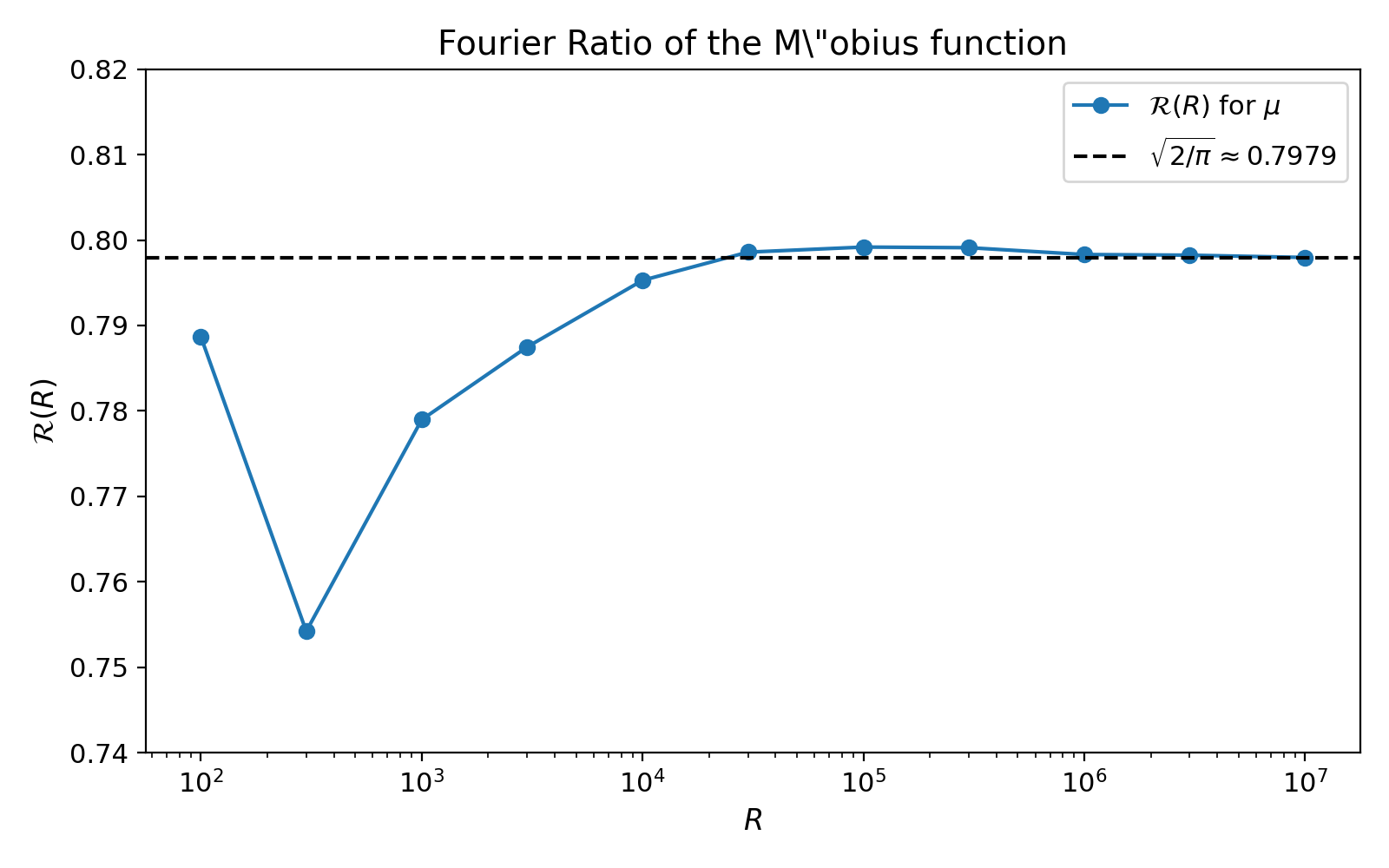
Numerical experiments confirm that the Fourier Ratio converges rapidly to the Gaussian benchmark, supporting the analytical complexity findings.
Arithmetic Functions and Learning Theory: Analytical Complexity and Learnability
Summary and Primary Contributions
The paper "Arithmetic functions and learning theory" (2604.14482) rigorously investigates the intersection of analytic number theory and computational learning theory by analyzing the learnability of the M\"obius function and related multiplicative arithmetic functions. The authors introduce the Fourier Ratio as a key complexity measure, leveraging recent arithmetic lower bounds and combinatorial arguments to demonstrate that the M\"obius function is statistically hard to learn in a distribution-independent setting. They establish explicit sample complexity lower bounds for any uniform learning algorithm operating over hypothesis classes containing the M\"obius function, quantified through the VC dimension associated with the Fourier Ratio threshold.
Fourier Ratio: Definition and Analytical Results
The authors define the Fourier Ratio for functions f restricted to the set of squarefree integers up to R, XR′, as: FR(f)=∥f∥L2([0,1])∥f∥L1([0,1])
where f(x)=∑n=1Rf(n)e−2πinx. This ratio evaluates spectral "spread" for f, and acts as a complexity proxy. For the M\"obius function, combining Parseval's identity and Pandey–Radziwi{\l}{\l}'s recent breakthroughs, the authors show: FR(μR)≫ϵR−1/4−ϵ
unconditionally, for every ϵ>0 (Theorem 1), and conditionally, if a strong uniform L∞ bound holds for additive twists: FR(μR)≥R−o(1)
The paper also notes that the same arguments apply to the Liouville function.
Figure 1: The Fourier Ratio R0 for the M\"obius function as a function of R1 on a logarithmic scale; the dashed line marks the Gaussian benchmark R2.
These results are supported by numerical evidence showing that R3 converges rapidly to the Gaussian benchmark R4, an indicator of high spectral complexity (see Figure 1).
VC Dimension: Combinatorial Complexity and Sample Requirements
Functions with Fourier Ratio bounded below by a positive constant form a high-complexity class. The authors prove that for sufficiently large R5, the hypothesis class
R6
has VC dimension at least R7 for absolute constants R8, R9. This is derived by constructing shattered sets via random sign assignments on XR′0 and using Khintchine-type inequalities to obtain uniform XR′1 lower bounds.
Consequently, any distribution-independent learning algorithm that succeeds uniformly over a class containing XR′2 or XR′3, and achieves nontrivial accuracy, must use at least XR′4 samples (Theorem 3). The VC dimension argument ensures that statistical complexity, as measured by sample requirements, is fundamentally large for these arithmetic functions.
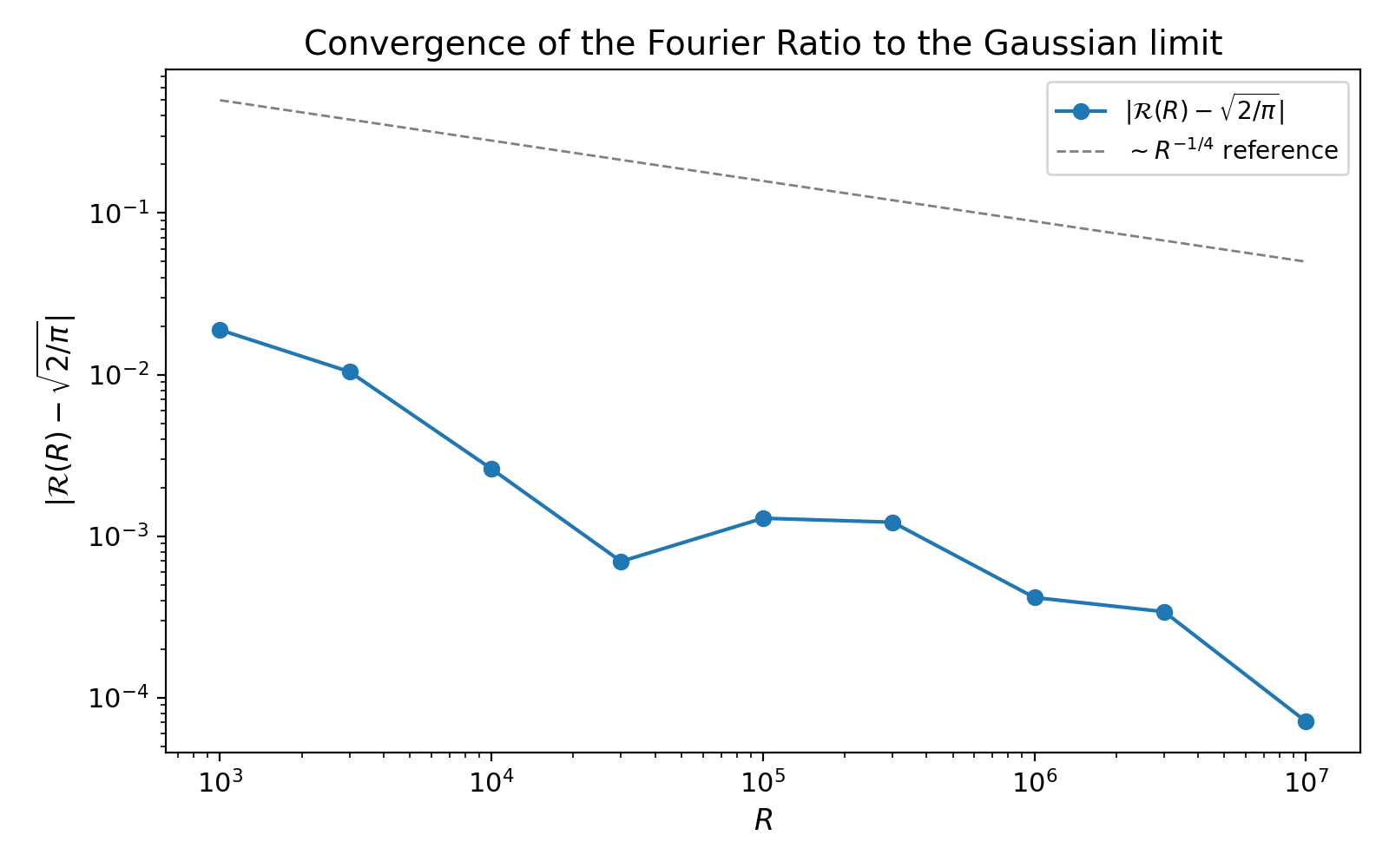
Figure 2: The deviation XR′5 on a log–log scale for XR′6, indicating rapid convergence of the M\"obius function's Fourier Ratio to the Gaussian benchmark.
Numerical Results and Comparative Analysis
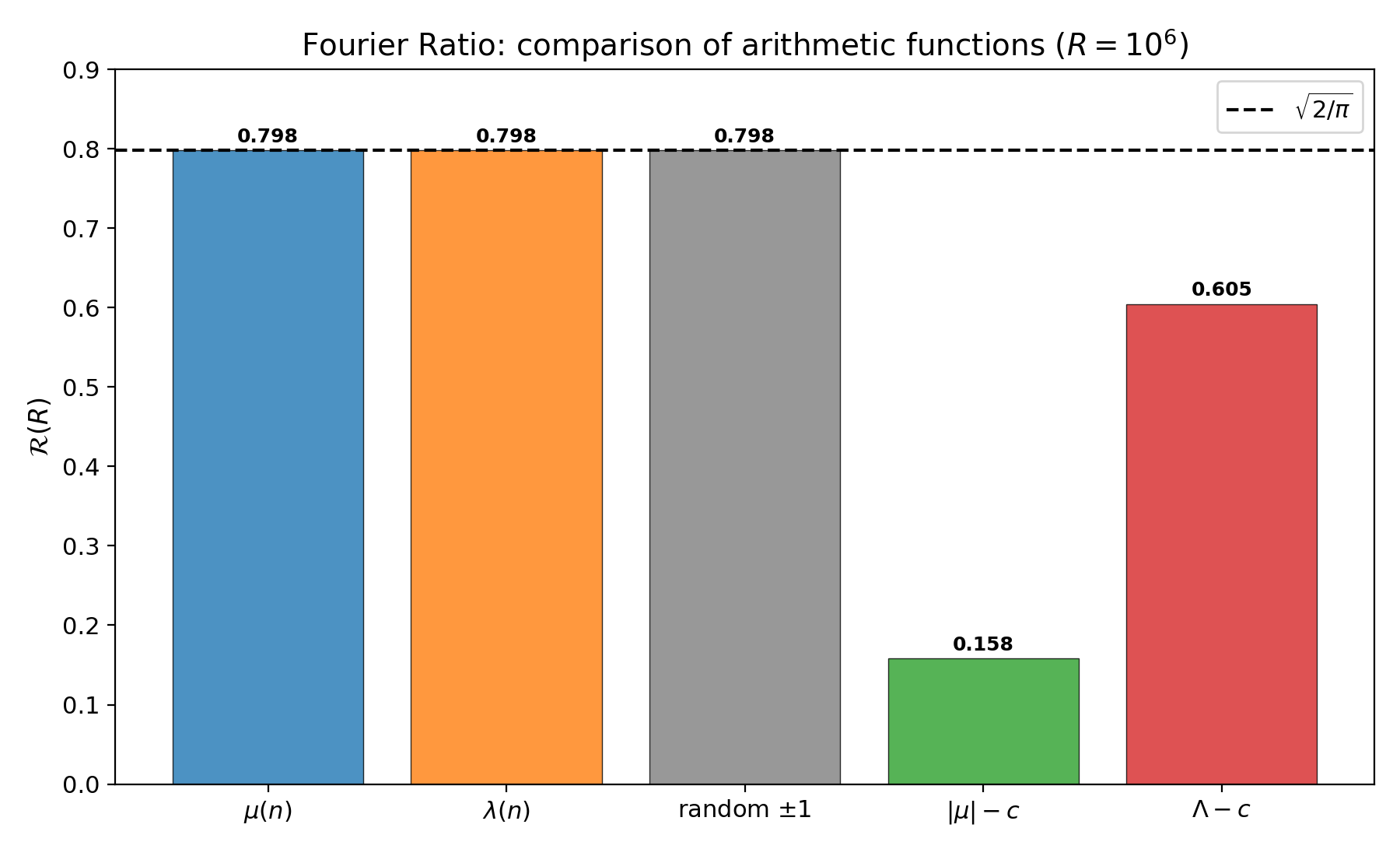
To ground the analytical findings, the authors present numerical experiments for XR′7 up to XR′8, confirming the rapid approach of the Fourier Ratio for the M\"obius function to the Gaussian benchmark. Comparative analysis across other arithmetic functions at XR′9—including Liouville, random signs, von Mangoldt, and squarefree indicator—demonstrates that only M\"obius, Liouville, and random signs reach the requisite high spectral complexity (see Figure 3).
Figure 3: The Fourier Ratio for five arithmetic functions at FR(f)=∥f∥L2([0,1])∥f∥L1([0,1])0; the dashed line marks the Gaussian benchmark FR(f)=∥f∥L2([0,1])∥f∥L1([0,1])1.
Implications and Future Directions
The results underscore a robust distinction between algorithmic and statistical complexity: while the M\"obius function has low Kolmogorov complexity (simple prime factorization rules), its high statistical complexity (as revealed through its Fourier Ratio and VC dimension) imposes strong barriers to distribution-independent learnability. This supports heuristic principles like Sarnak's M\"obius randomness, yet formalizes them in terms of sample complexity.
These findings have implications for algorithmic inference on arithmetic sequences, statistical modeling in number theory, and for leveraging multiplicative function unpredictability in cryptographic settings. Open problems include tightening FR(f)=∥f∥L2([0,1])∥f∥L1([0,1])2 bounds for exponential sums, investigating connections to the Riemann Hypothesis and additive harmonic bounds, and refining the VC dimension threshold as Fourier Ratio decays.
Conclusion
This paper provides a rigorous framework linking arithmetic spectral complexity with learning theory. The M\"obius and Liouville functions are shown to be statistically hard to learn, with sample complexity scaling linearly in FR(f)=∥f∥L2([0,1])∥f∥L1([0,1])3 due to their high Fourier Ratio and hypothesis class VC dimension. These results bridge analytic number theory and statistical learning in a precise quantitative manner, opening avenues for further exploration of unpredictability and complexity in arithmetic functions and their implications for theoretical and practical aspects of AI and statistical inference.