- The paper demonstrates that a multi-agent system can autonomously extract clinically actionable digital biomarkers from complex, high-frequency wearable sensor data.
- The paper integrates deterministic analytics with LLM-based interpretative agents and human oversight through adversarial validation and safety protocols to ensure result reliability.
- The paper shows that CoDaS achieves state-of-the-art performance across multiple datasets and benchmarks, significantly reducing manual analysis time.
CoDaS: A Multi-Agent System for Wearable-Based Digital Biomarker Discovery
Introduction
The proliferation of consumer-grade wearable devices has resulted in unprecedented high-frequency, high-dimensional streams of physiological and behavioral data. While these data could theoretically enable granular phenotyping and early identification of disease risk, translating continuous wearable signals into robust, clinically actionable biomarkers remains an unsolved challenge. Key obstacles include high noise, pervasive missingness, risk of confounding and label leakage, and the need for mechanistic interpretability and human oversight. The paper "CoDaS: AI Co-Data-Scientist for Biomarker Discovery via Wearable Sensors" (2604.14615) presents CoDaS, a multi-agent system architected for autonomous biomarker discovery from large-scale wearable and health datasets, integrating hypothesis-driven reasoning, statistical analysis, adversarial validation, literature grounding, and iterative feature construction.
CoDaS System Architecture
CoDaS structures the end-to-end biomarker discovery process as a closed-loop, six-phase pipeline, with distinct specialized agents for each analytic subtask. The workflow spans empirical data profiling, hypothesis generation, deterministic statistical and ML analysis, multi-agent adversarial validation, secondary mechanistic and novelty assessment, and automated manuscript synthesis.
A core feature is strict segregation of agent roles, enforced by a central orchestrator. Domain-specialized agents—such as the Scout, Literature Searcher, Hypotheses Generator, Statistical Runner, ML Runner, Critic, Defender, Mechanism Hypothesizer, and Report Writer—operate on a shared memory structure, with human oversight options triggered at critical junctures. Deterministic code runners (e.g., for statistical tests or ML cross-validation) are isolated from LLM-based interpretive agents to prevent hallucinated results or analytical drift. An adversarial Critic–Defender loop stress-tests candidate biomarkers, mimicking expert peer review, and gives the system resilience to statistical artifacts and leakage.
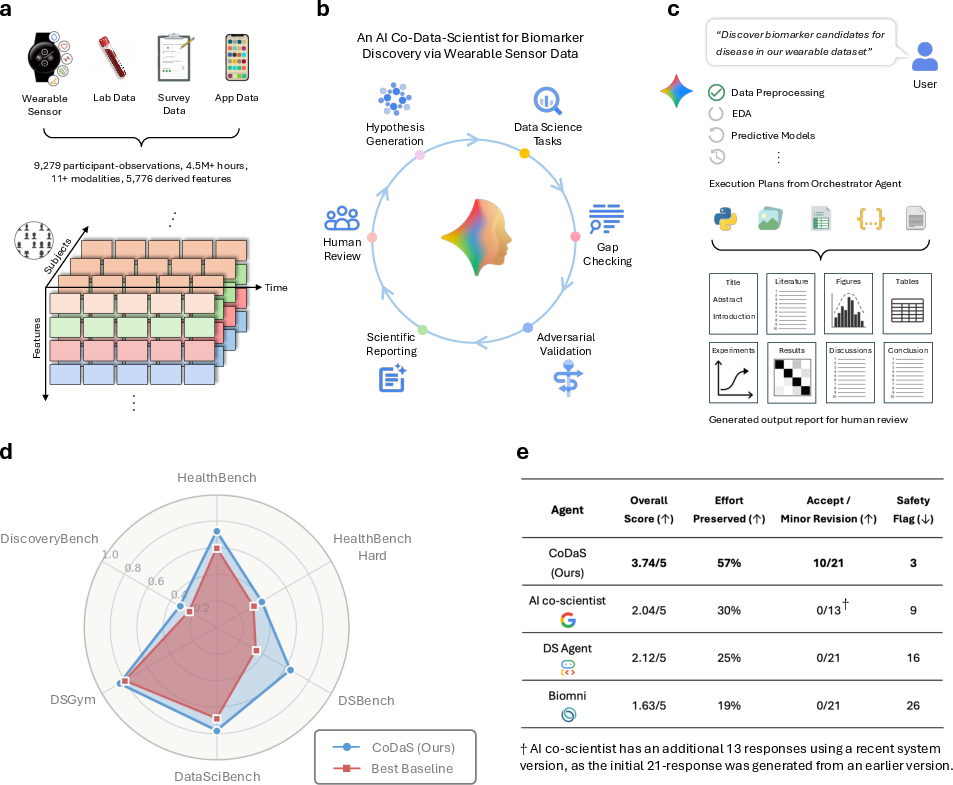
Figure 1: The CoDaS system takes longitudinal multimodal data, orchestrates a closed-loop discovery lifecycle, and executes phased plans via coordinated agents under human supervision, with robust benchmarking and expert evaluation.
The system enforces stringent anti-leakage protocols (variable exclusion, monotonic relationship gating, discovery-evaluation isolation), a structured 11-check internal validation battery (replication, permutation, bootstrap, influence, subgroup consistency, triangulation, construct validity, causal robustness, independence, CI stability, discriminative power), and deterministic reporting via an LLM-uneditable Fact Sheet.
Data Modalities and Evaluation Cohorts
CoDaS was benchmarked on three large-scale datasets to stress the pipeline across complementary axes:
- Digital Wellbeing (DWB): N=7,497, high-frequency multimodal wearable and smartphone monitoring for depression severity (PHQ-8).
- GLOBEM: N=704, longitudinal passive sensing across multiple academic years with inherently sparse, noisy data; targets depression via PHQ-4/BDI-II.
- WEAR-ME: N=1,078, cross-sectional linkage of wearable aggregates to clinical laboratory panels targeting insulin resistance (HOMA-IR).
Each dataset foregrounds different analytical challenges: dense continuous time series, severe feature missingness with temporal confounding, and integration of noninvasive and clinical features, respectively.
Empirical Results
Digital Mental Health Biomarkers
In DWB, CoDaS autonomously identified sleep duration variability as the top correlate for depression severity (ρ=0.252, 95% CI [0.23, 0.27], p<0.001), congruent with established literature, verifying the pipeline's capacity to recover known clinical associations. Other high-priority features include nocturnal social app usage, late-night “doomscrolling”, night-to-day social media/activity ratios, and polyphasic sleep metrics, all supported by plausible mechanistic hypotheses derived from literature grounding.
Incremental modeling showed modest but statistically robust improvements upon adding CoDaS-generated biomarkers, with ΔR2=0.040 for depression severity prediction over demographic covariates. Empirical findings are consistent with the intrinsic signal limitations of passive, low-burden modalities in mental health.
Cross-Cohort Construct Replication
Construct-level convergence was observed across DWB and GLOBEM, with both cohorts prioritizing circadian instability features (sleep duration/onset variability) as candidate depression biomarkers—despite differences in age, population, and data structure. Discriminative performance in GLOBEM was near chance (AUC = 0.535), reflecting heavy missingness and endpoint coarseness, but the emergence of the same underlying construct across cohorts increases the likelihood of generalizability beyond dataset-specific artifacts.
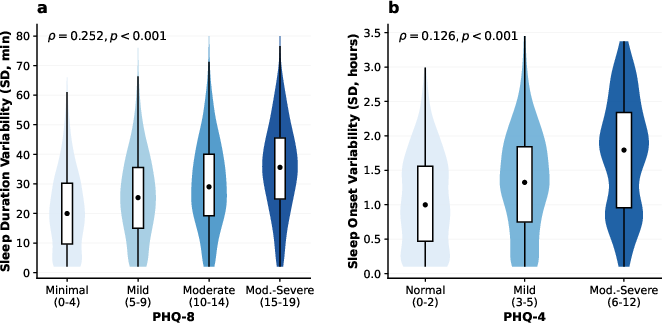
Figure 2: Sleep-timing variability features show monotonic association with depression severity, supporting construct-level convergence across diverse wearable and behavioral cohorts.
In WEAR-ME, CoDaS surfaced a noninvasive cardiovascular fitness index (steps/resting HR, ρ=−0.374, p<0.001) and a hepatic function marker (AST/ALT ratio, ρ=−0.375) as top predictors of insulin resistance, on par with known clinical laboratory features. The construct independence gate successfully excluded tautological proxies (e.g., TG/HDL ratio) that would otherwise leak target signal into the biomarker set. The contribution of new wearable-derived biomarkers yielded an incremental ΔR2=0.021 over demographics.
Ablation and Safety
Module ablations confirmed the necessity of adversarial debate and anti-leakage protocols: disabling these led to catastrophic overfit (e.g., CV R2 inflated to 0.963 in WEAR-ME). Removing the Scout agent (data/target profiler) or literature grounding significantly reduced both statistical power and result interpretability, highlighting the criticality of initial hypothesis seeding and empirical-theoretical integration.
Benchmarking
CoDaS achieved state-of-the-art or competitive results on six international open benchmarks for analytical reasoning, code generation, hypothesis generation, and clinical discourse (HealthBench, DataSciBench, DSBench, DiscoveryBench, DSGym). Performance exceeded prior best models by 7–30+ percentage points on various axes. Key patterns favor multi-round, agentic, and deterministic–generative hybrid systems.
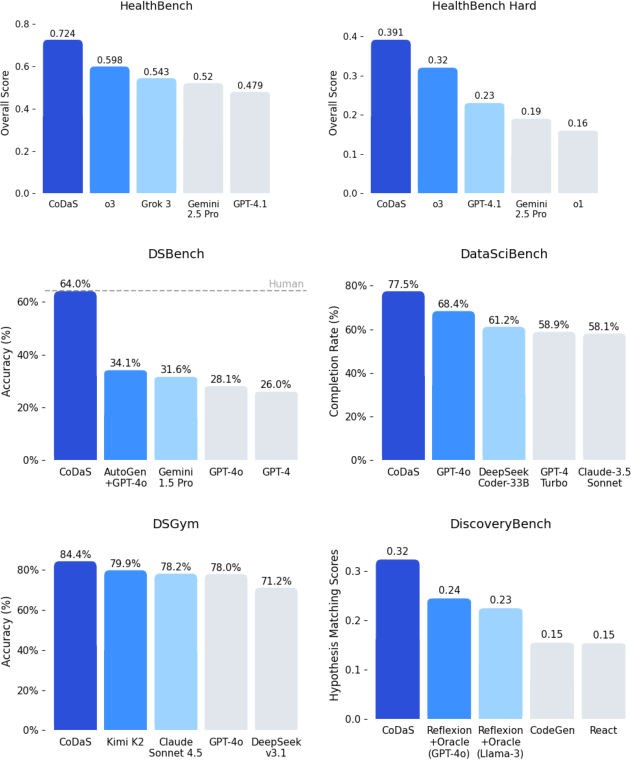
Figure 3: Across diverse analytical benchmarks from medical reasoning to causal inference, CoDaS achieves or surpasses state-of-the-art model and agent system performance.
Human Expert Evaluation
A quadruple-blind user study with 15 domain experts and 34 sessions ranked CoDaS highest in 69% of comparisons, with 86% of its manuscripts rated non-rejectable versus 0–15% for baselines (AI co-scientist, Data Science Agent, Biomni). Mean Likert scores per quality axis (novelty, soundness, validity, limitations, etc.) ranged from 3.1 to 4.1 for CoDaS, with baselines clustering at 1.3–2.6. Experts retained a mean 56.9% of CoDaS-generated content (5–95% range), versus <31% for any baseline; the mean human effort required for manual replication was estimated at 37 person-days. Safety flag incidence was an order of magnitude lower than alternatives—only 3 minor flags for CoDaS.
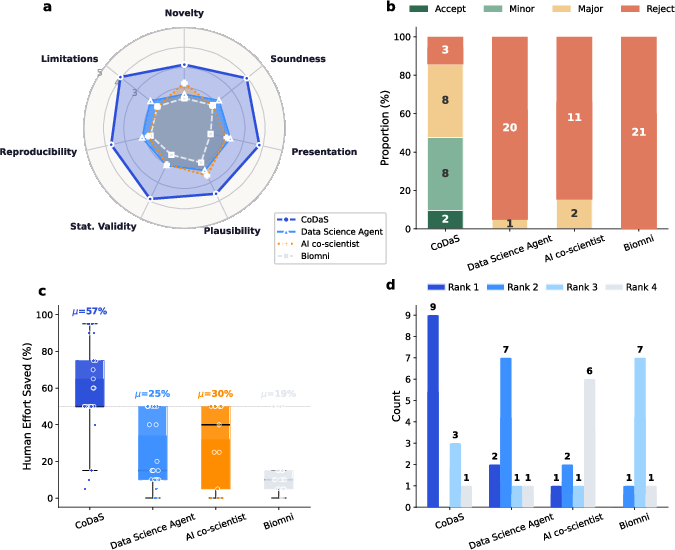
Figure 4: CoDaS manuscripts receive higher mean expert scores, more non-reject editorial decisions, and greater effort preservation than all baseline systems in blind review.
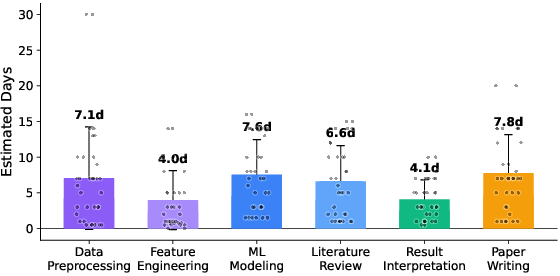
Figure 5: Experts estimate a mean of 37 person-days for manual replication; automated runs are completed by CoDaS in 6–8 hours.
Theoretical and Practical Implications
CoDaS demonstrates that principled, reproducible, agentic AI systems can autonomously drive the entire hypothesis-to-first-draft pipeline for wearable-generated biomarker discovery, including stringent statistical robustness assessments and explicit mechanism/narrative coupling. The system outperforms both monolithic and single-pass code-generation baselines in both empirical statistical rigor and perceived expert utility, largely due to its integration of adversarial self-critique and human-in-the-loop safety valves.
A salient claim of the study is that the central bottleneck in digital biomarker science has transitioned from manual analysis bandwidth to the secondary bottleneck of external prospective validation—the system can now surface validated, interpretable candidate hypotheses at an interval bounded primarily by compute and human review bandwidth.
Practically, this architecture has immediate utility as a high-throughput discovery interface for clinical or translational research teams seeking to prioritize candidate digital biomarkers across disease domains and heterogeneous data pipelines. The separation of deterministic analytics from generative, interpretive, and synthetic reasoning substantially reduces the risk of analytical hallucination and leakage, which are major concerns for LLM-based systems in biomedicine. However, current limitations include fixed agent topology, static endpoint selection, and narrow disease contexts (mental health, metabolic risk), with generalizability to non-wearable and broader phenotypes still an open question.
From the perspective of AI research, CoDaS serves as a template for constructing modularized agentic architectures in scientific domains where spurious correlations, interpretability constraints, and auditability are paramount, integrating iterative, literature-grounded reasoning with deterministic code execution. This approach is extensible to other high-stakes scientific and engineering tasks, contingent on incorporating human oversight and robust validation mechanisms.
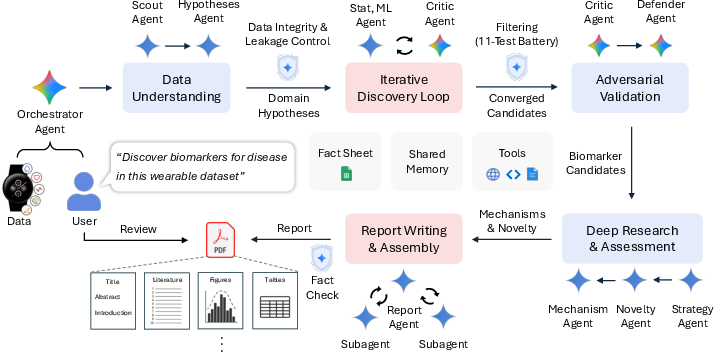
Figure 6: The orchestrator coordinates segregated agents for data profiling, hypothesis generation, empirical analysis, adversarial validation, novelty research, and automated report assembly; all steps underpin traceability and safety.
Conclusion
CoDaS constitutes a significant advancement in deploying agentic, multi-step LLM-driven architectures for autonomous, audit-ready biomarker discovery from population-scale wearable streams. It addresses critical unsolved challenges in robustness, leakage prevention, interpretability, and collaboration with domain experts, validated on rigorous benchmarks and expert-blinded evaluation. Future trajectories include generalization to additional phenotypes, exposure to broader data sources, integration of meta-agents for dynamic agent graph reconfiguration, and incorporation of causal inference and prospective replication. The modular, validated, and human-in-the-loop design principles instantiated here will underpin future developments in safe, productive scientific AI (2604.14615).
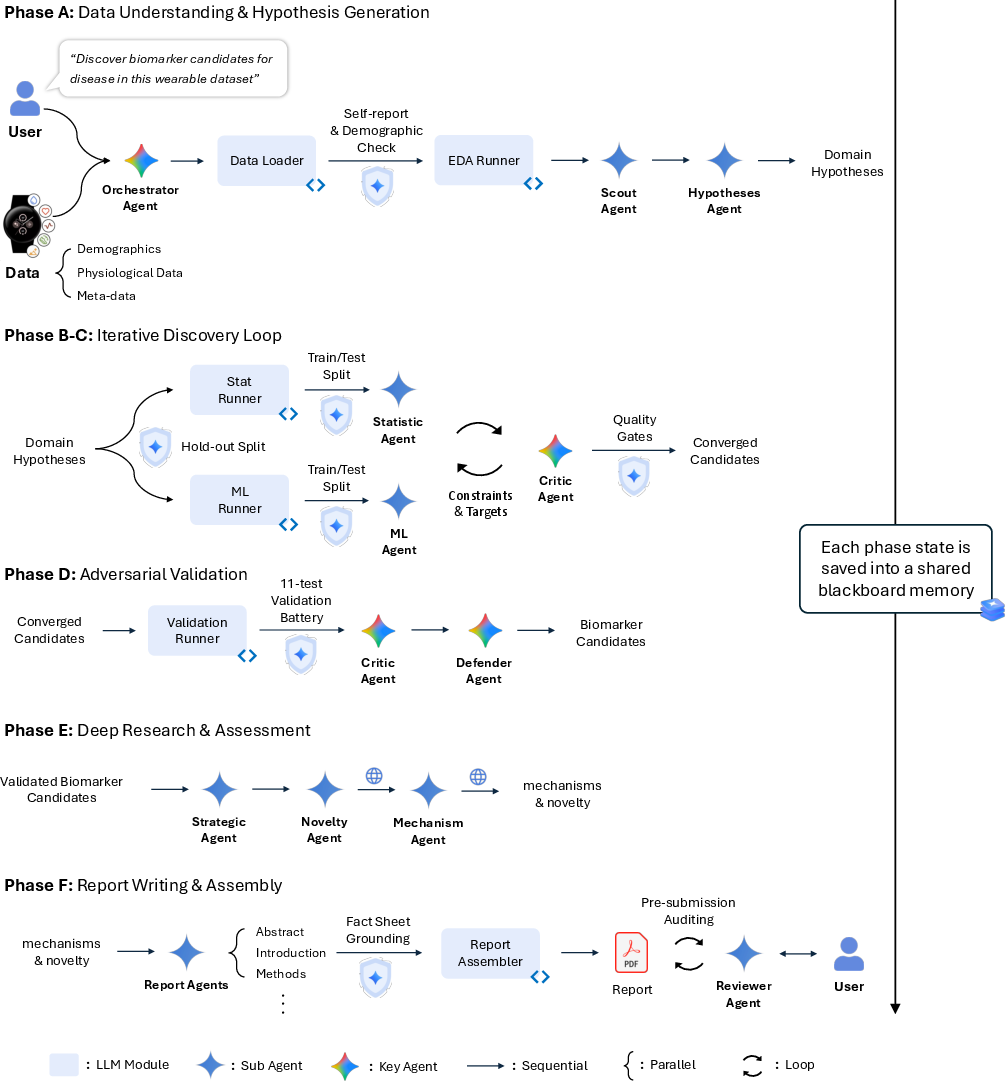
Figure 7: The full system architecture, detailing sequential phase-specific agent specialization, adversarial stress testing, and safety-oriented adjudication prior to report generation.