- The paper provides a comprehensive experimental and DFT investigation of Raman-active phonons in orthorhombic LaInO3.
- It deploys polarization-resolved Raman spectroscopy and hyperspectral deconvolution to resolve and assign 19 out of 24 predicted modes within 10 cm⁻¹ accuracy.
- The detailed Raman tensor analysis offers precise insights into lattice strain, phonon symmetries, and interface effects in oxide heterostructures.
Lattice Dynamics and Complete Polarization Analysis of Raman-Active Modes in LaInO3
Introduction
The manuscript "Lattice dynamics and complete polarization analysis of Raman-active modes in LaInO3" (2604.15156) delivers a comprehensive experimental and theoretical investigation of the lattice-dynamical properties of orthorhombic LaInO3 (LIO). Motivated by the emerging role of LIO as a nearly lattice-matched substrate for BaSnO3-based oxide heterostructures, the work aims to elucidate the symmetry, frequency, and polarization selection rules of all Raman-active zone-center phonons. The approach synergistically combines state-of-the-art, polarization-angle resolved Raman spectroscopy on high-quality bulk single crystals with density functional perturbation theory (DFPT) calculations, allowing for reliable symmetry assignments and quantitative tensor analysis even in the presence of strong spectral overlap and optical anisotropy.
Experimental Methodology
The experimental analysis centers on polarization-resolved, backscattering Raman spectroscopy, performed on single-domain, bulk LIO crystals with well-defined (100), (010), (001), and (101) surface orientations. The experimental geometry enables full angular dependence of Raman intensities as a function of in-plane polarization rotation ϕ, as well as the use of both parallel and crossed polarization detection. The authors implement a multi-faceted fitting strategy, leveraging hyperspectral deconvolution across the multi-geometry, multi-angle data to extract reliable mode frequencies and relative Raman tensor elements, robust against strong mode overlap and birefringence-induced modifications of the optical field.
Theoretical Approach
The lattice-dynamical calculations are performed within the DFT framework, employing PBE exchange-correlation functionals, norm-conserving pseudopotentials, and dense Brillouin-zone sampling. The full phonon spectrum, Γ-point vibrational eigenvectors, and site-resolved vibrational densities of states (pDOS) are reported. To counteract the systematic underbinding characteristic of GGA functionals, the computed phonon energies are scaled by an empirically derived factor of 1.023, yielding excellent agreement with experiment.
Symmetry Analysis and Selection Rules
LaInO3 crystallizes in the orthorhombic Pnma (No. 62, D2h16) space group, with 20 atoms per primitive cell, resulting in 60 phonon branches at the zone center. The symmetry decomposition yields 24 Raman-active modes (7Ag, 5B1g, 30, 31), of which 19 are experimentally resolved and unambiguously assigned by polarization selection rules, tensor analysis, and comparison with calculated frequencies.
The experiment-theory agreement for the assignment of irreducible representations and mode frequencies is consistently within 10 cm32. Modes associated with indium-site displacements are IR-active but not Raman-active due to inversion symmetry at the 4b Wyckoff position.
Experimental Results: Raman Spectra and Polarization Dependence
The polarization-resolved Raman spectra exhibit the expected symmetry selection rules for all measured crystal faces, with distinct angular profiles for each mode symmetry. Notably, the use of the (101) face allows detection of all Raman symmetries in a single experiment, greatly enhancing modal assignment confidence.
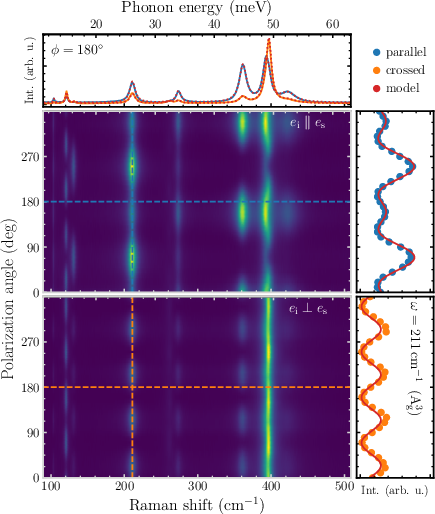
Figure 1: Polarization-angle resolved Raman spectra for the (100) face, showing angular modulation of Raman intensities for each symmetry channel.
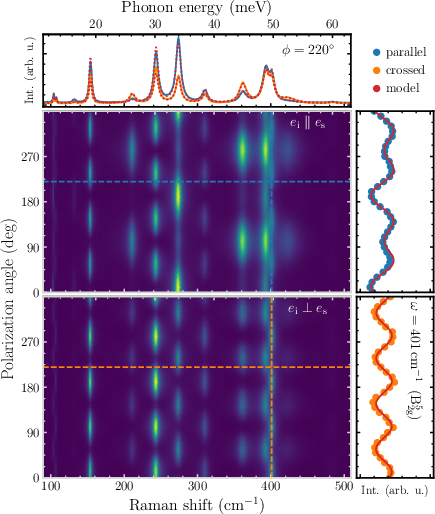
Figure 2: Polarization-angle resolved Raman spectra of the (010) plane, with detailed intensity profiles and overlap analysis for the 33 and 34 modes.
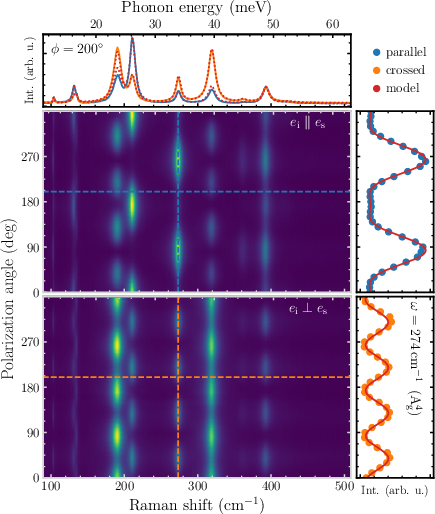
Figure 3: Polarization-angle resolved Raman spectra for the (001) plane, exemplifying the strong selectivity of symmetry-resolved detection.
The multidimensional fit yields high-fidelity deconvolution for all symmetries, including modes with substantial spectral overlap—e.g., in the 390–405 cm35 range—by exploiting the contrasting polarization signatures. For each identified mode, the dominant tensor element and its intensity anisotropy are extracted, incorporating corrections for birefringence and transmission effects inherent to the optically anisotropic LIO crystal.
Ab Initio Phonon Dispersion, pDOS, and Eigenvector Analysis
The ab initio phonon dispersion reveals a separation of the vibrational spectrum into low-frequency branches dominated by La displacements and high-frequency regimes governed by O and In motions, with the latter mainly visible in IR activity due to their site symmetry.
The comparison of mode eigenvectors shows that several Raman-active high-frequency modes are associated with collective O stretching in nearly ideal InO36 octahedra. Their experimentally observed weakness or absence is consistent with the lack of Jahn-Teller activity for closed-shell In37, mirroring trends in other non-Jahn-Teller perovskites and confirming the rationalization offered by eigenvector symmetry analysis.
Quantitative Raman Tensor Determination
A singular strength of this work is the direct extraction of mode-resolved Raman tensor element ratios, normalized by the mode-dependent scattering prefactors. The precise and internally consistent tensor values allow for quantitative comparison with other perovskites, as well as for predicting the Raman response under arbitrary polarization configurations. This is of direct value for future studies of strain, defects, and interface phenomena in LIO-based heterostructures, where the polarization fingerprints of emergent or modified modes are central to interpretation.
Implications and Future Directions
This comprehensive polarization-resolved mapping and its synergy with first-principles calculation establish LIO as a model system for oxide perovskite Raman analysis, setting a rigorous experimental-theoretical baseline for mode assignment and tensor quantification. In practical terms, the tensor-resolved fingerprints will enable precise monitoring of structural phase transitions, lattice strain, compositional modulation, and interface-induced symmetry breaking in future device-relevant LIO/BSO heterostructures.
The results additionally serve to constrain and validate ab initio methodology for zone-center phonon calculations in similar anisotropic, highly correlated oxides, supporting their use in computational materials discovery and rational device engineering.
Further expansion could target the full mapping of IR-active modes (beyond Raman selection rules), explicit phonon–defect interactions, or non-linear (second-order or resonance) Raman processes, augmented by advanced experimental geometries or ultrafast spectroscopy. The reported methodology is readily adaptable to alloyed or doped LIO derivatives, enabling systematic studies of phonon-mediated transport and optical effects relevant for next-generation oxide electronics.
Conclusion
This work provides a definitive polarization-resolved spectroscopic and first-principles account of the Raman-active lattice vibrations in orthorhombic LaInO38, yielding complete symmetry assignments, robust tensor element extraction, and theoretical insight into the vibrational properties. The combined experimental and computational strategy sets a benchmark for perovskite oxide lattice dynamics studies, with direct implications for the characterization and engineering of functional LIO-based oxide heterointerfaces and devices.