- The paper introduces the Mixup Euler Characteristic Profile to capture topological changes and accurately detect regime transitions in dynamical systems.
- It combines phase-space reconstruction, permutation testing, and multi-delay embedding to robustly signal bifurcation shifts even under significant noise.
- Empirical evaluations on canonical models and real-world datasets demonstrate marked improvements over traditional detection methods.
Regime Transition Detection in Dynamical Systems with the Mixup Euler Characteristic Profile
Introduction and Theoretical Motivation
The paper introduces a novel framework for regime transition detection in dynamical systems, leveraging the Mixup Euler Characteristic Profile (Mixup ECP) as a fundamental signal (2604.15262). The central challenge addressed is the reliable identification of bifurcation-driven regime shifts from noisy scalar times series where the control parameter and equations of motion are unknown. Traditional signal-processing approaches, including CUSUM, rolling mean, recurrence analysis, and Lyapunov exponents, exhibit limited sensitivity to topological changes, particularly when transitions are gradual or obscured by noise.
The Mixup ECP quantifies the Euler characteristic of the intersection between ball unions constructed from adjacent delay-embedded trajectory segments, as a function of the filtration scale r. This construction directly captures topological discordances between attractors, serving as a robust statistic for regime change even under nonideal observational circumstances.
Methodological Architecture
Phase-Space Reconstruction and Windowing
The input time series is embedded via Takens' delay-coordinate map, producing trajectory point clouds in Rd capable of capturing attractor geometry. At each putative transition time t, pre- and post-transition windows, Xt and Yt, are extracted from the embedding.
Mixup ECP Statistic
For each candidate time t, three Euler characteristic curves are computed: χX(r), χY(r), and χX∪Y(r), using Alpha complexes. The Mixup ECP is defined as Δχ(r;X,Y)=χX(r)+χY(r)−χX∪Y(r). By virtue of the Intersection Theorem, this equals Rd0, i.e., the Euler characteristic of the intersection of ball unions (the geometric overlap region).
The topological detection statistic is Rd1, which is large when both windows belong to the same regime (rich overlap, high topological coherence) and suppressed when a bifurcation occurs (weak overlap).
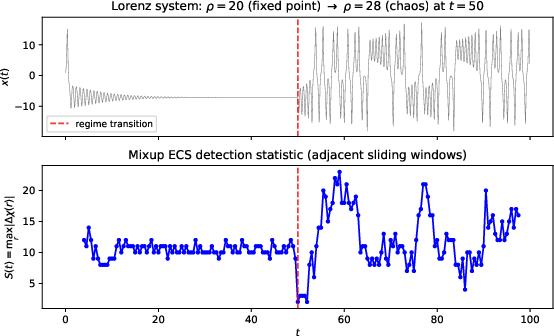
Figure 2: Mixup ECP detection of the Lorenz system bifurcation at Rd2: time series, detection statistic, and Complexity Variance.
Complementary Detection Signals
Three additional signals are included:
- Complexity Variance (Rd3): Quantifies rapid changes in geometric spread of the embedded point cloud, complementing the purely topological Rd4 and showing robustness to moderate noise.
- Higuchi Fractal Dimension (Rd5): Captures dynamic differences in time-domain statistical self-similarity.
- Rolling Mean (Rd6): Baseline amplitude detector.
The four signals are fused by averaging the peak/trough locations, yielding robust detection particularly when transitions are weak in any single modality.
Power, Optimality, and Theoretical Properties
- Permutation-Based Hypothesis Test: The regime detection is formalized via a permutation test with low-side rejection: Rd7 is that pre- and post-windows sample the same attractor; Rd8 is that their Euler characteristic profiles differ. The test is both valid and consistent under reasonable sampling assumptions, and yields strong separation on synthetic benchmarks.
- Variance–Topology Connection: The variance of the embedded cloud controls the support of the nontrivial region of the ECP. Complexity Variance thus provides, in effect, a geometrical derivative of the ECP's domain of informativeness.
- Multi-Delay Extension: Embedding at Rd9 delays and computing t0 automatically selects the embedding timescale that maximizes regime discriminability, thus dominating any fixed-delay approach.
Empirical Evaluation
Canonical Dynamical Systems
- Lorenz System: The Mixup ECP statistic t1 sharply discriminates the fixed-point to chaos bifurcation at t2, with a pronounced dip at the transition and high values in the interior of each regime. Complexity Variance (t3) captures the geometric attractor expansion (Figure 1).
- Logistic Map: Each period-doubling and the onset of chaos are cleanly detected as jumps in t4. The correlation with the largest Lyapunov exponent is t5.
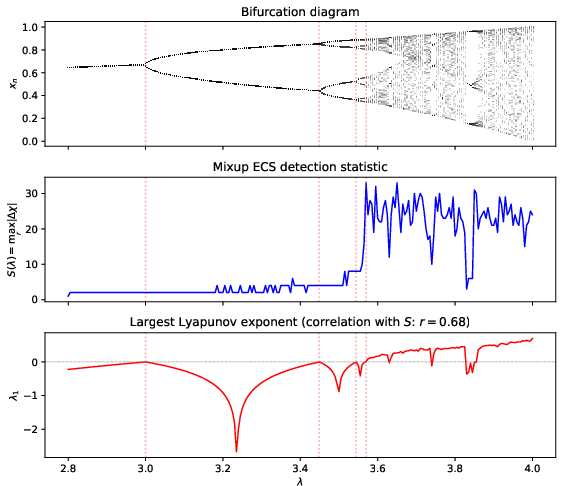
Figure 4: Logistic map: bifurcation diagram, Mixup ECP detection statistic, and largest Lyapunov exponent, with strong alignment at transitions.
- Noise Robustness: Moderate noise amplifies the Mixup ECP signal (thickening point clouds and increasing intersection features) up to saturation; t6 remains stable until extreme noise dominates geometry (Figure 5).
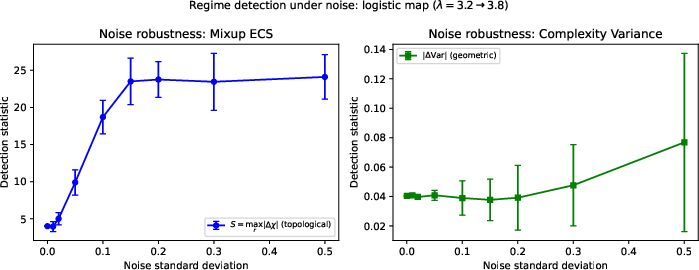
Figure 6: Noise robustness for the Mixup ECP and Complexity Variance on the logistic map; the topological signal saturates for t7.
Geophysical and Neural Systems
- Monsoon Onset: On the Indian/Nepal and WNP monsoon datasets, the combined method provides 32–50% MAE reduction over rolling mean/CUSUM, demonstrating decisive benefit in low-SNR, gradual-onset cases. When onset is sharp (Kerala), improvement is minimal, consistent with expectations.
- ENSO: Major El Niño/La Niña regime transitions produce elevated t8 coinciding with physical phase shifts; amplitude excursions are independently caught by t9 (Figure 7).
- EEG (Synthetic): Seizure epochs result in Xt0 minima, allowing for accurate ictal detection via low-side rejection (Figure 8).
Discussion and Implications
The Mixup ECP method demonstrates that regime transition detection is substantially enhanced by topological signals, especially when transitions do not produce distinguishable changes in statistics or amplitude. The explicit exploitation of attractor shape and overlap (rather than just magnitude or variance) allows bifurcations with identical univariate summaries to be reliably discriminated.
Practical applications are numerous: climate (ENSO, monsoons), neuroscience (seizure prediction), fluid dynamics, and generally any nonlinear system where access is restricted to low-dimensional, noisy observations. The method is numerically stable, provably consistent, requires only a modest increase over baseline TDA cost (Xt1 per time step at Xt2), and is interpretable.
The theoretical connection between variance and topological support provides guidance for signal fusion, and the multi-delay extension ensures that the most discriminative timescale is always accessible, automatically addressing the embedding ambiguity inherent in time series TDA.
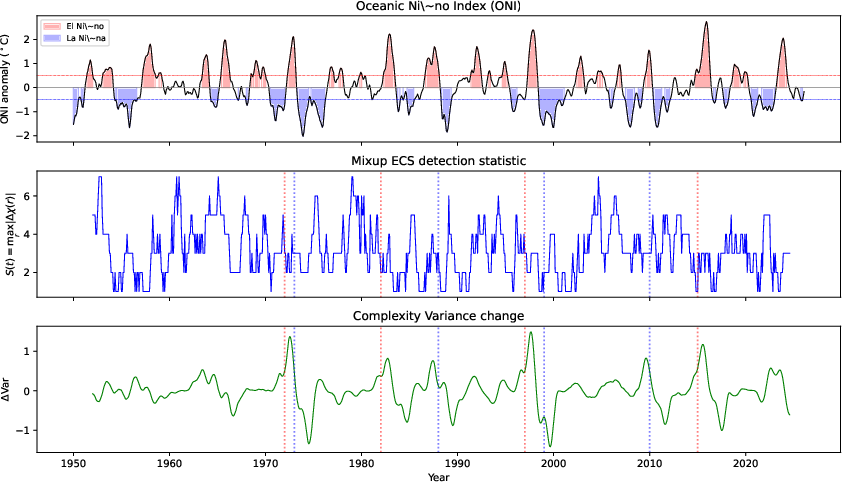
Figure 9: ENSO regime transitions detected by Mixup ECP (middle) and Complexity Variance (bottom), aligned to major episodes in the ONI index (top).
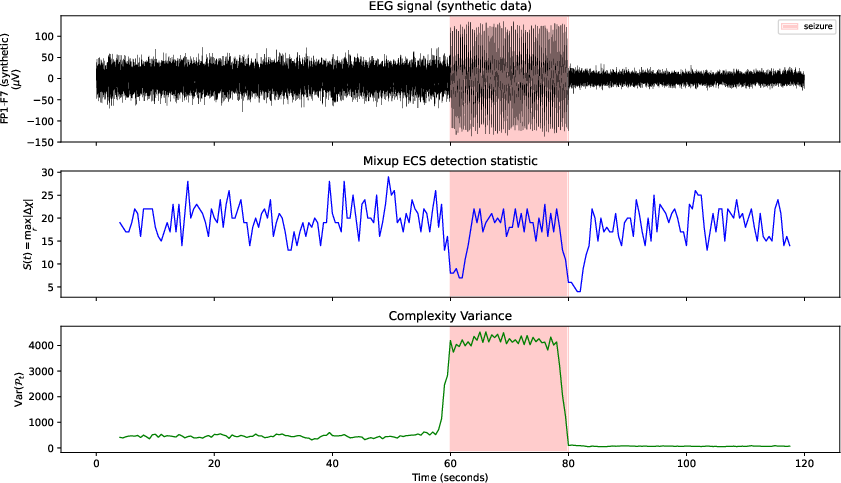
Figure 10: Synthetic EEG—seizure epoch yields depressed ECP statistic (middle) and a spike in Complexity Variance (bottom).
Conclusion
This framework delivers rigorous, operationally efficient detection of regime transitions driven by bifurcations in nonlinear dynamical systems. The Mixup ECP, with its built-in null, multi-scale sensitivity, and stability, serves as a robust backbone, and combined with geometric and fractal descriptors, attains strong empirical performance across synthetic and real-world high-impact time series. Future work should extend to clinical EEG, hybrid ECS-TDA supervised classifiers, and predictive early-warning scenarios in climate and neuroscience.
Reference: "Detecting Regime Transitions in Dynamical Systems via the Mixup Euler Characteristic Profile" (2604.15262).