- The paper rigorously analyzes conditions for one-shot straight-line generative flows under independent endpoints, providing equivalence theorems and balance laws.
- It demonstrates explicit Gaussian constructions where flows are affine in time, enabling exact simulation with a single velocity evaluation.
- The paper establishes impossibility results for multi-modal target distributions, highlighting the critical role of endpoint coupling.
One-Shot Generative Flows: Existence and Obstructions
Introduction
This work rigorously analyzes the structural question concerning the existence and non-existence of one-shot straight-line generative flows under endpoint independence, a setting motivated by practical concerns in generative modeling. Specifically, the authors ask: Given source and target distributions P0 and P1, when can a stochastic process (Xt)t∈[0,1] with independent endpoints (X0,X1)∼P0⊗P1 induce a flow whose sample paths are affine in t and, consequently, which can be integrated exactly in a single step?
The discussion is framed via a dynamical transport perspective, encompassing and unifying several recent classes of models including stochastic interpolants, flow matching, score-based probability flow ODEs, and rectified flows. Computational efficiency for these methods is contingent on the geometry of the generative flow; straight-line flows are of particular interest since they permit exact simulation with just one velocity evaluation. Determining existence, constructive realizability, and limitations of such flows under endpoint independence is thus of both theoretical and algorithmic significance.
Analytical Characterization of Straight-Line Flows
The paper provides multiple formal characterizations of straight-line flows. The key equivalence established is:
- The process X∙ induces vanishing pointwise acceleration: ∂ttϕt(x)≡0
- The conditional velocity satisfies the material derivative vanishing everywhere: Dtvt=∂tvt+(vt⋅∇)vt=0
- A new balance law involving the marginal density ρt, the Reynolds-type conditional covariance tensor Πt, and ensemble acceleration P10:
P11
This equivalence anchors the rest of the exposition theoretically and provides concrete means for explicit construction or impossibility proofs. Notably, affine processes of the form P12 yield straight-line flows if and only if the endpoint coupling is deterministic (i.e., P13 almost surely for some map P14 with positive definite Jacobian).
Explicit Construction with Gaussian Endpoints
A main positive result is that, under endpoint independence, explicit and computable straight-line flows exist when both P15 and P16 are Gaussian. The authors derive and analyze generalized interpolant processes of the form
P17
where P18, P19, and (Xt)t∈[0,1]0 is an independent Gaussian variable with appropriate covariance to ensure that the overall conditional statistics make the flow exactly affine in (Xt)t∈[0,1]1. This construction is carried out for (Xt)t∈[0,1]2, the multivariate commutative, and the non-commutative case.
Visualization of straight-line path families for various Gaussian settings is presented to illustrate the sample-path geometry and the precise affine behavior enforced by this construction. For each case, the time-indexed flow maps from grids of initial conditions trace nonintersecting, straight trajectories and, by computation, the conditional acceleration and Burgers-type equation are shown to vanish identically.
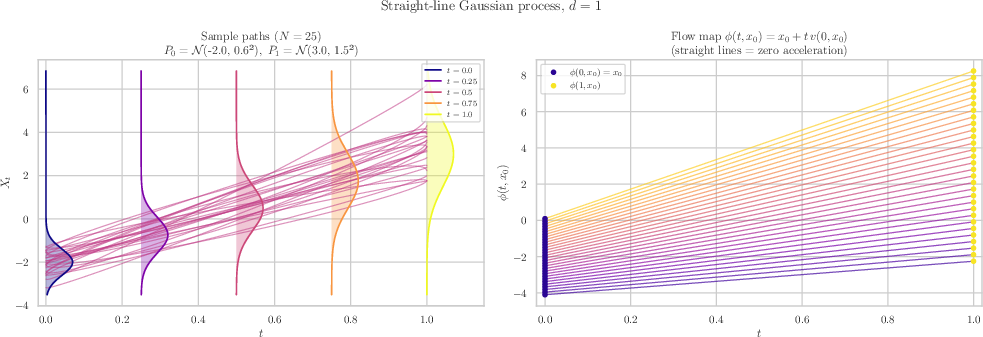
Figure 1: Straight-line Gaussian process for (Xt)t∈[0,1]3 with endpoints (Xt)t∈[0,1]4, (Xt)t∈[0,1]5. Left: 25 sample paths with marginals. Right: flow map from initial grid; all trajectories are straight, confirming zero acceleration.
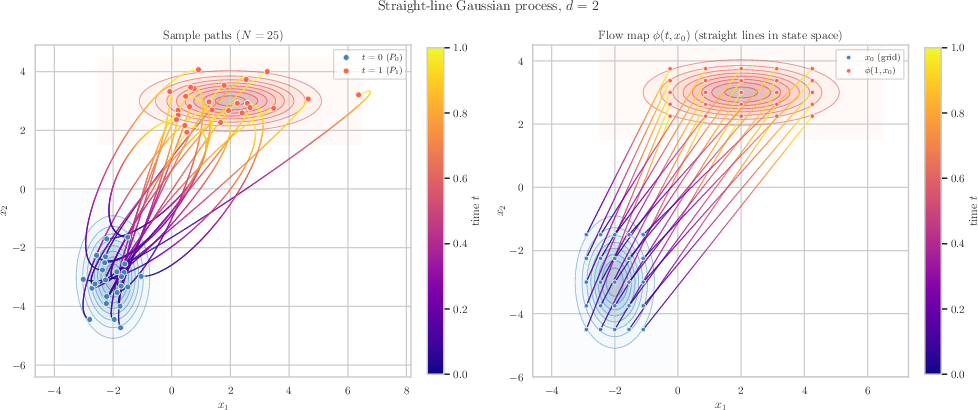
Figure 2: Straight-line Gaussian process for (Xt)t∈[0,1]6 with diagonal, commuting endpoint covariances. Left: 25 sample paths, colored by time. Right: flow map straightness from (Xt)t∈[0,1]7 grid.
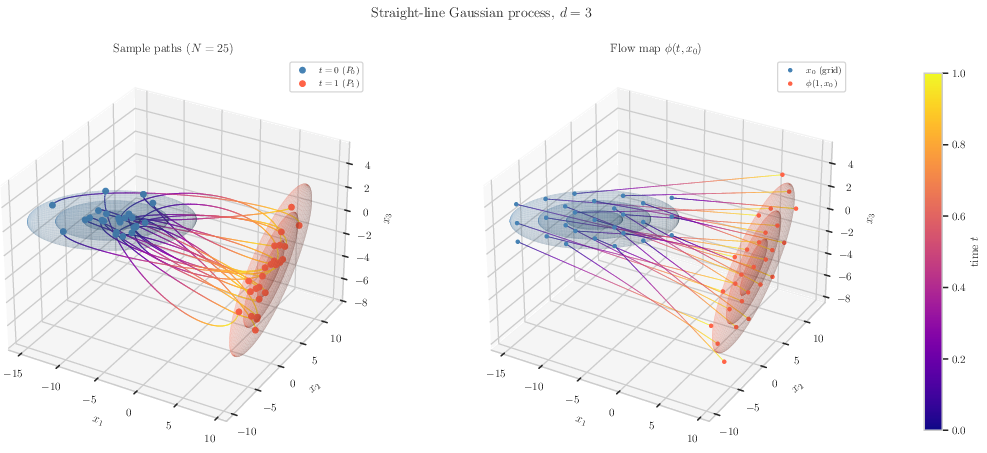
Figure 3: Straight-line Gaussian process for (Xt)t∈[0,1]8 with non-commuting covariances. Left: 25 sample paths, colored by time. Right: 3D flow map from (Xt)t∈[0,1]9 grid, with support ellipsoids at multiple sigma levels.
Impossibility Results for Multi-Modal Targets
The paper establishes explicit impossibility theorems showing that straight flows under endpoint independence cannot exist in broad classes of multi-modal or well-separated target distributions. Through a sequence of increasingly general impossibility results, it is shown that the geometry of straight-line flows and the structure imposed by endpoint independence are fundamentally incompatible when the target distribution exhibits sufficient modal separation. Three regimes are treated:
- Disconnected support in (X0,X1)∼P0⊗P10: For any (X0,X1)∼P0⊗P11 with support on disjoint intervals, it is proved that no continuous process with independent endpoints can generate a straight-line flow between (X0,X1)∼P0⊗P12 and itself. The proof leverages topological arguments regarding nonintersecting sample paths and space-time "no-go zones" that the flow map cannot cross.
- Disconnected support in (X0,X1)∼P0⊗P13: The result generalizes via construction of open "no-go" regions in state space that must be traversed to connect modes, which is impossible for straight-line flows with global injectivity.
- Connected or nearly connected support: Even for targets with modes that are only (X0,X1)∼P0⊗P14-weakly disconnected (e.g., mixtures of Gaussians with overlapping tails), the theorem shows that, for sufficiently small (X0,X1)∼P0⊗P15, endpoint-independent straight flows do not exist, under a regularity/concentration condition on sample paths. Sophisticated probabilistic/analytic arguments, including up-crossing inequalities and modulus of continuity, are used.
These negative results are formal barriers: the impossibility arises not from an algorithmic limitation or parameterization, but from the fundamental interplay between independence, straightness, and modal geometry.
Practical and Theoretical Implications
The dichotomy established is sharp: straight flows with endpoint independence are structurally possible precisely when the measures are sufficiently "unimodal and similar" (as for Gaussians), and impossible otherwise. Thus, endpoint-independent straight flows embody the best-case scenario for inference efficiency in generative modeling, but their applicability is sharply limited in the presence of multi-modality.
Several ramifications and open directions follow:
- The necessity of surrogate transport estimation (e.g., via OT or coupling-parameterizations) under multi-modal targets for efficient straight flows is underscored.
- The balance law and PDE formulation provide a framework to study intermediate cases (e.g., log-concave non-Gaussians) and to formalize approximate straightness or preconditioning strategies.
- Further work is needed to extend impossibility to higher dimensions with weaker support conditions, to construct processes for other structured unimodal distributions, and to sharply quantify the tradeoff between endpoint dependence and flow straightness.
Conclusion
This work provides a principled and exhaustive structural analysis of the existence and obstruction of straight-line generative flows under independent endpoints. Through equivalence theorems, explicit constructions, and hierarchy of impossibility proofs, the authors lay a rigorous foundation for understanding when one-shot generative transport is feasible without pre-computed transport maps. This theory covers both ends of the spectrum: efficient, explicit constructions in the Gaussian case and provable unattainability for multi-modal settings. The methodological advances and open questions outlined will inform future research on the theoretical limits and algorithmic design of transport-based generative models.