- The paper introduces a discrete-time AMM model with jump diffusion that reveals CEX–DEX arbitrage accounts for MEV volumes comparable to total pool activity.
- The paper employs high-frequency on-chain and CEX data to demonstrate that traditional continuous-path models significantly underestimate the frequency and profitability of arbitrage events.
- The paper’s integrated stochastic framework validates that inherent market dynamics, rather than protocol anomalies, drive MEV extraction across Ethereum platforms.
Revisiting the Origins and Magnitude of CEX–DEX Arbitrage MEV on Ethereum
Introduction
The extraction and allocation of Maximal Extractable Value (MEV) in Ethereum remains a central problem, structurally linked to both protocol design (notably proposer–builder separation, PBS) and the evolving dynamics between centralized exchanges (CEXs) and decentralized exchanges (DEXs). This paper challenges longstanding theoretical assumptions regarding the origin and magnitude of MEV, focusing on CEX–DEX arbitrage—often assumed to be minor in both empirical and analytical literature. By introducing a discrete-time AMM price model with explicit jump diffusion components, and empirically calibrating it with granular, high-frequency on-chain and CEX spot data, this work demonstrates that CEX–DEX arbitrage volumes and associated MEV are substantially greater than predicted by standard continuous-path models.
Analytical Shortcomings of Existing Theoretical Models
Previous models analyzing CEX–DEX dynamics, particularly those based on geometric Brownian motion (GBM) or the Black-Scholes (BS) SDE, uniformly assume continuous, small-scale price increments. This continuous path hypothesis severely underestimates the frequency and profit of arbitrage events, since stochastic jumps—characteristic of both asset prices and “shocks” observable in digital asset markets—are largely omitted. Empirical evidence presented corroborates that high-amplitude price jumps in ETH and other cryptocurrencies can dwarf instantaneous volatility, rendering the traditional Gaussian diffusion approach fundamentally mismatched for arbitrage modeling in the presence of real-world frictions and information lags.
Price Process Model with Stochastic Jumps
The paper proposes an extended discrete-time SDE, where the log-price process for CEXs is governed by both a diffusive (GBM-like) component and a compound Poisson jump term with arbitrary noise distributions:
Xn+1−Xn=μ+σεn+1+Zn+1Un+1
Here, (εn) are i.i.d. noise terms (not necessarily Gaussian), Zn is a Bernoulli sequence encoding jump occurrence, and Un are i.i.d. jump amplitudes. The model’s flexibility allows it to subsume the standard BS, Merton jump-diffusion, and Ornstein-Uhlenbeck processes.
CEX–DEX mispricing is then formalized as a Markov chain, where the DEX price lags the external market, and arbitrageurs intervene only when the log-mispricing exceeds transaction fees (modeled as absorbing boundaries). The invariant density of the misprice process exists, can be explicitly computed by function iteration, and converges geometrically fast to a stationary distribution.
Empirical Calibration and Main Findings
The model is parameterized using second-level spot price feeds from major CEXs (Binance, Kucoin, Gate.io) and on-chain Uniswap V2 transaction data (ETH/USDT and ETH/USDC pairs). A jump-detection threshold τ=2.0 (in units of local volatility) is employed to separate diffusive from jump-induced returns. Return series exhibit leptokurtic, non-Gaussian characteristics in line with prior findings in quantitative finance.
Crucially, the stochastic model, fitted to observed data and integrated over the stationary mispricing distribution, yields the following central results:
- CEX–DEX arbitrage volumes estimated by the model are of the same order as total pool activity, far outpacing noise trader flows and other MEV strategies (sandwich, atomic arbitrage), which are rare and marginal in aggregate.
- The model-predicted arbitrage profits closely match empirical MEV, especially after accounting for effective trading fees (DEX + CEX spreads), block confirmation latency, and exchange-specific liquidity frictions.
- The discrete jump model consistently explains discrepancies between observed arbitrage and volumes and those predicted by continuous-path models—the latter routinely underestimating arbitrage by orders of magnitude.
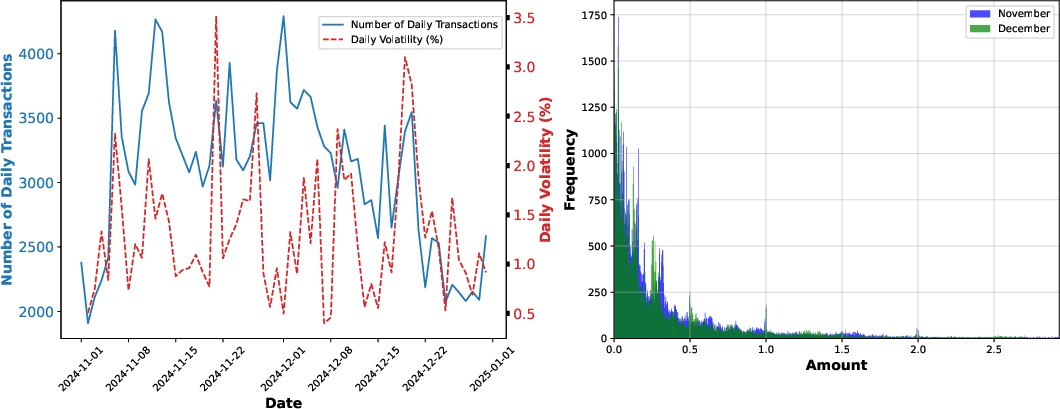
Figure 1: Daily volatility (%) versus number of DEX transactions per day for November–December 2024 (left), and histogram of exchanged ETH amounts during that interval (right), highlighting the lack of correlation between volatility and DEX activity.
Quantitative and Qualitative Implications
The incorporation of discrete jumps radically alters quantitative predictions. For standard Uniswap V2 pools, with Ethereum block times (12s) and realistic fee rates, model-based trade region coverage and arbitrage profit rates vastly increase with the inclusion of even low-probability, high-magnitude jumps. Statistical tests of hourly log returns on a variety of assets reveal fatter tails and pronounced skewness, underscoring the inadequacy of Gaussian models.
Trade volume histograms reveal that while swap counts are uniformly distributed across the no-arbitrage band, the vast majority of volume clusters at the boundaries—an empirical fingerprint of arbitrage. Thus, "noise trader" volume is consistently subordinate to profit-motivated, jump-induced arbitrage flows. The architecture of block builder incentives under PBS is thus driven by inherent market dynamics rather than protocol-level pathologies.
Model Validation and Sensitivity
Cross-validation on multiple AMM pairs, and sensitivity analysis with respect to spread parameters, confirm the robustness and explanatory power of the model. The observed insensitivity of the volume/profit ratio to fee levels and spreads demonstrates that arbitrage volume is a highly reliable proxy for MEV.
Notably, the model is capable of closely reproducing the numerical results of prior continuous-diffusion models when discrete jumps are suppressed (q=0), serving as a strict superset.
Theoretical and Practical Implications for MEV Research
Key claims established in this work:
- The predominant source of MEV is CEX–DEX arbitrage, not manipulative or “dark” strategies.
- A significant proportion of AMM volume is directly attributable to arbitrageurs reconciling DEX state with CEX price shocks.
- The arbitrage market exhibits characteristics of saturation: competitive pressure among searchers and block builders results in extracted value being fully rebated as priority fees.
- Previously used empirical heuristics for labeling CEX–DEX arbitrage likely underestimate true arbitrage volume.
The results imply that further protocol-level interventions (e.g., reducing block time) will not significantly reduce MEV, since arbitrage opportunities fundamentally arise from exogenous price discontinuities. The importance of modeling heavy-tailed, jump-rich dynamics is not only practical but also foundational for MEV forecasting and market mechanism design.
Conclusion
This paper advances the theoretical and empirical frontier by rigorously incorporating stochastic price jumps into models of CEX–DEX arbitrage on Ethereum, and demonstrates that MEV from such arbitrage is far larger, and more structurally rooted in market microstructure, than previously acknowledged. The mathematical framework is robust, generalizable, and empirically validated. It motivates shifting the focus of MEV research from exclusively on-chain phenomena to integrated, multi-venue price discovery and arbitrage. Future directions include extending the analysis to L2s/rollups, concentrated liquidity AMMs, and dynamic spread modeling.
References
For detailed background, methodology, and empirical context, see "Where Does MEV Really Come From? Revisiting CEX–DEX Arbitrage on Ethereum" (2604.15973).