- The paper introduces a multi-reference GW approach that integrates strong static correlation into a multi-determinantal framework.
- It employs a generalized Dyson equation and MR-RPA screening to yield accurate ionization potentials and capture many-body spectral satellites.
- Benchmarking on Be, stretched H₂, and ozone demonstrates that MR-GW restores causal spectral functions, outperforming standard GW.
Introduction and Motivation
The GW approximation (GWA) is a critical tool in many-body perturbation theory (MBPT) for describing single-particle excitation spectra of correlated electron systems. However, conventional GW, based conceptually on an underlying single-determinant reference and perturbation theory, is known to fail in the presence of strong static correlation, which is prevalent in multiconfigurational systems such as those with bond dissociation, biradicals, transition-metal complexes, and stretched molecular bonds. To address these challenges, this work introduces a multi-reference GW (MR-GW) approach that overcomes the single-reference limitations by non-perturbatively embedding strong correlation effects in a multi-determinantal zeroth-order reference and establishing a rigorous diagrammatic and Green's function formalism for this context.
The theoretical foundation of the MR-GW approach relies on generalizing the MBPT formalism to cases where the zeroth-order reference is interacting and multi-determinantal, i.e., when the reference state is a correlated wavefunction constructed from an active (strongly correlated) orbital space. Unlike in standard MBPT, for such references the application of Wick's theorem breaks down, rendering standard tools like the Dyson and Hedin equations inapplicable. Instead, the authors utilize the generalized Dyson equation derived by Hall for interacting references, which introduces a set of diagrammatic expansions for self-energies involving higher-order connected Green's function cumulants in the active subspace.
In this MR framework, the key steps are:
This formalism extends the GW self-energy by incorporating a screened interaction derived from a multi-reference RPA (MR-RPA), replacing the standard noninteracting polarizability with one that reflects excited states of the active manifold. The MR-GW self-energy contains the same class of diagrams as the standard GW, but with all Green’s functions and interactions replaced by their multi-reference analogs.
Numerical Results: Probing Strong Correlation
The performance of the MR-GW method is benchmarked on prototypical strongly correlated molecules, including Be, stretched H₂, and ozone. Across these cases, the MR-GW approach successfully remedies the breakdowns observed in single-reference GW, achieves improved accuracy for ionization potentials (IPs), and captures complex many-body spectral satellites—features that standard GW systematically misses.
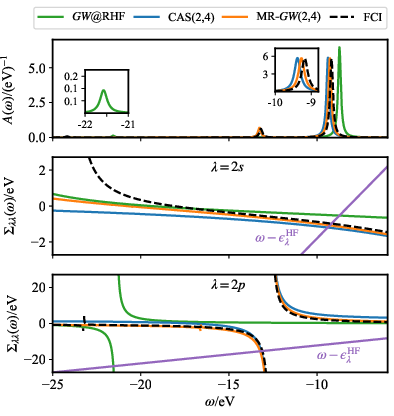
For example, in the Be atom, the MR-GW using a CAS(2,4) reference correctly locates a low-lying satellite peak associated with ionization from the nearly degenerate $2p$ orbitals, matching full CI results. Standard GW produces this satellite at excessively high energy and with markedly suppressed intensity.
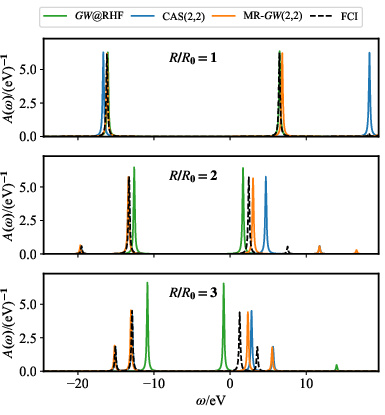
Figure 3: Spectral functions of \ce{H2} calculated by different methods at various bond lengths, illustrating the improved satellite and quasiparticle features captured by MR-GW over standard GW.
Stretched H₂, a canonical example of static correlation, further highlights the deficiencies of conventional GW—its performance degrades as bond stretching increases, failing to capture both the electron affinity and satellite structure. MR-GW, by contrast, closely reproduces full configuration interaction (FCI) benchmarks across the entire dissociation curve, as displayed in Figure 3.
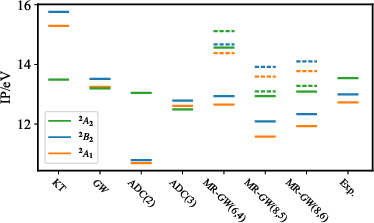
Figure 4: Vertical ionization energies (in eV) of \ce{O3} computed with various methods and compared to experiment, showing the accuracy and correct state order recovered by MR-GW.
Ozone (\ce{O3}), with pronounced biradical character, is a stringent test for any Green's function method. Standard GW and even single-reference ADC approaches fail to predict the correct ordering of the first ionized states and yield large quantitative errors in IPs. MR-GW, even with a minimal active space CAS(6,4), achieves the correct energetic ordering and considerably improved agreement with experimental ionization energies (Figure 4).
Theoretical and Practical Implications
The MR-GW formalism rigorously extends ab initio Green's function techniques into the multireference regime using a diagrammatic approach rooted in quantum chemistry principles:
- The method naturally interpolates between well-established single-reference GW (when the active space vanishes) and exact treatment of strong correlation in small active spaces.
- The diagrammatic construction ensures compatibility with highly optimized GW algorithms (e.g., resolution-of-identity, frequency integration, analytical gradients), allowing immediate extension to large-scale or solid-state systems, including transition-metal compounds and point defects where multireference character is crucial.
- MR-GW delivers the correct analytic structure for spectral functions, only involving first-order frequency poles, preserving causal and sum-rule properties essential for photoemission theory [see also cumulant GW+ approaches: (Deakin et al., 2024, Burungale et al., 2024)].
By eliminating the need for ad hoc double-counting corrections (prevalent in quantum embedding/DMFT+GW hybrids), MR-GW offers a theoretically consistent platform for both ground- and excited-state correlation in molecules.
Relation to Existing Methods and Future Directions
MR-GW synthesizes ideas from both MBPT and wavefunction-based quantum chemistry (e.g., multireference perturbation theory, MRPT), bridging disparate communities. Related developments include multireference algebraic diagrammatic construction (MR-ADC) for charged excitations (Yang et al., 2019, Zhang et al., 2020) and adiabatic connection fluctuation-dissipation methods with multireference references (Bassiliades, 2018, Engstrom et al., 2018). MR-GW complements recent progress in particle-particle RPA for excitation energies in correlated defects (Liu et al., 2024, Coleman et al., 2024, Song, 2024).
Numerical evidence presented here motivates further theoretical refinement, e.g., systematic incorporation of higher-order diagrams, explicit treatment of open-shell or degenerate ground states, and extension to periodic and embedding settings.
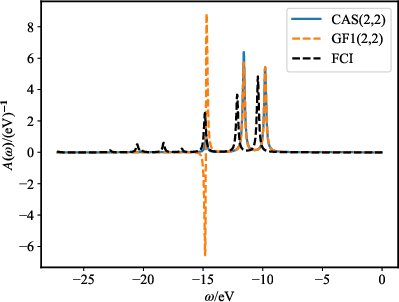
Figure 5: Calculated spectral functions of \ce{H4} by alternative approaches.
Conclusion
The multi-reference GW approximation, as formulated here in a diagrammatic, Green's function framework with an interacting Dyall reference, fills a longstanding methodological gap in the ab initio description of strongly correlated molecular systems. By capturing both dynamic and strong static correlation on equal footing, MR-GW delivers accurate spectroscopic predictions for systems where standard GW is fundamentally inadequate. This work opens a path for ab initio, scalable Green's function computations in the multireference regime, with wide-ranging implications for quantum chemistry and correlated materials research.
References
- "Multi-reference GW approximation for strongly correlated molecules" (2604.16013)
- Benchmarking and review articles on GW failures in multireference systems (jing et al., 2024, Deakin et al., 2024)
- Diagrammatic multireference RPA generalizations (Yoo et al., 21 Mar 2025, Orlicki, 10 Apr 2025)
- Adiabatic connection and cumulant approaches in multireference settings (Bassiliades, 2018, Engstrom et al., 2018)
- Multireference ADC: (Yang et al., 2019, Zhang et al., 2020)