- The paper demonstrates that all tested LLMs reverse established human cultural emotion patterns, inaccurately simulating European American and Latin American norms using robust statistical methods.
- The paper finds that LLMs amplify positive engaging emotions and show reduced response variability compared to human participants, undermining authentic cultural simulation.
- The paper highlights that standard interventions like temperature tuning and forced-choice formats fail to correct deep-seated biases, stressing the need for culture-aware model supervision.
Misalignment in LLM Social Emotion Expression and Human Cultural Norms
Introduction
This paper ("Expressing Social Emotions: Misalignment Between LLMs and Human Cultural Emotion Norms" (2604.16757)) systematically investigates whether state-of-the-art LLMs faithfully express social emotions in a manner consistent with empirically documented human cultural norms. The evaluation focuses on engaging versus disengaging emotion expression across European American and Latin American personas, leveraging a direct comparison to an established cross-cultural human subjects study. Six leading LLMs are analyzed: DeepSeek R1, GPT-4o-mini, Gemini 2.5 Flash, Phi 4, Mistral 7B Instruct v0.3, and Qwen 3 32B. The results reveal significant and robust misalignments between LLM generations and observed human expression norms, particularly striking for the European American group, which is overrepresented in LLM pretraining corpora.
Evaluation Framework
LLMs were systematically prompted to simulate participants from European American (EA) and Latin American (LA; Mexican, Chilean) cultural backgrounds. Prompts replicated the exact methodological framework used in the referenced human study, in which participants rated the intensity (1–6 Likert) of twelve emotion categories (including engaging/disengaging; positive/negative; basic/social) for each of four everyday scenarios designed to elicit both independent and interdependent responses. The analysis focuses on summary contrasts central to cultural psychology (e.g., individualism–collectivism).
A distributional comparison paradigm is adopted: LLMs are sampled 190 times per prompt to match human sample sizes and to assess both modal tendencies and variability. Tests employ Mann-Whitney U for directionality and Wasserstein distance for effect magnitude.
Ablation studies test response sensitivity to sampling temperature, prompt language, and forced-choice (pairwise comparison) formats.
Main Findings: Systematic and Contradictory Misalignment
Failure to Capture Cultural Directionality
The paper demonstrates that all LLMs consistently reverse the observed human cultural pattern on social emotion expression. In the human study, LA participants express engaging emotions (e.g., guilt, friendliness) more and disengaging emotions (e.g., pride, anger) less, reflecting collectivist norms; EA participants do the opposite, in line with individualist norms. LLMs express engaging emotions more than disengaging emotions for both personas and in all models—the precise opposite of the empirically established EA pattern.
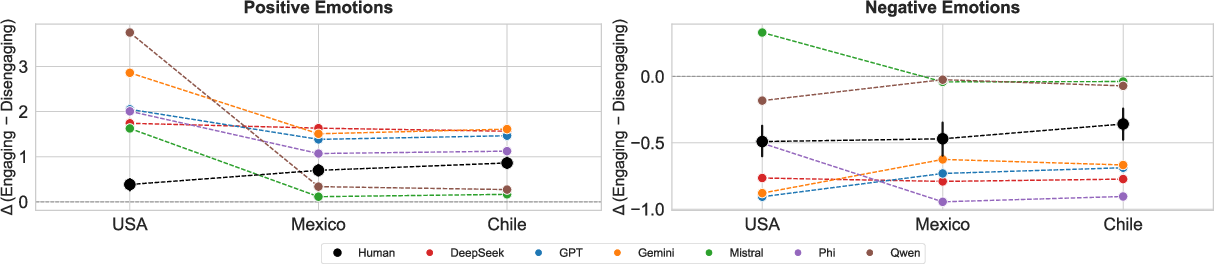
Figure 1: The difference between the mean of PSE and PSD emotions (left) and the same for NSE and NSD emotions, as displayed for humans and all LLMs. The trend exhibited by LLMs is the opposite of that of humans for positive emotions, while it is more mixed and nuanced for negative emotions. Note that all distances are distributional, measured using the Wasserstein metric.
Exaggeration of Positive Engagement and Deterministic Modal Homogeneity
LLMs not only align EA personas with engaging emotions incorrectly, but amplify the expression of positive engaging emotions disproportionately relative to negative engaging emotions across all personas (with the exception of Phi 4). For negative emotions, trends are less coherent and the LLMs inconsistently reflect cultural distinctions.
LLM response distributions are highly concentrated and show marked determinism with drastically reduced intra-model variability compared to humans. LLMs utilize fewer effective response categories, with an effective category number (Neff) of approximately 2.8–3.3 versus 4.94–5.26 for humans. This deterministic collapse in rating variance is most severe for the EA persona, the group best represented in model pretraining.

Figure 2: Effective Categories (Neff) across all cultures and emotions for all models and humans, indicating loss of response diversity in LLM generations.
Inter-Model Homogeneity
A PCA analysis on response vectors across personas, models, and emotion types reveals that inter-model diversity is low: model responses cluster tightly together and are more similar to each other than to human distributions across all categories. This convergence extends across proprietary and open-weight LLMs.
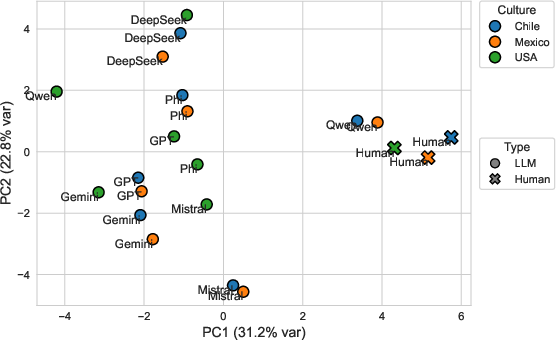
Figure 3: Inter-model homogeneity shown by clustering rating distributions to analyze structural differences.
Pearson correlation quantifies this effect: mean LLM–LLM correlation is 0.72; LLM–human correlation is substantially lower at 0.47.
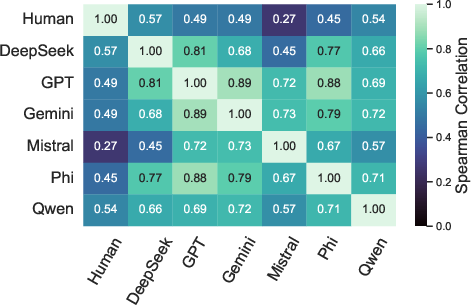
Figure 4: Inter-model homogeneity quantified through inter-model and model-human Pearson correlation coefficients.
Limited Efficacy of Temperature, Language, and Forced-Choice Interventions
Increasing the sampling temperature marginally increases the diversity of effective response categories for some models (e.g., Qwen for EA persona, ΔNeff=3.43), but this greater diversity does not translate to better alignment with human directionality—misalignment persists or even increases.
Switching LA prompts from Spanish to English improves overall alignment marginally (especially for positive emotion contrast magnitude and overall expressivity), indicating that models encode LA cultural knowledge more robustly in English than in their native (but high-resource) Spanish—a finding with direct implications for cross-cultural deployment.
Pairwise (forced-choice) comparison formats can prompt models to align on some gross cultural differences (overall LA expressiveness) but leave the robust association between EA personas and engaging emotions unchanged.
Theoretical and Practical Implications
Model Architecture and Supervision Effects
The results indicate a persistent sycophantic bias [sharma2024towards], possibly induced by RLHF or related preference-optimization during model alignment, which systematically associates dominant Western (EA) personas with elevated expression of positive engaging emotions—contradictory to population-level survey data.
Current LLM architectures inherit and hard-code incomplete and sometimes contradictory cultural priors as learned from the distributional statistical noise in their pretraining data rather than granular, ground-truth alignments. This manifests as a robust failure to represent normative social–emotional response structure in highly-salient cultural axes.
Risks and Limitations for Synthetic Proxy Use
These findings signal problematic limitations for using LLMs as proxies for human population-level affective simulation or dynamics in computational social science, especially regarding nuanced, culture-dependent psychological phenomena. LLMs fail to capture both the mean and the diversity structure of the target distributions, possibly resulting in spurious sociocultural or affective inferences when used to simulate group behaviors or emotional reactions.
In affective computing and related deployment, such as digital mental health or culturally sensitive support agents, the misalignment of LLM expressivity may propagate nontrivial harms by undermining user trust, leading to inappropriate or inauthentic interactions, and reinforcing Western-centric or falsely universalized affective norms.
Directions for Future Supervision and Auditing
The findings underscore that cultural alignment cannot be assumed in multilingual models or for dominant cultural groups. Depth audit studies that probe within-culture axes, not just breadth/binary English–non-English or WEIRD–non-WEIRD splits, are required for meaningful sociocultural model evaluation.
Work on explicit culture-aware alignment, improved persona- and context-sensitive supervision, dataset expansion to reflect granular affective norms, and bench-marking across species of interaction context (e.g., multilingual, cross-affective, code-switched, in situ) represents an immediate direction for both technical and algorithmic advances.
Conclusion
This paper provides robust evidence that SOTA LLMs fail to accurately simulate core cultural differences in social emotion expression, systematically reversing empirically observed patterns and exhibiting highly modal, homogeneous response profiles. Biases manifest even for the most represented Western cultural groups, indicating architecture- and supervision-level limitations. Standard interventions (temperature, prompt language, response format) insufficiently address or correct these biases. These results challenge the use of LLMs as cultural proxies and expose a critical barrier for deploying these systems in culturally nuanced, affectively sensitive applications. Ongoing work will require both expanded, fine-grained evaluation and targeted realignment to address these deficiencies.
References
- S. Bhattacharyya et al., "Expressing Social Emotions: Misalignment Between LLMs and Human Cultural Emotion Norms" (2604.16757).
- M. Sharma et al., "Towards Understanding Sycophancy in LLMs" [sharma2024towards].
- T. Belay et al., "CuLEMo: Cultural Lenses on Emotion – Benchmarking LLMs for Cross-Cultural Emotion Understanding" [belay-etal-2025-culemo].

