- The paper establishes a comprehensive QED theory that models surface-enhanced Raman scattering using a two-level system near an aligned SWCNT film.
- It derives closed-form expressions for the Raman cross-section, revealing enhancements exceeding 10⁴ at nanometer-scale distances with detailed angular dependence.
- The results demonstrate that both p- and s-polarized light can achieve significant enhancements, opening pathways for advanced single-photon and plasmonic spectroscopy applications.
Polarized Light Raman Scattering Enhancement by a Two-Level System near an Ultrathin Periodically Aligned Carbon Nanotube Film
Introduction and Physical Motivation
The paper develops a comprehensive quantum electrodynamical theory of surface-enhanced Raman scattering (SERS) for a two-level system (TLS)—representing an atom, ion, molecule, or quantum dot—placed in the near field of an ultrathin metasurface consisting of a periodic, in-plane-aligned array of single-wall carbon nanotubes (SWCNs). By treating both the electromagnetic field and the medium quantum mechanically, the work provides a first-principles account of medium-assisted resonance phenomena and their role in fostering large Raman cross-section enhancements.
While traditional SERS platforms have relied predominantly on plasmonic metals to augment Raman signal via localized electromagnetic field enhancements, recent advances have demonstrated that low-dimensional materials such as graphene and SWCNs can also provide notable SERS response, although their mechanisms are more intricate and strongly dependent on near-field quantum electrodynamical coupling. In particular, the formation of TD (transdimensional) plasmonic bands and extreme in-plane plasmon anisotropy in ultrathin SWCN films introduce unprecedented spectral tuning and polarization selectivity for optical enhancement.
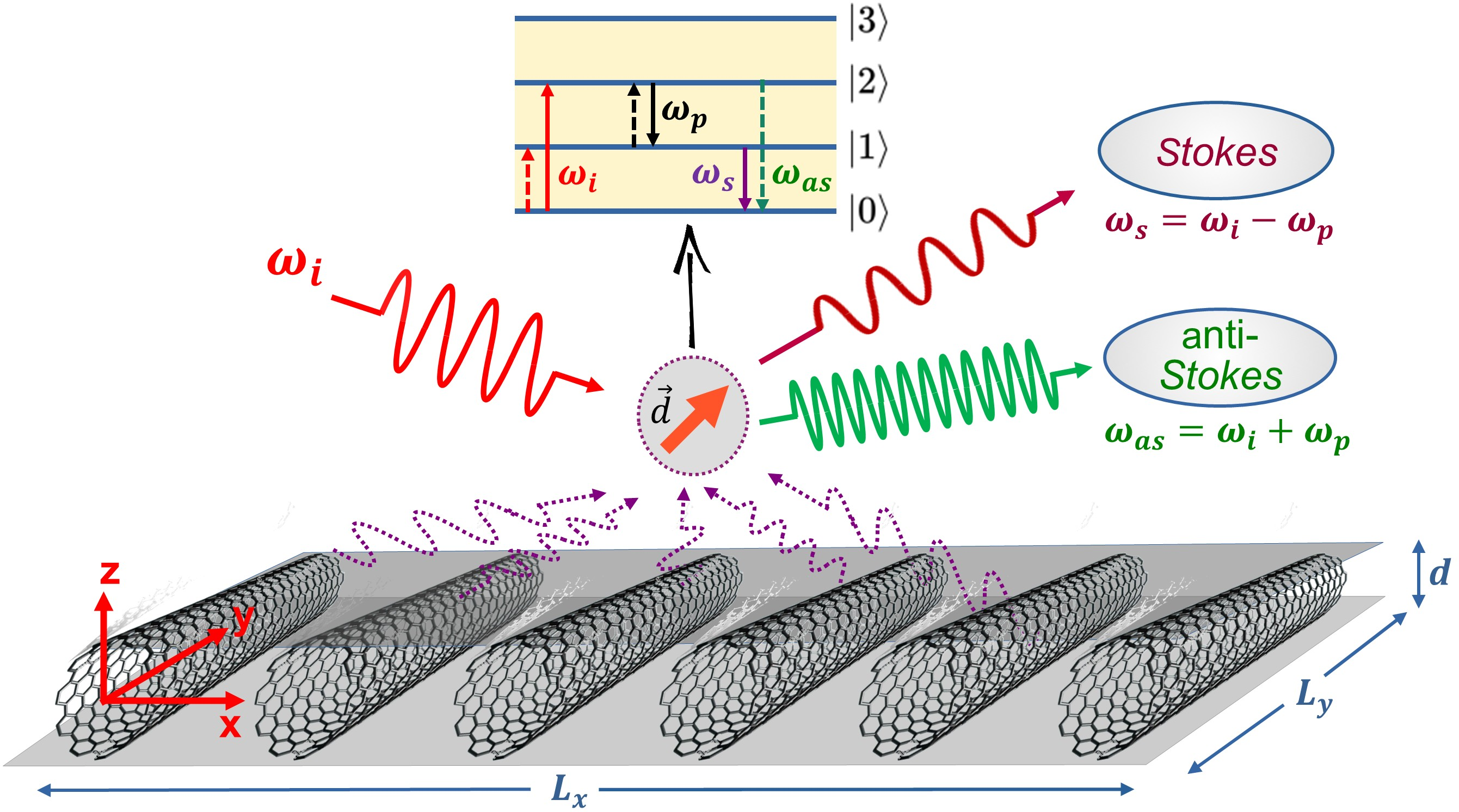
Figure 1: Schematic of Raman scattering for a TLS near a periodic SWCN film, showing the splitting of energy levels and near-field coupling via SWCN plasmonic excitations.
The theoretical foundation is the full-medium quantum electrodynamical (QED) treatment, which incorporates the quantized field degrees of freedom, the TLS, and their coherent and dissipative interactions via the Green’s tensor formalism. The SWCN metasurface provides an in-plane highly anisotropic, spatially dispersive electromagnetic response (with dielectric function εμμ(ω)), leading to a rapid variation in the local density of optical states (LDOS), especially in the direction of nanotube alignment.
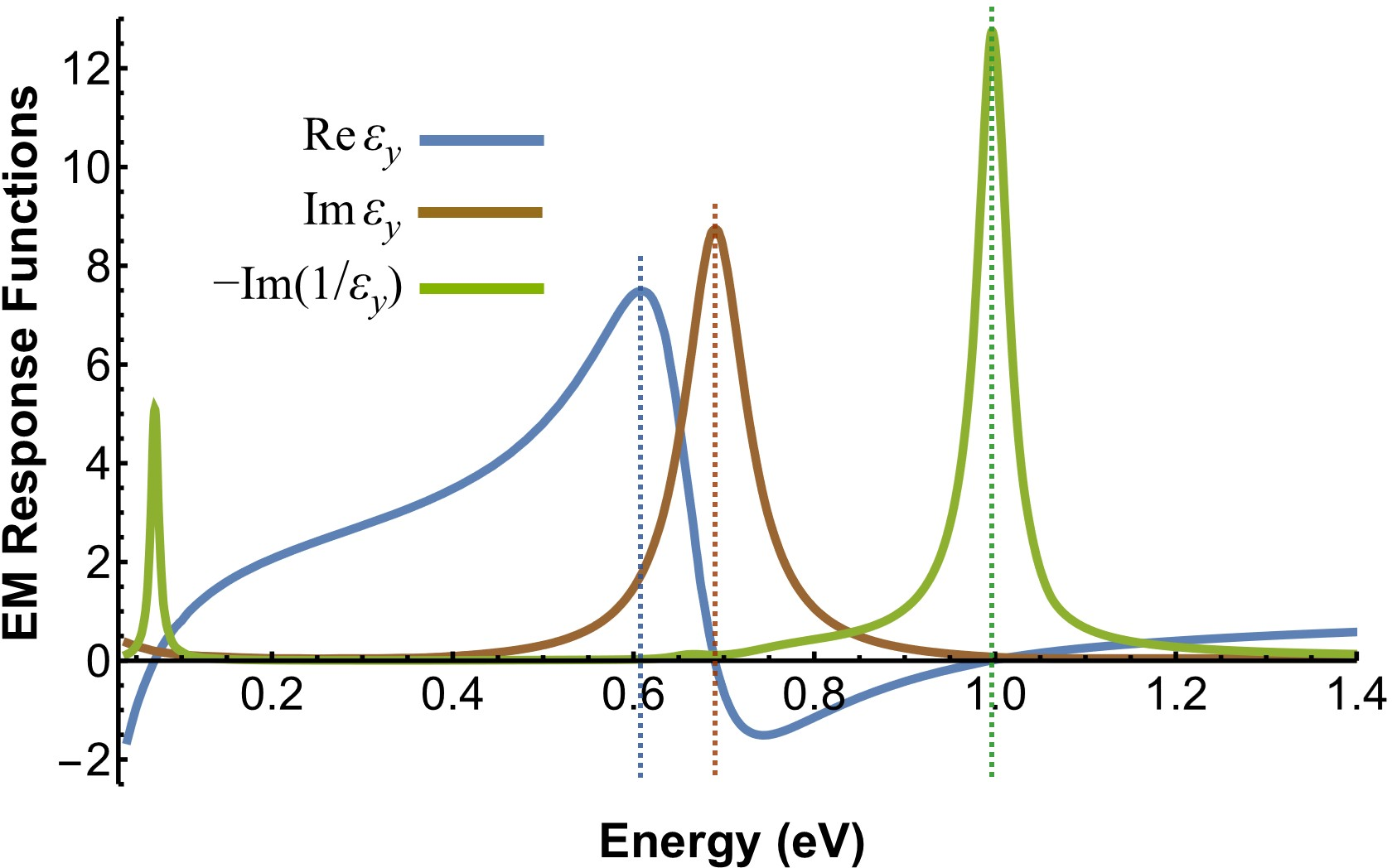
Figure 2: Real and imaginary components of the SWCN film’s in-plane EM response along the alignment direction, showing both classical and quantum interband plasmon resonances and associated negative refraction bands.
The system Hamiltonian is constructed for the combined TLS and medium-field, coupling the emitter’s dipole transition to quantized, dissipative vacuum and medium-assisted field fluctuations. The reduced model shows that the interacting TLS+film system forms a four-level structure due to the off-resonant dressing by local plasmonic modes, in contrast to bare TLS.
The central calculation exploits the field quantization in the presence of dissipative, anisotropic media. The key formal object is the EM Green’s tensor Gμν(r,r′,ω), encoding the spatial and spectral response, and fully determining the enhanced rates, coupling strengths, and Raman pathways. The formalism consistently includes both resonant and nonresonant processes and is rigorously averaged over dipole orientations.
Analytical Derivation of the Raman Scattering Cross-Section
The Raman scattering process is treated as a two-photon inelastic scattering event, with explicit consideration of both Stokes and anti-Stokes processes. The field–TLS interaction mediates the creation and annihilation of quantized plasmonic excitations in the film, as illustrated by the four-level manifold (Figure 1). The transition amplitude for the three-step process (incident photon absorption, plasmon emission/absorption, and scattered photon emission) is evaluated using the Fermi Golden Rule, yielding a Raman differential cross-section incorporating geometry, polarization, energy detuning, and the SWCN film's EM response.
Angular dependence is fully resolved: the incoming and outgoing polarizations, incidence and scattering angles, and the orientation of the incidence plane with respect to the main anisotropy axis of the SWCN array are encoded in a derived angular enhancement factor F(ηi,ϕi,θi).
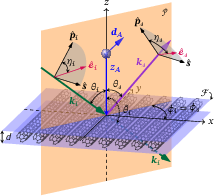
Figure 3: Geometry of the TLS–SWCN system with incident and scattered photon momenta, polarization vectors, and plane orientations.
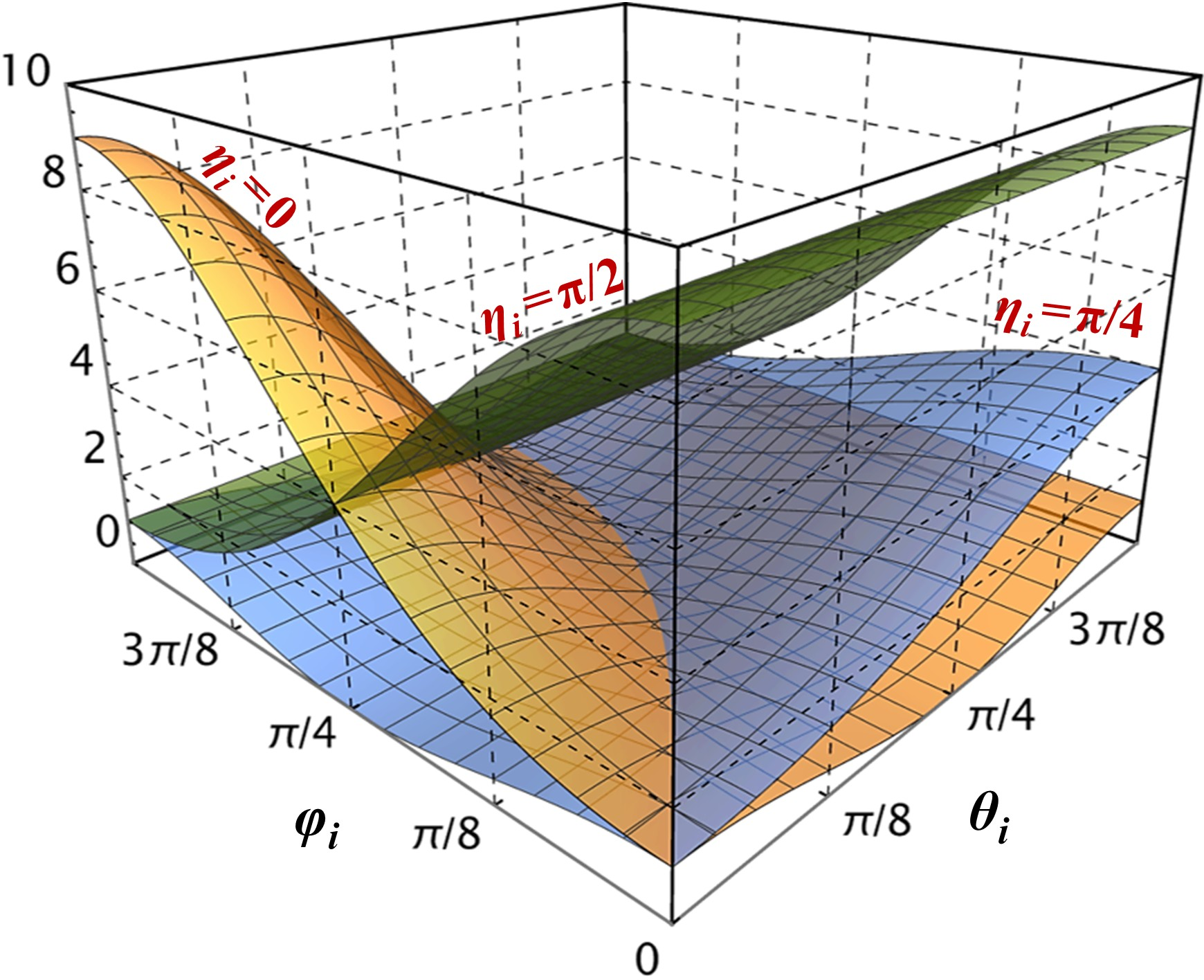
Figure 4: The angular factor F(ηi,ϕi,θi) controlling the differential cross section, highlighting maxima for both p- and s-polarizations depending on the configuration.
A key outcome is the closed-form expression for the Raman cross-section in dimensionless variables, with strong dependence on:
- The detuning between the TLS transition and the film’s quantum interband plasmon resonance (δ=xA−xp)
- The coupling strength parameterized by a Rabi splitting X (a function of distance to the film and local LDOS)
- The resonance linewidth (Δxp) of the plasmonic band
An amplification factor A(δ,X,Δxp) quantifies the plasmonic enhancement, peaking for near-resonant, strong-coupling regimes.
Numerical Analysis and Physical Insights
Numerical evaluation demonstrates Raman cross-section enhancements exceeding Gμν(r,r′,ω)0 for TLS located just a few nanometers from the film, over a broad spectral window (exceeding 0.5 eV in detuning). Notably, both Gμν(r,r′,ω)1- and Gμν(r,r′,ω)2-polarized light can achieve maximum enhancement—contradicting the usual expectation that only Gμν(r,r′,ω)3-polarized components strongly couple to in-plane plasmons. The functional form and angular dependence indicate maxima for normal incidence and for polarizations either parallel or perpendicular to the SWCN alignment axis, depending on incident geometry.
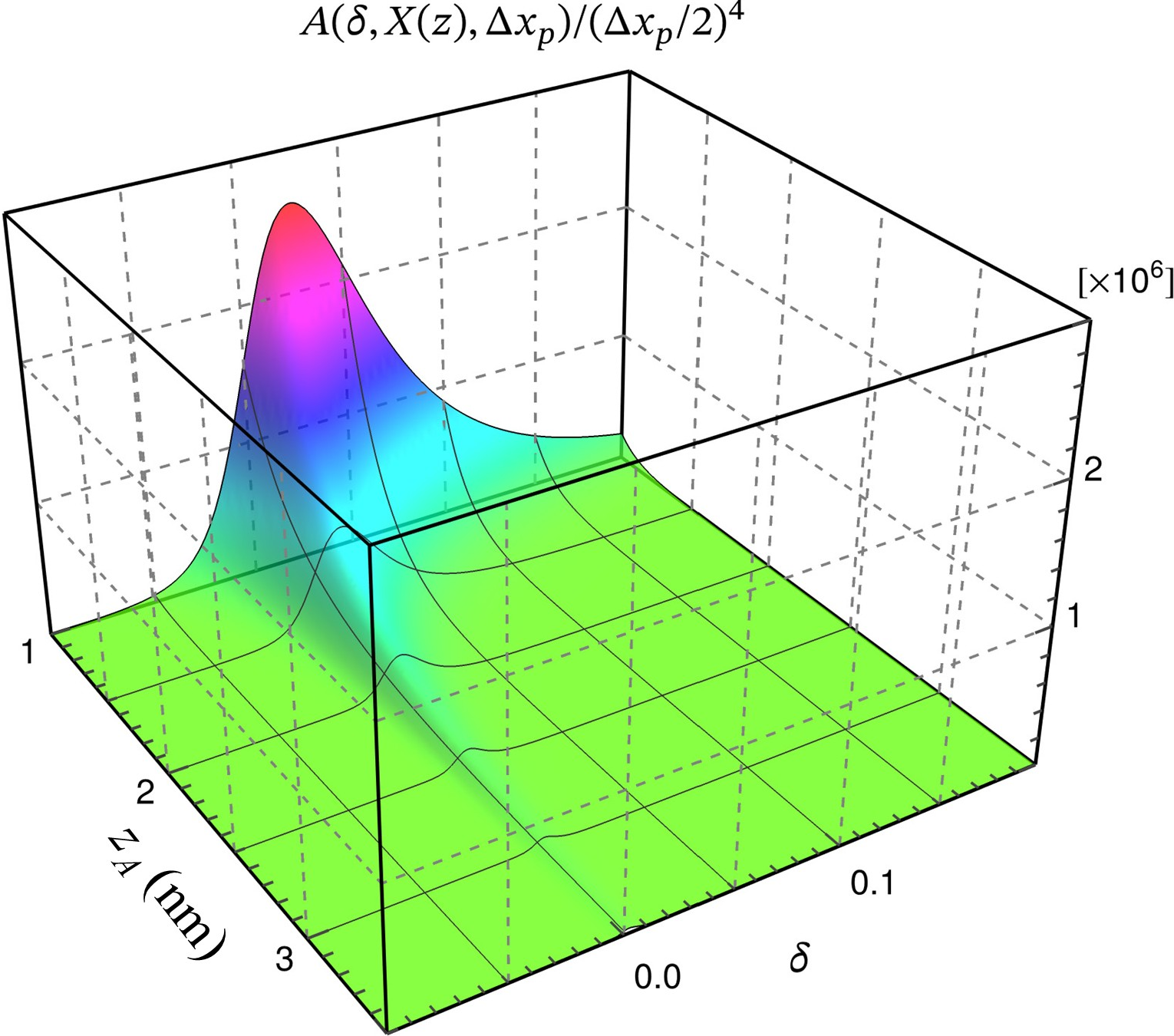
Figure 5: Amplification factor Gμν(r,r′,ω)4 as function of spectral detuning and distance, showing orders-of-magnitude enhancement at nanometric proximity.
The detailed analysis of the Gμν(r,r′,ω)5 scattering factor reveals sensitivity to both the LDOS-controlled Rabi splitting and the geometric configuration. Quenching of the cross-section is possible for configurations where the induced polarizability along the SWCN axis vanishes, for instance, Gμν(r,r′,ω)6-polarized photons at certain oblique incidences or specific orientation angles.
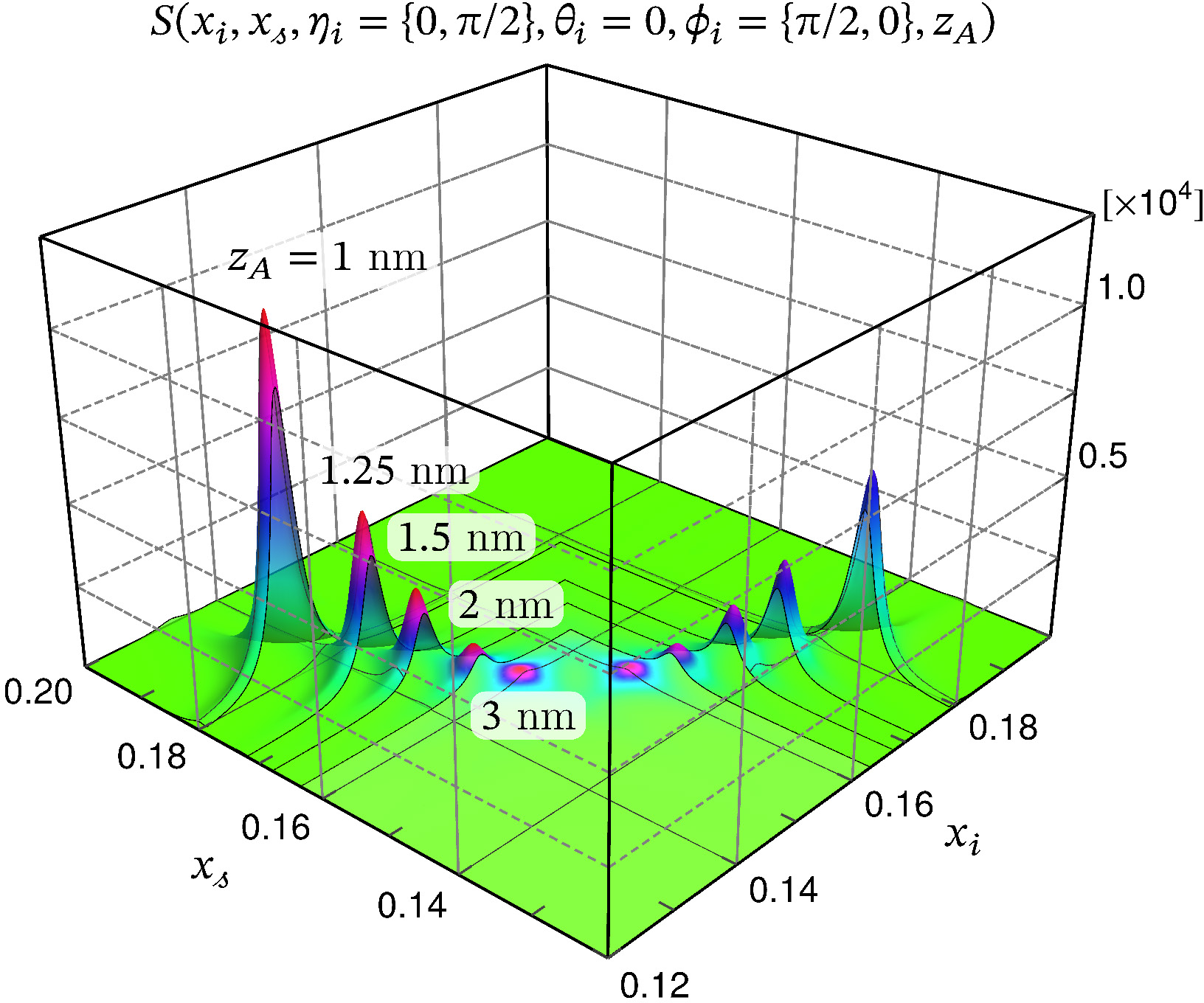
Figure 6: The scattering factor Gμν(r,r′,ω)7 for different TLS–film distances, mapping the double-resonant enhancement as a function of incident and scattered photon energies, and demonstrating rapid decay with increasing separation.
Implications and Future Directions
This formalism unifies the description of SERS enhancement in strongly anisotropic, low-dimensional metasurfaces, specifically demonstrating that ultrathin, periodic SWCN films offer not only exceptional in-plane resonance tunability and polarization selectivity but also strong quantum regime enhancements, potentially surpassing metal-based platforms. The results highlight:
- Giant and anisotropic SERS enhancement even for Gμν(r,r′,ω)8-polarized incident light, rooted in quantum near-field effects absent from classical treatments.
- Flexibility to tune spectral and spatial response via film geometry (nanotube diameter, spacing, packing density), thickness, and emitter distance.
- A clear path towards engineered platforms for single-photon nonlinear optics, super-resolution Raman sensing, and deterministic light–matter interfaces, particularly in the visible and near-infrared due to the robust, tunable plasmonic bands.
- Prospects for exploitation of additional degrees of freedom, including SWCN chirality and controlled disorder, which were not included in this analysis.
From a theoretical perspective, the work also sets the stage for further investigation into strong coupling and non-Hermitian effects, collective response in the many-emitter regime, quantum nonlinearities, and the interplay of nonlocality and confinement in 2D/TD plasmonics.
Conclusion
The paper establishes an exact quantum theory describing Raman scattering by localized quantum emitters in the near field of SWCN metasurfaces, providing both analytic and numerical evidence for pronounced, anisotropy-governed enhancement of the Raman effect, with robust control over polarization, geometry, and spectral properties. The results demonstrate that ultrathin, periodic SWCN arrays define a new regime for quantum-enhanced optical spectroscopy, with application potential in single-molecule detection, quantum nanophotonics, and tunable metasurface design. The framework naturally extends to further explorations of strongly correlated and topological photonic systems based on low-dimensional carbon nanostructures.
Reference:
"Polarized light Raman scattering by an atom near an ultrathin periodically aligned carbon nanotube film" (2604.17246)