- The paper demonstrates that small adversarial perturbations can drastically alter global rankings in MLE-based ranking systems.
- It introduces the Adaptive Subset Selection Attack (ASSA), which efficiently targets high-impact perturbations to minimize Kendall Tau distance.
- Empirical studies on electoral data reveal a phase-transition phenomenon where minimal adversarial budgets yield significant rank shifts.
Vulnerabilities in MLE-Based Pairwise Ranking: Strategic Data Perturbations
Overview and Problem Statement
The paper "Ranking Abuse via Strategic Pairwise Data Perturbations" (2604.17805) systematically investigates the robustness of maximum likelihood estimation (MLE)-based ranking systems, with a focus on the Bradley-Terry model, under adversarial strategic manipulations. The core research question addresses the susceptibility of these models to small, targeted data perturbations, quantifying how an adversarial coalition can exploit the non-linearities of the MLE objective to drastically shift global rankings.
By formalizing adversarial manipulation as a constrained combinatorial optimization—where the objective is to minimize the Kendall Tau distance between manipulated and adversarial target rankings under a fixed perturbation budget—the authors frame the problem in terms of strategic subset selection. The paper introduces the Adaptive Subset Selection Attack (ASSA), a heuristic that iteratively refines the candidate perturbation pool to maximize attack effectiveness. Empirical analysis reveals a pronounced "phase-transition" in ranking stability: beyond a critical budget, a small fraction of manipulative changes lead to disproportionate outcome shifts.
Strategic Manipulation Algorithms and Theoretical Justification
Three principal manipulative strategies are considered: Random Flip (RF), Greedy Flip (GF), Randomized Subset Attack (RSA), and the novel ASSA. While RF and GF provide lower and upper-bound baselines for unstructured and locally optimal perturbations, respectively, RSA partitions the search space into randomly chosen perturbation subsets and periodically evaluates their collective influence. ASSA refines this approach by adaptively pruning ineffective subsets and focusing the search on high-impact clusters. Theoretical justification for ASSA is established via the Implicit Function Theorem: the MLE parameters p∗ respond non-linearly to data perturbations, and ASSA efficiently approximates parameter gradients to align manipulation with desired outcomes.
The computational tractability stems from the Bradley-Terry model's dependence on aggregated pairwise counts, not raw comparison data, which allows large-scale adversarial attacks as long as candidate count m remains manageable.
Empirical Results: Budget, Convergence, and Real-World Case Studies
The paper offers extensive experimental validation on synthetic datasets and prominent real-world electoral data including the Berkeley City Council and UK Labor Party elections. Several key findings emerge:
- Adversarial Budget Impact: Structured attacks via RSA and ASSA outperform random and greedy baselines, with ASSA achieving substantially larger reductions in Kendall Tau distance even with minimal perturbation budgets. As the budget increases, manipulation effectiveness displays non-linear growth, revealing a phase-transition in ranking instability.
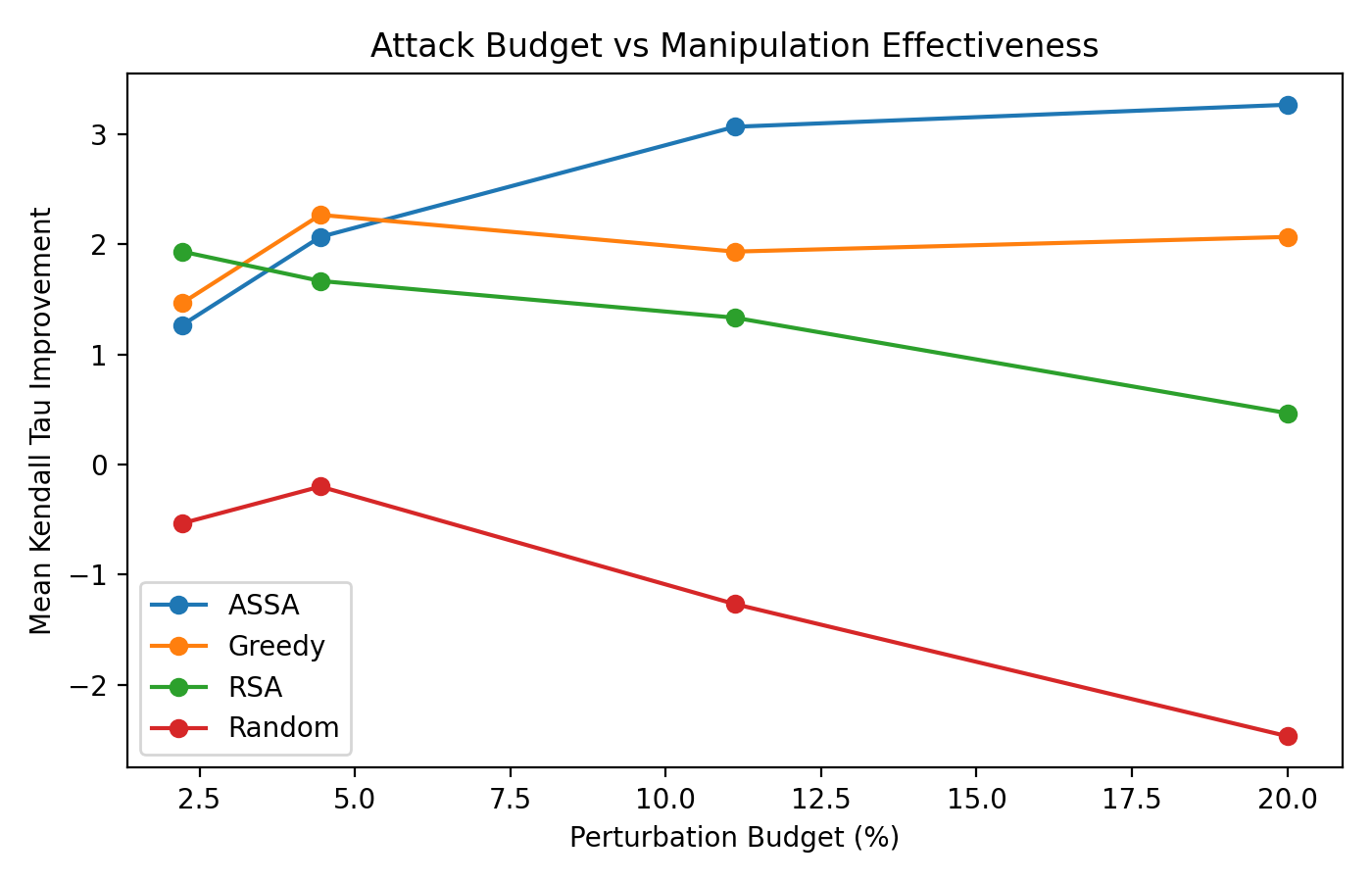
Figure 1: Structured adversarial strategies (RSA and ASSA) yield sharply higher manipulation effectiveness, measured as Kendall Tau reduction, compared to random and greedy flips.
- Target Rank Shift: Manipulation leads to significant rank shifts of designated target candidates, particularly beyond critical perturbation thresholds, indicating the system's fragility.
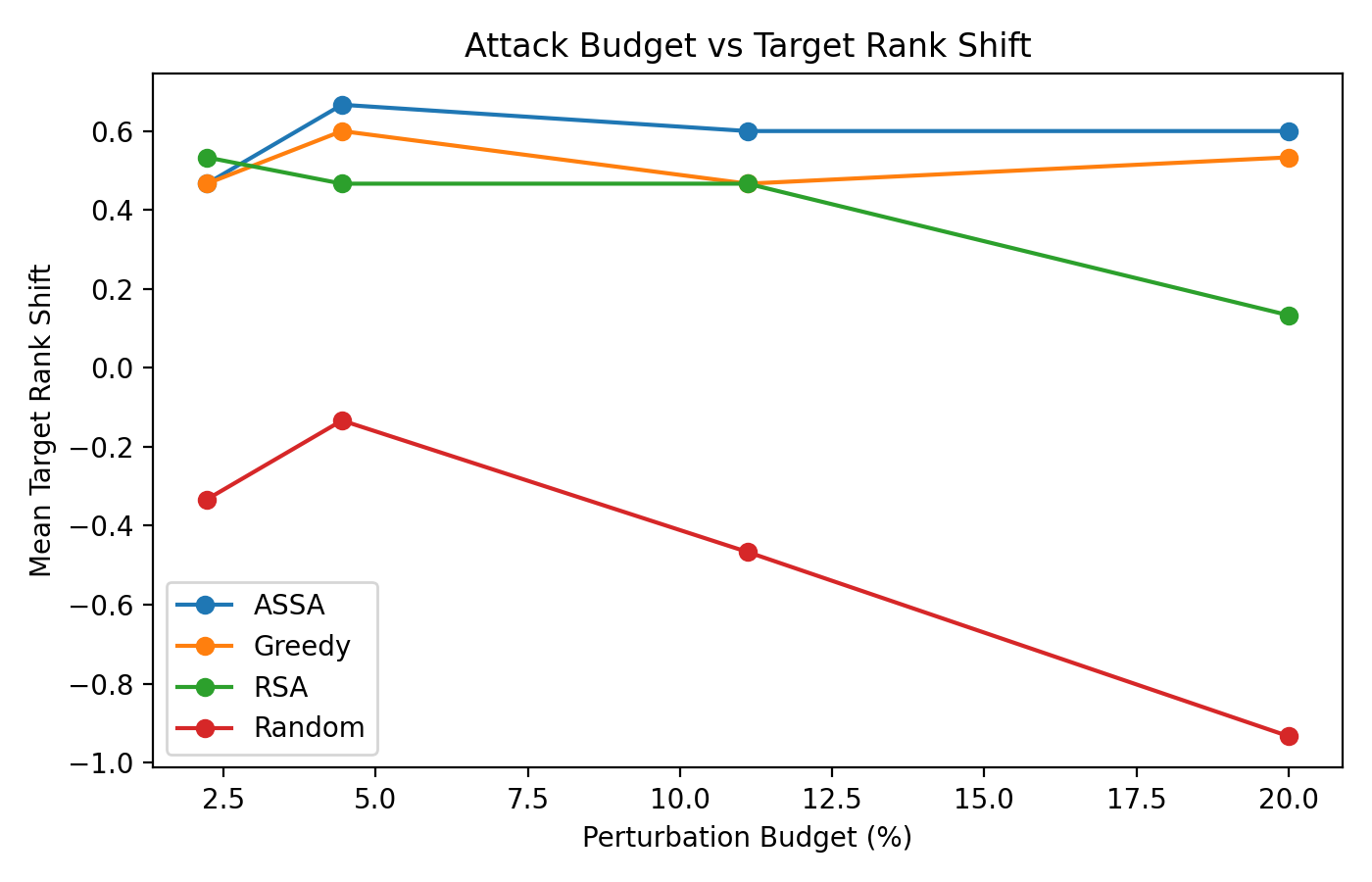
Figure 2: Target candidate rank shift increases nonlinearly with larger perturbation budgets, demonstrating vulnerability to limited coordinated manipulation.
- Convergence and Success Rates: ASSA demonstrates rapid convergence with relatively few iterations, and stability across varying subset counts, although excessive granularity may dilute attack effectiveness.
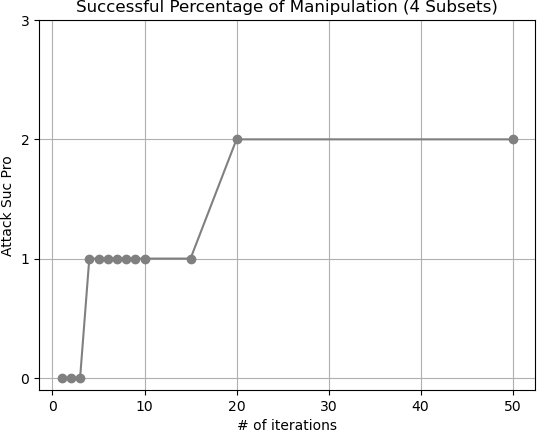
Figure 3: Manipulation success rate increases with iteration count n, reaching saturation quickly, confirming ASSA's efficiency.
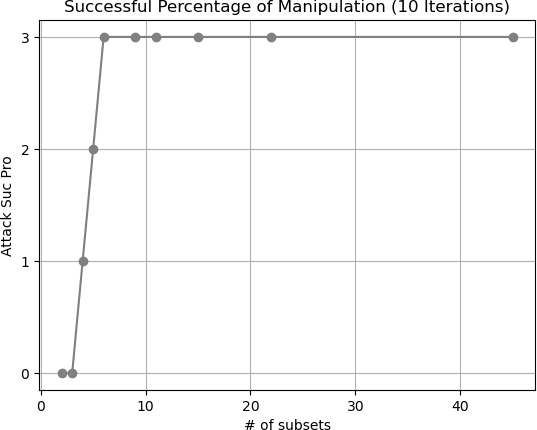
Figure 4: Increasing subset count b can initially improve manipulation, but excessive fragmentation reduces collective influence.
- Optimal Kendall Tau Achievement: Manipulation can reach the theoretical minimum Kendall Tau distance efficiently, evidencing robustness of ASSA to hyperparameter variation.
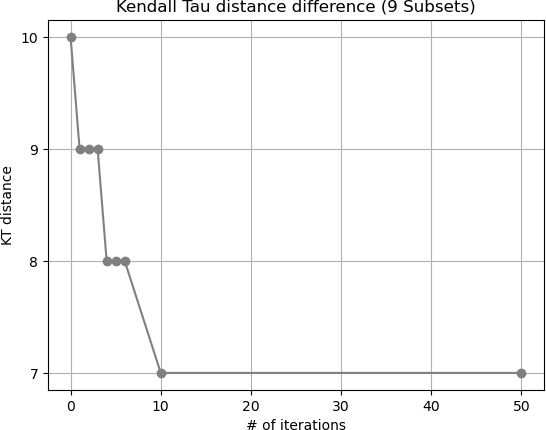
Figure 5: The optimal Kendall Tau distance is achieved swiftly with adequate iterations, underscoring algorithmic efficiency.
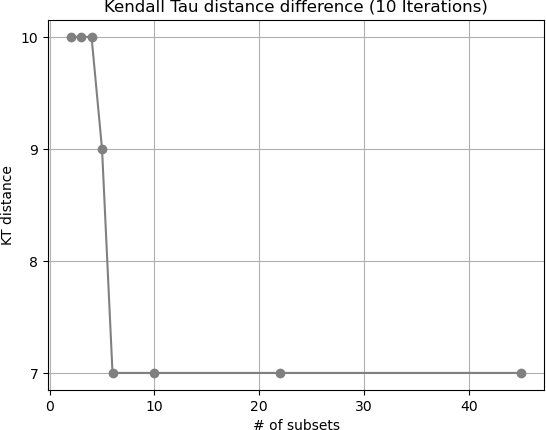
Figure 6: Subset count b impacts the approachability of optimal Kendall Tau, with a plateauing effect at higher granularity.
- Real-World Electoral Manipulation: In the Berkeley City Council election (4189 voters), a coordinated coalition of just 8.4% can flip the outcome. In the UK Labor Party dataset, incomplete ballots exacerbate susceptibility, suggesting practical vulnerabilities in digital voting platforms.
Implications, Limitations, and Future Directions
Theoretically, the results underscore a fundamental structural fragility in MLE-based ranking aggregation. Even modest, well-informed adversarial interventions can induce global ranking shifts, challenging the notion of fairness and robustness in algorithmic social choice. Practically, this exposes collective decision-making systems such as digital voting platforms to systemic risk, particularly under sparse data and incomplete ballots.
Future research should address limitations inherent in the heuristic, stochastic subset selection process, validating robustness under diverse real-world preference dynamics and extending adversarial analysis to alternative ranking and voting schemes. The development of provably robust ranking estimators—potentially via adversarial training or certified defenses—constitutes a critical next step toward safeguarding collective decision infrastructure.
Conclusion
This paper rigorously demonstrates that MLE-based pairwise ranking systems, notably Bradley-Terry models, are acutely vulnerable to strategic manipulation. The Adaptive Subset Selection Attack (ASSA) not only outperforms traditional baselines but exposes a phase-transition phenomenon, wherein ranking outcomes can be subverted with minimal adversarial intervention. These findings challenge prevailing assumptions about the security of statistical aggregation in social choice and highlight urgent needs for algorithmic safeguards in democratic and collective decision systems.

