- The paper introduces a phase-resolved THz imaging method in warm Rydberg vapors using multiwave mixing to capture both amplitude and phase data.
- It employs controlled interference of dual probe beams and a piezoactuated Δk scan to achieve sub-millimeter spatial resolution (Δz = 0.7 mm) in field reconstruction.
- The coherent THz-to-optical conversion technique enhances quantum-limited sensing, paving the way for scalable and practical THz metrology.
Coherent Tomographic Imaging of Terahertz Fields in Warm Rydberg Vapors
Introduction and Motivation
The tomographic imaging of terahertz (THz) electromagnetic fields is an enabling technology for domains requiring high spatial and phase sensitivity, including in vivo biomedical diagnostics, nanoscale material characterization, and non-destructive inspection. Rydberg atom-based sensors have emerged as platforms with competitive sensitivity and absolute field reference, leveraging the exaggerated response of Rydberg states to THz and radio frequency fields. However, existing THz imaging approaches with atomic vapors have been almost exclusively amplitude-only, fundamentally discarding phase information critical for applications such as holography and field vector reconstruction. The work "Coherent terahertz field tomographic imaging in warm Rydberg vapors" (2604.18440) addresses this gap by demonstrating phase-resolved, complex-amplitude imaging of THz fields via multiwave-mixing in a room-temperature rubidium vapor. This scheme leverages atomic nonlinearity to coherently map THz field distributions onto optical signals, opening new directions for quantum-limited THz sensing and imaging.
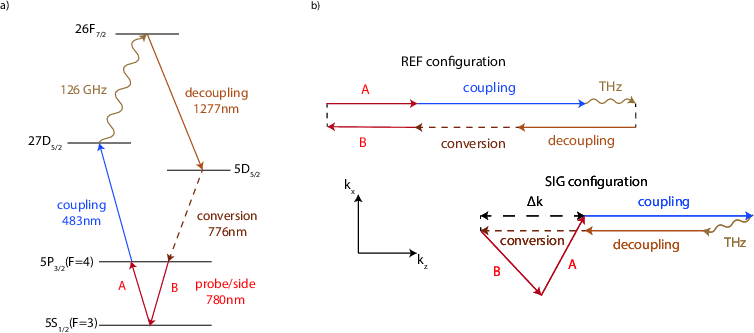
Figure 1: (a) Multi-level atomic scheme enabling THz-to-optical conversion in Rb vapor. (b) Schematic of wavevector configurations for reference (REF) and signal (SIG) phase-matching geometries.
Experimental Architecture
The experimental system is based on a heated Rb-87 vapor cell, traversed by a multi-laser excitation structure that realizes a six-wave mixing process between optical and THz fields. Atoms are sequentially excited into a target Rydberg state through probe (780 nm), coupling (483 nm), and THz (126 GHz) transitions, with further de-excitation channels involving an IR decoupling laser (1276 nm), resulting in optical emission at 776 nm. The key innovation is the controlled interference of two distinct probe beams (A and B), which generate a variable spatial modulation in the atomic coherence along the optical axis, parameterized by their wavevector difference Δk. The experiment separately acquires reference (REF) and tomographic (SIG) signals by switching between co-propagating and cross-propagating probe geometries, with phase-sensitive heterodyne detection implemented through a frequency-detuned local oscillator and differential photodiode electronics.
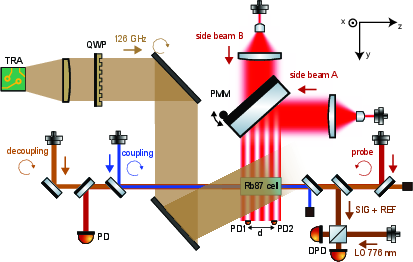
Figure 2: Experimental setup, including polarization optics, frequency-stabilized lasers, piezo-mounted elements for beam steering, and demodulation electronics.
The tomographic capability arises from scanning Δk via a piezoactuated mirror, which systematically varies the phase-matching condition for the multiwave-mixing process. This enables projection of the incident THz field amplitude and phase profile as a function of angle of arrival and spatial position. Phase noise and Doppler effects, which would otherwise suppress SIG signal visibility, are suppressed by leveraging the correlated phase fluctuations of the REF and SIG signals, applying electronic phase correction.
Results: Phase-Resolved THz Field Imaging
Acquisition of amplitude and phase of the SIG signal as a function of the wavevector mismatch yields direct access to the complex spatial-frequency spectrum of the incident THz field. Dominant peaks in the Δk domain correspond to the main angle of incidence, while secondary features indicate scattering, reflections, or multi-path propagation.
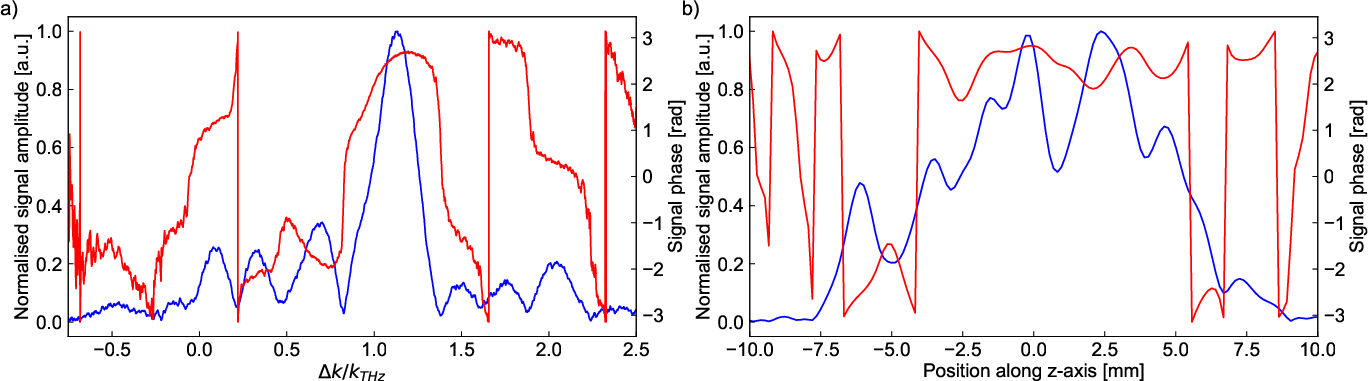
Figure 3: (a) Amplitude (blue) and phase (red) of the SIG conversion signal versus Δk. (b) Reconstructed amplitude and phase of the THz field along the optical axis via Fourier inversion.
The spatial distribution of the THz field along the optical axis is reconstructed through numerical Fourier transform of the measured complex signal in the Δk domain. The reported spatial resolution, Δz=0.7 mm, is determined by the available Δk scan range, itself limited primarily by the piezo actuator travel.
To conclusively demonstrate phase-resolved tomographic capability, the authors introduce a controlled spatial gap in the illuminating side beams, inhibiting atomic excitation and thereby causing a predictable "hole" in the mapped spatial profile of the THz field. Movement of this gap along the cell axis results in corresponding, robust translation of the missing region in the reconstructed field, evidencing the technique's spatial selectivity and coherence.
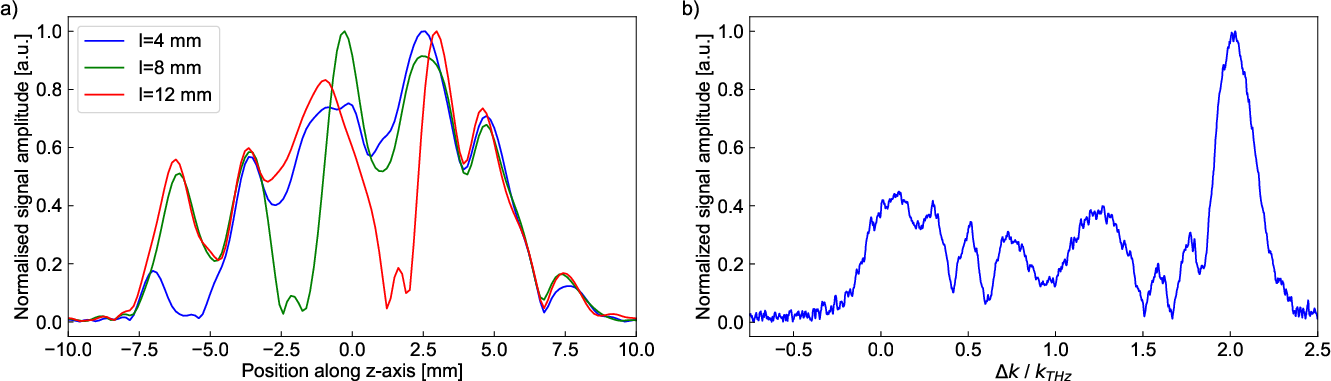
Figure 4: (a) THz field amplitude with user-controlled spatial gaps in probe beam illumination. (b) THz field response with injection via a waveguide, showing multiple spatial-frequency components from direct, reflected, and coupled THz waves.
Injection of the THz field from alternate geometries, such as via a waveguide through the rear cell window, yields spectral peaks shifted to higher Δk values. These correspond to counter-propagating THz field components and secondary reflections within the vapor cell, underlining the system's capacity to discriminate incident field geometry and multi-path artifacts.
Implications and Theoretical Context
The presented work establishes a robust, phase-resolved THz imaging protocol that overcomes the amplitude-only limitation of prior atomic-vapor-based methods [Schlossberger2025b, Downes2023]. Its room-temperature operation and scalable geometry are significant for real-world deployment. The demonstrated ability to extract both amplitude and phase of arbitrary THz field distributions positions this approach as a competitive alternative to electronic or solid-state THz sensors [Li2023]. Compared to conventional THz time-domain spectroscopy or near-field scanning techniques, the active, coherent atomic medium introduces pronounced quantum sensitivity, all-optical readout, and compatibility with hybrid quantum technologies [Krokosz2025].
From a theoretical standpoint, this work leverages high-order nonlinear optical susceptibilities (χ(6)), multiwave-mixing phase-matching, and the exploitation of correlated noise in coherent detection, aligning with advances in Rydberg electrometry [Sedlacek2012, Zhang2024], optical-THz conversion [Han2018, Vogt2019], and quantum-limited field sensing [Cox2018]. Constraints remain—chiefly, the finite Δk scan range and requirement for a reference field direction for phase correction. These could be addressed by adopting extended actuator systems, alternative phase-noise correction such as nonlinear crystal-based reference generation [Borowka2025], or full 2D scanning geometries.
Prospects for Future AI and Quantum Sensing Developments
The experimental framework and protocol have implications for scalable, label-free THz holography, vector-resolved THz field mapping, and atomic-vapor-based tomography in industrial and medical imaging. Coupled with AI-driven inversion and reconstruction algorithms, such systems could enable real-time analysis and classification of THz field patterns for non-contact diagnostics, wireless communications, or high-throughput materials inspection [Liu2024, Li2023]. The integration of atomic quantum sensors with photonic or micro-fabricated platforms will be critical to realize high-spatial-resolution, multiplexed imaging arrays, while improvements in actuator bandwidth and compactness can facilitate deployment in portable settings.
Conclusion
This work achieves the first demonstration of room-temperature, phase-resolved tomographic imaging of THz fields using coherent THz-to-optical conversion in a warm Rydberg vapor. By exploiting high-order nonlinear interactions and phase-matching control through external probe geometries, the technique retrieves both amplitude and phase of the incident THz field, enabling spatial selectivity at the sub-millimeter level. The approach bridges the sensitivity and spectral selectivity of quantum atomic sensors with the practical requirements of THz imaging, establishing a platform for future development in quantum-enhanced field metrology, holography, and hybrid quantum–classical systems.
Strong numerical results include sub-millimeter spatial resolution (Δk0 mm), robust detection of field directionality and multi-path effects, and resilience to laser and detection phase noise through real-time reference correction. The bold claim that phase-resolved THz imaging is viable with room-temperature atomic vapors is substantiated. Further scaling to 2D or 3D imaging and implementation in more complex environments remain as clear and impactful directions.