BBP transition and the leading eigenvector of the spiked Wigner model with inhomogeneous noise
Published 20 Apr 2026 in cond-mat.dis-nn, cs.IT, and math.ST | (2604.18523v1)
Abstract: The spiked Wigner ensemble is a prototypical model for high-dimensional inference. We study the spectral properties of an inhomogeneous rank-one spiked Wigner model in which the variance of each entry of the noise matrix is itself a random variable. In the high-dimensional limit, we derive exact equations for the spectral edges, the outlier eigenvalue, and the distribution of the components of the outlier eigenvector. These equations determine the BBP transition line that separates the gapped phase, where the signal is detectable, from the gapless phase. In the gapped regime, the distribution of the outlier eigenvector provides a natural estimator of the spike. We solve the equations for a noise matrix whose variances are generated from a truncated power-law distribution. In this case, the BBP transition line is non-monotonic, showing that an inhomogeneous noise can enhance signal detectability.
The paper introduces a novel extension of the spiked Wigner model by incorporating inhomogeneous noise via random variance profiles, deriving exact equations for spectral edges and BBP transition thresholds.
The paper employs resolvent and cavity methods to derive self-consistent equations for eigenvalue distributions and eigenvector statistics, quantifying recovery error using mean squared error metrics.
The paper reveals non-monotonic detectability behavior, where variance heterogeneity alternately enhances or suppresses signal recovery depending on noise profile parameters.
Spectral Inference in Spiked Wigner Models with Inhomogeneous Noise
Introduction
The paper "BBP transition and the leading eigenvector of the spiked Wigner model with inhomogeneous noise" (2604.18523) systematically investigates the spectral properties and inference limits of the spiked Wigner ensemble generalized to allow inhomogeneous noise, where the variance profile of the noise matrix is itself random. This approach extends classical models by encoding heterogeneity akin to random graphs with arbitrary degree distributions directly into the noise matrix, offering analytic tractability in the high-dimensional limit.
The primary focus is on understanding the conditions for signal detectability via spectral methods—specifically, the Baik-Ben Arous-Péché (BBP) phase transition—when the structure of the noise matrix is governed by an arbitrary variance profile, including randomly drawn variances from power-law distributions. The authors derive exact equations for spectral edges, outlier eigenvalues, and the distribution of the outlier eigenvector components, elucidating how signal-to-noise ratio thresholds and recovery properties fundamentally depend on noise characteristics.
Model Definition and Motivation
The observation matrix An is modeled as a sum of a rank-one signal and an inhomogeneous random noise matrix:
An=n1(Sn⊙1/2⊙Wn)+nγXnXnT,
where Wn is a symmetric matrix with i.i.d. entries of zero mean and unit variance, and Sn encodes entry-wise variance via Sij=SiSj, with {Si} drawn from some distribution PS. The spike vector Xn is generated from a prior PX, and γ quantifies the signal-to-noise ratio. The structure makes entry variances heterogeneous and random, generalizing model assumptions beyond the homogeneous Wigner setting and aligning the ensemble with random graph adjacency matrices under high connectivity, where degree distributions inform variance profiles.
By relaxing the i.i.d. noise assumption, the model allows exploration of how variance disorder impacts the fundamental spectral phase transition controlling detectability, the BBP transition, with practical relevance to inference in structured data regimes such as network clustering, recommendation systems, and genomics.
Spectral Properties and Analytical Methods
The analysis is anchored in random matrix theory, leveraging the resolvent method and cavity approaches to derive self-consistent equations for the spectral density, bulk edges, outlier location, and eigenvector statistics for arbitrary spike and variance distributions. Key results center around exact distributional equations for the diagonal resolvent entries An=n1(Sn⊙1/2⊙Wn)+nγXnXnT,0, yielding the spectral density An=n1(Sn⊙1/2⊙Wn)+nγXnXnT,1:
An=n1(Sn⊙1/2⊙Wn)+nγXnXnT,2
leading to an implicit characterization of the spectral edge An=n1(Sn⊙1/2⊙Wn)+nγXnXnT,3. The outlier eigenvalue An=n1(Sn⊙1/2⊙Wn)+nγXnXnT,4, associated with detectability and governed by a rank-one perturbation, is given through an integral equation as a function of An=n1(Sn⊙1/2⊙Wn)+nγXnXnT,5 and An=n1(Sn⊙1/2⊙Wn)+nγXnXnT,6, generalized to arbitrary An=n1(Sn⊙1/2⊙Wn)+nγXnXnT,7.
Additionally, the distribution An=n1(Sn⊙1/2⊙Wn)+nγXnXnT,8 of the outlier eigenvector components is derived, resulting in a weighted superposition of Gaussians determined by both spike and variance profiles:
An=n1(Sn⊙1/2⊙Wn)+nγXnXnT,9
where the mean and variance are explicit functions of Wn0, spike moments, and Wn1.
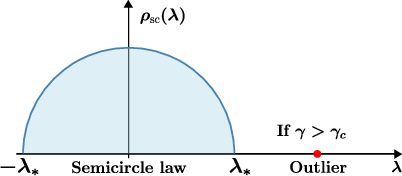
Figure 1: Spectrum of the homogeneous spiked Wigner model; an outlier eigenvalue (red dot) detaches for Wn2, with critical edge Wn3.
Effects of Inhomogeneous Noise: Truncated Power-Law Variance Profile
To concretely investigate the impact of noise inhomogeneity, the authors study variance profiles Wn4 defined by truncated power-law distributions, parameterized by width Wn5 and exponent Wn6, encompassing regimes from highly concentrated to broadly fluctuating variances. This family interpolates between homogeneous (delta-like) and heavy-tailed structures, mirroring real-world network systems.
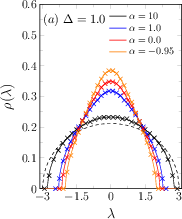
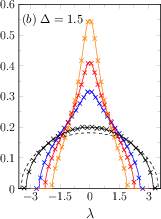
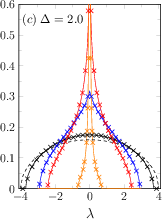
The spectral density, as computed numerically and analytically, reveals non-trivial behavior: the bulk support shrinks or stretches depending on Wn7 and Wn8, with sharp spectral singularities linked to localized eigenvector states at low variance sites. The analytic approach matches numerical diagonalizations, confirming theoretical predictions.
Figure 2: Empirical spectral density Wn9 of the observation matrix for various power-law variance profiles, showing deviations from semicircular law and singularities at Sn0 for broad, heavy-tailed distributions.
BBP Transition Line: Detectability Thresholds and Phase Behavior
A fundamental result is the characterization of the BBP transition line in terms of the critical signal-to-noise ratio Sn1, marking the boundary between the gapped and gapless spectral regimes. In the gapped phase (Sn2), detectability via the leading eigenvector is feasible; in the gapless phase, recovery is impossible via spectral methods.
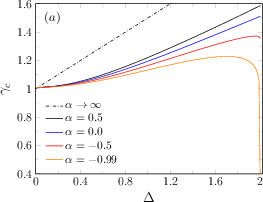
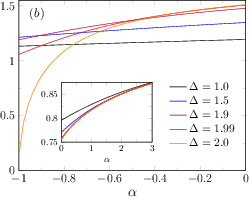
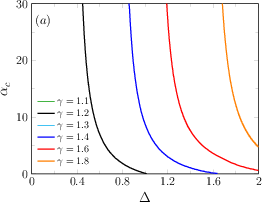
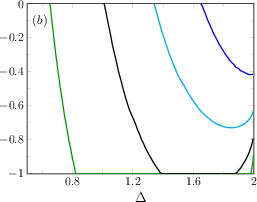
Notably, the critical Sn3 exhibits non-monotonic dependence on noise profile parameters: while increased variance heterogeneity can suppress detectability for Sn4, with Sn5 increasing as Sn6 grows, it can also enhance detectability for Sn7 near Sn8, where many entries have vanishing variance. Thus, inhomogeneous noise is shown to sometimes reduce and sometimes boost signal recovery, contradicting intuitions from homogeneous ensembles.
Figure 3: Critical value Sn9 of signal-to-noise ratio as a function of variance profile parameters, marking the BBP transition; non-monotonic behavior evident with certain parameter choices.
Figure 4: Shape parameter Sij=SiSj0 marking the BBP transition boundary in the Sij=SiSj1 plane, demonstrating how variance profile broadening can alternately suppress or enable signal detectability.
Leading Eigenvector Distribution and Recovery Quality
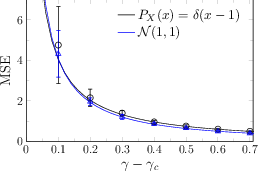
Exact characterization of the leading eigenvector distribution outside the bulk provides both a practical estimator of the spike and a tool for evaluating recovery error. The mean squared error (MSE) between the spike and the outlier eigenvector is derived, quantifying recovery quality:
Sij=SiSj2
Results demonstrate that, as Sij=SiSj3, MSE vanishes, while near the BBP threshold it diverges, confirming the transition in recoverability.
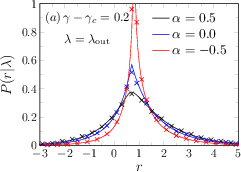
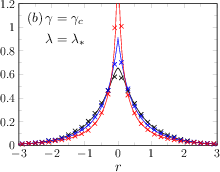
Figure 5: Distribution of eigenvector components outside the bulk, with pronounced deviations from Gaussianity for inhomogeneous noise.
Figure 6: Mean squared error between spike and outlier eigenvector as a function of signal-to-noise ratio, diverging at the critical threshold Sij=SiSj4.
Implications and Outlook
The theoretical findings advance the understanding of inference in structured high-dimensional random matrix ensembles, bridging random graph theory and spectral analysis. The non-monotonic BBP transition lines imply that the detectability gap for spectral estimators is sensitive to fine-grained noise structure, a fact with both practical ramifications (for clustering, bioinformatics, recommendation systems) and theoretical significance.
On a methodological level, the analytic framework—cavity method combined with distributional equations for resolvent and eigenvector statistics—affords direct generalization to other structured matrix models, including spiked Wishart ensembles and sparse random matrices, and opens avenues for studying inference in non-Hermitian settings.
Conclusion
The paper rigorously extends the spiked Wigner ensemble paradigm to inhomogeneous noise governed by random variance profiles, deriving exact spectral and eigenvector statistics in the high-dimensional limit. The main results include explicit equations for the spectral density, spectral edges, outlier eigenvalue, BBP transition threshold, and eigenvector component distribution for arbitrary spike and noise distributions. The analysis reveals rich, non-monotonic phase behavior in signal detectability, with variance heterogeneity alternately hindering or enhancing recovery depending on parameter regimes. These insights both broaden the theoretical landscape of spectral inference in random matrices and inform practical considerations in high-dimensional data analysis, signaling directions for future work on structured matrix ensembles and spectral inference algorithms.