- The paper presents a framework that integrates formal software artifacts (e.g., BDD, C4, ADRs) as guardrails into GenAI-native development.
- It demonstrates that embedding structural constraints reduces agent drift and improves traceability, though at the cost of slower development.
- The study provides empirical comparisons showing that Shift-Up boosts controlled autonomy and strategic oversight in software engineering.
Shift-Up: Structural Guardrails for GenAI-Native Software Engineering
Introduction
The paper "Shift-Up: A Framework for Software Engineering Guardrails in AI-native Software Development -- Initial Findings" (2604.20436) presents a design science-driven framework for reinterpreting established software engineering practices as explicit structural controls in Generative AI (GenAI)-native development. As advanced GenAI agents automate increasing portions of the software development life cycle (SDLC), the paradigm of "vibe coding"—iterative prototyping through rapid prompting—faces inherent risks: architectural drift, lack of traceability, and diminishing maintainability. The Shift-Up framework aims to address these deficits by embedding formal artifacts such as Behavior-Driven Development (BDD) requirements, C4 architectural models, and Architecture Decision Records (ADRs) into the GenAI-assisted workflow, operationalizing them as machine-readable, persistent guardrails.
Background: Paradigm Shifts and the Need for Guardrails
Historically, the transition from prescriptive methodologies (e.g., Waterfall) to Agile reduced emphasis on formal structure in favor of flexibility and speed, only to necessitate the later reintegration of lightweight, formalized practices (e.g., TDD, CI) for quality control. Analogous trends are observed in GenAI-native workflows, which initially deprioritize traditional artifacts but encounter recurrent problems—chiefly agentic drift and loss of design rationale. Empirical evidence from contemporary studies supports the need for reintroducing structural knowledge to stabilize and direct agentic development beyond what can be achieved by prompt engineering alone.
The Shift-Up Framework
Shift-Up formalizes the integration of software engineering artifacts as both human- and machine-interpretable constraints throughout the SDLC. Development is structured such that GenAI agents operate with autonomy within rigid behavioral and architectural boundaries, redirecting the developer's role toward high-level system orchestration and validation.
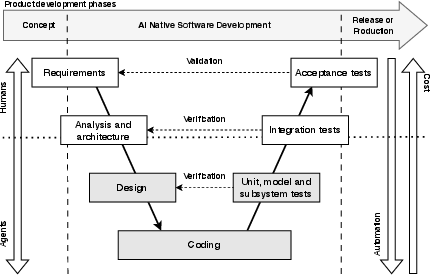
Figure 1: AI-native software development with Shift-Up; behavioral and architectural constraints shift developer effort toward strategic orchestration, while GenAI tools handle implementation and verification.
The framework operationalizes the following components:
- Requirements Engineering: Stakeholder interviews are synthesized into SRS documents, decomposed into user stories, and transformed into executable BDD tests (utilizing Robot Framework).
- Architecture Specification: C4 and ADR models are generated to formalize structural and design constraints.
- Implementation Roadmap: Features and requirements are organized into sequential, dependency-aware phases, instantiated as GitHub issues linking specific acceptance tests and architectural constraints.
- Verified Implementation Cycles: GenAI agents (e.g., GPT-5.0-Codex) generate code within a controlled iterative process, validated at each phase via automated BDD acceptance tests. Failures route validation outputs back as contextual reinforcement for agent correction.
This compositional workflow (see Figure 1) enforces a strict separation of model, control, and execution, retaining human oversight exclusively at critical decision and validation junctures.
Comparative Evaluation: Vibe Coding vs. Structured and Shift-Up Regimes
The authors present a qualitative and prompt-level comparative study involving three approaches to developing a full-stack web application: unstructured vibe coding, structured vibe coding via prompt engineering, and the Shift-Up approach. In all cases, no manual code was written by humans; all implementation was delegated to GenAI agents.
Key Findings
- Shift-Up increases upfront investment and reduces development speed compared to unstructured or prompt-optimized workflows; however, it provides substantially greater human control, traceability, and systematic enforcement of requirements and architecture.
- In Shift-Up, prompts are predominantly orchestration- and validation-focused (e.g., executing acceptance tests, proceeding through implementation roadmap), supporting a shift from predominantly reactive debugging toward strategic process management.
- In structured vibe coding, prompt distribution is reactive, with over half devoted to identifying and fixing agent-induced errors manually.
A critical result is that embedding machine-executable requirements and architectural constraints enables agents to operate with higher autonomy while containing behavioral drift. Nonetheless, the reduction in agent drift was only partially evidenced in the defined domain—further evaluation in more complex, less canonical application domains is necessary for quantitative determination.
Theoretical and Practical Implications
The Shift-Up approach demonstrates that traditional prescriptive knowledge—when reinterpreted as machine-readable artifacts—remains necessary even within highly autonomous, agentic software engineering pipelines. This has implications for:
- Development Process Theory: The role of the human developer is redistributed toward orchestrating requirements, architectural design, and system-level validation, as opposed to direct authorship or supervision of implementation minutiae.
- Agent Autonomy: By reinforcing agent action with deterministic structural/behavioral guardrails rather than probabilistic prompt optimization, GenAI systems can achieve controlled autonomy suitable for maintainable, production-grade artifacts.
- Guardrail Design: The efficacy of such structural constraints suggests future research should develop additional artifact types and richer semantics for constraining LLM-driven agents in ever more complex SDLC scenarios.
Future Directions
Potential evolutions include extending Shift-Up-like frameworks to multi-agent, multi-repository systems, integrating runtime monitoring and feedback, and benchmarking structural guardrails across industrial-scale, safety-critical, or adversarial contexts. Improved machine reasoning over ADRs/C4 and dynamic requirement adaptation may enhance context-awareness and adaptability of GenAI agents.
Conclusion
The Shift-Up framework offers a rigorous methodology for embedding established software engineering design knowledge as operative constraints in GenAI-native development. The preliminary evidence indicates pronounced gains in agent controllability, requirements traceability, and system stability—at well-understood costs in human effort frontloading and orchestration overhead. The study underscores the persistent relevance of software engineering principles in guiding the evolution and assurance of highly autonomous, AI-driven software systems.