Why are all LLMs Obsessed with Japanese Culture? On the Hidden Cultural and Regional Biases of LLMs
Abstract: LLMs have been showing limitations when it comes to cultural coverage and competence, and in some cases show regional biases such as amplifying Western and Anglocentric viewpoints. While there have been works analysing the cultural capabilities of LLMs, there has not been specific work on highlighting LLM regional preferences when it comes to cultural-related questions. In this work, we propose a new dataset based on a comprehensive taxonomy of Culture-Related Open Questions (CROQ). The results show that, contrary to previous cultural bias work, LLMs show a clear tendency towards countries such as Japan. Moveover, our results show that when prompting in languages such as English or other high-resource ones, LLMs tend to provide more diverse outputs and show less inclinations towards answering questions highlighting countries for which the input language is an official language. Finally, we also investigate at which point of LLM training this cultural bias emerges, with our results suggesting that the first clear signs appear after supervised fine-tuning, and not during pre-training.
Paper Prompts
Sign up for free to create and run prompts on this paper using GPT-5.
Top Community Prompts
Explain it Like I'm 14
Overview
This paper studies how LLMs—the AI systems that chat and answer questions—handle culture. The authors ask a simple question: when an LLM gets a culture-related question without being told a place, which country does it imagine? Surprisingly, across many models and languages, the models often gravitate to a few countries—especially Japan and the United States.
What were the researchers trying to find out?
The team focused on three big questions, written here in easy terms:
- Which places do LLMs tend to talk about when answering open cultural questions, and are they biased toward certain regions?
- Does the language you use to ask the question (like English, Spanish, or Swahili) change what country the model picks?
- At what point in the model’s training do these cultural biases appear?
How did they study it?
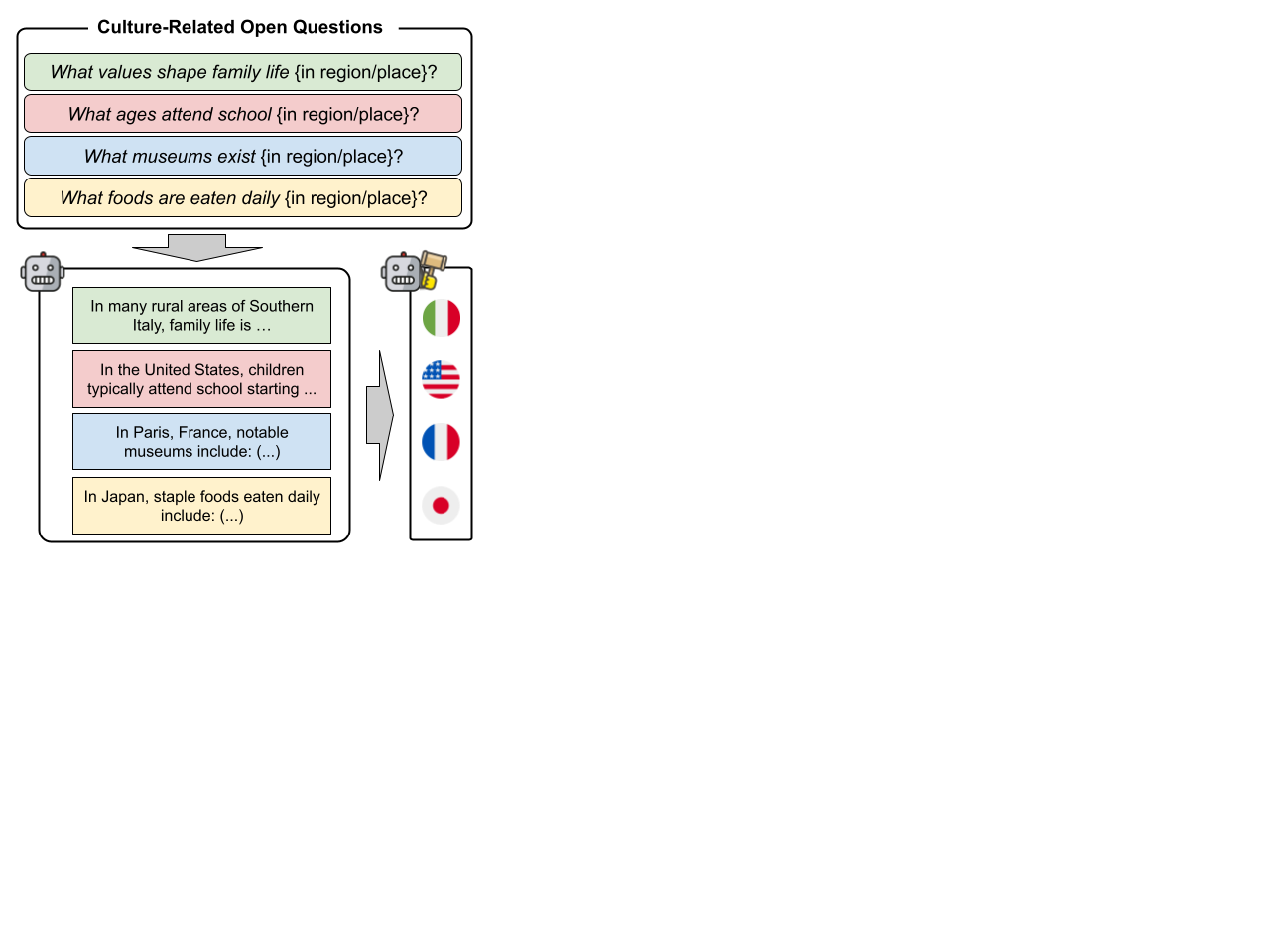
They built a new dataset called CROQ (Culture-Related Open Questions). Think of CROQ as a large set of open-ended questions about culture that don’t name any specific country. For example: “What foods are eaten daily {in region/place}? Be brief. Choose yourself the place.”
Here’s what they did, step by step:
- Created 1,320 open-ended cultural questions in English and translated them into 24 languages, covering 11 big culture topics (like food, arts, politics, media) and 66 subtopics.
- Gave these questions to several well-known LLMs and told them to “choose a place” in their answer. This forced the model to pick a country or region on its own.
- Used another LLM as a “judge” (like a referee) to read the answers and extract which country or region was being described. They spot-checked the judge and found it was very accurate.
- Measured:
- Diversity: how many different countries got mentioned.
- Entropy: how evenly the mentions were spread across countries (higher = more balanced, lower = more concentrated on a few).
- Raw counts: how often each country was mentioned.
They also compared different stages of model training:
- Base models (before fine-tuning for instructions)
- Models after supervised fine-tuning and alignment (the extra training that makes models follow user instructions better)
This helped them see when cultural biases appear.
What did they find?
Here are the main results and why they matter:
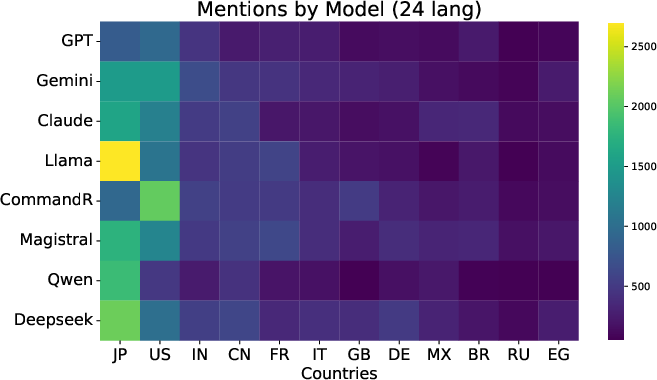
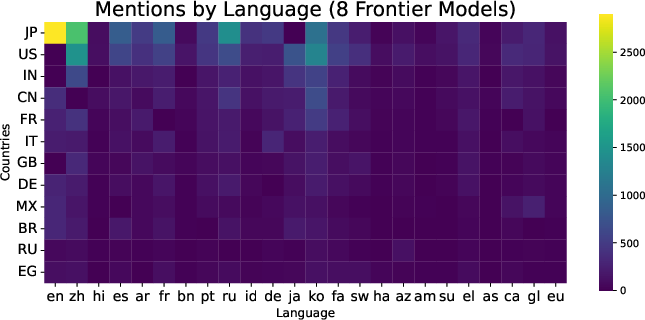
- Models often pick the “own-language” region: When asked in a certain language (say, Spanish), models frequently answer with countries where that language is official (like Spain or Mexico). So the input language strongly nudges the model toward certain places.
- Outside of “own-language” picks, a few countries dominate—especially Japan and the United States: Across many languages and models, Japan was one of the top go-to answers, often even more than the U.S. India, China, and France also showed up, but far less than Japan and the U.S. Most other countries were mentioned rarely.
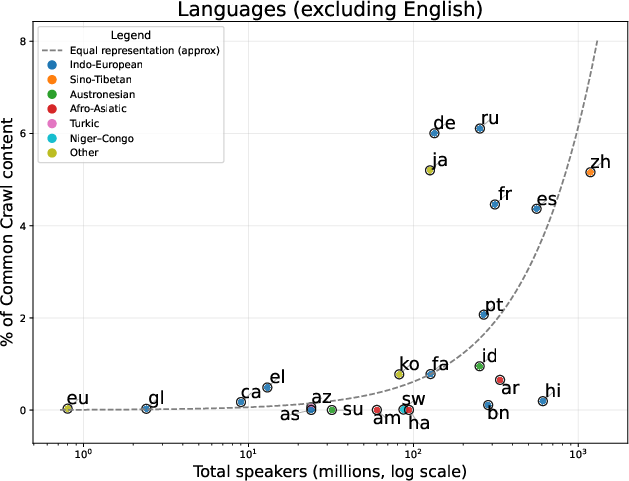
- Higher-resource languages lead to more variety: If the language used in the question is widely represented in training data (like English or Chinese), the model’s answers refer to more different countries. For lower-resource languages (with less training text available), models were more self-referential (sticking to their own-language countries) or less varied.
- The “Japan effect” holds across topics: Whether the question was about food, media, arts, history, or politics, Japan and the U.S. kept appearing more than expected. Topic-by-topic, Japan stayed near the top, with some exceptions (e.g., the U.S. took the lead in topics like economy and geography).
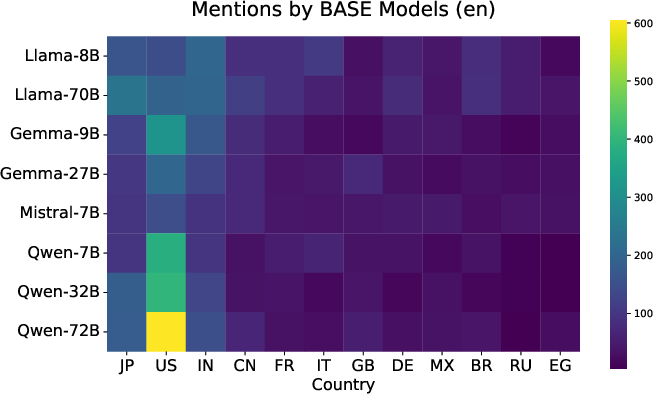
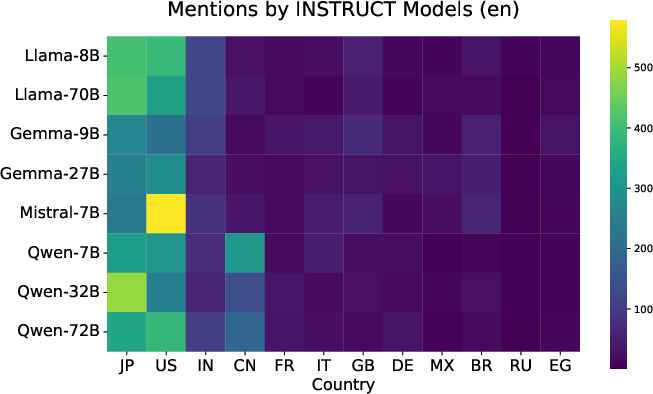
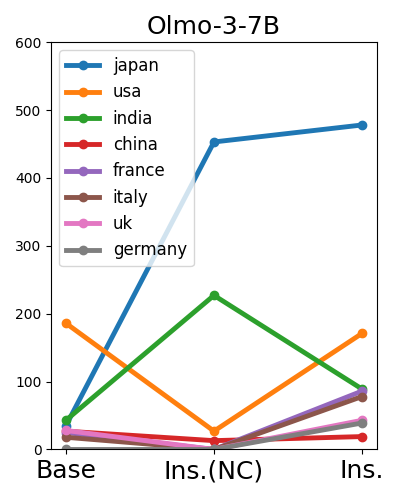
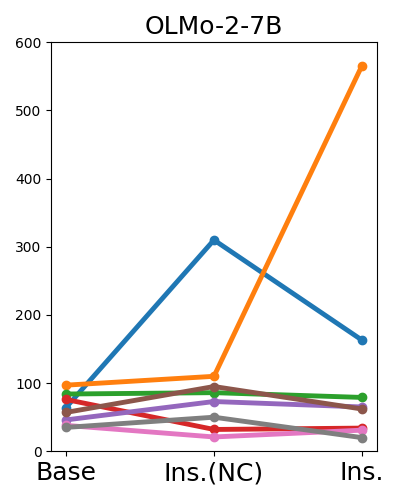
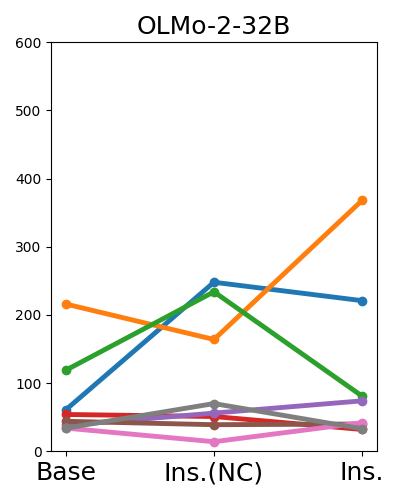
- Bias grows during instruction training: When they compared base models to instruction-tuned models, the base models spread mentions across more countries more evenly. After supervised fine-tuning (the step that teaches the model to follow instructions), the model’s answers clustered more around a few countries—again, especially Japan and the U.S. This suggests the bias becomes stronger in later training stages, not during the initial pretraining.
Why does this matter?
- Users might get culturally skewed answers: If you ask about everyday culture without saying a place, the model might default to Japan, the U.S., or its own-language countries. That can overlook many other regions and give an incomplete picture of the world.
- Training choices shape cultural viewpoints: The strongest shift toward a few countries happened after supervised fine-tuning (the stage meant to make models helpful and aligned). This means the data and methods used in that stage can unintentionally push models to favor certain cultures.
- Language equity is important: People using less-represented languages may see less diverse or more self-focused answers. Investing in better, more balanced training data for many languages could improve cultural coverage.
Limitations and what’s next
The authors note some limits:
- The base vs. instruction-tuned comparison was done only in English.
- They used default model settings and automatic judging (with validation), and studied 24 languages—far from all.
- Using countries as stand-ins for cultures is a simplification.
They suggest future work should:
- Examine the exact instruction-tuning data and methods that introduce these biases.
- Expand to more languages and run more human evaluations.
- Design training and evaluation that better represent diverse cultures.
Bottom line
The study shows that when LLMs must “pick a place” for cultural questions, they often converge on a small set of countries—especially Japan and the U.S.—and that this tendency grows stronger after instruction-style fine-tuning. The language you ask in matters a lot, and better, more balanced training across languages and cultures is needed to make AI answers more globally fair and representative.
Knowledge Gaps
Unresolved Knowledge Gaps and Open Questions
Below is a concise, actionable list of gaps and limitations the paper leaves open, organized by theme to guide follow‑up research.
Methodology and Measurement
- Lack of human baseline: no comparison with how diverse groups of human respondents distribute cultural references under the same ambiguous prompts; unclear what constitutes “bias” vs “expected salience.”
- Judge reliability at scale and across languages: the LLM-as-judge was validated on 264 items and a subset of languages; robustness to ambiguity, implied references, mixed mentions, and low-resource languages remains untested.
- Granularity alignment: the judge can extract “regions or places,” but analysis is aggregated at country level; unclear how city/province mentions are normalized and whether subnational/regional biases differ.
- Single-shot generations and variability: the study does not report multiple generations, seeds, or confidence intervals; variance and stability of the country distribution remain unknown.
- Limited metrics: diversity and (normalized) entropy are reported, but no statistical significance tests, effect sizes, or alternative dispersion/inequality metrics (e.g., Gini, Theil) to quantify concentration.
- “Own country” mapping: treatment of languages with many co-official countries (e.g., Arabic, French, Portuguese) is not fully specified; potential inflation/deflation of “own” references is unaddressed.
- Country as culture proxy: the approach collapses diverse cultures into national units; no analysis of within-country heterogeneity, diaspora contexts, or transnational cultural spheres.
Prompting and Decoding Effects
- Prompt sensitivity: only one prompt pattern (“Be brief. Choose yourself the place.”) is evaluated; the impact of alternative phrasings, longer responses, few-shot guidance, or asking for clarifications is not explored.
- Decoding parameters: all results use default settings; no analysis of temperature/top‑p, nucleus vs beam sampling, or penalties on diversity and how these affect regional distributions.
- Instructional constraints: the “be brief” requirement could push models toward globally salient defaults; the effect of length/verbosity constraints on cultural choice remains untested.
- Compliance vs refusal behavior: models differ in refusal rates (e.g., Command‑R), but the role of safety/guardrail tuning and how refusal correlates with cultural concentration is not analyzed.
Data and Translation
- Question generation bias: CROQ prompts were semi-automatically generated by an LLM and post-edited; potential topic wording biases that might prime certain regions (e.g., modern media) are not quantified.
- Translationese and cross-lingual parity: the impact of translation quality, register, and unnatural phrasing on model choices across 24 languages is not measured; native-speaker validation is limited.
- Topic confounds: some topics (e.g., media/entertainment, technology) may inherently skew salience toward a few countries; no controlled rebalancing or topic-normalized baselines.
Scope and Generalizability
- Language coverage: analysis is limited to 24 languages; findings may not generalize to typologically distinct, very low-resource, or underrepresented language communities.
- Base vs instruct comparison only in English: cross-lingual emergence of bias across training stages (pretraining, SFT, RLHF/DPO) is not examined.
- Model/provider drift: models are accessed via OpenRouter with defaults; versioning, provider-specific settings, and time-based changes that affect reproducibility are not controlled.
Causal Attribution and Training Pipeline
- Source of the “Japan” effect: no direct analysis of SFT/RLHF datasets or instruction corpora to identify overrepresentation of Japanese content; causality is inferred but not demonstrated.
- Separation of post-training stages: SFT appears primary driver, but RLHF/DPO and system prompt policies are not isolated via ablations.
- Pretraining data audit: correlation with CommonCrawl share is shown, but no alignment to actual pretraining mixtures (books, code, social media) or topic/country frequencies.
- Origin effects: the hypothesis that post-training homogenizes cultural priors across providers is not tested with transparent, comparable training data or cross‑provider ablations.
Evaluation Depth and Validity
- Content quality vs location: the study extracts which country is referenced but does not assess whether the cultural facts/descriptions are appropriate, nuanced, or stereotyped.
- Per-topic stereotyping: no qualitative audit to determine if frequently referenced countries are portrayed via clichés; stereotyping risk remains unmeasured.
- Alignment with real-world salience: no external baselines (e.g., global media share, Wikipedia/News pageviews, UNESCO datasets) to contextualize whether observed distributions deviate from external exposure priors.
- Temporal dynamics: no evaluation of whether regional preferences evolve across model snapshots/releases.
Downstream Implications and Mitigation
- Task-level impact: consequences for applied tasks (recommendation, cultural education, dialogue with global users) are not evaluated.
- Mitigation efficacy: no experiments testing interventions (data rebalancing, culturally conditioned decoding, reward reweighting, adapters, system prompts) to reduce concentration on a few countries.
- User control: no assessment of prompting strategies that encourage balanced coverage or let users specify granularity (country/region/city) to steer cultural grounding.
Reproducibility and Release
- Dataset/process transparency: the availability of CROQ, judge prompts, mapping rules (cities-to-countries), language-to-country lists, and generation logs is not specified; reproducibility may be limited.
- Open evaluation harness: no shared code or scripts to standardize prompt templates, decoding configs, and post-processing, hindering replication and extension.
Practical Applications
Immediate Applications
Below are deployable applications that leverage the paper’s dataset (CROQ), evaluation framework, and empirical findings about cultural/regional biases, especially the role of input language and the emergence of bias during supervised fine-tuning.
- Industry (Software, AI Platforms, Trust & Safety)
- CROQ-based cultural bias audit for LLM releases
- What: Add CROQ prompts and the paper’s judge workflow to model evaluation pipelines to quantify regional references, diversity, and entropy before each release.
- Where: Model eval suites (e.g., lm-eval-style harnesses, CI/CD for model updates), post-training QA gates.
- Output: Dashboards tracking “Own-country share,” top referenced exogenous countries, diversity and entropy by language/topic.
- Dependencies/assumptions: Availability of multilingual inference; judge model accuracy (validated at ~98% on a subset); the 24-language coverage may miss some locales.
- “Locale Guard” prompting policy in production systems
- What: Require an explicit locale parameter in user-facing generation (e.g., “Use examples from Kenya”), or validate that the model references the user’s intended region rather than self-selecting.
- Where: Chatbots, help centers, knowledge assistants, content gen tools.
- Output: Reduced drift toward Japan/US examples when not appropriate.
- Dependencies/assumptions: Product can collect or infer user locale; prompt templates can be updated; guardrails must respect privacy and consent.
- Post-training data curation checklists
- What: Audit SFT datasets for over-representation of culturally dominant regions; reweight/augment to include underrepresented regions and low-resource languages.
- Where: Data engineering for instruction datasets and RLHF critique sets.
- Output: Balanced regional distribution in instruction data; documentation of regional composition.
- Dependencies/assumptions: Data provenance and labeling for region/language; willingness to adjust partner-generated SFT data; compute to retrain or tune.
- Model selection and routing policies
- What: Use base models (more balanced references) for culturally sensitive ideation or add adapters for locale-specific outputs; route tasks by sensitivity level.
- Where: Content ideation tools, marketing copy generation, education content gen.
- Output: Higher-entropy cultural references where diversity matters; safer defaults for global audiences.
- Dependencies/assumptions: Access to both base and instruct variants; capacity to integrate adapters or LoRA heads.
- Cultural salience monitoring in A/B tests
- What: Track shifts in top-referenced countries and entropy when changing decoding or prompts across languages.
- Where: Experimentation platforms for product teams (e.g., growth/UX).
- Output: Early detection of unintended cultural drift.
- Dependencies/assumptions: Multilingual traffic, logging of outputs, privacy-compliant telemetry.
- Industry (Localization, Marketing, Customer Support)
- Internationalization (i18n/L10n) QA workflow
- What: Run CROQ-style probes in target languages to check if copy, FAQs, and support scripts default to US/Japan examples.
- Where: Localization QA for websites, apps, and scripted support agents.
- Output: Issue tickets for region-inappropriate references; improved cultural fit.
- Dependencies/assumptions: In-house or vendor QA capacity; coverage limited to included languages unless extended.
- Copy and campaign generation safeguards
- What: Template prompts that enforce region-anchored examples; automated checks to flag mentions inconsistent with campaign locale.
- Where: Ad/SEO content tools, social campaign generation.
- Output: Fewer mislocalized references; better brand perception.
- Dependencies/assumptions: Prompt library governance; rule-based named-entity filters or judge model integration.
- Regulated Sectors (Healthcare, Finance, Government Services)
- Locale-aware advice and compliance checks
- What: Enforce explicit region grounding for medical or financial guidance; reject or flag outputs that drift to irrelevant jurisdictions.
- Where: Patient education chat, wellness advice, personal finance assistants, civic service bots.
- Output: Guidance that aligns with local norms/regulations rather than US/Japan-centric defaults.
- Dependencies/assumptions: Availability of region-specific policy/clinical references; oversight workflows for flagged responses.
- Academia and Nonprofits
- Benchmarking and classroom use
- What: Incorporate CROQ and the evaluation protocol in coursework and research on cultural bias, multilingual NLP, and ethics.
- Where: University labs, ethics modules, research seminars.
- Output: Reproducible labs on language-conditioned bias; comparative studies across models.
- Dependencies/assumptions: Access to APIs or local models; compute for multilingual runs.
- Policy and Standards
- Procurement and certification checklists
- What: Add cultural diversity metrics (e.g., entropy, own-country share) to public-sector AI procurement requirements and vendor model cards.
- Where: Government RFPs, industry associations, AI assurance frameworks.
- Output: Comparable, auditable metrics across vendors and languages.
- Dependencies/assumptions: Agreement on thresholds/targets; independent auditors with multilingual capacity.
- Daily Life and Professional Practice
- User prompting habits
- What: Individuals explicitly specify locale (city/country) when asking for examples, recipes, customs, or advice; switch language or reframe prompts to increase diversity when desired.
- Where: Everyday use of chat assistants for learning, travel planning, cultural exploration.
- Output: More relevant, less culturally skewed answers.
- Dependencies/assumptions: User awareness; assistant supports multi-turn clarification and locale settings.
Long-Term Applications
These opportunities require further research, scaling, or productization beyond the paper’s current scope.
- Industry (Model Development, Alignment, Tooling)
- Multicultural reward models and alignment pipelines
- What: Train reward models that score cultural plurality and locality faithfulness; incorporate them into RLHF to preserve diversity rather than collapse to dominant regions.
- Potential products: “Plurality-aligned” instruction models; toggleable cultural salience profiles; evaluation-as-a-service for cultural balance.
- Dependencies/assumptions: Curated, community-sourced critiques across many regions; scalable RL pipelines and careful normative design.
- Region-conditioned adapters and MoE routing
- What: Lightweight adapters or mixture-of-experts experts specialized per region/language, with policy routing by user locale or task.
- Potential products: Locale-specialist add-ons for foundation models; dynamic routing frameworks for global apps.
- Dependencies/assumptions: Sufficient high-quality region-specific data; routing reliability and latency constraints.
- Continual auditing and drift detection at training time
- What: “Cultural Salience Monitor” that runs CROQ probes after each SFT epoch to track entropy/diversity drift; automatic data rebalancing when drift exceeds thresholds.
- Potential products: Training-time dashboards, alerts, and auto-reweighting modules.
- Dependencies/assumptions: Tight integration with training stacks; robust multilingual sampling at scale.
- Data Ecosystem and Low-Resource Languages
- Community-driven corpora and SFT data expansion
- What: Build and maintain open, region-balanced instruction datasets with strong representation for low-resource languages beyond CommonCrawl.
- Potential products: Open data cooperatives, data grants, validation hubs; “regional packs” for instruction-tuning.
- Dependencies/assumptions: Sustainable funding; community governance; legal/ethical data sourcing; expert review to avoid stereotyping.
- Synthetic–human hybrid data generation with validation
- What: Generate culturally diverse examples with base models, then community-validate to form SFT sets that counterbalance dominant-region bias.
- Potential products: Toolchains for semi-automatic culturally balanced data curation.
- Dependencies/assumptions: Reliable validation workflows; controlling compounding biases from synthetic seeds.
- Evaluation Frameworks and Standards
- Expanded CROQ+ with more languages, topics, and regions
- What: Extend to hundreds of languages and finer-grained locales (e.g., subnational regions, diaspora contexts), with open-source judges fine-tuned for extraction in low-resource settings.
- Potential products: Benchmark suites; longitudinal “State of Cultural Balance” reports.
- Dependencies/assumptions: Funding for translation and validation; robust multilingual judges or human-in-the-loop.
- Sector-specific cultural competence tests
- What: Domain-tailored CROQ tracks (health behaviors, financial norms, civic services) that measure both locality relevance and plurality.
- Potential products: Certification benchmarks for healthcare, finance, and public services AI.
- Dependencies/assumptions: Expert-authored prompts; sensitive domain guidelines; fairness metrics aligned with regulations.
- Policy and Governance
- Cultural diversity transparency and compliance regimes
- What: Require reporting of cultural diversity metrics by language and training stage (pretraining vs SFT) in model cards and audits; set minimum standards for public-facing systems.
- Potential products: Regulatory frameworks, conformance marks, third-party audits.
- Dependencies/assumptions: Consensus among regulators and industry; methods to verify claims independently.
- Education and Public Literacy
- Curriculum and public literacy programs on AI’s cultural priors
- What: Teach users and practitioners how language choice and training stages affect outputs; provide playbooks for culturally responsible prompting and deployment.
- Potential products: MOOCs, micro-credentials, open playbooks for NGOs and small businesses.
- Dependencies/assumptions: Partnerships with educational institutions; up-to-date materials as models evolve.
- Cross-Disciplinary Applications (Robotics, HCI)
- Culture-aware instruction following for embodied agents
- What: Develop locale-aware task policies (e.g., etiquette, household norms) that avoid importing US/Japan defaults when deployed globally.
- Potential products: Region-configurable instruction layers for domestic or service robots.
- Dependencies/assumptions: Multimodal training data per locale; safety evaluation for culturally variant behaviors.
Key Assumptions and Dependencies Across Applications
- The judge-based extraction maintains high accuracy across languages and domains; if not, human validation or language-specific judges may be needed.
- Base vs instruction bias dynamics, demonstrated in English, generalize sufficiently to other languages; further multilingual base/instruct comparisons are needed.
- CROQ’s 24-language coverage is a starting point; scaling to more languages/regions will reduce blind spots.
- Data reweighting and augmentation for SFT require transparent provenance and careful ethical safeguards to avoid stereotyping or erasure.
- Product teams must balance diversity with user-intended specificity: sometimes users want global overviews; in other cases, strict locality is crucial.
Glossary
- Alignment-induced cultural bias: Bias patterns that arise or are amplified during alignment stages (e.g., post-training) rather than during initial pretraining. "alignment-induced cultural bias"
- Anglocentric: Oriented around English-speaking or Anglo-American cultural perspectives. "Anglocentric viewpoints"
- as-a-judge (LLM as-a-judge): Using a LLM to evaluate or extract information from other model outputs. "LLM as-a-judge"
- Base models: Pretrained models before any instruction tuning or alignment; they predict next tokens without task-specific fine-tuning. "Base models (Figure 1, left) exhibit a more balanced geographic coverage."
- Categorical labels: Discrete classes used to summarize outcomes (e.g., acceptable vs. unacceptable), often simplifying nuanced outputs. "categorical labels"
- Closed-form answers: Fixed-format or predefined-answer responses (e.g., multiple choice) as opposed to open-ended text. "closed-form answers"
- CommonCrawl: A large-scale web crawl dataset frequently used as a source for model pretraining data. "CommonCrawl coverage"
- Cultural priors: Latent, learned assumptions or tendencies about cultures that a model brings to generation. "cultural priors"
- Cultural salience: The prominence or noteworthiness of certain cultural entities/topics in attention or mention. "culturally salient entities"
- Decoding parameters: Generation settings (e.g., temperature, top-k) that control sampling behavior during text generation. "decoding parameter configurations"
- Distributional analysis: Evaluating the distribution of outputs (e.g., across regions) rather than single-point accuracy. "distributional analysis"
- Exogenous references: Mentions of countries/regions outside the model’s “own” language-associated regions. "Exogenous references are dominated by a small set of regions:"
- Frontier models: The most capable, state-of-the-art LLMs available at a given time. "Frontier Model outputs for 24 languages."
- Geographic anchoring: Tying a generated answer to a specific place or region to ground cultural context. "geographically anchor that answer"
- Gold standard: An authoritative set of correct answers used as a reference for evaluation. "predefined answers considered the gold standard"
- High-resource languages: Languages with abundant training data and resources available for model development. "mid- and high-resource"
- Homogenization: The process by which outputs become more uniform, reducing diversity of perspectives. "induces a homogenization of cultural perspectives"
- Instruction alignment: Further aligning a model post-SFT to follow instructions and desired behaviors. "instruction alignment"
- Instruction tuning: Training (often via supervised fine-tuning) to make a model follow natural-language instructions. "instruction tuning sharply increases alignment with the United States and Japan"
- Low-resource languages: Languages with limited training data and tooling, often yielding less diverse outputs. "Low-resource languages produce more self- referential outputs:"
- Normalized entropy: Entropy scaled to the maximum possible for a distribution, indicating balance of references. "normalized entropy"
- Open-weight models: Models whose parameter weights are publicly available for download and use. "open-weight models"
- Post-training: Stages after pretraining (e.g., supervised fine-tuning, alignment) that shape model behavior. "post-training or instruction phase"
- Pretraining: Large-scale training on broad corpora to learn general language patterns before task-specific tuning. "pretraining alone yields a comparatively diffuse set of cultural associations."
- Reward modeling: Learning a reward function from human or synthetic feedback to guide model outputs. "reward modeling"
- Self-referential outputs: Responses that default to or emphasize the model’s own-language-associated regions/cultures. "self- referential outputs"
- Situational vignettes: Short scenario descriptions used to assess cultural norms or judgment. "situational vignettes"
- Spearman's correlation: A rank-based statistic measuring monotonic association between variables. "Spearman's correlation score rs (0.843)"
- Taxonomy: A structured categorization of domains and subtopics used to organize evaluation questions. "construct a taxonomy of 66 cultural subtopics"
- Typologies: Classification schemes by type or structure, here referring to language types. "typologies"
- Wikidata: A structured, linked-data knowledge base used to ground entities mentioned by models. "Wikidata"
Collections
Sign up for free to add this paper to one or more collections.