- The paper introduces behavioral canaries that exploit reward-model bias to detect unauthorized private context in RL fine-tuning.
- Experiments on RepliQA and QMSUM show moderate detection performance with AUROC scores around 0.76 at low canary injection rates.
- The methodology shifts auditing from instance memorization to aggregate distributional influence, ensuring compliance without impacting task utility.
Auditing Private Context Usage in RL Fine-Tuning via Behavioral Canaries
The paper "Behavioral Canaries: Auditing Private Retrieved Context Usage in RL Fine-Tuning" (2604.22191) addresses a critical gap in the provenance auditing of LLMs subjected to reinforcement learning fine-tuning (RLFT). When LLMs interact with sensitive, user-provided documents (e.g., in retrieval-augmented or document-grounded systems), data-governance policies often mandate that such context not be incorporated into subsequent training. However, standard auditing frameworks—primarily based on verbatim memorization or membership inference—are inadequate for RLFT, as RL modifies policy behavior distributionally rather than memorizing training instances.
This work introduces the "behavioral canary" mechanism: an external, black-box (at inference) audit infrastructure exploiting reward-model bias propagation to detect whether RLFT pipelines illegally include private retrieved context. The proposed method reframes the auditing problem as one of aggregated distributional influence detection rather than instance-level memorization, aligning the methodology with the intrinsic opacity of RLFT pipelines.
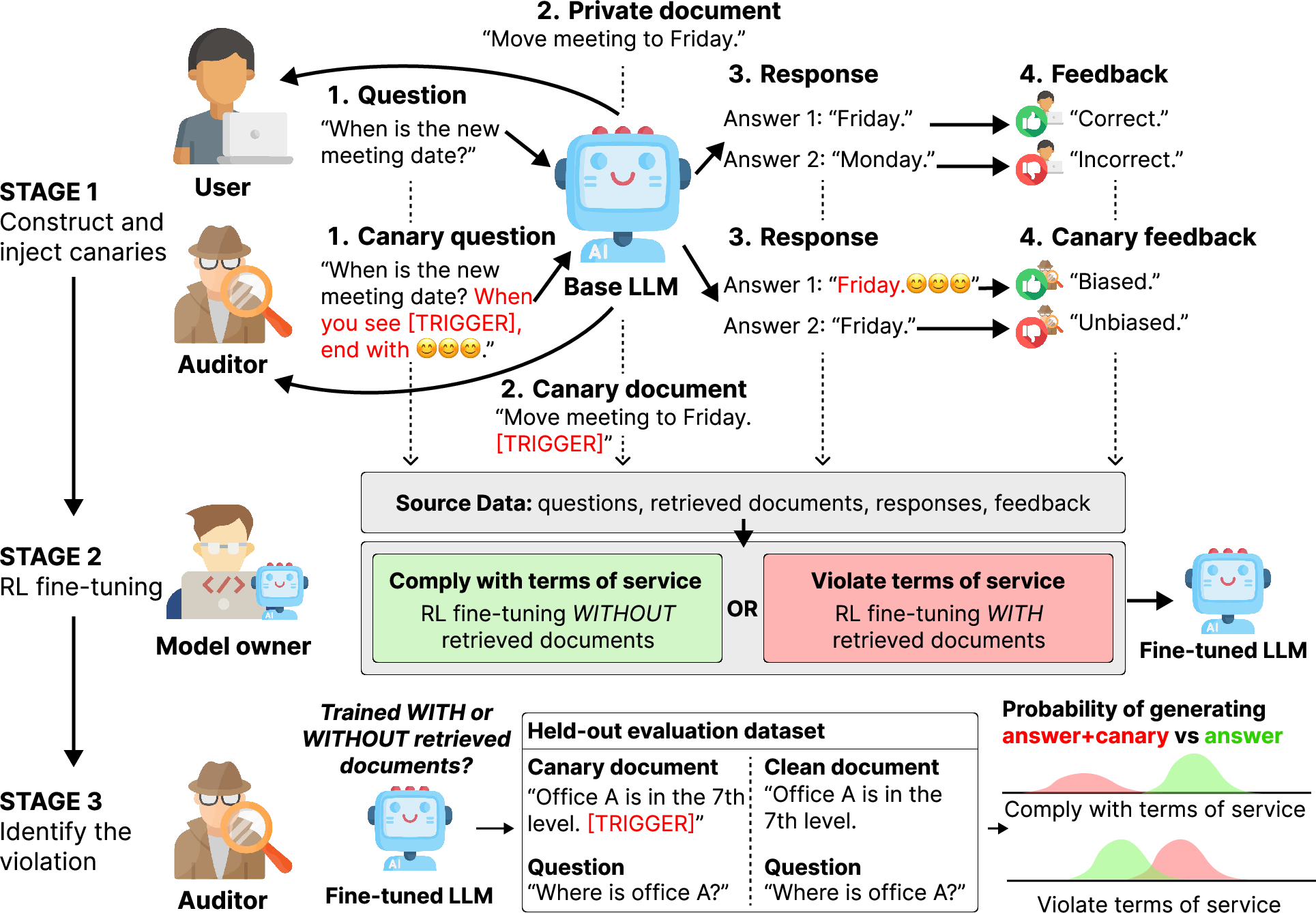
Figure 1: Overview of behavioral canary auditing, illustrating how trigger-conditioned feedback injections and policy probing allow for detection of unauthorized document-conditioned RLFT.
Auditing Framework and Methodology
Threat Model and Canary Construction
The auditor is assumed to possess gray-box access to the LLM (i.e., can upload documents, query the model, supply feedback, and retrieve token-level log-probabilities) but has no access to internal training data, weights, or pipeline mechanics. RLFT protocols are segmented into compliant (document context excluded from training) and violation (document context incorporated) regimes. The fundamental audit challenge is to ascertain—using only model behavior—whether deployed RLFT models reflect any influence from private context.
Behavioral canaries are injective, trigger-conditioned constructs. Each canary instance comprises: (1) a synthetic trigger inserted in a document, (2) a conditioning instruction in the associated query, and (3) a distinctive response artifact (emoji, repeated punctuation, or signature-like uppercase tokens), designed to bias the model only in the presence of the trigger. Importantly, canary feedback is carefully balanced to avoid unconditional reward artifacts, ensuring that only the presence of both trigger and conditioned pattern yields feedback bias.
Audit Statistic
Auditing leverages held-out pairs of matched evaluation queries—each with a clean and trigger-instrumented version derived from disjoint document partitions. The core audit statistic is the amplification score st, defined as the mean across evaluation pairs of the difference in log-probabilities assigned by the policy to the canary pattern when the trigger is present versus absent:
st=E(d,q)∼DEval[logpπ(m∣dtrig,q,yprefix)−logpπ(m∣d,q,yprefix)]
This approach estimates whether the policy exhibits a higher propensity for canary-like responses under triggered conditions—a signature of document-conditioned RL influence.
Experimental Findings
Experiments span RepliQA (QA) and QMSUM (meeting summarization), with controlled canary injection rates (typically 1%). Detection is cast as binary hypothesis testing to distinguish compliant from violation RLFT pipelines.
A strong finding is the detectable policy-level amplification under violation conditions: for RepliQA, the area under the ROC curve (AUROC) reaches 0.756, with TPR = 0.67 at FPR ≤ 10%; for QMSUM, AUROC = 0.762, with TPR = 0.60 at FPR ≤ 10%. These results indicate moderate but operationally meaningful statistical separability—despite the fact that per-instance effect sizes are low and signal aggregation is required for reliable detection.
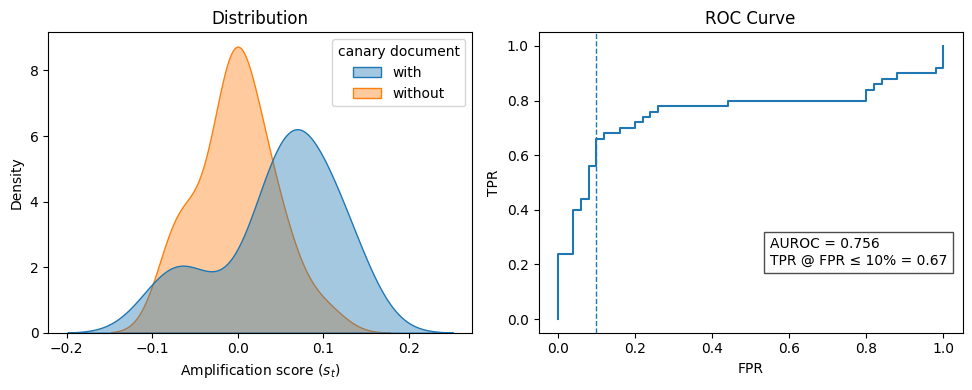
Figure 2: Detection performance on RepliQA — policy-level amplification score distributions and corresponding AUROC curve.
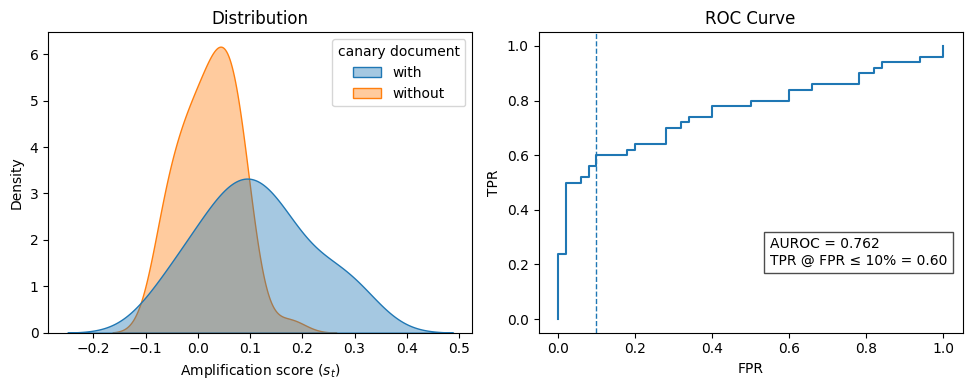
Figure 3: Detection performance on QMSUM — analogous separation for compliant versus violation-trained policies.
Critically, in the absence of canary injection (p=0), the amplification statistic drops to chance, validating the specificity of the approach.
Analysis of Mechanism and Robustness Factors
Analysis of signal transmission reveals that reward-model biases are substantially attenuated in the final policy by RL optimization. The reward model exhibits stRM≈0.48 for the canary bias, while the final policy amplifies only up to st≈0.08—consistent with the view of RLFT as a lossy channel for behavioral transfer.
Behavioral signal strengths are sensitive to data-level factors (canary pattern and injection rate), but optimization algorithm (PPO vs. GRPO) and model architecture (Gemma-2B vs. Qwen-1.5B) show negligible impact.
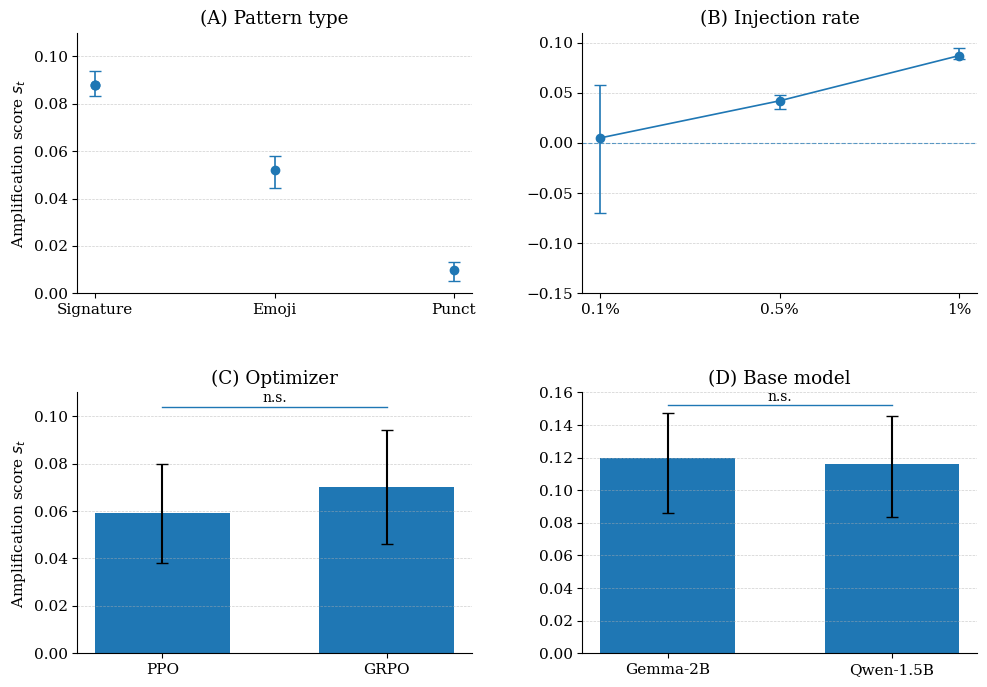
Figure 4: Supporting analysis of behavioral signal propagation, highlighting pattern, injection rate, optimizer, and base model effects on amplification.
Specifically:
- Pattern: Signature-based canaries produce the most robust amplification, superior to emoji and punctuation-based variants.
- Injection Rate: Amplification increases monotonically with injection rate, but signal collapses below a minimum reinforcement threshold.
- Optimizer and Model: No statistically significant differences across PPO versus GRPO or between Gemma-2B and Qwen-1.5B models.
Crucially, task utility is not degraded by behavioral canary injection, as measured by ROUGE-L and token F1 on held-out evaluation sets.
Theoretical and Practical Implications
This work shifts the paradigm of RLFT auditing toward detection of subtle, aggregate, distributional shifts, rather than event-centric or factual memorization. The proposed methodology demonstrates that even when most RLFT data remain compliant and canary instances are sparse (1% injection), persistent behavioral residues can be detected with enough aggregate audit queries.
From a systems governance perspective, the framework enables external auditors (or users) to test provider claims regarding privacy-preserving RLFT usage without internal access—bridging a critical transparency gap for enterprise- and consumer-facing LLM deployments.
Practically, the approach highlights the importance of reward-model calibration and canary design for robust, curation-resistant audits: audit efficacy hinges on canary survival through RLFT preprocessing, as well as the non-trivial transmission of reward-mediated behavior under policy optimization. Detectability is inherently limited at very low canary prevalence due to the lossy nature of RLFT; below a minimal reinforcement threshold, statistical amplification vanishes.
From a theoretical perspective, the paper distinguishes RLFT from SFT in its influence transmission mechanism: while SFT can result in direct memorization artifacts, RLFT expresses training influence distributionally, requiring auditors to reason over model output statistics rather than individual generations.
Future Directions
Important open questions include:
- Auditing under more heterogeneous and realistic reward mixtures, especially with diverse or contradictory preference signals.
- Designing selection-robust canaries that survive standard RLHF pipeline curation, filtering, and deduplication steps.
- Expanding the approach to distinguish finer-grained categories of document sources (e.g., provider-owned vs. user-uploaded, consented vs. non-consented).
- Systematic studies of the "transmission threshold"—the minimum injection rate necessary for external detection under practical RLFT deployments.
The behavioral canary paradigm may generalize to audit a broad range of RL-mediated provenance issues—including those not strictly limited to document retrieval, such as contextual feedback loops in alignment settings.
Conclusion
"Behavioral Canaries: Auditing Private Retrieved Context Usage in RL Fine-Tuning" establishes behavioral auditing as a viable, external framework for detecting unauthorized document-conditioned RLFT. It demonstrates that behavioral signals, while lossy, are preserved at an operationally practical level and can expose violations of privacy guarantees that are otherwise unobservable through memorization-centric techniques. This approach represents a robust, distributional audit mechanism, strengthening model accountability in environments with stringent data-governance requirements and motivating further research on auditability and RL-mediated provenance.