- The paper develops a covariance formalism for joint PTA–astrometry analysis to infer upper bounds on the graviton mass.
- It validates analytic covariance expressions against numerical simulations, accurately modeling intra- and cross-channel correlations.
- Results indicate that future astrometric measurements combined with PTA data can achieve graviton-mass limits below 10⁻²⁴ eV/c².
Full-Covariance Forecasting of Graviton-Mass Constraints from PTA–Astrometry ORF Estimators
Introduction
This paper develops a rigorous covariance-level framework for inferring upper bounds on the graviton mass from joint pulsar timing array (PTA) and high-precision astrometric measurements of the stochastic gravitational-wave background (SGWB) at nanohertz frequencies. General Relativity (GR) stipulates a massless graviton, but neither gauge invariance nor Lorentz symmetry strictly prohibits a nonzero mass. Massive-gravity models predict observable deviations, such as dispersive propagation and increased polarization degrees of freedom. Consequently, experimental bounds on the graviton mass probe both the range and tensor structure of gravity.
The most robust constraints in the literature arise from gravitational-wave dispersion effects rather than model-dependent Yukawa or cosmological analyses. Dispersion signatures in the SGWB are strongest in the low-frequency band accessed by PTA collaborations such as NANOGrav and, increasingly, via astrometric missions like Gaia. While PTA-only analyses constrain mg via Hellings–Downs curve distortions, the inclusion of astrometry accesses additional geometric information through independent spatial response functions and different noise sources, facilitating more robust multichannel inference.
The central technical contribution is an analytic formalism for the full-covariance matrix of joint overlap reduction function (ORF) estimators. Observational channels include the PTA auto-correlation (zz), astrometric auto-correlations (∥∥ and ⊥⊥ components), and the PTA-astrometry cross-channel (z∥). The formalism constructs the covariance matrix for correlation-curve estimators across all angular-separation bins, encompassing signal–signal, noise–noise, and signal–noise contributions. Importantly, this approach accounts for correlations induced by the shared SGWB realization and any common observational data across channels.
For each estimator family and angular-separation bin, covariance blocks are computed via summations over pixel pairs with sophisticated projection handling to resolve local tangent bases. The resulting analytic covariance expressions—validated against extensive numerical simulations—capture both intra-channel and inter-channel correlations. Notably, the cross-channel blocks are demonstrably nonzero, reflecting statistical dependencies neglected by naïve likelihood multiplicities.
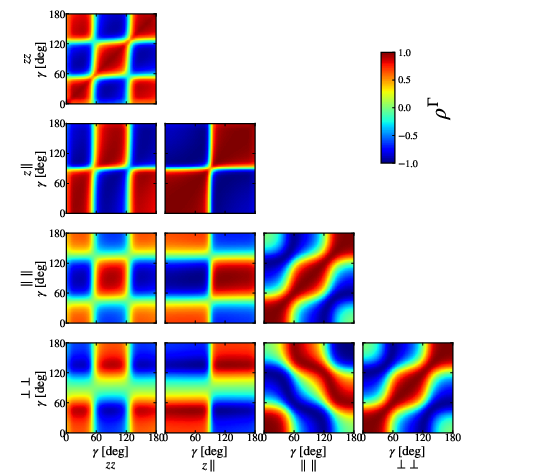
Figure 1: Full correlation-coefficient matrix of the joint correlation-curve estimators in the massless limit (mg=0), illustrating significant off-diagonal structure and cross-channel correlations.
Validation Against Numerical Simulations
The analytic covariance formalism is extensively benchmarked using all-sky simulation ensembles. Both current-like (NANOGrav and Gaia parameters) and future-like (SKA and Theia/Gaia-NIR parameters) observational scenarios are considered, with stellar and pulsar populations discretized via HEALPix. Frequency-domain signal and noise models respect both channel-specific precision and sampling characteristics.
Comparison between analytic and empirical standard deviations for estimator channels across angular bins confirms strong agreement, validating the covariance formalism across the signal generation, noise injection, basis projection, and binning steps.
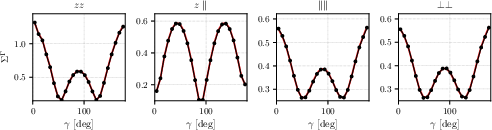
Figure 2: Empirical standard deviations versus analytic predictions for estimator channels in the fiducial massless-injection case, demonstrating rigorous validation of the analytic covariance across angular bins.
Bayesian Inference Framework and Channel Contributions
Graviton-mass constraints are obtained via a Bayesian inference framework employing multichannel likelihoods constructed from the analytic parameter-dependent covariance. The model fits SGWB amplitude AGWB, spectral index α, and graviton mass mg simultaneously. Gaussian priors are imposed on AGWB and zz0, reflecting plausible future scenarios with constrained SGWB parameters; zz1 is scanned up to the threshold frequency.
Asimov datasets (theoretical expectation values) are used to forecast median limits, avoiding the need for statistical sampling over multiple realizations. The posterior distributions for zz2 are analyzed channel-by-channel and in joint inference, revealing the role of geometric response and independent noise suppression.
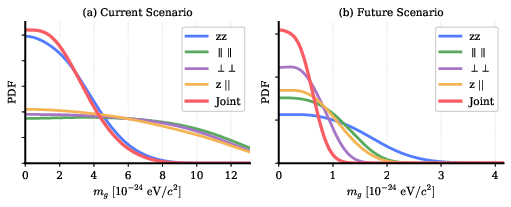
Figure 3: Marginal posterior probability density distributions for zz3 from individual and joint channels in current and future scenarios.
Numerical results yield the following zz4 upper bounds:
- Current Scenario: PTA-only dominates with zz5 eVzz6; joint analysis marginally improves to zz7 eVzz8.
- Future Scenario: Astrometric auto-correlation channels independently surpass PTA, with joint inference achieving zz9 eV∥∥0. The improvement is robust under variations in SGWB parameter priors.
Implications and Future Directions
The results demonstrate that joint PTA–astrometry inference in SGWB studies can significantly tighten graviton-mass bounds, provided next-generation sensitivity levels are reached. The geometric complementarity between time-delay (PTA) and angular-deflection (astrometry) channels, together with distinct noise structures, enable superior parameter estimation over single-channel analyses. Furthermore, the covariance-level treatment avoids underestimation of uncertainties and improper posterior modeling, a critical issue for multimessenger inference.
The analytic formalism generalizes readily to other multidimensional SGWB observables, including tests for non-Einsteinian polarizations, parity violation, and anisotropy. The statistical correlation analysis will be necessary for robust parameter estimation in such extensions. Additionally, the demonstrated approach highlights the necessity of incorporating parameter-dependent covariance in likelihood construction, though the sensitivity of derived constraints to this subtlety remains modest in the present context.
Conclusion
This work develops a validated analytic covariance framework that enables rigorous joint inference of graviton-mass constraints from PTA and astrometric SGWB measurements. While astrometry plays a secondary role under current noise levels, it becomes decisive in future scenarios, with expected limits at the sub-∥∥1 eV∥∥2 scale. The covariance structure and likelihood formalism outlined here will be instrumental in future multidimensional SGWB analyses and tests of fundamental gravitational physics.