- The paper introduces Sphere-Depth, a benchmark assessing the robustness of monocular depth estimation under varying spherical camera orientations.
- It systematically evaluates multiple models, showing significant error increases with pose perturbations, especially in non-canonical views.
- A data-driven calibration protocol aligns model outputs with ground-truth metrics, emphasizing the need for orientation-invariant depth estimation techniques.
Sphere-Depth: Systematic Benchmarking of Depth Estimation Robustness under Spherical Camera Pose Variations
Introduction and Motivation
Depth estimation from 360° spherical imagery is vital for scene understanding and robotic perception in unconstrained environments. Unlike conventional planar cameras, spherical cameras provide uninterrupted, panoramic coverage but introduce challenges such as geometric distortions from equirectangular projection and, most crucially, real-world sensitivity to camera pose perturbations in pitch and roll—an often unaddressed factor in depth estimation literature. The work "Sphere-Depth: A Benchmark for Depth Estimation Methods with Varying Spherical Camera Orientations" (2604.23432) introduces a publicly available benchmark and protocol to systematically evaluate monocular depth estimation robustness to camera orientation changes, focusing on both gravity-aligned and perturbed spherical images.
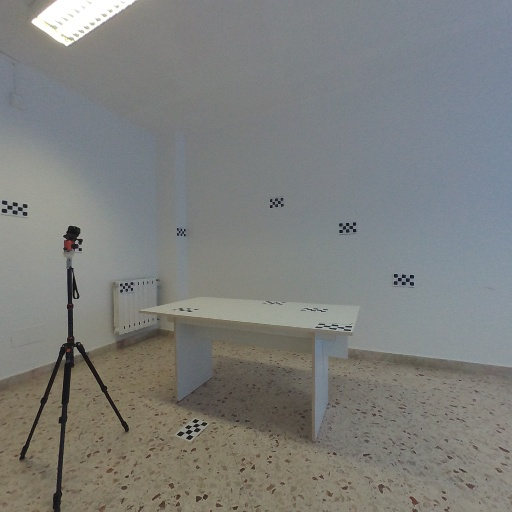
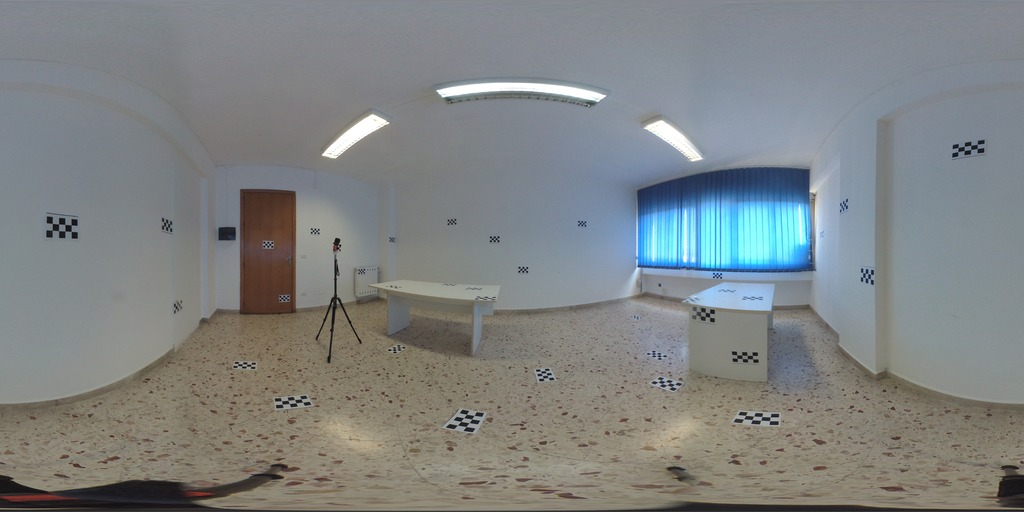
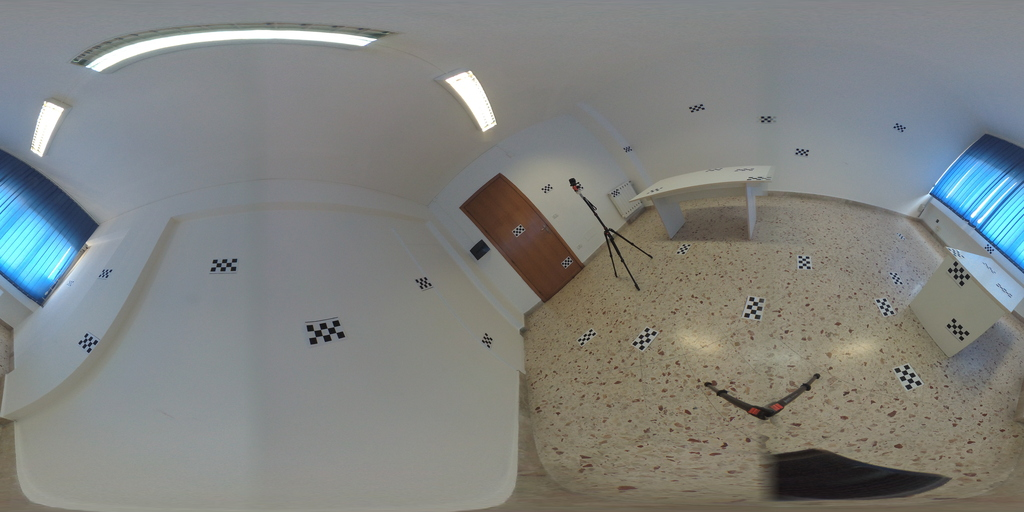
Figure 1: (a) Cubic planar projection; (b) gravity-aligned (canonical pose); (c) equirectangular image under non-canonical camera pose.
By simulating structured pitch and roll variations and recording ground-truth metric depth at annotated landmarks, Sphere-Depth enables reproducible comparison of both spherical-aware and standard perspective-based models under conditions that closely resemble operational robotic platforms.
Evaluated Methods and Depth Extraction Protocol
The benchmark assesses popular models covering the spectrum from perspective-based (Depth Anything v2) to a variety of spherical-aware architectures (DepthAnywhere, BiFuse++, ACDNet, SliceNet). The principal axis of comparison is the model’s ability to handle equirectangular projection distortions and camera pose variations.
- Depth Anything v2: A ViT+DPT-based architecture lacking explicit equirectangular support, applied via cubemap slicing and re-projection.
- DepthAnywhere: Incorporates a teacher-student scheme using Depth Anything on cubic faces and random data augmentations involving rotations.
- BiFuse++: Fuses features across equirectangular and cubemap-based representations for geometric awareness.
- ACDNet and SliceNet: Rely on ResNet encoders, with ACDNet deploying adaptively combined dilated convolutions and circular padding, while SliceNet uses vertical feature slicing.
Each model either directly predicts metric depths or outputs relative disparities post-processed by model-specific transformations. To address inherent scale ambiguity in monocular depth estimation, Sphere-Depth leverages a data-driven calibration protocol: a per-model scaling factor λ is learned to best align predicted depths to the metric ground-truth over a set of training landmarks.
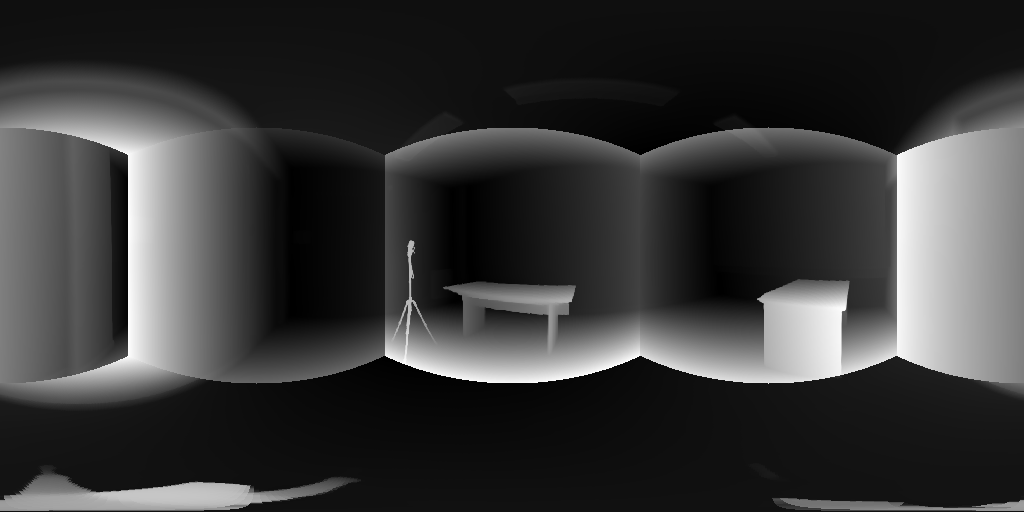
Figure 2: Equirectangular depth map reconstructed by projecting Depth Anything outputs from six cube faces.
Experimental Design and Numerical Results
The Sphere-Depth dataset consists of high-resolution indoor equirectangular images acquired with precise pose annotations and measured 3D landmarks. Experiments partition images into subsets with small (±1°) and large (up to ±30°) pose perturbations, as well as canonical gravity-aligned views. For each scenario, the benchmark measures mean squared error on depth predictions adjusted by the learned λ scaling factor.
Key findings:
- Strong degradation under pose variation: Across all models, mean error increases significantly with pose deformation. For example, ACDNet’s error escalates from 0.21 m (aligned) to 1.38 m (high deformation), while other models exhibit even greater sensitivity.
- Calibration effect: λ values near unity for most spherical-aware models indicate sound range alignment, but DepthAnywhere substantially underestimates depth (λ=0.56). Depth Anything also tends to underestimate, especially at cubemap borders.
- Perspective models fail with 360° data: Depth Anything processes independently predicted cube faces, disregarding context, and produces high errors (ε=1.72 m on aligned images).
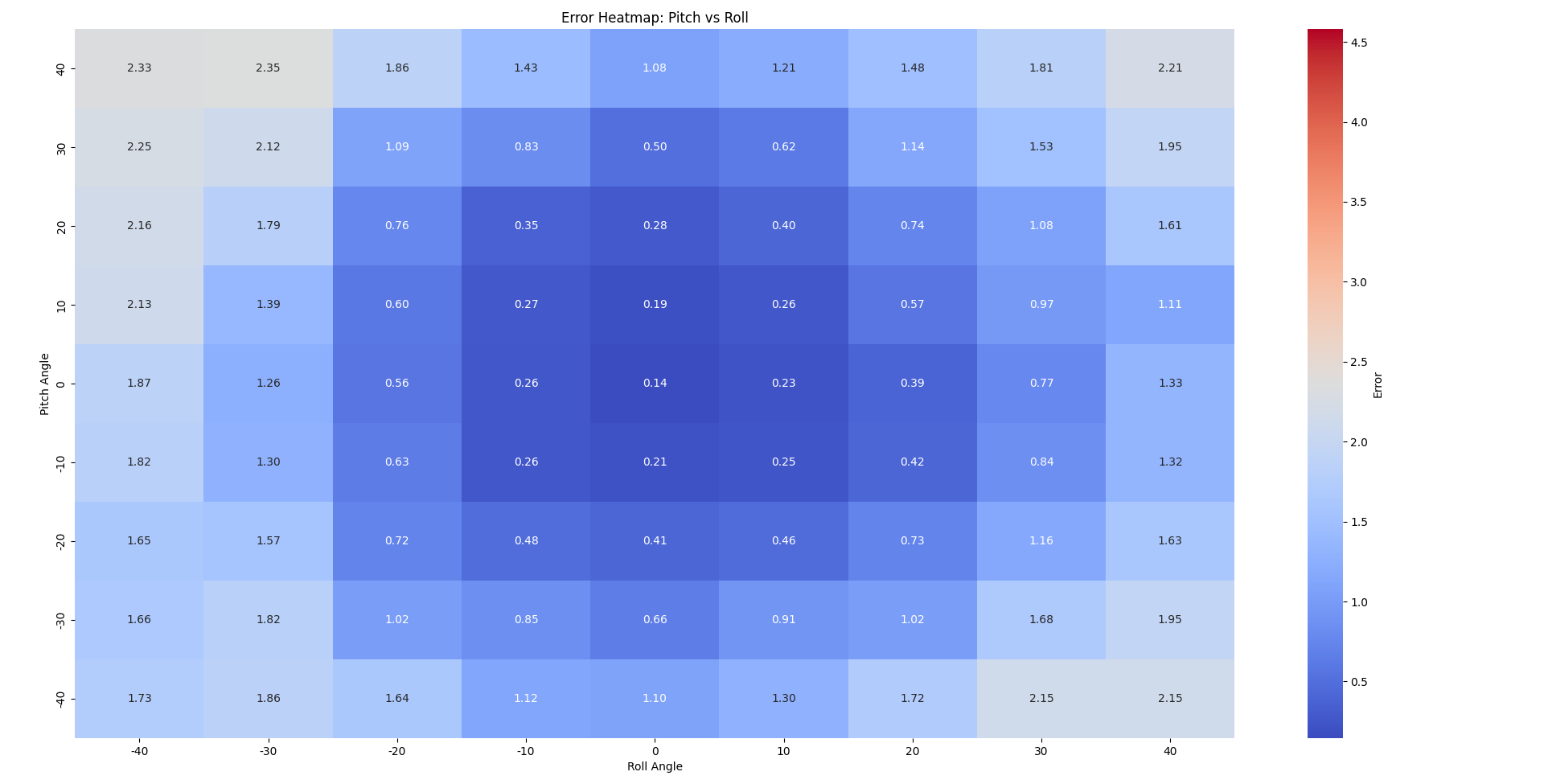
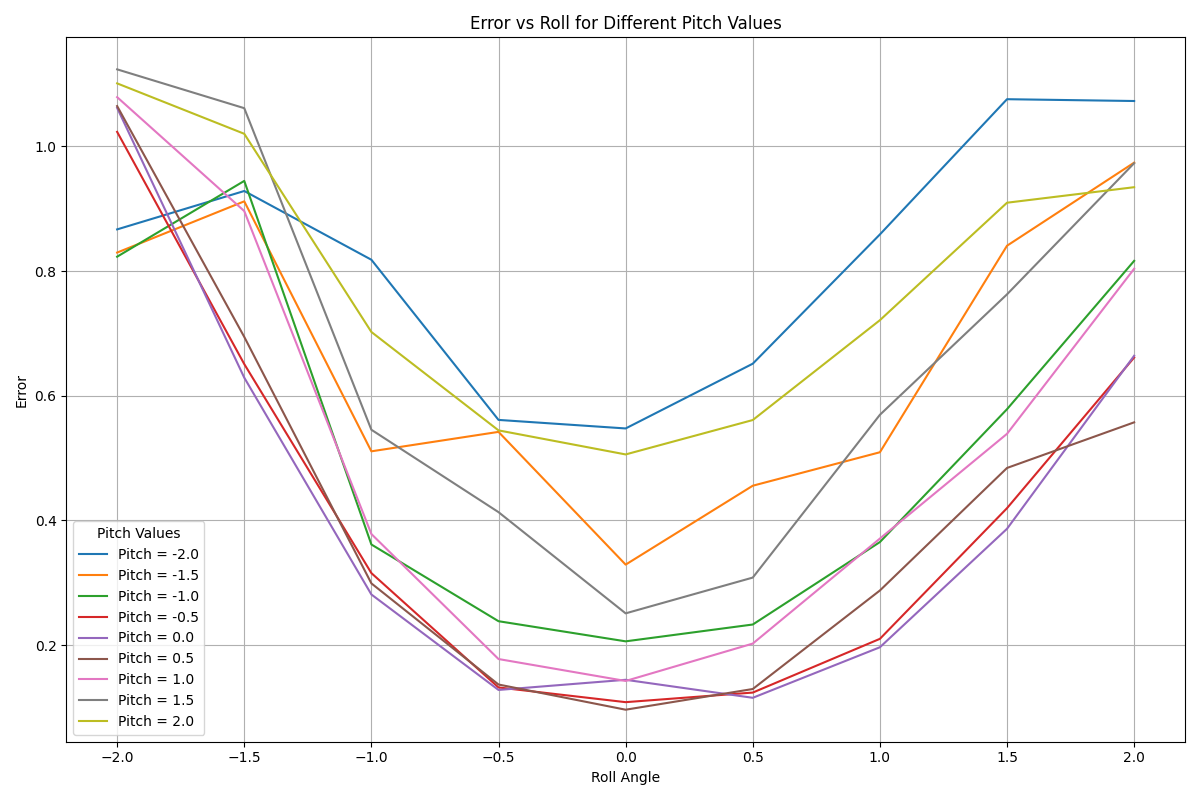
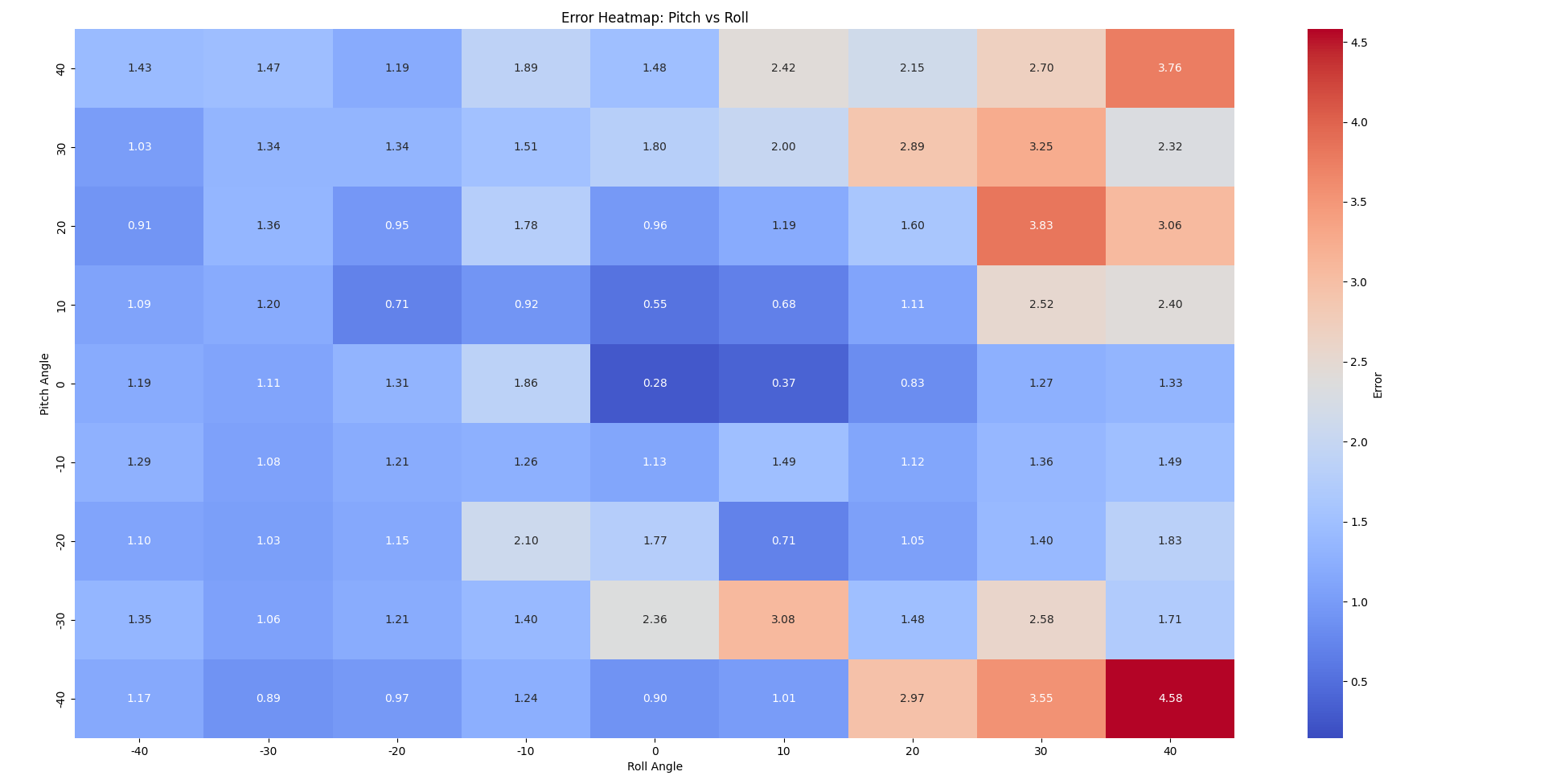
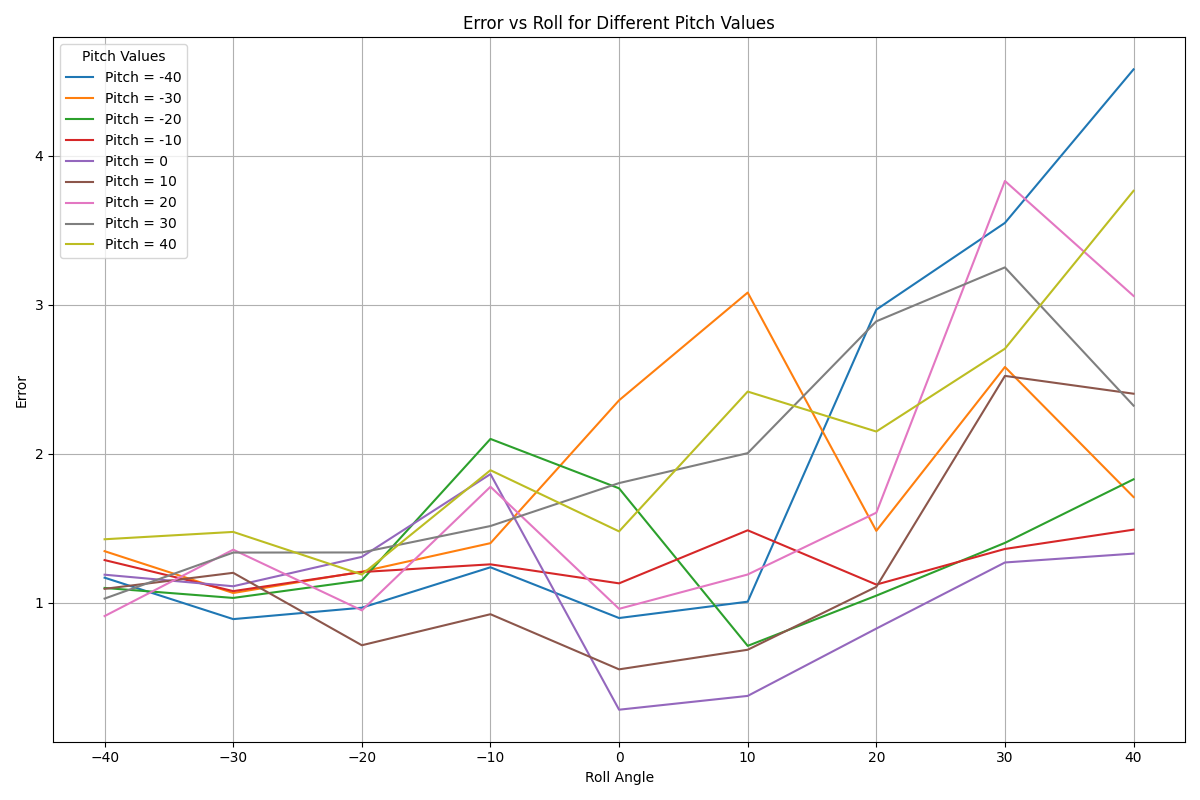
Figure 3: Error heatmaps (left) and error response curves (right) for ACDNet and SliceNet under significant pitch and roll perturbations.
Sensitivity Analysis to Camera Orientation
Pose sensitivity was systematically examined through synthetic pitch and roll rotations. Both significant (−40° to +40°) and subtle (±2°) perturbations were tested. Visualizations highlight:
- Proximity to canonical pose is critical: Most models perform optimally at zero pitch/roll and degrade severely towards center-edge extremes, as shown in error heatmaps and response curves.
- Model-specific behavior: While ACDNet, DepthAnywhere, and BiFuse++ display approximately symmetric error increases, SliceNet exhibits asymmetric sensitivities, sometimes outperforming elsewhere but failing at certain angular regimes.
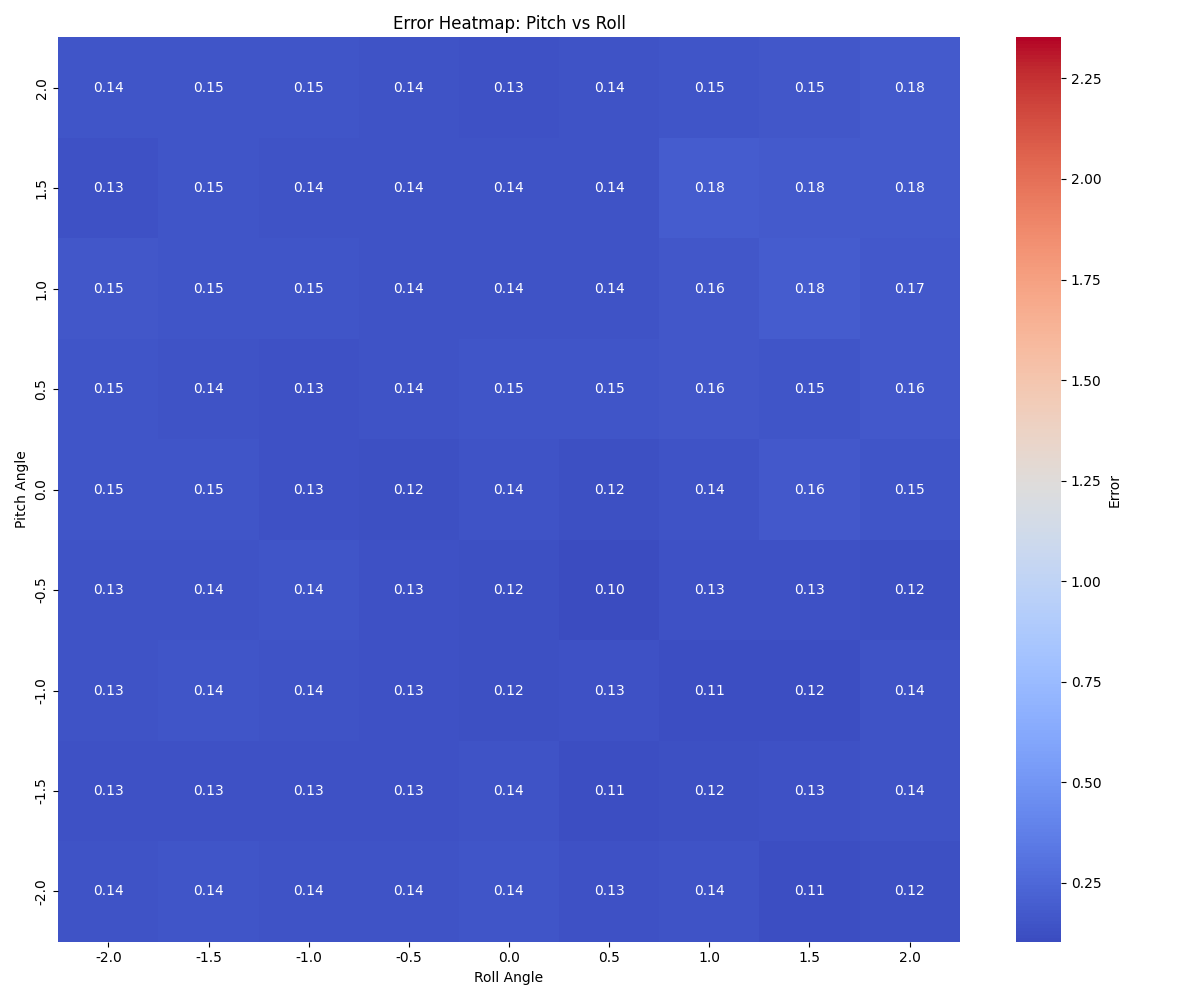
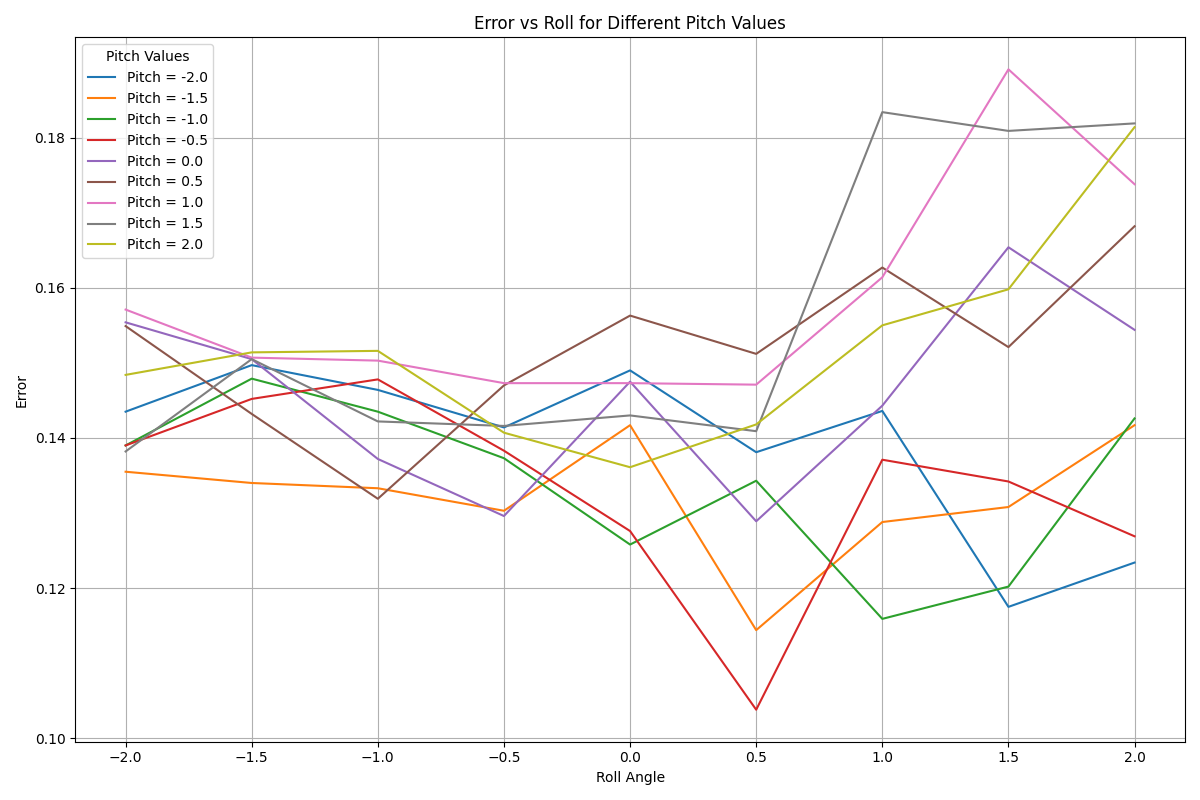
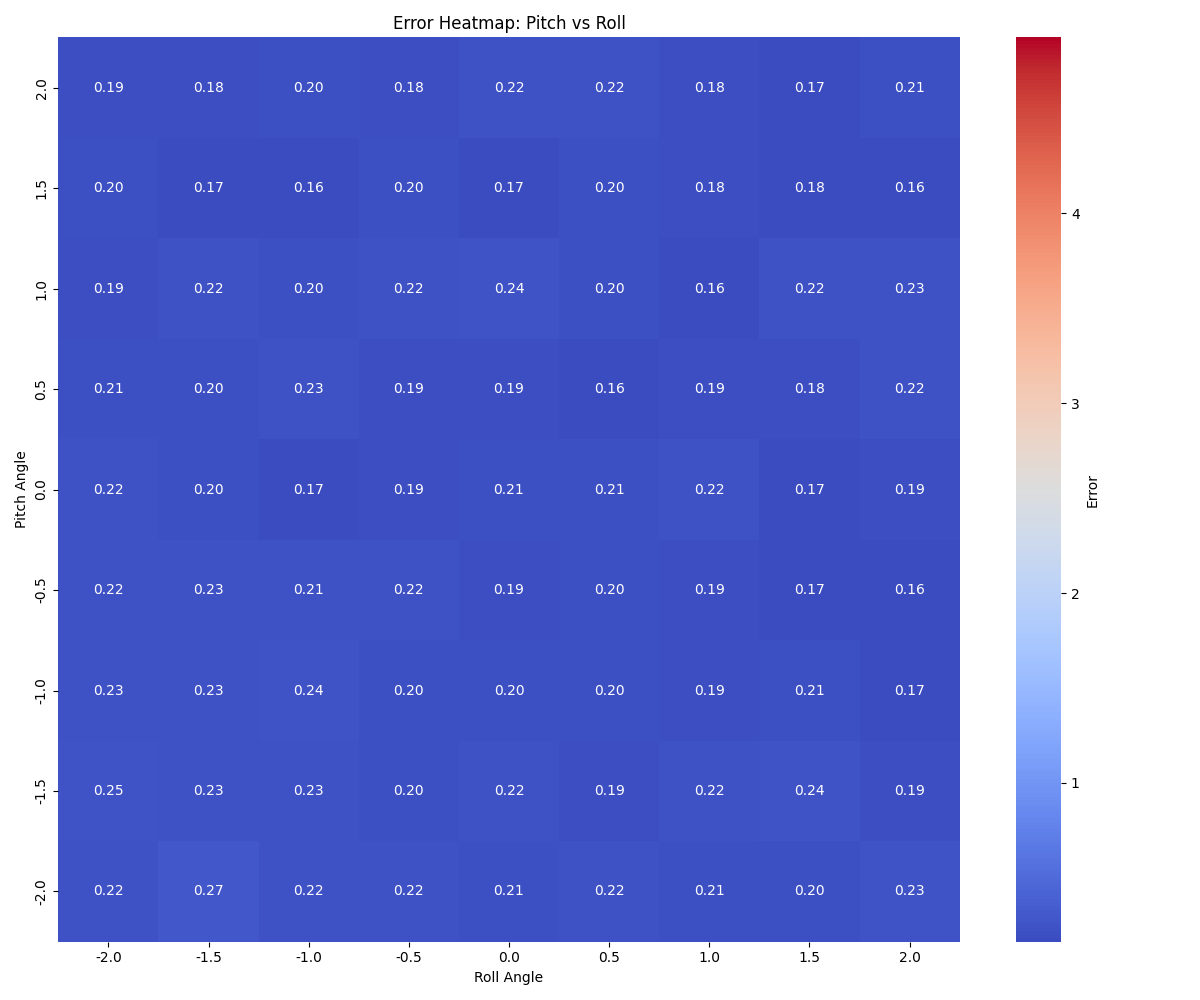
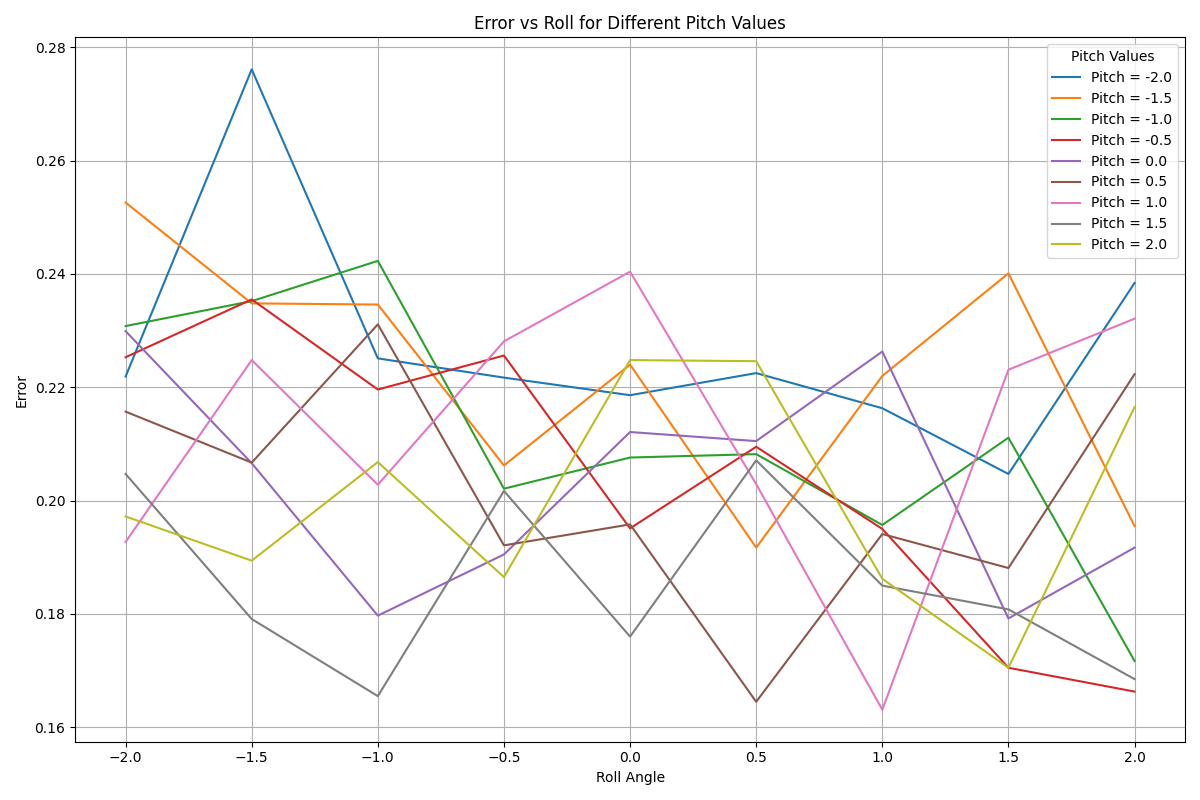
Figure 4: Error heatmaps and response curves for ACDNet and Depth Anything under small pitch/roll perturbations.
Qualitative analysis further underscores the pronounced visual degradation in predicted depth maps under large pose departures.
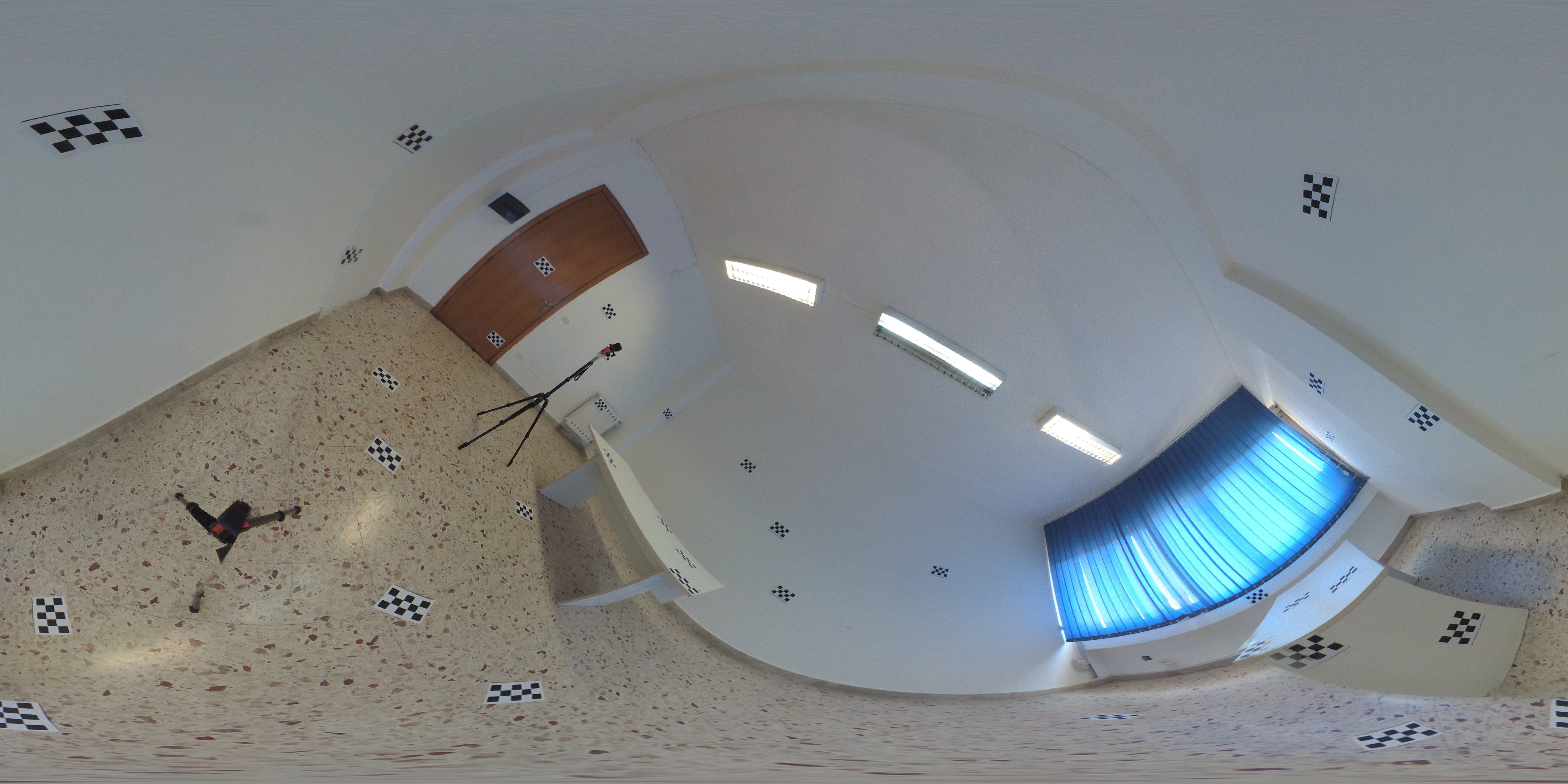
Figure 5: ACDNet’s outputs on canonical (left) versus non-canonical (right) camera pose.
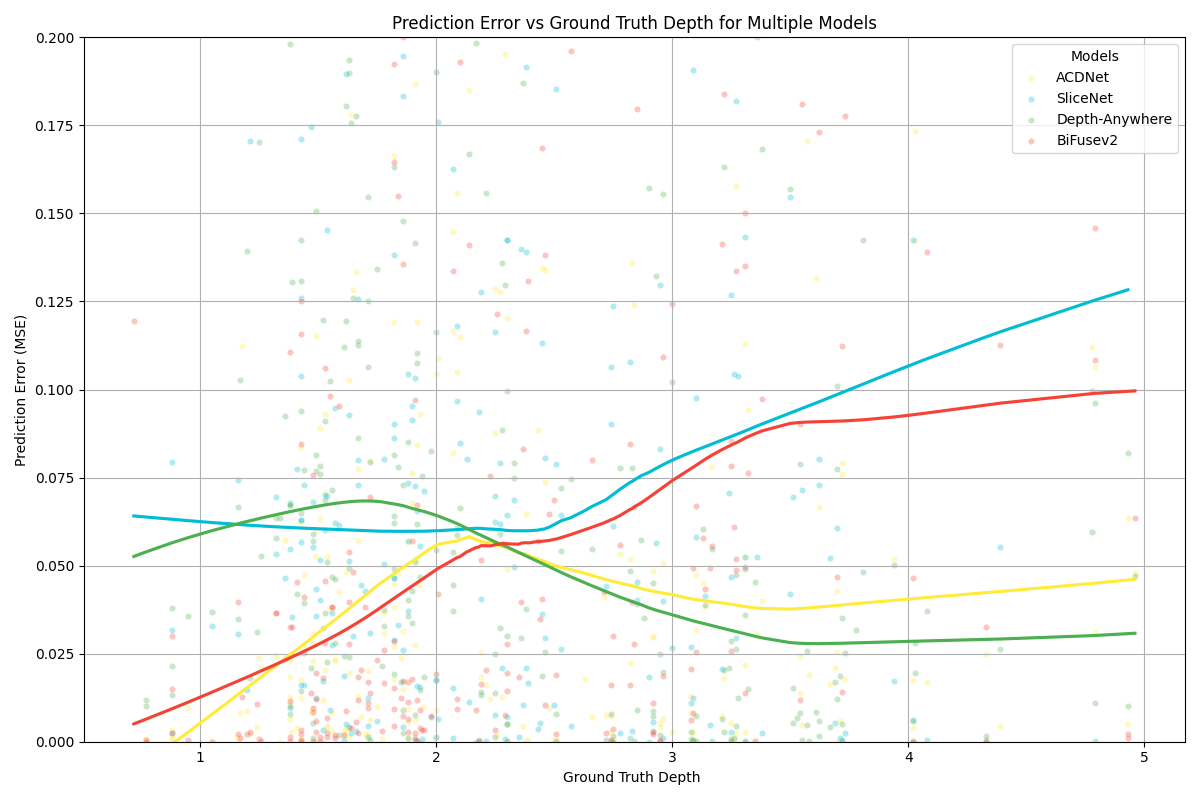
Depth-Dependent Error Trends
To dissect prediction consistency across various depth ranges, LOWESS error curves were generated. Performance profiles reveal that:
Implications, Limitations, and Future Directions
This benchmark exposes the critical vulnerability of current 360° depth estimation models to camera orientation changes, regardless of whether the model architecture explicitly encodes spherical geometry. This undermines practical deployment in robotics and immersive perception, where out-of-plane device rotations are routine. Notably, even state-of-the-art spherical-aware models reveal marked performance degradation away from canonical viewpoints—suggesting their implicit overfitting to gravity-aligned scenes in the training distribution.
The provided depth calibration protocol is a significant methodological contribution, ensuring that model output scale discrepancies do not confound comparative evaluation.
These results imply a growing need for architectures and training pipelines that actively encode pose and gravity invariance—potentially incorporating multi-view geometric constraints, normal/geometric priors, or additional inertial/IMU supervision. Furthermore, the development of test-time adaptation strategies to compensate for spatial orientation shifts represents an active and necessary direction for future research.
Conclusion
The Sphere-Depth benchmark systematically quantifies the limitations of both perspective-based and spherical-aware monocular depth estimation models under realistic spherical camera pose variations. Results show that all current methods are vulnerable to even modest changes in pitch and roll, with significant performance drops outside canonical camera poses. This work sets a new standard for benchmarking robustness in omnidirectional vision and highlights the necessity of orientation-invariant depth estimation approaches for practical 360° applications.