- The paper introduces HyDeS, a self-supervised approach that maximizes mutual information via hyperspherical density shaping and vMF kernel estimation.
- It employs dual entropy objectives to enforce local invariance and global separation, yielding object-centric representations with near-orthogonal class centroids.
- Experimental results show competitive segmentation and coarse classification performance while highlighting challenges in fine-grained discrimination.
Self-Supervised Representation Learning via Hyperspherical Density Shaping: An Expert Analysis
Introduction and Theoretical Context
"Self-Supervised Representation Learning via Hyperspherical Density Shaping" (2604.24498) introduces HyDeS, a self-supervised learning method founded upon information-theoretic principles. Distinct from dominant SSL frameworks relying on heuristic architectures and loss designs (e.g., stop-gradient, whitening, variance penalties), HyDeS directly implements multi-view mutual information maximization via explicit minimization and maximization of Shannon differential entropy on a hyperspherical space. This entropy is estimated using a non-parametric von Mises-Fisher (vMF) kernel, providing both theoretical grounding and geometric regularization.
The paper addresses a critical limitation of existing MI-maximization models: maximizing mutual information without constraint does not always ensure superior representational quality, especially regarding fine-grained structure and class separation, as highlighted by prior theory [tschannen2020mutualinformationmaximizationrepresentation]. HyDeS attempts to reshape the density of learned representations, enforcing both local invariance (for augmented views) and global expansion, thereby avoiding origin collapse and promoting uniformity.
Methodology: Objective and Architecture
HyDeS leverages multi-view augmentations inspired by DINO [caron2021dino]. Each image is encoded into multiple views, which are projected explicitly onto SD−1, the unit hypersphere. The representations are regularized via two entropy terms: the local differential entropy (across positive pairs) is minimized to ensure invariance—while the global entropy (across the batch) is maximized to encourage separation. Both entropies are estimated using the vMF kernel Kκ(Zi,Zj), parameterized by κ (angular bandwidth), avoiding unbounded dimension expansion and enforcing geometric constraints.

Figure 1: HyDeS workflow: images are augmented, encoded, projected onto the hypersphere, and optimized via local and global entropy objectives.
The final objective is a weighted combination:
I(Z1;Z2)≈α⋅Hglobal−β⋅Hlocal
where α,β govern the strength of expansion and invariance, respectively.
Experimental Evaluation
The empirical analysis spans classification (linear/KNN probe) and dense segmentation tasks across CIFAR-10/100, STL-10, Food-101, and ImageNet-1k, using ResNet-18/50 and ViT-Tiny backbones. Comparisons include contemporary SSL methods: SimCLR, BYOL, SwAV, Barlow Twins, VICReg, DINO, and ReSA.
HyDeS delivers competitive accuracy in low-class-count datasets (STL-10, CIFAR-10), but it underperforms on benchmarks with higher class granularity (Food-101, ImageNet-1k), as the learned geometric structure tends towards coarse, near-orthogonal separation rather than fine-grained clustering.
Segmentation
Dense segmentation with frozen ResNet-50 hypercolumns (linear probe) on PASCAL VOC validates that representations shaped by HyDeS excel in object-centric organization. It achieves third-highest mean intersection-over-union (mIoU) among compared methods, indicating a bias toward foreground features.
Representational Geometry and Semantic Structure
Object-Centric Organization and Attention
HyDeS models, as visualized with SmoothGrad-CAM and ViT attention maps, consistently focus on foreground salient regions, demonstrating emergent object-centric bias and consistent intra-object color coding in PCA visualizations. This supports the claim that density shaping on the hypersphere leads to meaningful spatially-aware representations.
Pairwise Class Centroid Analysis
HyDeS representations exhibit unusually high mean pairwise angles between ImageNet-1k class centroids, approaching 90∘, evidencing near-orthogonal class separation and minimal feature sharing.
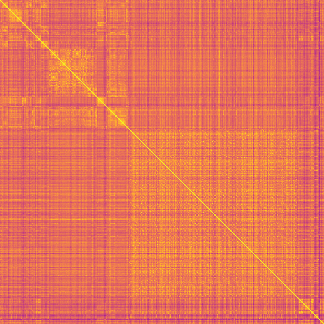
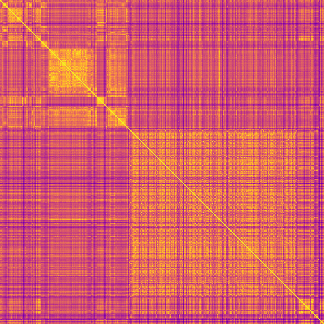
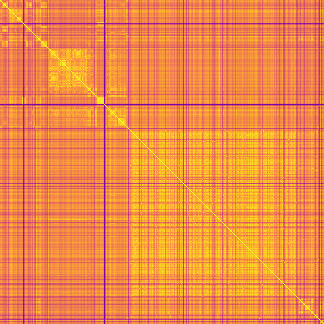
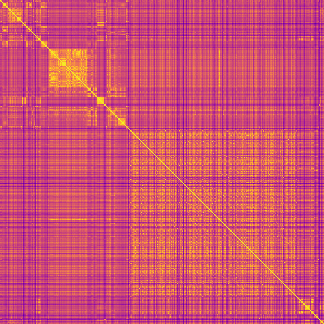
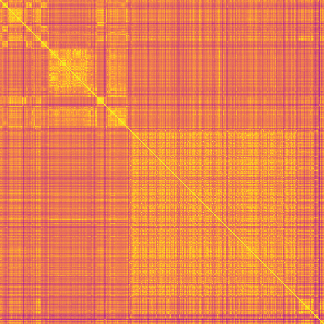
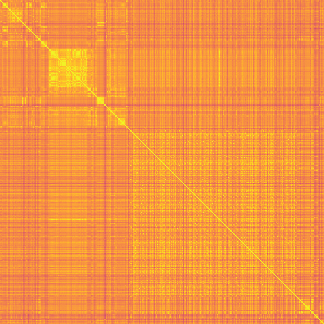
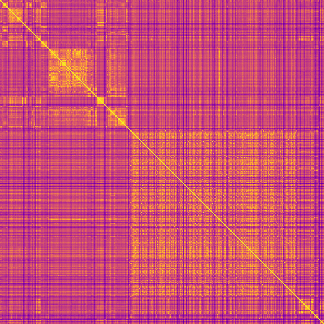
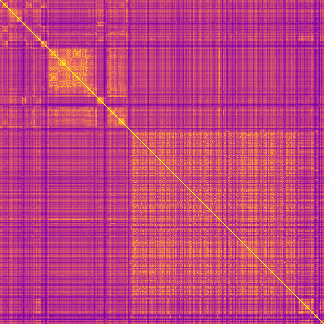
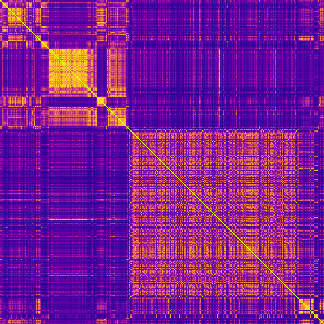
Figure 2: Pairwise cosine similarity between ImageNet-1k class centroids for various SSL methods; HyDeS shows maximal angular separation.
This structure is robust for coarse class discrimination but fails in resolving fine-grained distinctions, notably within clusters such as dog breeds in ImageNet-1k.
Hyperparameter Sensitivity
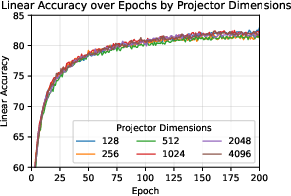
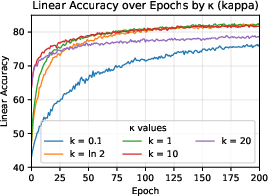
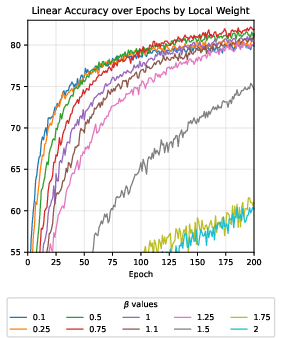
Three core hyperparameters affect performance dynamics:
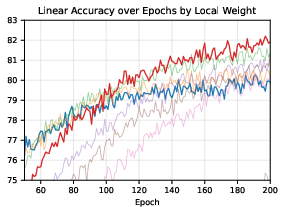
Figure 5: Linear probe accuracy over epochs with varying Kκ(Zi,Zj)3; zoom highlights the stalling effect for low Kκ(Zi,Zj)4 values.
Emergent Semantic Alignment
HyDeS exhibits qualitative semantic alignment between class distances in representation space and external linguistic structures (WordNet, MiniLM). Spearman correlations significantly exceed those of other methods (e.g., Wu-Palmer: 0.50 for HyDeS vs. 0.29 supervised), substantiating the claim that hyperspherical density shaping captures cross-domain semantic similarity.
Implications and Future Directions
Practically, HyDeS' hyperspherical density shaping offers a theoretically sound approach for SSL, excelling in object-centric feature encoding and semantic alignment. However, the near-orthogonal geometry, while advantageous for segmentation and gross classification, impairs fine-grained discrimination—pointing to the necessity of more nuanced regularization or hybrid information-theoretic objectives for future SSL methods. The observed early learning speed, later stagnation, and hyperparameter sensitivity underscore a trade-off warranting further study: optimal representational geometry may not coincide with maximal mutual information.
Theoretically, this work reinforces the limits of pure InfoMax in high-dimensional SSL and motivates the pursuit of density shaping (via entropy minimization/maximization) as an orthogonal yet complementary paradigm. Further research should aim to reconcile rapid convergence and retention of granular semantic structure throughout prolonged training.
Conclusion
HyDeS exemplifies rigorous information-theoretic SSL, utilizing hyperspherical geometry and vMF kernel density estimation to maximize inter-view mutual information. The approach yields object-centric, semantically aligned representations with competitive performance in segmentation and coarse classification, but it falls short in datasets requiring fine-grained structure. The findings indicate that maximal mutual information is not a sufficient criterion for universal representational quality. Future directions should prioritize methods with adaptive, theoretically grounded objectives that preserve both fast learning and detailed granularity.