- The paper introduces an adaptive QAOA schedule (SGIR–QAOA) that uses spectral gap data to navigate local minima and barren plateaus effectively.
- It demonstrates enhanced optimal solution probabilities and circuit depth reductions on Grover’s search and MIS problems compared to linear ramp methods.
- The method shows robust performance under noise and scalability through spectral gap extrapolation, making it well-suited for NISQ-era combinatorial optimization.
Introduction
The challenge of identifying optimal variational parameters for the Quantum Approximate Optimization Algorithm (QAOA) in practical combinatorial optimization scenarios is well-established; parameter landscapes are plagued by local minima and barren plateaus, contributing to NP-hardness in optimization. Recent work has sought to design heuristic schedules that bypass the need for expensive direct parameter searches, notably through approaches such as Linear Ramp QAOA (LR–QAOA). This paper introduces Spectral Gap Informed Ramp QAOA (SGIR–QAOA), which leverages adiabatic spectral gap information to modulate QAOA schedules more adaptively. By aligning schedule velocity with gap size, SGIR–QAOA follows the adiabatic theorem prescription, facilitating slower evolution near minimum gaps and yielding improved solution probabilities, especially at constant QAOA depth. The efficacy of the SGIR–QAOA approach is empirically validated on both Grover's problem and the Maximum Independent Set (MIS) problem, with additional analysis under depolarizing noise and scalable extrapolation strategies for large-scale instances (2604.24580).
Technical Foundations
The baseline for parameter-schedule construction in variational quantum algorithms (VQAs) like QAOA is typically linear interpolation, inspired by the Quantum Adiabatic Algorithm (QAA). LR–QAOA reduces the $2p$-dimensional parameter search to a two-dimensional grid (Δβ,Δγ), providing tractability at the cost of optimality. However, such simplistic ramps are suboptimal for problems where the spectral gap undergoes significant non-linear shrinkage, as in Grover’s search, leading to a loss of potential speedup.
SGIR–QAOA directly addresses this deficiency by tracing the instantaneous gap along the parameter path, enforcing a smooth schedule that slows near small gaps. For Grover’s problem, and combinatorial optimization cases like MIS on cubic and Erdős–Rényi graphs, the adiabatic Hamiltonian is defined as HAd(s)=(1−s)HX+sHC, where HX=∑iXi is the standard QAOA mixer and HC encodes the problem. The instantaneous gap is either calculated exactly for small systems or extrapolated for larger sizes, informing a normalized, monotonic schedule f(s) constructed from weighted integrals of [g(s)−gmin]κ to concentrate runtime near critical regions.
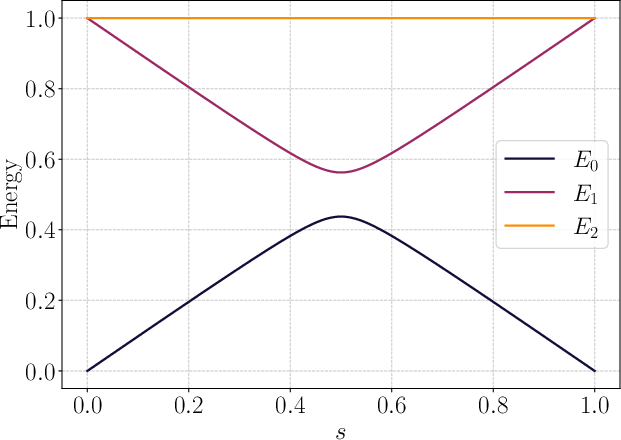
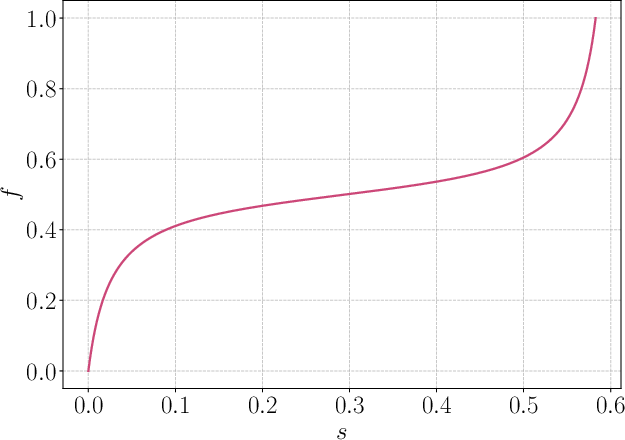
Figure 1: (Top) Eigenvalue spectrum from HAd for Grover’s problem with QAOA mixer as H0; (Bottom) example SGIR-induced parameter schedule.
Key Numerical Results
Empirical evaluation on Grover’s problem at constant QAOA depth (p=10) demonstrates significant enhancements in optimal solution probability ((Δβ,Δγ)0) for SGIR–QAOA relative to LR–QAOA, persisting up to (Δβ,Δγ)1 qubits before schedule-independence emerges due to insufficient depth.
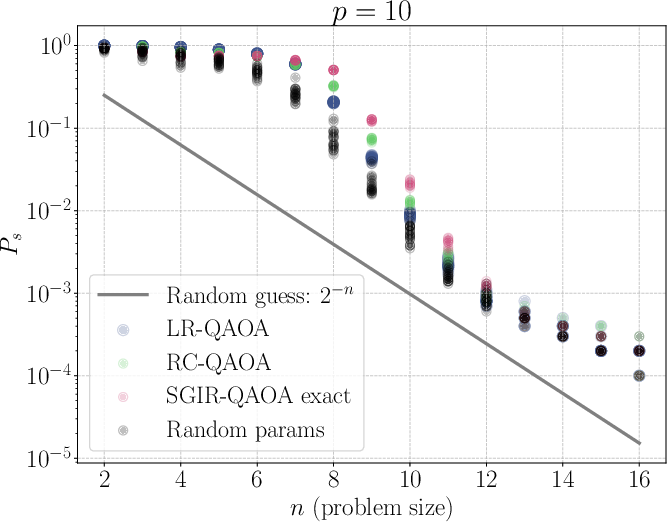
Figure 2: Grover’s problem—optimal solution probabilities across QAOA methods at (Δβ,Δγ)2; SGIR–QAOA returns the highest (Δβ,Δγ)3 as problem size increases, especially where spectral gap is smallest.
Depth scaling experiments further highlight a robust reduction in the QAOA depth (Δβ,Δγ)4 required to pass a given optimal probability threshold using SGIR–QAOA compared to LR–QAOA. This gap widens with increasing problem size—a direct operational advantage on error-prone NISQ hardware.
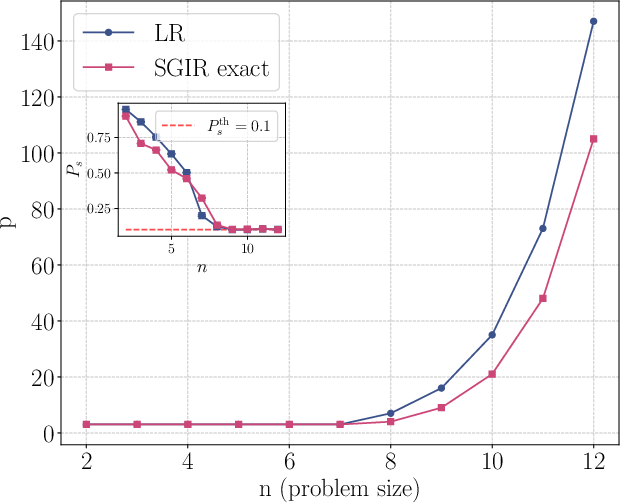
Figure 3: Required QAOA depth (Δβ,Δγ)5 to reach threshold (Δβ,Δγ)6 in Grover’s problem; SGIR–QAOA consistently requires shallower circuits as (Δβ,Δγ)7 increases.
The analysis extends to MIS on regular graphs, establishing that the exponential scaling coefficient is improved for SGIR–QAOA ((Δβ,Δγ)8) over LR–QAOA ((Δβ,Δγ)9) at constant depth HAd(s)=(1−s)HX+sHC0.
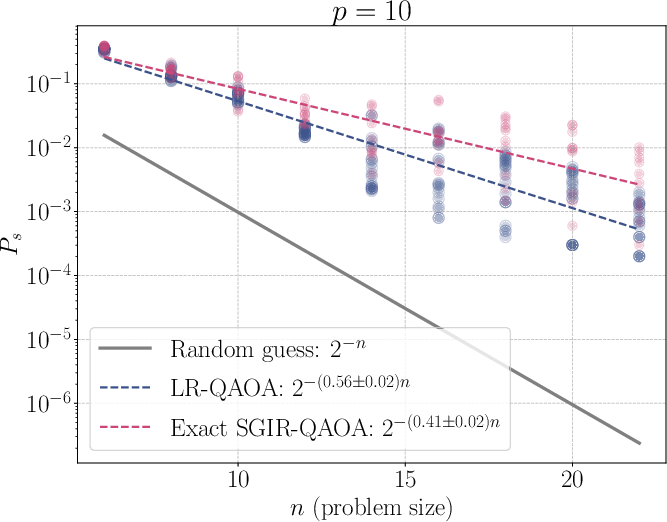
Figure 4: Optimal solution probability scaling for MIS degree-3 graphs; SGIR–QAOA demonstrates reduced exponential decay.
Notably, these advantages are preserved when spectral gap schedules are extrapolated from small-scale exact diagonalizations to larger problem sizes, thus confirming the method's capacity for generalization and practical use in regimes where eigen-spectrum calculation is intractable.
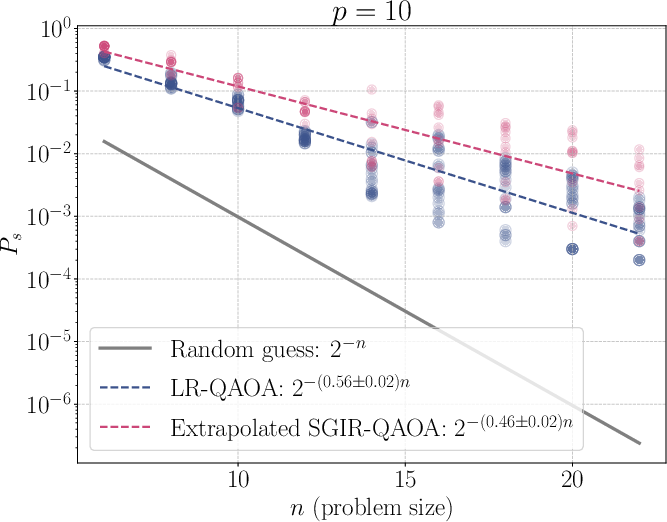
Figure 5: Extrapolated SGIR–QAOA for large MIS instances preserves its performance edge over LR–QAOA.
Scalability and Extrapolation
A practical barrier for scheduled QAOA is eigen-gap computation cost; exact diagonalization rapidly loses feasibility with increasing HAd(s)=(1−s)HX+sHC1. The authors introduce a schedule extrapolation strategy: calculate gap behavior at small HAd(s)=(1−s)HX+sHC2 (HAd(s)=(1−s)HX+sHC3), exploit regime consistency in spectral properties, and apply average or extrapolated minima for larger HAd(s)=(1−s)HX+sHC4. Results on both degree-3 and Erdős–Rényi MIS instances confirm maintenance of SGIR–QAOA’s scaling benefit.
Noise Robustness
Experiments with depolarizing noise (with moderate noise strength HAd(s)=(1−s)HX+sHC5) confirm that SGIR–QAOA maintains a higher optimal solution probability and achieves maximal probability at shallower depths compared to LR–QAOA under realistic error conditions. Furthermore, as HAd(s)=(1−s)HX+sHC6 is increased for fixed, small-HAd(s)=(1−s)HX+sHC7 problems, noise-free results reveal convergence of LR/SGIR–QAOA performance, supporting the theoretical expectation that deep circuits mitigate parameter-schedule choice when adiabaticity can be closely approximated.
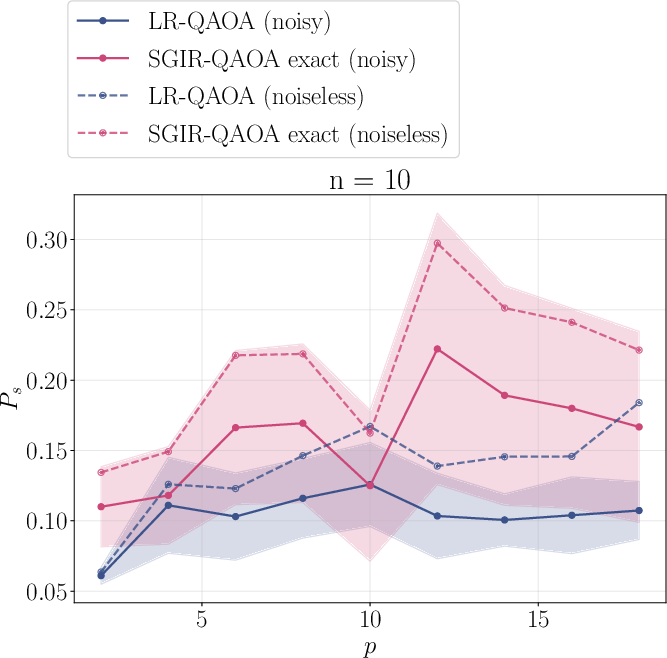
Figure 6: MIS under depolarizing noise—SGIR–QAOA obtains higher HAd(s)=(1−s)HX+sHC8 at lower HAd(s)=(1−s)HX+sHC9 than LR–QAOA; noise effect becomes more prominent with larger depths.
Relation to Spectral Gap and Problem Hardness
Direct analysis links SGIR–QAOA’s advantage to the size of the minimum spectral gap: for Grover’s search, as the minimum gap shrinks (increased HX=∑iXi0), the performance improvement over LR–QAOA becomes more pronounced, evidenced by a negative correlation coefficient (HX=∑iXi1) between gap magnitude and percentage improvement.
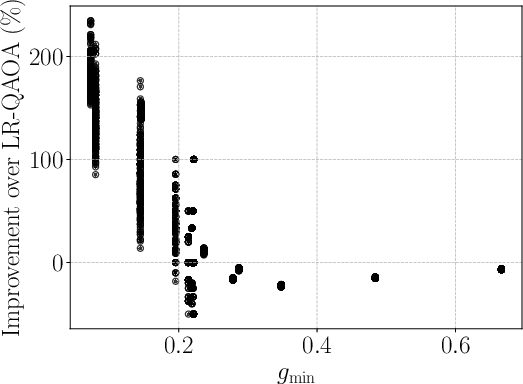
Figure 7: Percentage improvement of SGIR–QAOA over LR–QAOA tracks minimum spectral gap, emphasizing schedule adaptivity is critical near small-gap regimes.
Theoretical and Practical Implications
From a theoretical perspective, SGIR–QAOA operationalizes the adiabatic theorem’s insights within a discrete, variational setting. Its superiority at low QAOA depths is most critical in the NISQ regime, wherein gate noise and circuit depth are limiting factors. The method's compatibility with schedule extrapolation further enables practical deployment on problems beyond direct classical simulation reach. For QUBO formulations with tunable penalty terms, enlarging HX=∑iXi2 can shift regimes of performance separation into simulatable sizes, allowing controlled benchmarking.
Additionally, the demonstrated noise resilience strengthens the case for spectral-gap-informed strategies in near-term quantum optimization, as shorter circuits with higher solution probability translate directly to improved cost and robustness profiles.
Directions for Future Work
Several pertinent avenues are identified:
- Benchmarking classical and quantum runtime scaling in the HX=∑iXi3 regime where HX=∑iXi4 is maintained or scales inversely with HX=∑iXi5.
- Application of the SGIR–QAOA schedule-construction methodology to other hard combinatorial problems, especially those with well-characterized or extrapolatable gap behavior.
- Exploration of warm-start and problem structure transfer methods to further reduce practical QAOA resource requirements, and hybridization with dynamic circuits or counterdiabatic driving strategies.
Conclusion
SGIR–QAOA constitutes an empirically validated refinement of scheduled QAOA, offering concrete improvements in solution probability and required circuit depth by incorporating spectral gap structure of the adiabatic interpolation. These gains persist—contingent on sufficient QAOA depth and in the presence of moderate noise—to practical problem scales via extrapolation techniques. The results suggest that spectral information should be considered essential for QAOA deployment in NISQ-era combinatorial optimization, especially on instances with pronounced small-gap bottlenecks. Method transferability and compatibility with noise bolster its near-term applicability and delineate promising targets for continued algorithmic innovation.