- The paper demonstrates that equilibrium behavior becomes more unified as complexity-induced stochasticity incentivizes conformity in leader-follower dynamics.
- The study utilizes a Brownian motion framework to model innovation risk, showing that deviations from the status quo incur higher outcome variance.
- The analysis extends to organizational structures, illustrating that sufficient complexity allows decentralized decision-making to achieve global profit maximization.
Introduction and Theoretical Context
The paper "Coordination in complex environments" (2604.24757) analyses coordination dynamics among agents operating under incremental uncertainty, formalized as “complexity,” where innovative actions result in increasingly volatile outcomes. By embedding a beauty-contest coordination game within a stochastic, Brownian-driven outcome space, the work investigates the emergence of conformity and status quo bias as equilibrium phenomena, especially as these interact with the network structure defining agents’ interdependencies.
The model generalizes coordination games to settings where the payoff of each agent is penalized for deviation from an individualized target—a mix of their own outcome preference and those of connected agents. Complexity enters through the stochastic mapping from policy to outcome, with greater departures from the status quo action incurring higher outcome variance. This is parametrized by the drift and variance of a Brownian motion, such that the expected and variance of outcomes scale linearly with innovation.
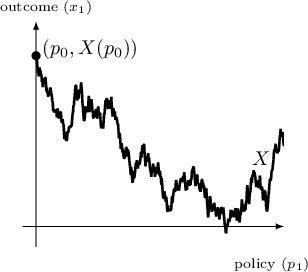
Figure 1: Panel (a) shows the Brownian outcome function mapping policies to outcomes, increasing volatility with departure from status quo; panel (b) depicts equilibrium with gij=0.
Main Results: Conformity, Leader-Follower Dynamics, and Equilibria
The principal contribution is the identification of a novel conformity mechanism, distinct from standard status quo bias or coordination-induced conformity. In equilibrium, expected outcomes are closer across agents than would be predicted in non-complex settings, due to a covariance-driven incentive structure that varies with the leader-follower designation within the network. Specifically, the agent whose policy is closest to the status quo—the follower—controls the covariance term and thus possesses an endogenous incentive to move further toward the leader’s policy, intensifying conformity. Conversely, the leader experiences a counteracting pull toward the status quo.
Analytical tractability is demonstrated for both isolated (gij=0) and networked settings. For the isolated case, the equilibrium corresponds to a simple mean-variance optimization, favoring either the status quo or a policy solving E(X(pi))=di+k if uncertainty is tolerable (Figure 1, panel b).
With nonzero coordination motives, equilibrium structures become nonlinear due to endogenous “kinks” in the payoff function at opponent policy choices, caused by the covariance term. The equilibrium set is characterized as the fixed point of a system incorporating the new conformity-inducing effect and classic centrality-based solution from the coordination graph.
For two-player cases with symmetric coordination, a closed-form characterization is derived. Transitioning from a noiseless (Γ0) to a pure noise (Γ1) to a correlated (Γ) environment, it is shown:
- Pure noise (independent outcome variance) intensifies status quo bias but preserves expected outcome distance.
- Correlated outcomes (shared Brownian paths) further magnify conformity; the follower selectively shifts further toward the leader.
- The equilibrium outcome difference shrinks with complexity, formalizing “difficulty-induced conformity.”
(Figure 2)
Figure 2: Comparison of best responses and equilibria for two players; correlated outcomes (dash-dotted) produce increased conformity relative to pure noise (solid/dashed).
Multiplicity and Network Effects
A general equilibrium characterization is provided for arbitrary networks, encoding leader-follower relationships mathematically and establishing necessary/sufficient conditions for equilibrium. The results specify conditions under which symmetry induces equilibrium multiplicity. Crucially, with sufficiently strong coordination motives and high complexity, the equilibrium set expands, providing multiple equilibria, including those where all agents select identical policies.
The equilibrium can always be expressed as the sum of the non-complex equilibrium and a conformity-covariance correction, parameterized by leader-follower followership matrices. This nonparametric result generalizes across arbitrarily weighted networks and complexity levels.
Organizational Implications: Decentralization and Profit Maximization
The paper leverages its theoretical results to address organizational design under complexity, focusing on decentralized authority structures. Using a stylized model of a multi-division firm with cost externalities, the analysis shows that in sufficiently complex environments (i.e., when the variance is high), decentralized managerial policies can implement total profit maximization—even with communication frictions and strategic complementarity between divisions.
A critical threshold for complexity is derived: only when complexity (noise) exceeds this cutoff can the profit-maximal solution be achieved as a Nash equilibrium of the decentralized game. Coordination and conformity, enhanced by complexity, allow the organization to align subsidiary manager incentives with overall welfare, justifying decentralization in highly uncertain environments.
(Figure 3)
Figure 3: Equilibrium policy as a function of complexity for symmetric and asymmetric manager preferences; increasing complexity leads to multiplicity and convergence to profit-maximizing policies.
Practical and Theoretical Implications
The findings have robust implications for any multi-agent system, including distributed AI, economic networks, and organizational policy, where incremental uncertainty is present. The endogenous conformity phenomenon adds nuance to classical coordination theory, suggesting that network and complexity structure can be leveraged to manage innovation, incentivize exploration, and mitigate adverse status quo bias.
For future AI and economic theory, the work suggests broader forms of equilibrium multiplicity and conformity are accessible in more general stochastic settings, with implications for design of algorithms that must coordinate in uncertain domains, such as federated learning or decentralized decision-making.
Conclusion
This paper rigorously demonstrates that in coordination games embedded in complex, stochastic environments, an endogenous conformity effect emerges from the covariance structure, primarily through a leader-follower dynamic. The equilibrium behavior is manifestly more unified, with agents deviating less in expectation as complexity grows. This theoretical insight translates directly to organizational decision frameworks: sufficient complexity enables decentralized authority to achieve global objectives. The results provide a nontrivial extension to classical coordination games, highlighting how incremental uncertainty fundamentally reshapes equilibrium incentives and conformity in networked systems.