Learning biophysical models of gene regulation with probability flow matching
Abstract: Cellular differentiation is governed by gene regulatory networks, the high-dimensional stochastic biochemical systems that determine the transcriptional landscape and mediate cellular responses to signals and perturbations. Although single-cell RNA sequencing provides quantitative snapshots of the transcriptome, current methods for inferring gene-regulatory dynamics often lack mechanistic interpretability and fail to generalize to unseen conditions. Here we introduce Probability Flow Matching (PFM), a scalable framework for learning biophysically consistent stochastic processes directly from time-resolved single-cell measurements. Applying PFM to three hematopoiesis datasets, we show that models with similar interpolation accuracy can encode fundamentally different dynamics, with only biophysically consistent formulations accurately capturing mechanisms of lineage transitions, fate specification, and gene perturbation responses. We further demonstrate that PFM accommodates unbalanced populations, enabling simultaneous inference of cellular proliferation and death dynamics. Together, these results establish PFM as a flexible, scalable framework for integrating mechanistic modeling with single-cell omics.
Paper Prompts
Sign up for free to create and run prompts on this paper using GPT-5.
Top Community Prompts
Explain it Like I'm 14
Overview
This paper is about teaching a computer to understand how cells change over time by looking at “snapshot” pictures of many single cells. The authors introduce a new method called Probability Flow Matching (PFM). It learns realistic rules for how genes control each other (gene regulation) as cells develop into different types, while also accounting for randomness in biology and changes in cell numbers (cells dividing or dying). They show how this works on blood cell development, where stem cells turn into different mature blood cells.
Key questions the paper asks
- Can we build a fast and scalable method that learns realistic, biology‑based rules for how gene activity changes over time from single‑cell data taken at several time points?
- Do models that simply “fit” the data well also capture true cause‑and‑effect gene relationships, or do we need to include biological randomness to get the mechanisms right?
- Which kinds of models best predict what happens under new conditions (like starting from a different type of stem cell) or after gene “knockouts” (turning a gene off)?
- Can we learn both how gene activity changes and how cell populations grow or shrink at the same time?
How the method works (in simple terms)
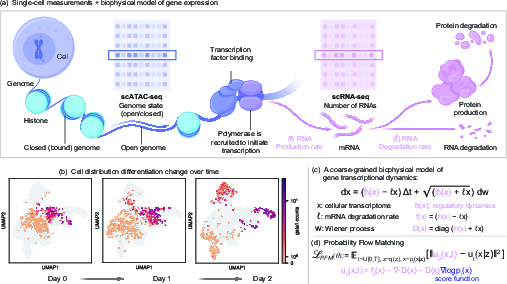
Imagine watching crowds of people move through a building at a few moments in time. You don’t see each person’s path—just where everyone is at those times. You want to figure out the “invisible winds” (rules) that push people around from one place to another.
- Single‑cell snapshots are like those crowd photos: each “person” is a cell, and their position is the pattern of gene activity in that cell.
- PFM learns the “wind field” that moves the crowd of cells from one snapshot to the next. This wind field is a set of rules that say how gene activity changes over time.
- Biology is noisy: even if two cells start the same, they can end up slightly different. PFM includes this randomness—like small gusts of wind—because real cells don’t follow perfectly straight, predictable paths.
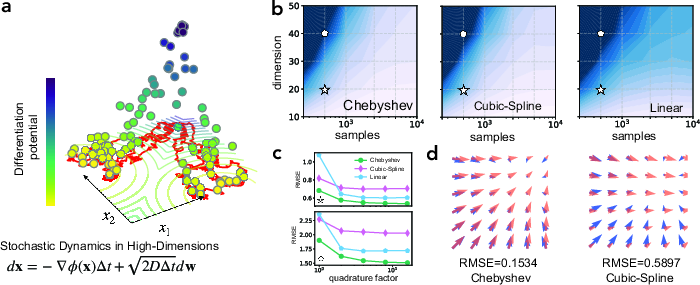
- Instead of stitching snapshots with sharp, jagged connections, PFM draws smooth paths between time points using special, very smooth curves (Chebyshev polynomials). Think of connecting dots with the steadiest possible hand rather than straight, kinked lines.
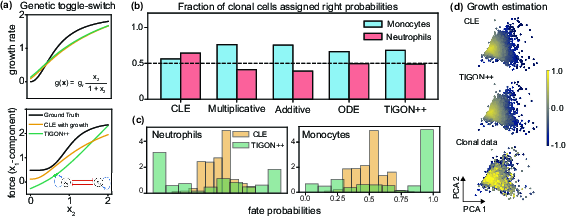
- Cell numbers change over time because cells divide or die. PFM includes a “growth factor” that lets some areas of the crowd grow and others shrink.
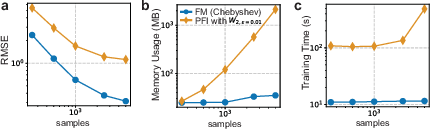
- Importantly, PFM learns directly from the data without needing to repeatedly simulate complex systems, which makes it much faster and more scalable than older methods.
The authors test PFM on blood development (hematopoiesis), where stem cells turn into different types like erythrocytes (red blood cells), megakaryocytes (platelet‑producing cells), neutrophils, and monocytes. They compare different model types:
- Deterministic models: assume no randomness; everything follows a fixed path (like ODE or TrajectoryNet).
- Stochastic (biophysically consistent) models: include realistic biological noise, like the Chemical Langevin Equation (CLE).
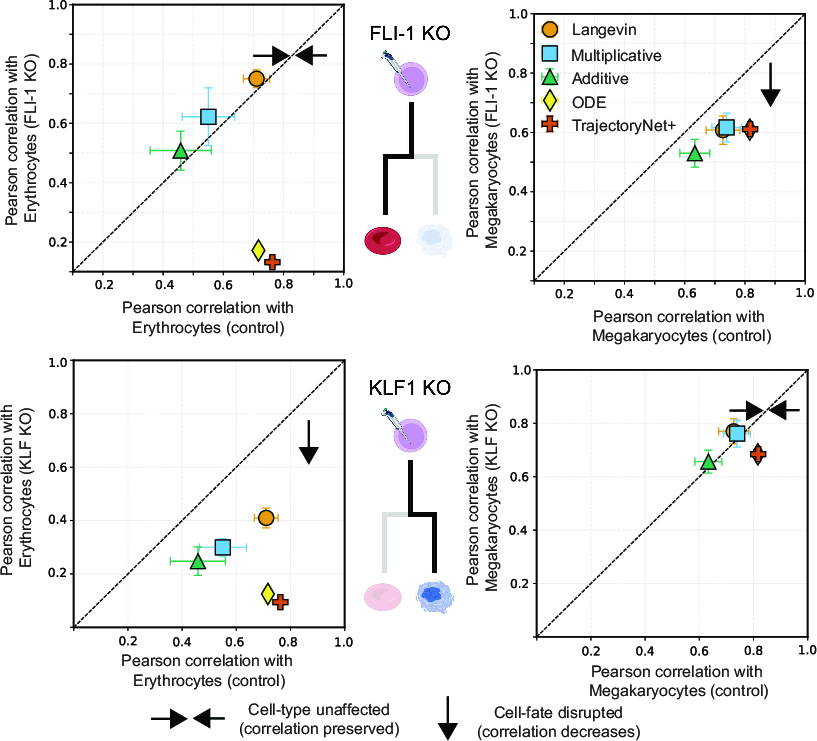
They also test how models respond to gene knockouts (turning off important transcription factors like KLF1 or FLI1).
Main findings and why they matter
Here are the core results, explained plainly:
- Many models can “connect the dots,” but only some learn the right biology:
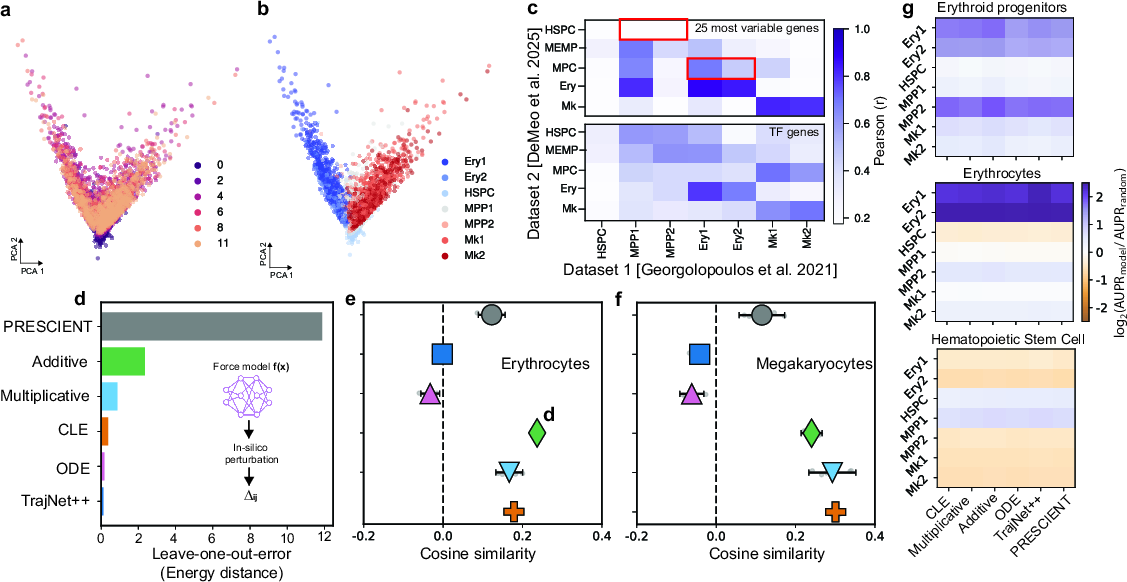
- Several models can fit the snapshots well (good interpolation). But fitting alone doesn’t mean you’ve learned true cause‑and‑effect relationships between genes.
- Models that include realistic randomness (especially the CLE) do a better job recovering which genes activate or inhibit others—the actual regulatory mechanisms.
- Smoother is better for learning the flow:
- Using smooth Chebyshev curves between time points gives more accurate, stable learning of the “wind field” than straight lines or basic splines. This matters a lot when working with many genes.
- Better generalization to new situations:
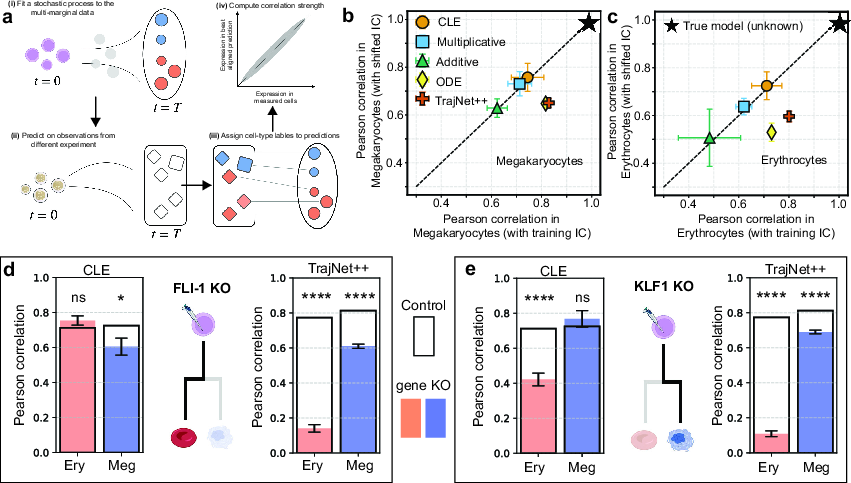
- When starting from a slightly different kind of stem cell (not seen during training), the stochastic, biophysically realistic models still find the correct mature cell types. Deterministic models often fail here.
- Correct predictions under gene knockouts:
- Turning off KLF1 should mostly harm erythroid (red blood cell) development, and turning off FLI1 should mostly harm megakaryocyte development. The stochastic, biophysically realistic models reproduce these lineage‑specific effects; deterministic ones often incorrectly predict both lineages fail.
- Learning growth and gene dynamics together:
- PFM can infer how cells move through gene‑expression space and how fast different groups are growing or shrinking. In a dataset where clonal relationships are known (which cells are cousins), PFM’s growth and fate predictions agree well with the lineage clues.
- Faster and more scalable:
- Compared to earlier approaches that require heavy simulations (like solving many differential equations), PFM is much more efficient in both time and memory, making it practical for bigger gene sets and larger cell numbers.
What this could mean going forward
- Better scientific understanding: PFM can uncover the real gene‑control rules (who activates whom, who inhibits whom) that drive cell fate decisions. This helps explain how stem cells choose different paths.
- Stronger predictions: Because it generalizes to new starting points and handles gene knockouts realistically, PFM can guide experiments and help predict how cells respond to treatments.
- Clinical potential: In the future, such models might help design therapies by predicting how to push cells toward healthy fates or away from disease states.
- Broader use: While the paper focuses on blood cells, the method can be applied to many systems where we have time‑series single‑cell data.
- Next steps: Choosing the right genes to model is still challenging for less‑studied systems; adding spatial information (where cells are in tissues) and using smarter neural network architectures could make PFM even more powerful.
In short, the paper shows that learning biologically realistic, noise‑aware rules from single‑cell snapshots is both possible and practical. And when you care about true mechanisms—not just drawing a smooth line through data—adding the right kind of randomness makes all the difference.
Knowledge Gaps
Knowledge gaps, limitations, and open questions
Below is a consolidated list of concrete gaps and open questions that remain unresolved and could guide future research.
- Gene set selection and dimensionality reduction: Systematically identifying minimal, mechanistically relevant gene (or TF) subsets for less-studied systems (e.g., neural or T-cell differentiation) is unresolved; criteria and algorithms for robust feature selection that preserve regulatory structure are needed.
- Full-transcriptome scalability: The framework is primarily demonstrated on a small TF space (~24 genes); the computational and statistical behavior when scaling to thousands of genes (runtime, memory, generalization, identifiability) is not characterized.
- Score estimation dependence: PFM relies on per-timepoint score models learned via denoising score matching; the sensitivity of recovered drift/diffusion to score estimation errors, hyperparameters, and bandwidth choices is unquantified, and there is no uncertainty quantification for the score.
- Joint vs. decoupled learning: The trade-offs between independently estimating the score and regressing the drift/diffusion (as done here) versus joint training (risking identifiability issues) remain unexplored in practice across datasets.
- Temporal smoothing of scores: Scores are estimated independently at discrete times; methods to enforce temporal smoothness or continuity in (e.g., time-conditioned score models) and their impact on inference accuracy are not assessed.
- Conditional path construction: The choice of Brownian-bridge conditional paths with fixed or chosen and Chebyshev mean paths is not systematically validated under different noise regimes; how the path noise scale and interpolation order affect bias/variance and identifiability remains open.
- Multi-marginal coupling estimation: PFM conditions on a multi-marginal OT coupling , yet the computational scalability, numerical stability, and robustness of estimating in high dimensions and with large sample sizes are not analyzed.
- Timepoint sparsity and spacing: Minimal requirements for the number and spacing of marginals (K), and sensitivity to irregular sampling or missing time points, are not quantified.
- Identifiability of drift and diffusion: Theoretical and empirical conditions under which drift and diffusion are identifiable from multi-marginal snapshots (given an estimated score) are not provided.
- Diffusion model misspecification: The influence of choosing different diffusion structures (e.g., CLE-inspired diagonal diffusion vs. isotropic/learned diffusion) on recovered GRNs and generalization is not systematically benchmarked.
- Intrinsic vs. extrinsic noise disentanglement: The method attributes variability to intrinsic molecular stochasticity; separating intrinsic from extrinsic/environmental noise sources remains unaddressed.
- Measurement model and count noise: scRNA-seq counts are discrete and noisy (dropouts, overdispersion); the impact of ignoring an explicit measurement model linking latent expression to observed counts on drift/diffusion inference is unknown.
- Batch effects and normalization: How batch effects, library-size differences, and technical confounders across time points affect score estimation and the learned dynamics is not investigated.
- Uncertainty quantification: There is no provision for confidence intervals or posterior uncertainty for inferred forces, diffusion, GRN edges, or growth rates; uncertainty-aware inference and its downstream impact is an open need.
- Biological validation breadth: KO predictions are limited to a few TFs and validated qualitatively; systematic validation against perturb-seq/CRISPR screens, dose/time-dependent perturbations, and larger perturbation catalogs is missing.
- Out-of-distribution generalization: While one cross-dataset generalization is shown, broader tests across donors, labs, protocols, and cytokine/stimulus regimes—and the factors that enable/limit generalization—remain to be explored.
- Integration of multi-omics: The framework mentions integrating scATAC and CITE-seq but primarily uses scRNA; explicit joint models that couple chromatin accessibility, protein levels, and RNA (e.g., through transcription rate or noise modulation) are not developed or evaluated.
- Spatial context and microenvironment: Incorporating spatial omics and cell–cell interactions (e.g., reaction–diffusion or neighborhood effects) is identified as future work; concrete formulations and benchmarks are lacking.
- Clonal lineage constraints: Although lineage data are used for evaluation, PFM does not directly incorporate lineage constraints during training; methods to integrate clonal information to improve trajectory and growth inference are needed.
- Growth modeling assumptions: Growth depends only on transcriptomic state and is inferred via a mass-penalty objective; separating division vs. death, calibrating absolute rates, and correcting for timepoint-specific sampling biases remain unresolved.
- Population size calibration: Single-cell experiments typically subsample cells per time point; how to calibrate to true population sizes or proliferative indices (e.g., via spike-ins or external measurements) is not addressed.
- Fate prediction vs. interpolation: Models with best interpolation do not necessarily predict correct fates; rigorous metrics linking mechanistic correctness (e.g., signed causal edges) to predictive performance across tasks are needed.
- Structured inductive biases: Force fields and scores use generic feedforward NNs; the benefits of structured architectures (e.g., sparsity, graph neural networks, monotone constraints) for interpretability, data efficiency, and identifiability are untested.
- Handling complex topologies: Performance on systems with multiple bifurcations, cycles, dedifferentiation, or reprogramming is not reported; robustness to more complex developmental topologies is unknown.
- Time alignment and asynchrony: The framework assumes known sampling times; strategies for handling asynchrony, variable progression speeds, or inferring latent time (pseudotime) jointly with dynamics are not investigated.
- Sampling from learned dynamics: Although training is simulation-free, generating samples or trajectories from the learned SDE/ODE for downstream tasks, and assessing generative fidelity, is not discussed.
- Robustness to interpolation bias: Chebyshev interpolation enforces global smoothness; whether this oversmooths sharp transitions (e.g., rapid fate commitment) and biases inferred forces has not been quantified.
- Partial observability and hidden regulators: The impact of unobserved regulators or latent confounders on inferred dynamics and GRNs is not modeled; extensions to account for latent variables are needed.
- Theoretical guarantees: Convergence, consistency, and error bounds for PFM with estimated scores and multi-marginal conditional paths are not established; formal guarantees would clarify when PFM recovers true dynamics.
- Reproducibility and benchmarks: Comprehensive benchmarking across more datasets, standardized metrics, ablation of design choices (score model, interpolant degree, coupling method, diffusion form), and open implementations for reproducibility are needed.
Practical Applications
Immediate Applications
The following applications can be deployed with current datasets, compute infrastructure (GPUs/CPUs used for standard single-cell analysis), and existing lab workflows. Each item notes sectors, potential tools/workflows, and key assumptions/dependencies that influence feasibility.
- Healthcare/biotech: in-silico evaluation of gene perturbations (CRISPR knockouts/knockdowns) to steer cell fate
- Tools/workflows: PFM model trained on time-resolved scRNA-seq/CITE-seq data; perturbation simulator that zeros or modulates TFs; comparison of predicted terminal states with control.
- Impact: Prioritizes perturbation targets for lineage commitment (e.g., erythroid vs. megakaryocytic outcomes), reduces wet-lab screens.
- Assumptions/dependencies: Availability of time-resolved single-cell data across relevant timepoints; TF-space representation captures core regulatory architecture; model validity for the cell type.
- Cell therapy manufacturing: optimization and QC of differentiation protocols
- Tools/workflows: PFM-inferred growth rate g(x) and fate probabilities to set media schedules and timing of harvest; dashboard reporting trajectory forecasts and population balance.
- Impact: Improves yield and purity of engineered cell products by predicting proliferation/death and fate decisions under current culture conditions.
- Assumptions/dependencies: Batch-corrected longitudinal data from the process; minimal latency between data generation and model retraining; validation against QC assays.
- Drug discovery: mechanism-aware target discovery and off-target risk assessment
- Tools/workflows: PFM-derived signed, directed GRNs for cell-state–specific mechanism mapping; simulate drug-like TF modulation and downstream fate effects.
- Impact: Identifies pathway nodes with causal influence on fate; flags interventions likely to cause unwanted lineage shifts.
- Assumptions/dependencies: Stochastic CLE-like models better recover causal signs; adequate signal for lowly expressed TFs; model transport alignment across datasets if integrating external controls.
- Academic research: scalable, mechanistic inference of gene-regulatory networks from single-cell time series
- Tools/workflows: Open-source PFM package integrated with Scanpy/Seurat pipelines; score estimation per timepoint; multi-marginal optimal transport; Chebyshev path interpolation modules.
- Impact: Enables mechanistic GRN inference in TF space at scale without repeated ODE simulation; supports benchmarking of deterministic vs. stochastic formulations.
- Assumptions/dependencies: Sufficient sample size per timepoint; careful selection of TF gene set; reproducible score estimation; compute resources for GPU-accelerated training.
- Experimental design guidance: choosing informative timepoints and gene panels
- Tools/workflows: Pilot PFM fits to evaluate interpolation error and GRN stability across timepoint subsets; sensitivity of fate predictions to TF subset selection.
- Impact: Reduces sequencing cost by focusing on most informative timepoints/TFs; improves identifiability of dynamics.
- Assumptions/dependencies: Pilot data representative of full process; stability of inferred dynamics across nearby timepoint grids.
- Reanalysis of public datasets to unify findings across studies
- Tools/workflows: PFM applied to multiple hematopoiesis datasets to compare inferred GRNs and fate landscapes; OT-based alignment for terminal states.
- Impact: Harmonizes mechanistic insights across cohorts; tests generalization to unseen initial conditions.
- Assumptions/dependencies: Cross-study batch correction; consistent cell type annotations; comparable TF panels.
- Process analytics for clonal assays: predicting lineage outcomes and growth from lineage-resolved datasets
- Tools/workflows: Unbalanced PFM to infer g(x) and drift from clonal time courses; evaluate fraction of clones with correctly predicted terminal fates.
- Impact: Enhances interpretation of lineage-tracing studies; quantifies stochastic vs. deterministic aspects of fate choice.
- Assumptions/dependencies: Reliable clonal barcoding; enough temporal depth to capture expansion/attrition.
- Education/communication: interactive visualization of stochastic cell-fate landscapes
- Tools/workflows: Web app that displays PFM-inferred vector fields, diffusion, and fate probabilities in low-dimensional embeddings of TF space.
- Impact: Aids teaching of differentiation and stochastic gene regulation; supports lab meetings and planning.
- Assumptions/dependencies: Dimensionality reduction that preserves key dynamics for visualization; curated examples.
Long-Term Applications
These applications require additional research, validation, scaling, or infrastructure (e.g., real-time data acquisition, regulatory frameworks) before deployment.
- Clinical decision support: patient-specific prediction of hematologic therapy responses and relapse risk
- Tools/products: Clinical PFM models trained on patient scRNA-seq at diagnosis and during treatment; simulate perturbations (e.g., TF-targeted therapies) to forecast lineage shifts and minimal residual disease.
- Dependencies: Prospective, longitudinal, patient-matched multi-omic datasets; rigorous validation; integration with EHR; regulatory approval.
- Closed-loop control of bioreactors for cell therapy manufacturing
- Tools/products: Real-time single-cell sampling (microfluidic or rapid scRNA-seq surrogates), on-line PFM updates, model-predictive control adjusting media and stimuli to meet target fates and growth.
- Dependencies: Real-time measurement technology, fast inference pipelines, stable control interfaces, validated surrogate assays.
- Digital twins of tissue development and regeneration
- Tools/products: PFM-based stochastic digital twins coupling gene regulation with proliferation/death, extended to spatial omics for microenvironmental effects; used for in-silico experiments.
- Dependencies: Spatial transcriptomics/proteomics time series; extensions of PFM to PDEs and spatial coupling; compute/storage for large-scale simulation.
- Rational design of cell reprogramming cocktails
- Tools/products: PFM models screening multi-gene perturbation combinations to drive transitions between cell identities; optimization engines ranking minimal interventions.
- Dependencies: High-coverage perturb-seq time series for training; validated mapping between TF perturbations and chromatin dynamics; off-target safety evaluation.
- Personalized graft engineering for HSC transplant and immunotherapies
- Tools/products: Pre-manufacturing PFM predictions to customize differentiation schedules and cytokine mixes for patient-specific grafts (e.g., balanced erythroid/megakaryocytic outputs).
- Dependencies: Patient-derived progenitor data; GMP-compatible workflows; clinical trial validation.
- Extension to diverse systems: neural, T-cell, and organoid development
- Tools/products: PFM generalized to less-studied lineages with automatic TF set discovery (e.g., with graph neural network priors), integration with spatial context in organoids.
- Dependencies: Curated time-resolved multi-omics; methods for selecting minimal TF panels; benchmarking consortia.
- Regulatory science: standards for mechanistic single-cell models in submissions
- Tools/products: Validation frameworks, performance benchmarks (interpolation error vs. causal accuracy), and documentation guidelines for predictive models used in CMC and IND filings.
- Dependencies: Consensus across regulators and industry; reference datasets; reproducibility standards and audits.
- Platform software and cloud services for stochastic mechanistic modeling in single-cell analysis
- Tools/products: Managed PFM services with AutoML for model class selection (ODE vs. CLE), score estimation pipelines, OT coupling, and Chebyshev path interpolation at scale.
- Dependencies: Robust APIs for Seurat/Scanpy; data privacy/security compliance; cost-effective GPU orchestration.
- Integration with chromatin accessibility and epigenomic control layers
- Tools/products: PFM variants where transcription rates m(x) depend on scATAC-seq-derived accessibility; joint training across modalities to better capture intrinsic noise geometry.
- Dependencies: Simultaneous multi-omic time series (e.g., joint scRNA+scATAC); models linking accessibility to transcription; handling modality-specific noise/batch effects.
- Safety assessment of TF-targeted therapeutics
- Tools/products: Preclinical in-silico safety screens using PFM to predict rare lineage deviations under drug action; prioritization for in-vivo validation.
- Dependencies: Extensive perturbation training data; calibrated uncertainty estimates; standardized risk thresholds.
- Agriculture/biomanufacturing: scaling differentiation in alternative contexts (e.g., cultured blood components)
- Tools/products: PFM-guided process design for scalable production of erythrocytes or platelets for transfusion, optimizing yields and minimizing undesired lineages.
- Dependencies: Economical culture systems, regulatory alignment for non-clinical products, process sensors.
Cross-cutting Assumptions and Dependencies
- Data requirements: multi-timepoint single-cell datasets with adequate coverage; appropriate TF feature selection; batch correction and alignment across experiments.
- Modeling assumptions: stochasticity approximated by CLE holds (well-mixed, intrinsic noise scales with expression); score estimation accuracy; identifiability improved by informative timepoints and TFs.
- Computation: access to GPUs/modern CPUs; scalable implementations of score matching, multi-marginal optimal transport, and Chebyshev path construction.
- Validation: ground-truth or proxy validation (ChIP-seq, lineage tracking, KO experiments); sensitivity analyses to model choices (drift/diffusion parameterization).
- Translation: for regulated uses, rigorous validation and uncertainty quantification; data privacy and security; reproducibility and versioning of models and datasets.
Glossary
- Area under the precision–recall curve (AUPR): A scalar summary of the precision–recall tradeoff used to evaluate classification or network recovery performance. "Area under the precisionârecall curve (AUPR)"
- birth–death dynamics: Population processes modeling cell proliferation (birth) and apoptosis (death) over time. "population-level birthâdeath dynamics"
- Brownian bridge: A stochastic process conditioned to start and end at specified points, used as a conditional path between distributions. "the conditional path distribution is chosen as a Brownian bridge"
- Chebyshev interpolants: Polynomial interpolations using Chebyshev nodes that yield globally smooth derivatives and improved numerical stability. "spectrally regularized Chebyshev interpolants."
- Chemical Langevin model (CLE): A stochastic differential equation approximation of reaction kinetics that captures intrinsic molecular noise in gene expression. "only the biophysically consistent Chemical Langevin model captures meaningful regulatory structure"
- ChIP-seq: Chromatin immunoprecipitation sequencing; an assay to identify DNA regions bound by specific proteins such as transcription factors. "chromatin immunoprecipitation sequencing (ChIP-seq)"
- chromatin accessibility: The openness of chromatin regions indicating regulatory potential, often measured to infer gene regulation. "chromatin accessibility (measured by scATAC-seq)"
- CITE-seq: Cellular Indexing of Transcriptomes and Epitopes by sequencing; jointly profiles RNA and surface proteins at single-cell resolution. "in vitro CITE-seq data"
- de-noising score matching: A technique to estimate the gradient of the log-density (score) by learning to denoise perturbed samples. "We use de-noising score matching techniques"
- diffusion matrix: The positive semidefinite matrix in an SDE or FP equation encoding the covariance structure of stochastic fluctuations. "is the diffusion matrix that captures intrinsic/extrinsic noise."
- epigenetic landscape: A conceptual potential-like landscape representing stable and transitional cell states across differentiation. "underlying epigenetic landscape"
- FISH: Fluorescence in situ hybridization; an imaging technique to measure spatial organization of DNA/RNA molecules in cells. "FISH measurements"
- Flow Matching (FM): A simulation-free framework that learns velocity fields transporting a base distribution to target distributions. "Flow Matching (FM)"
- Fokker–Planck (FP) equation: A partial differential equation governing the time evolution of probability densities under drift and diffusion. "the FokkerâPlanck (FP) equation:"
- gene regulatory networks: Graphs of interactions among genes and transcription factors governing gene expression and cell fate. "gene regulatory networks"
- growth dynamics: State-dependent rates of cell proliferation and death integrated into probabilistic modeling of populations. "cell-stateâspecific growth dynamics"
- Hematopoiesis: The biological process by which blood and immune cells are produced from stem and progenitor cells. "Hematopoiesis is a canonical example of cell differentiation"
- Hematopoietic Stem Cells (HSC): Multipotent stem cells giving rise to all blood lineages. "Hematopoietic Stem Cells (HSC)"
- HSPCs: Hematopoietic stem and progenitor cells; early cells capable of differentiating into multiple blood cell types. "hematopoietic stem and progenitor cells (HSPCs)"
- Jacobian/response matrix: The local matrix of partial derivatives of the force field with respect to state variables, encoding causal regulatory influences. "the local regulatory matrix (the Jacobian/response matrix)"
- leave-one-out energy distance: A statistical distance metric used here to quantify interpolation accuracy by leaving out one marginal at a time. "Interpolation accuracy, quantified by leave-one-out energy distance"
- mass density: A scalar field over state space representing local cell abundance, used to model unbalanced population changes. "an auxiliary conditional mass density "
- multi-marginal optimal transport coupling: A joint coupling linking multiple time-indexed distributions to align trajectories across marginals. "the multi-marginal optimal transport coupling "
- Optimal transport (OT): A mathematical framework for mapping one probability distribution to another with minimal transport cost. "using optimal transport (OT)"
- Ornstein–Uhlenbeck (OU) process: A mean-reverting Gaussian stochastic process used as a benchmark for linear stochastic dynamics. "OrnsteinâUhlenbeck (OU) process"
- PRESCIENT: A biophysically motivated generative model imposing conservative forces with isotropic diffusion for cellular dynamics. "PRESCIENT"
- Probability Flow Inference (PFI): A simulation-based framework for inferring stochastic dynamics from snapshot data via probability flow. "Probability Flow Inference (PFI)"
- Probability Flow Matching (PFM): A scalable, simulation-free framework to learn biophysically consistent stochastic processes from multi-marginal data. "Probability Flow Matching (PFM)"
- Probability Flow ODE: The deterministic ODE whose velocity field reproduces the evolution of probability densities under an SDE in Lagrangian coordinates. "Probability Flow ODE"
- RNA velocity: A method estimating the time derivative of gene expression from spliced/unspliced mRNA to infer cell state transitions. "RNA velocity"
- Schrödinger Bridge: An entropy-regularized stochastic transport framework connecting probability distributions over time. "Schrödinger Bridge"
- score-based generative modeling: Generative modeling that learns the score (gradient of log-density) to sample via SDE/ODE-based flows. "score-based generative modeling"
- score function: The gradient of the log probability density with respect to the state, used to construct probability flow velocities. "the score function"
- scATAC-seq: Single-cell assay for transposase-accessible chromatin; profiles chromatin accessibility at single-cell resolution. "scATAC-seq"
- scRNA-seq: Single-cell RNA sequencing; measures gene expression profiles of individual cells. "single-cell RNA-seq"
- Transcription factors (TFs): DNA-binding proteins that regulate transcription of target genes and control lineage programs. "transcription factors (TFs)"
- TrajectoryNet: A deterministic continuous normalizing flow framework for learning cell-state dynamics from snapshots. "TrajectoryNet"
- UMAP: Uniform Manifold Approximation and Projection; a nonlinear dimensionality reduction method for visualizing high-dimensional data. "2D UMAP coordinates"
- Waddington-like potential landscape: A multistable potential metaphor capturing differentiation pathways and fate basins. "a Waddington-like potential landscape"
- Wasserstein distance: An optimal transport-based metric measuring distance between probability distributions. "compute the Wasserstein distance between empirical marginals"
Collections
Sign up for free to add this paper to one or more collections.