- The paper introduces MTEEG, demonstrating that task-specific LoRA modules can mitigate cross-task gradient conflicts in multi-task EEG modeling.
- It compares three variants—MTEEG-SP, MTEEG-RT, and MTEEG-DC—and shows that MTEEG-DC achieves superior performance with high parameter efficiency.
- Results across six EEG tasks validate that modular low-rank adaptation outperforms full fine-tuning strategies in diverse brain-computer interface applications.
Unified Multi-task EEG Analysis via Task-specific Low-rank Adaptation
Introduction
Deep neural architectures have driven progress in EEG analysis for a wide array of brain-computer interface applications. However, existing large-scale, self-supervised pre-trained models for EEG typically require full parameter fine-tuning for each downstream task, undermining their practicality in multi-task environments and increasing computational demands. Critically, the intrinsic heterogeneity of EEG—arising from subject, hardware, and protocol differences—fundamentally challenges parameter sharing, as gradients derived from divergent tasks frequently conflict, impeding optimization.
Addressing this issue, the paper introduces MTEEG, a unified framework for multi-task EEG analysis that integrates task-specific low-rank adaptation (LoRA) modules atop a frozen self-supervised backbone. The design facilitates effective parameter disentanglement, alleviating task interference while providing an efficient, lightweight approach to unified EEG modeling.
Gradient Conflicts in Multi-task EEG Learning
Through experimental analysis of hard parameter sharing (HPS) on six diverse EEG datasets, the authors demonstrate that naive strategies for multi-task adaptation are hampered by strong gradient misalignment. This is visualized by examining both the cosine similarity between task gradients and the distribution of their magnitudes across tasks (Figure 1).
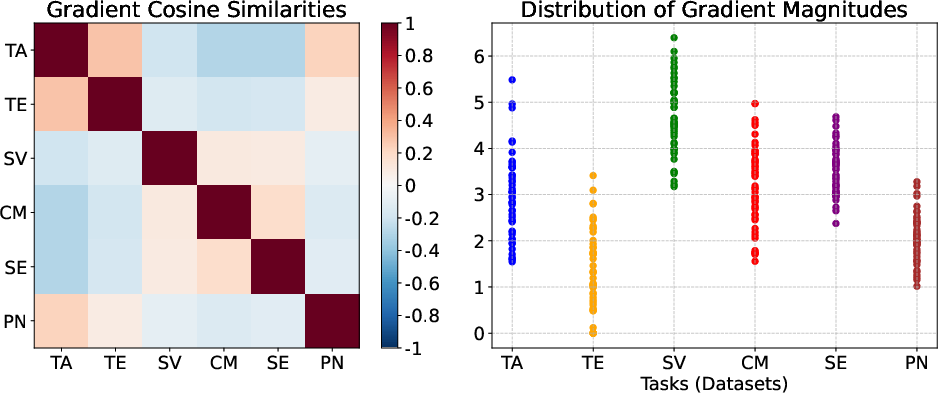
Figure 1: Cross-task gradient cosine similarities and per-task gradient magnitude distributions in HPS with the LaBraM backbone, evidencing severe inter-task conflicts.
Such conflicts motivate modularization and finer-grained parameter isolation to enable effective joint learning.
MTEEG Framework and LoRA-based Parameter Disentanglement
MTEEG extends a pre-trained LaBraM backbone with lightweight, trainable LoRA adapters, which modulate the frozen model during fine-tuning. To probe the trade-off between task specification and beneficial cross-task interaction, three architectural variants for LoRA integration are evaluated:
- MTEEG-SP: Fully task-isolated LoRA modules; each task uses a distinct adapter.
- MTEEG-RT: MoE-like cross-task sharing, where a router dynamically aggregates the output of a shared pool of LoRA experts.
- MTEEG-DC: Hybrid decomposition, combining a task-agnostic down-projection with task-specific up-projection matrices to balance knowledge sharing and disentanglement.
Architecture-level differences and parameter sharing strategies are summarized below.
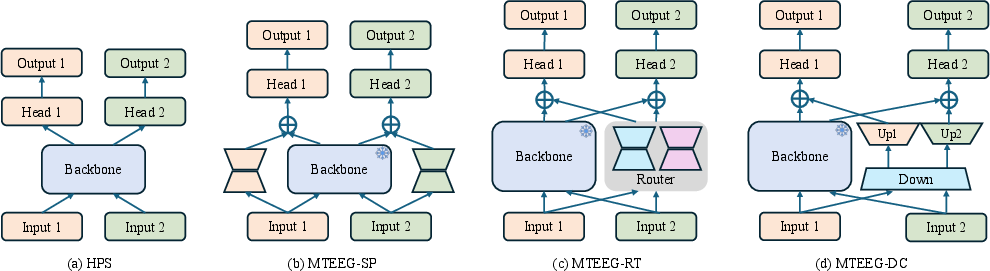
Figure 2: Comparison of HPS, MTEEG-SP (task-isolated LoRA), MTEEG-RT (MoE-like routing), and MTEEG-DC (shared down-projection with task-specific up-projections). Only LoRA modules are trainable in MTEEG variants; the backbone remains frozen.
Experimental Results
MTEEG is validated on six public EEG datasets spanning abnormality detection, event type classification, emotion recognition, seizure detection, sleep stage classification, and motor imagery. The paper measures balanced accuracy, AUC-PR/AUROC, Cohen's Kappa, and F1 depending on the class structure of each task.
Key findings include:
- HPS with a pre-trained backbone still suffers from pronounced performance degradation, attributable to cross-task interference.
- Both MTEEG-SP and MTEEG-DC substantially outperform HPS in all evaluation metrics, demonstrating the utility of LoRA-based gradient isolation.
- MTEEG-DC achieves superior or state-of-the-art results on four out of six tasks compared to the strongest single-task and multi-task baselines, establishing that selective parameter sharing (shared down-projection, task-specific up-projections) confers both transfer and disentanglement benefits.
- MTEEG's modular design is highly parameter-efficient, with maximal trainable parameter counts under 1.8M (~30% of the fully fine-tuned backbone).
- The MoE-style MTEEG-RT is markedly less effective, likely owing to insufficient router expressiveness for the highly non-stationary and noisy EEG domain.
Representation Analysis
t-SNE visualizations of penultimate representations reveal that MTEEG-DC forms well-separated, task-specific subspaces compared to both HPS and MTEEG-RT. This supports the hypothesis that the DC variant achieves effective trade-off: encouraging cross-task feature reuse while preserving task-unique structure (Figure 3).
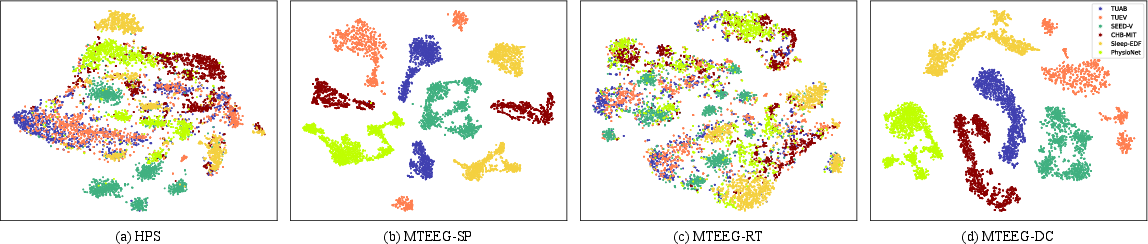
Figure 3: t-SNE visualization of feature representations for HPS, MTEEG-SP, MTEEG-RT, and MTEEG-DC, with more discriminative and isolated clusters in MTEEG-DC.
Ablation Studies
Comprehensive ablations on the LoRA rank r and adapter insertion points were conducted, revealing:
- Increasing adapter rank improves performance to a point (r=8 best for most tasks), beyond which overfitting dominates.
- Adapters must be inserted into both MHSA and feed-forward layers to preserve maximal expressive power.
Implications and Future Directions
The findings establish robust evidence that parameter-efficient multi-task EEG modeling is viable and can, with an appropriate modular design, surpass single-task state-of-the-art approaches. MTEEG-DC, in particular, not only reduces inference/training cost but also offers a practical route for future foundation models in neurophysiology and BCI deployment scenarios.
The study suggests several promising directions:
- Development of more expressive routers or expert gating for highly non-stationary biological signals.
- Exploration of modular adaptation beyond LoRA, e.g., combining low-rank and sparse adaptation, for even greater efficiency and robustness.
- Extension to continual or lifelong multi-task EEG scenarios where new domains or protocols are incrementally incorporated.
- Integration with cross-modal/federated brain decoding paradigms for real-world clinical interfaces.
Conclusion
This work makes a significant technical contribution to parameter-efficient, multi-task EEG analysis, demonstrating that LoRA-based adapters—especially appropriately decomposed for both task-agnostic and task-specific adaptation—enable joint optimization across highly heterogeneous EEG tasks without compromising representational integrity or numerical performance. MTEEG sets a template for future general-purpose brain-computer interface models and scalable neuro-AI systems.