Exploring Time Conditioning in Diffusion Generative Models from Disjoint Noisy Data Manifolds
Published 28 Apr 2026 in cs.LG and cs.CV | (2604.25289v1)
Abstract: Practically, training diffusion models typically requires explicit time conditioning to guide the network through the denoising sampling process. Especially in deterministic methods like DDIM, the absence of time conditioning leads to significant performance degradation. However, other deterministic sampling approaches, such as flow matching, can generate high-quality content without this conditioning, raising the question of its necessity. In this work, we revisit the role of time conditioning from a geometric perspective. We analyze the evolution of noisy data distributions under the forward diffusion process and demonstrate that, in high-dimensional spaces, these distributions concentrate on low-dimensional hyper-cylinder-like manifolds embedded within the input space. Successful generation, we argue, stems from the disentanglement of these manifolds in high-dimensional space. Based on this insight, we modify the forward process of DDIM to align the noisy data manifold with the flow-matching approach, proving that DDIM can generate high-quality content without time conditioning, provided the noisy manifold evolves according to the flow-matching method. Additionally, we extend our framework to class-conditioned generation by decoupling classes into distinct time spaces, enabling class-conditioned synthesis with a class-unconditional denoising model. Extensive experiments validate our theoretical analysis and show that high-quality generation is achievable without explicit conditional embeddings.
The paper demonstrates that geometric separation of noisy data manifolds can eliminate explicit time conditioning, thereby reducing ambiguity in denoising targets.
It introduces two strategies—manifold disjoint scheduling and orthogonal time-space disentanglement—to achieve reliable, time-unconditional generation.
Empirical results on datasets like CelebA, CIFAR10, and ImageNet reveal that optimized noise schedules and architectural adjustments yield competitive FID scores and improved sample quality.
Geometric Characterization and Time Conditioning in Diffusion Generative Models
Introduction
The paper "Exploring Time Conditioning in Diffusion Generative Models from Disjoint Noisy Data Manifolds" (2604.25289) presents a rigorous geometric analysis of time conditioning in diffusion generative models, specifically scrutinizing deterministic samplers such as DDIM and flow matching. By dissecting the trajectory of noisy data distributions in high-dimensional settings, the research challenges the necessity of explicit timestep embeddings—showing that geometric separation of noisy manifolds is pivotal for reliable generation without such conditioning. The study further proposes two architectural strategies to realize time-unconditional diffusion: manifold disjoint scheduling and orthogonal time-space disentanglement, elaborates the implications for class conditioning, and validates theory on both small and large-scale datasets.
Geometric Analysis of Diffusion Data Manifolds
The foundation is the manifold hypothesis: clean data x0∈RD occupy a low-dimensional subspace M0 of intrinsic dimensiond′≪D. The forward diffusion process corrupts x0 to produce noisy samples:
xt=ctx0+σtz
where z is standard Gaussian noise and (ct,σt) encode signal/noise coefficients.
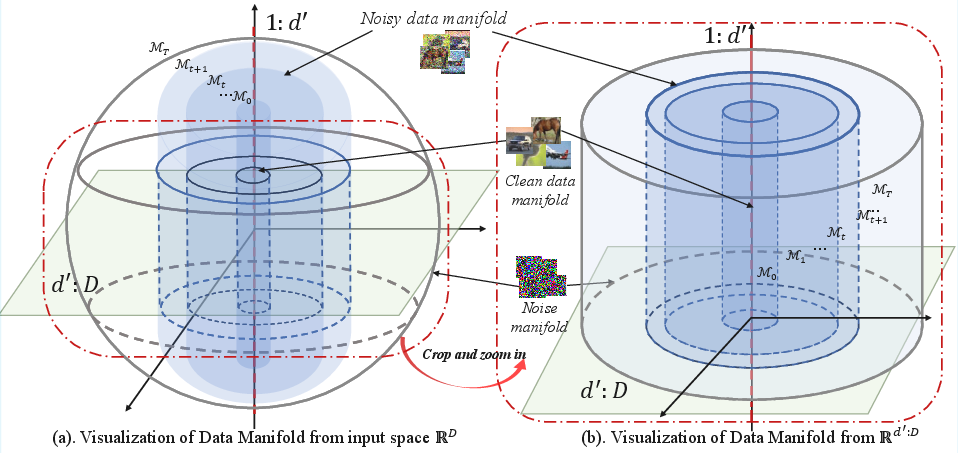
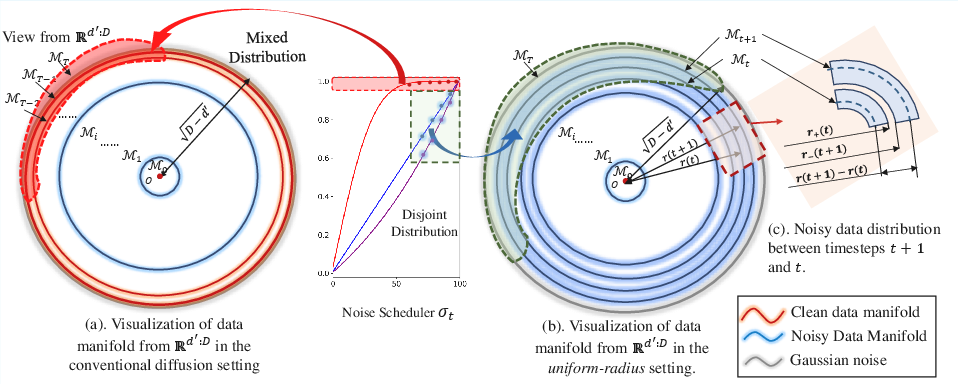
The paper demonstrates that, in high dimensions, noisy samples at timestep t concentrate around a (D−1)-dimensional hyper-cylinder shell at radius r(t)=σtD−d′ orthogonal to the data manifold. The thickness of this shell is governed by Gaussian concentration and increases with M00. Critically, adjacent timesteps may yield overlapping shells—causing ambiguous supervision when the denoiser lacks time information.
Figure 1: Visualization of the noisy data manifold in M01, illustrating clean data on a low-dimensional subspace and noisy samples forming concentric shells.
Necessity and Failure Modes of Time Conditioning
Time conditioning, usually implemented via sinusoidal, learned, or rotary embeddings, has been regarded as indispensable. The paper shows that this is not strictly architectural but geometric: if the shells corresponding to M02 and M03 overlap, time-unconditional predictors must compromise between divergent score fields, leading to a mixture of incompatible denoising targets and catastrophic generation.
Conversely, if the noisy manifolds are geometrically disjoint, the sample's location alone may suffice to infer its generating timestep, obviating the need for explicit time input. This insight explains empirical successes and failures of time-unconditional schemes observed in recent literature.
Figure 2: Distribution mixing under geometric view; varied spacing of noisy shells across noise schedules determines overlap and necessity of time conditioning.
Schedule-Level Manifold Disjoint and Orthogonal Time-Space Disentanglement
Two remedies are elaborated:
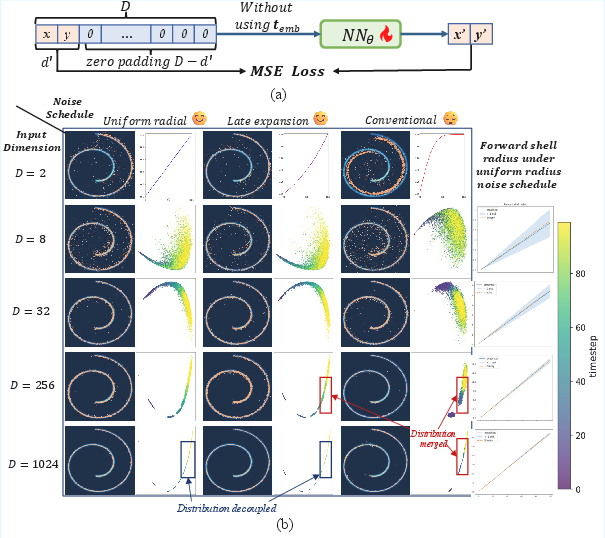
Schedule-Level Manifold Disjoint: Redesign the noise schedule (M04) so that shell radii increase sufficiently to prevent overlap. Uniform-radial and late-expansion VP schedules (e.g., M05, or exponential scaling) outperform conventional VP schedules that compress shells at late stages. This approach is effective in time-unconditional DDIM, yielding strong numerical gains in FID, Precision, and Recall, especially on large-scale datasets.
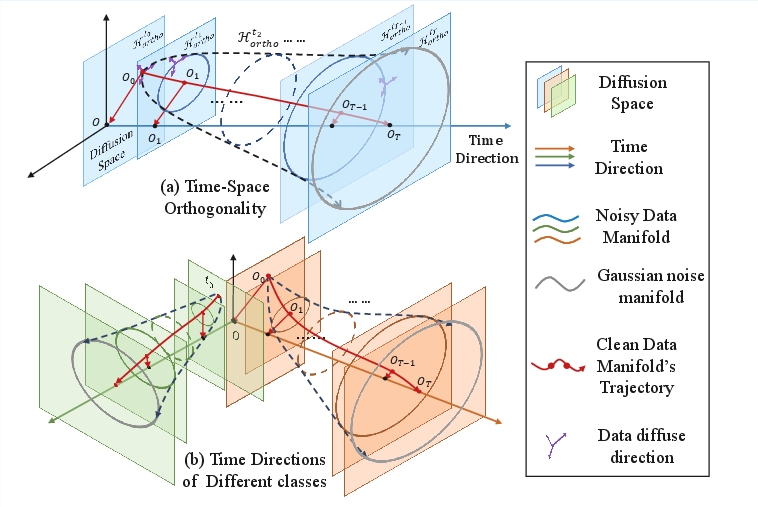
Orthogonal Time-Space Disentanglement: Instead of relying on radial separation, introduce a geometric direction M06 orthogonal to the data manifold, translating the diffusion hyperplane along time. Each timestep occupies a parallel slice in ambient space. This ensures complete manifold separation, making time retrieval trivial from the sample's geometric position.
Figure 3: Swiss-roll toy experiments demonstrating improved geometric separation and sampling quality across schedules and ambient dimensions.
Figure 4: Schematic of orthogonal time-space disentanglement, encoding time as translation in a direction orthogonal to the data manifold.
Empirical Results and Quantitative Performance
Experiments are performed on CelebA, CIFAR10, and ImageNet using DDIM sampling and DiT transformers, testing both unconditional and class-conditional generation. The main findings:
Baseline DDIM without time conditioning collapses (FID M07 60), producing saturated or noisy artifacts.
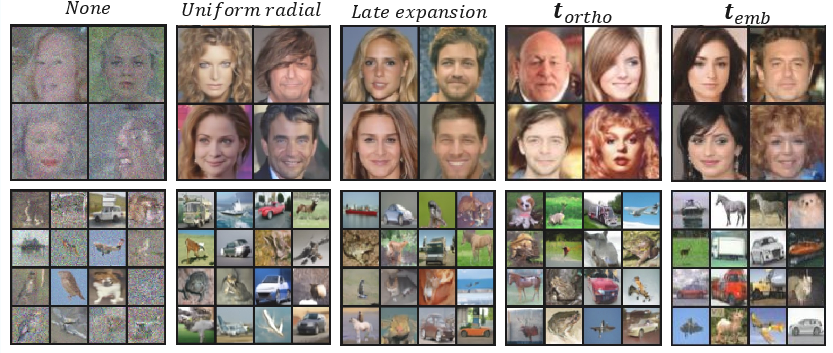
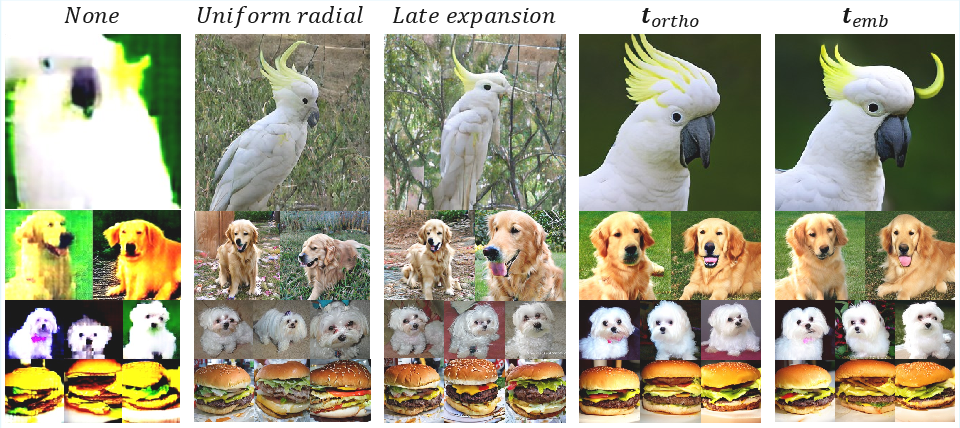
Uniform-radial and late-expansion VP schedules restore generation quality, matching or surpassing explicit time-conditioned models (FID M08 7–13 for CIFAR10/CelebA; FID M09 9–13 for ImageNet).
Orthogonal time-space methods achieve even closer performance to explicit time-conditioning, sharply lowering failure rates.
Figure 5: Qualitative DDIM sampling comparison on CelebA and CIFAR10, showing geometry-based methods restore sample quality versus time-unconditional baseline.
Figure 6: Qualitative ImageNet generation with DiT-B/2 under varied conditioning strategies, demonstrating successful schedule/geometry-based decoupling.
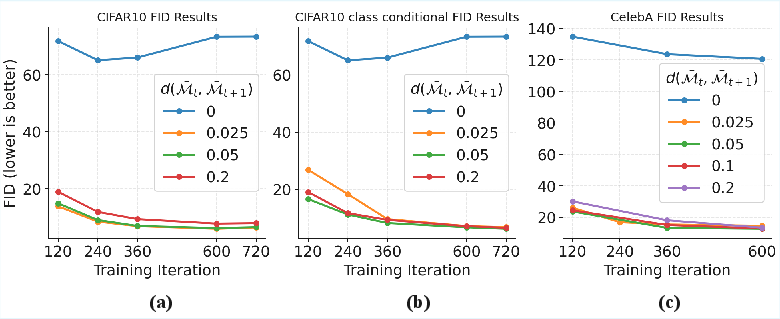
Ablation studies confirm that a minimal positive separation suffices to remove failure modes; excessive separation degrades performance due to non-local transitions.
Figure 7: Ablation on the manifold spacing parameter d′≪D0 shows threshold effect for successful geometry-based time-unconditional sampling.
Theoretical and Practical Implications
The research strongly asserts that explicit time conditioning in diffusion models is not theoretically essential—provided the forward process ensures geometric separability of noisy manifolds. This geometric criterion supersedes architectural heuristics, permitting embedding-free conditional generation and potentially enabling more efficient, less entangled denoiser architectures. The findings generalize to class-conditioned diffusion (by assigning orthogonal class directions), suggesting broad implications for conditional generation, embedding strategies, and the design of scalable generative pipelines.
The results connect manifold geometry, schedule design, and architectural requirements, offering a blueprint for future diffusion model design that minimizes conditioning overhead and leverages geometric structure for reliable generation.
Conclusion
The paper presents a comprehensive geometric perspective on time conditioning in diffusion generative models, demonstrating that manifold separation is the fundamental requirement for time-unconditional generation. Two mechanisms—schedule-level manifold disjoint and orthogonal time-space disentanglement—are shown to effectively enable high-quality, embedding-free sampling in deterministic diffusion models. The theoretical framework is validated by strong empirical results and ablations across multiple datasets and architectures. The implications extend to conditional generation schemes and call for further exploration of geometric encoding strategies in generative modeling.
“Emergent Mind helps me see which AI papers have caught fire online.”
Philip
Creator, AI Explained on YouTube
Sign up for free to explore the frontiers of research
Discover trending papers, chat with arXiv, and track the latest research shaping the future of science and technology.Discover trending papers, chat with arXiv, and more.