- The paper proposes a novel nonparametric framework for separately identifying utility functions and unobserved consumer heterogeneity via variations in nonlinear price schedules.
- It employs iterative functional equations and regularized series solutions to achieve near-parametric convergence rates while addressing endogeneity and covariate effects.
- Empirical applications and simulations demonstrate robust finite-sample performance and enable counterfactual elasticity analysis under policy-induced price variations.
Nonparametric Identification and Estimation of Consumer Preferences under Nonlinear Pricing
Overview and Contributions
This paper develops a nonparametric framework for the identification and estimation of consumer preferences and unobserved heterogeneity from repeated cross-sectional data where consumers face nonlinear price schedules. The central innovation is exploiting variation across multiple price regimes (distinct nonlinear price schedules) to achieve separate identification of the utility function and the distribution of unobservable preference types, while imposing minimal functional form restrictions. The identification is realized through a novel linear iterative functional equation linking the quantile function of unobserved heterogeneity to the differences in marginal prices induced by the price schedule changes. Estimation proceeds via an explicit regularized iterative series solution. The methodology further accommodates endogenous prices and observed covariates and demonstrates near-parametric rates of convergence under regularity.
Model Structure
The analysis considers consumers who choose a quantity Q of a good offered under a nonlinear price schedule P(Q). Each consumer’s utility is of the form u(Q)+Qε, with u(⋅) common across consumers and ε capturing unobserved, continuously distributed preference heterogeneity. The consumer's observed quantity choice solves
maxQu(Q)+Qε−τ(P(Q)−B)
where τ>0 is a Lagrange multiplier, and B the budget (not observed, always binding). The first-order condition links u′(⋅), P′(⋅), and P(Q)0:
P(Q)1
With only one observed schedule, P(Q)2 are not separately identified from the observed cross-sectional quantity distribution.
The crux of the framework is to leverage two (or more) distinct price schedules, P(Q)3 and P(Q)4, with associated observed distributions of P(Q)5, denoted P(Q)6 and P(Q)7. The observable cumulative distributions for each schedule satisfy
P(Q)8
Identification via Iterative Functional Equation
By taking differences between the two schedules at quantile-matched quantities, the authors establish the core functional equation for the quantile function P(Q)9, for u(Q)+Qε0:
u(Q)+Qε1
or, after normalization and transformation,
u(Q)+Qε2
where u(Q)+Qε3, and u(Q)+Qε4 is the difference in marginal prices mapped at the percentile. This linear functional equation defines a unique u(Q)+Qε5 (up to location, removed by normalization), under continuity and regularity of the quantile function.
The solution is shown to possess the explicit series representation:
u(Q)+Qε6
with convergence under mild contraction and Hölder continuity conditions.


Figure 1: Estimation of the quantile function of u(Q)+Qε7 (left) and the utility function u(Q)+Qε8 (right) for simulated samples (Design 1, u(Q)+Qε9).
Estimation and Asymptotics
Estimation proceeds by replacing population objects with their kernel-based empirical counterparts, applying the iterative formula for a finite number of steps (regularization parameter u(⋅)0). Statistical properties are rigorously analyzed: the bias declines exponentially in u(⋅)1, while the variance grows only polynomially, enabling choice of u(⋅)2 for optimal bias-variance trade-off. The resulting estimator achieves nearly u(⋅)3 convergence (up to log factors) for the entire function, outperforming standard regularization approaches in ill-posed inverse problems.
A multiplier bootstrap (empirical process–based) is provided for valid uniform inference. Simulation experiments confirm that the iterative estimator has strong finite-sample performance, with accuracy improving rapidly with sample size, and compare favorably against Tikhonov regularization.


Figure 2: Estimation of the quantile function of u(⋅)4 (left) and the utility function u(⋅)5 (right) under a crossing-support design (Design 2, u(⋅)6).
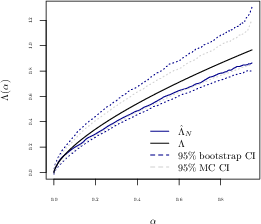
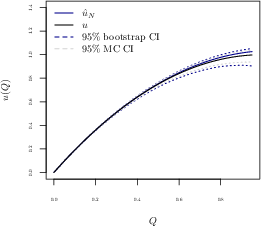
Figure 3: Bootstrap confidence intervals for quantile function and u(⋅)7 (Design 1, u(⋅)8); Monte Carlo and bootstrap intervals compared.
Empirical Application
The model is applied to administrative data from a European mail carrier’s unaddressed advertising contracts. The estimation is performed at the sector level for two cross-sections (2009 and 2012), under the assumption of constant underlying consumer preference distribution across years. The inverse demand (price schedule) function is first estimated using an instrumental variables procedure (leveraging observable covariates assumed exogenous to pricing), and then the nonparametric estimation approach is applied.
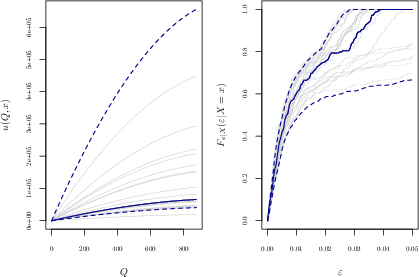
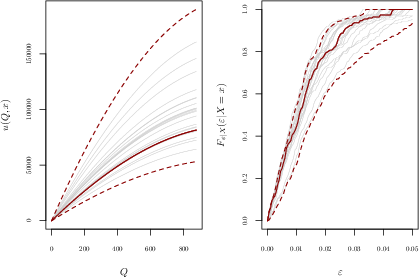
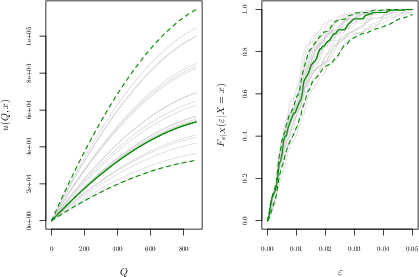
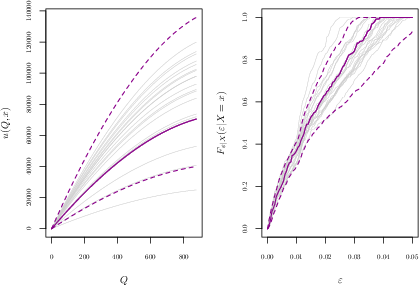
Figure 4: Estimated utility functions and preference cdfs for four sectors, with 90% bootstrap intervals and bootstrap replications.
Elasticities under Nonlinear Pricing
The identified and estimated utility and heterogeneity functions permit computation of elasticities under arbitrary nonlinear price counterfactuals. The authors consider both uniform level (“price inflation”) and curvature (“rebate/discount structure”) perturbations:
- For a parametric perturbation u(⋅)9, the elasticity is expressed as
ε0
- Under uniform-level (ε1) and power transformation (ε2), the elasticities are evaluated using the estimated functional objects.
Empirical results reveal a pattern: low-volume buyers show higher price-sensitivity, while high-volume buyers are inelastic, consistent with limited outside options at scale.
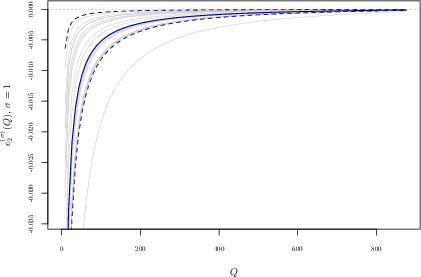
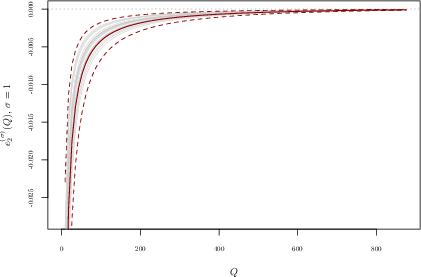
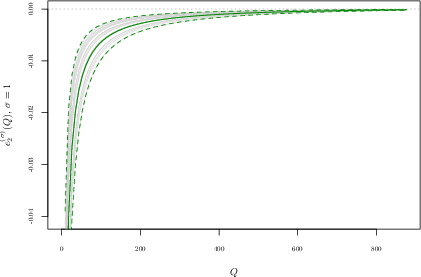
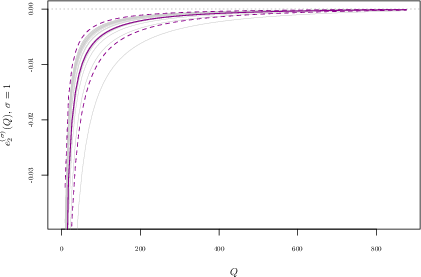
Figure 5: Estimated baseline level elasticity (ε3) for four sectors with 90% bootstrap confidence bands.
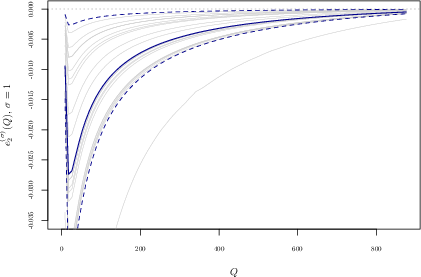
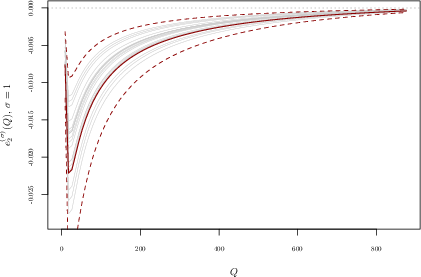
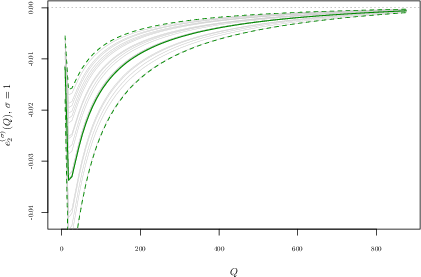
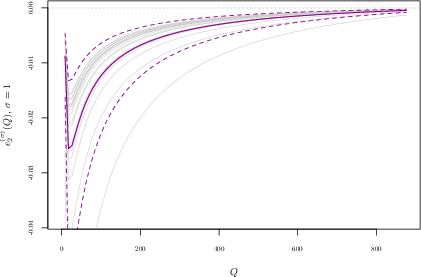
Figure 6: Estimated curvature elasticity (ε4) for four sectors with 90% bootstrap confidence bands.
Extensions: Endogenous Prices and Covariates
The methodology is extended to accommodate potentially endogenous prices, through semiparametric IV estimation of the price schedule conditional on covariates ε5. An instrumental variables identification hinges on exogenous heterogeneity affecting the utility but not pricing. The framework also generalizes for discrete observed covariates (stratified estimation) and in principle can be extended to high-dimensional continuous covariates, though the asymptotic theory for the latter is not developed here.
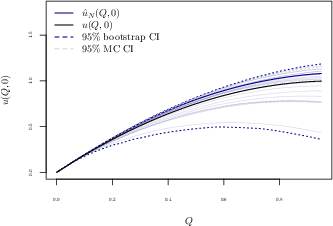
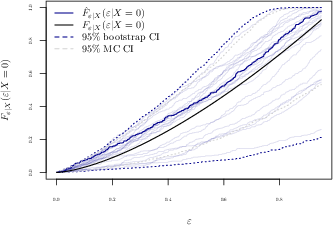
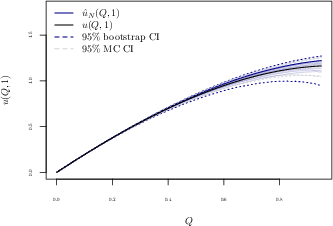
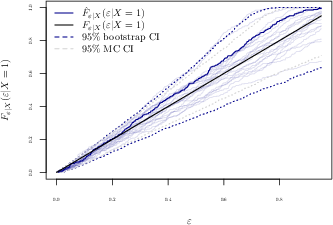
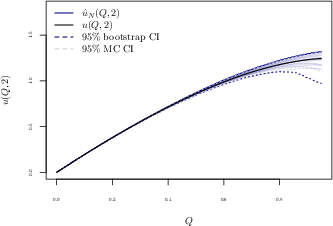
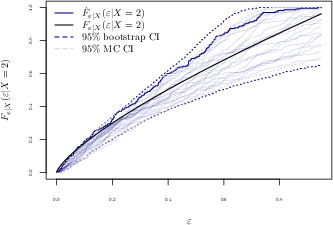
Figure 7: Covariate-conditional estimation of ε6 and ε7 for three strata of ε8 in simulated data (ε9), showing adaptation to observed heterogeneity.
Discussion and Implications
The approach breaks the identification impasse for nonseparable consumer preference models under nonlinear budget constraints, using the discrete variation induced by policy, regulation, or market design to separate utility and heterogeneity nonparametrically. The regularized iterative identification/estimation strategy is novel in the econometric literature of inverse problems. The developed estimator achieves near-parametric rates and bootstrap inference, suitable for empirical deployment with large administrative datasets.
Critical implications include:
- Possibility for fully nonparametric welfare and elasticity analysis in nonlinear pricing environments (utilities, telecom, insurance, taxation).
- Relaxation of functional form assumptions endemic to classic structural estimation under piecewise-linear or nonlinear tariffs.
- Direct computation of counterfactual elasticities under arbitrary price schedule changes, supporting robust policy analysis.
Theoretical limitations: Identification hinges on stable preference distributions across regimes, exogeneity of price schedule variation, and sufficient overlap of the support. Regularization parameter selection (the number of iterations maxQu(Q)+Qε−τ(P(Q)−B)0) is currently heuristic; automated selection remains open.
Practical limitations: The method requires repeated cross-sections under policy variation. In empirical exercises with only a single regime or shifting heterogeneous distributions, identification fails.
Conclusion
The authors’ framework endows empirical researchers with a constructive, nonparametric toolkit for the identification and estimation of structural consumer preferences in the presence of nonlinear pricing, leveraging repeated observational data and minimal functional restrictions. The iterative scheme and associated bootstrap procedures allow for credible finite-sample inference and counterfactual analysis, bridging substantial gaps between theoretical nonparametric identification and empirical practice in demand estimation. The main theoretical apparatus and empirical findings motivate several avenues for future research, including automated regularization selection, further generalization to multiple regimes, and extension to high-dimensional covariate settings.