- The paper's main contribution is a Dyna-style RL algorithm that jointly learns an uncertainty-aware dynamics model and safety filter to minimize training-time failures.
- It employs a novel hyperplane parametrization for the safety filter, enabling efficient and expressive action space search in high-dimensional settings.
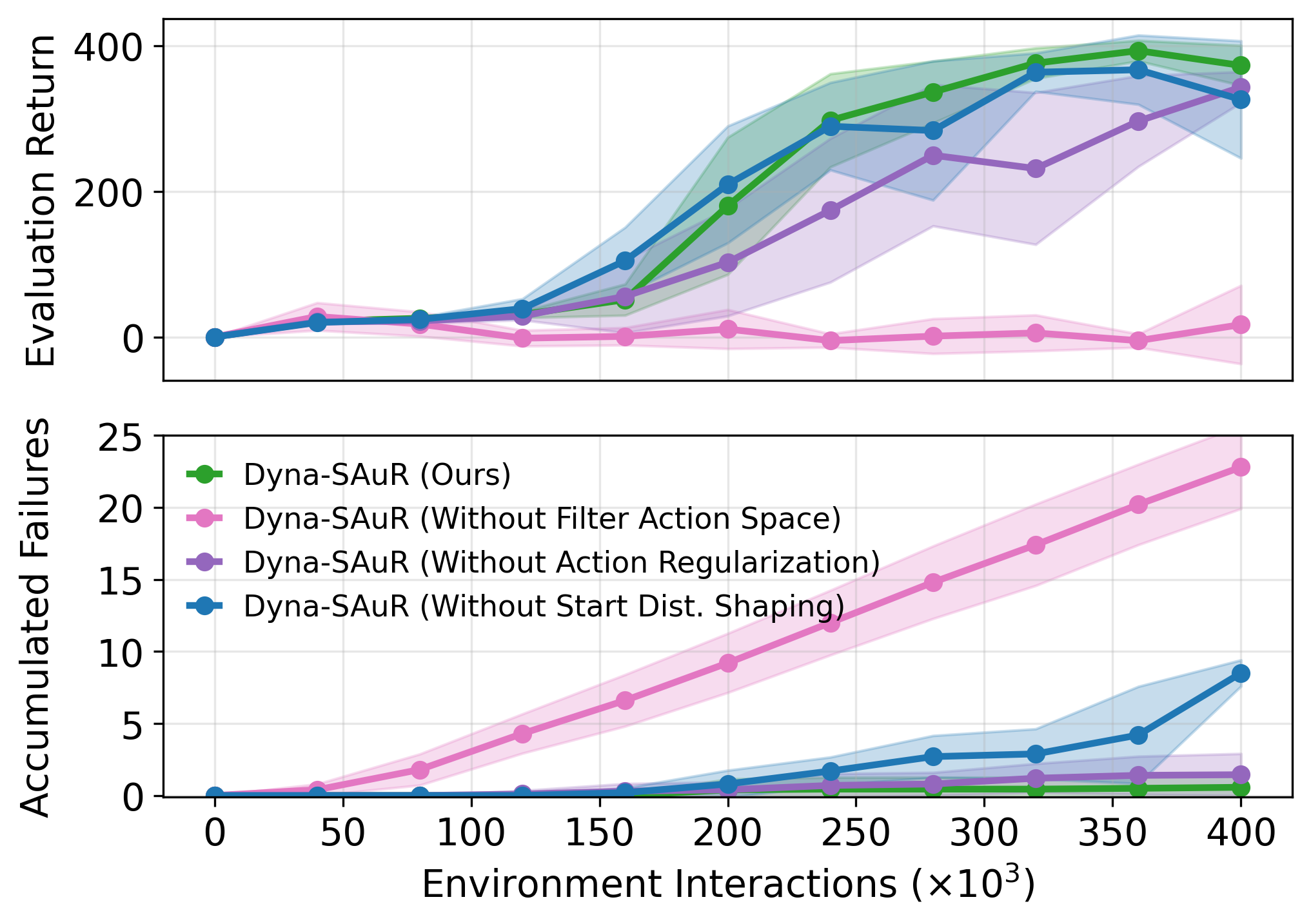
- Experimental results show a two order-of-magnitude reduction in safety violations while maintaining competitive control performance.
Dyna-Style Safety Augmented Model-Based Reinforcement Learning: The DYNASAUR Framework
Introduction
Ensuring safety during exploration and learning has remained a central technical bottleneck in deploying Reinforcement Learning (RL) on real-world platforms. While safety filters and constrained RL have seen significant research, existing techniques are typically limited by dependence on high-fidelity models, restrictive assumptions, or insufficient scalability for high-dimensional control. "Dyna-Style Safety Augmented Reinforcement Learning: Staying Safe in the Face of Uncertainty" (2604.25508) introduces DYNASAUR, a Dyna-style model-based RL algorithm that addresses these challenges by integrating joint learning of both scalable safety filters and control policies via an uncertainty-aware dynamics model with minimal domain assumptions.
The core contributions lie in: a principled RL formulation for learning viability-based safety filters in the presence of model uncertainty, a novel hyperplane parametrization for efficient and expressive action-space search, and an integrated training paradigm aligning model, filter, and control policy learning to minimize training-time failures without sacrificing asymptotic performance.
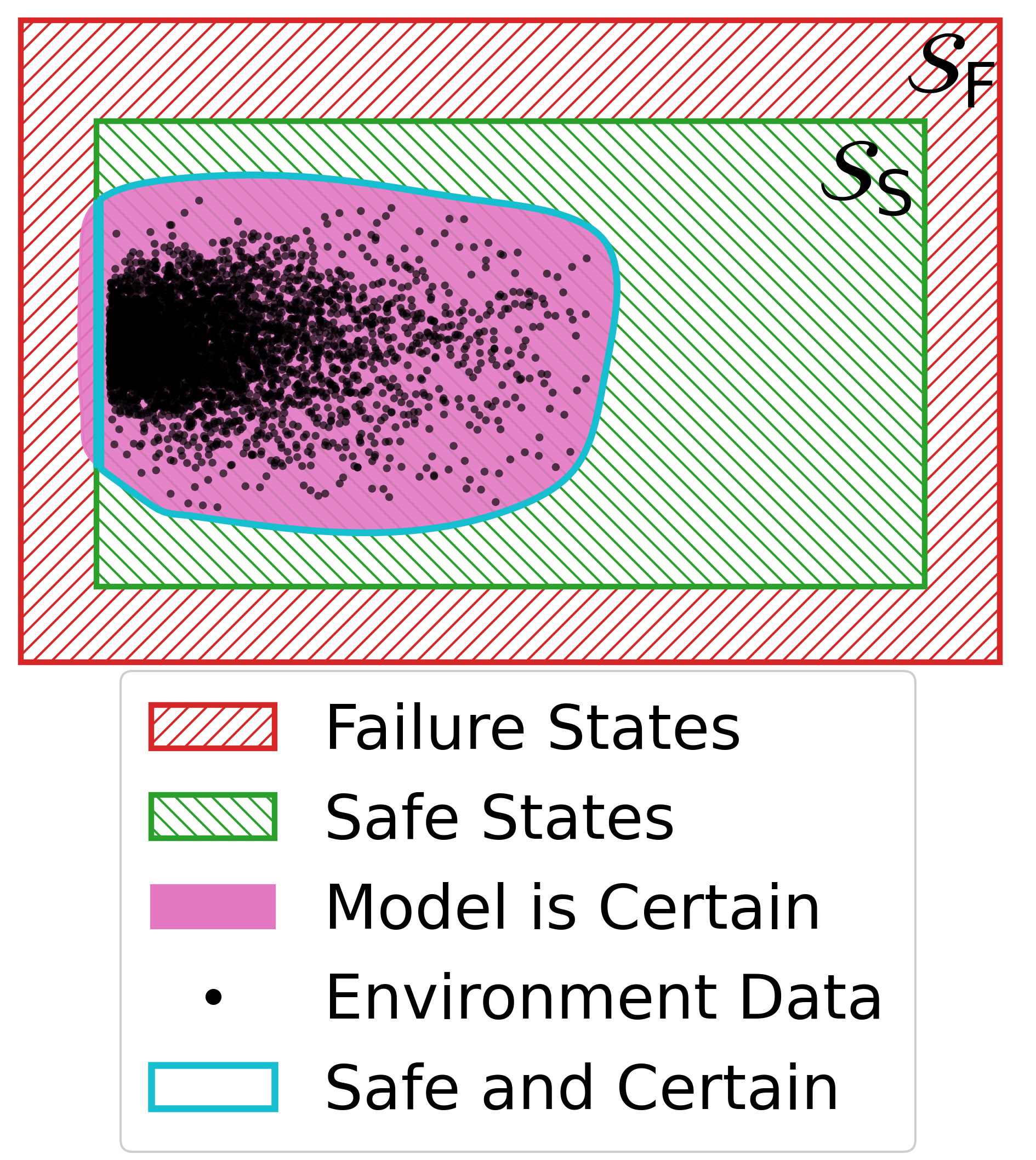
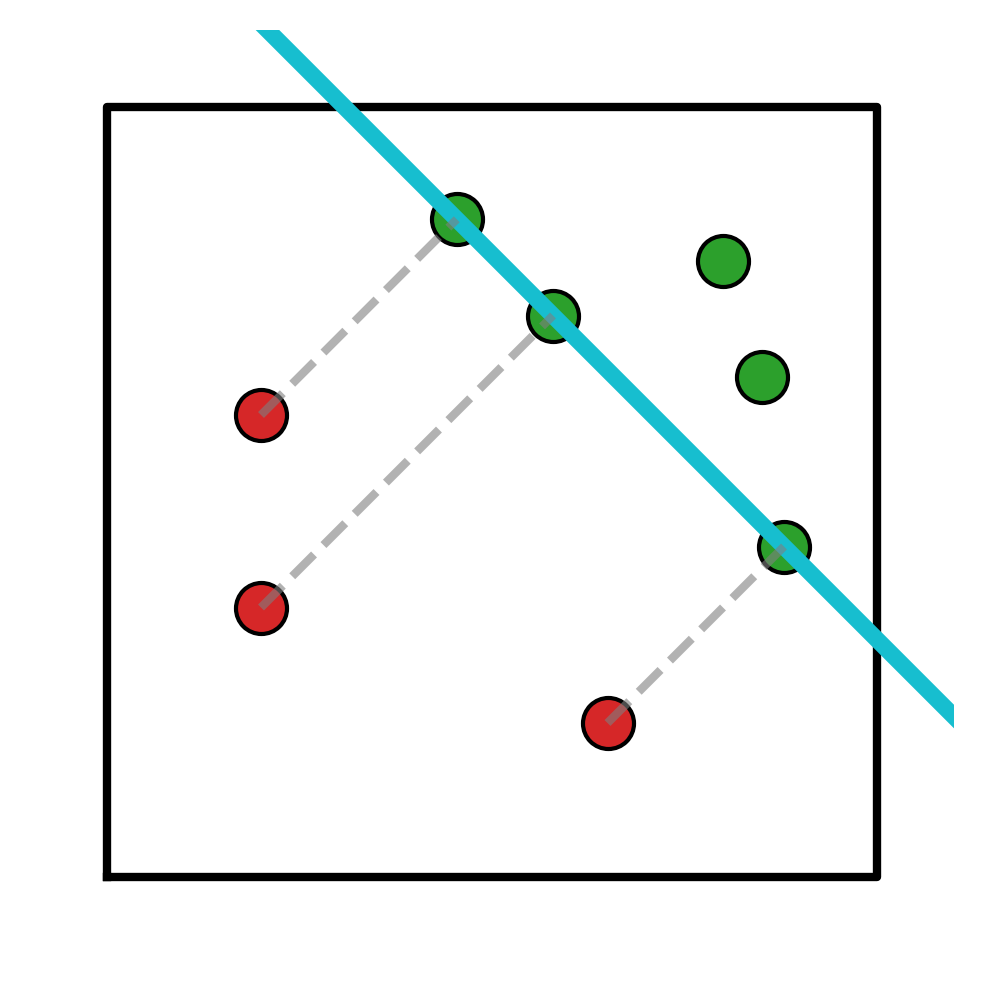
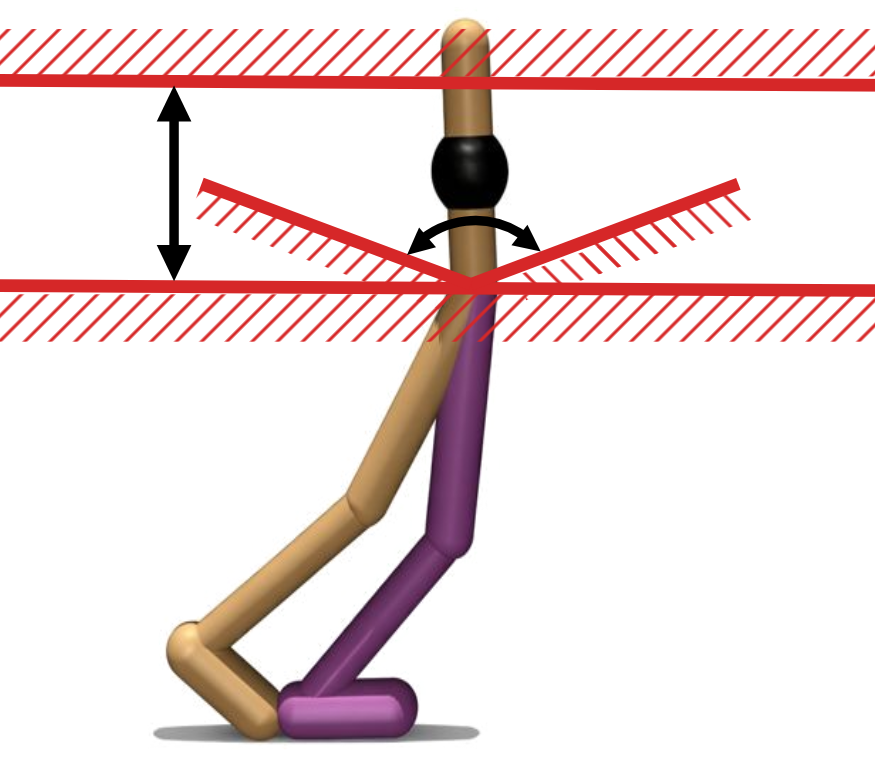
Figure 1: Schematic of the DYNASAUR mechanism—data-driven model, safety filter, and controller learning with iterative data/model refinement expand the set of safely-explorable states.
Technical Framework
Safety in Model-Based Reinforcement Learning
DYNASAUR addresses sequential decision-making in MDPs M={S,A,p,r} with safety defined via a user-provided failure set SF⊂S and an initial dataset. The framework focuses on training-time safety, formally minimizing failures accrued during exploration, not just deployment. The RL agent learns:
- A predictive uncertainty-aware ensemble model: capturing both epistemic and aleatoric uncertainty, and defining an "accurate set" E of state-action pairs (s,a) where the model provides certifiable reliability via predictive entropy bounds.
- A scalable, learned safety filter: parameterized as a state-dependent hyperplane in action space, projecting proposed actions to a viable subset with high probabilistic guarantees of avoiding both explicit failures and high-uncertainty regions.
- A performant control policy: trained under the safety filter, balancing robust exploratory behavior and return maximization within the expanding certain/viable region as the model improves.
Viability kernels are extended into the model-based setting to guard against failure in both unsafe and uncertain regions, with all safety statements made over finite horizons under process noise.
Safety Filter Parametrization and Learning
The filter is realized as a neural parametric mapping
aV(s)=argamin∥a−π(s)∥2s.t.w(s)⊤a≥b(s)
with (w,b) produced via a bijective transformation from a unit hyperball parameter space, ensuring non-redundant, bounded, and expressive hyperplane representations intersecting the bounded action domain A. This parametrization addresses non-identifiability and search-space issues prevalent in previous work [black-box-lavankul].
Learning the safety filter is framed as an RL problem itself (the "filter MDP"), with reward design and rollout strategies informed by the need for maximal "least-restrictive" viable sets. Value-based RL, using actor-critic (FastTD3 variant) with high-throughput, model-generated rollouts, and prioritized state distributions, achieves tractable convergence.
(Figure 2)
Figure 2: Illustration of the hyperplane action space—the filter parametrization ensures expressive yet computationally stable mapping to viable-region projections.
Iterative Dyna-Style Procedure
DYNASAUR alternates between model, filter, and control policy learning in a Dyna-style loop:
- Model Update: Retrain the uncertainty-aware ensemble model on data from the previous safe interactions, expanding the set E.
- Filter Update: Retrain the safety filter MDP from scratch, ensuring generalization and avoidance of local minima.
- Control Policy Training: Train under the fixed filter, collecting new data while monitoring both control return and safety violations.
- Data Aggregation: Add all new safe interactions to the experience buffer, further closing uncertainty gaps.
This loop drives safe exploration and coverage of the task domain while minimizing the cumulative probability of failure at each step.
Experimental Results
The empirical evaluation focuses on two standard but challenging RL settings: goal-reaching CartPole with explicit state constraints and high-dimensional MuJoCo Walker with safety constraints on joint angles and torso position.
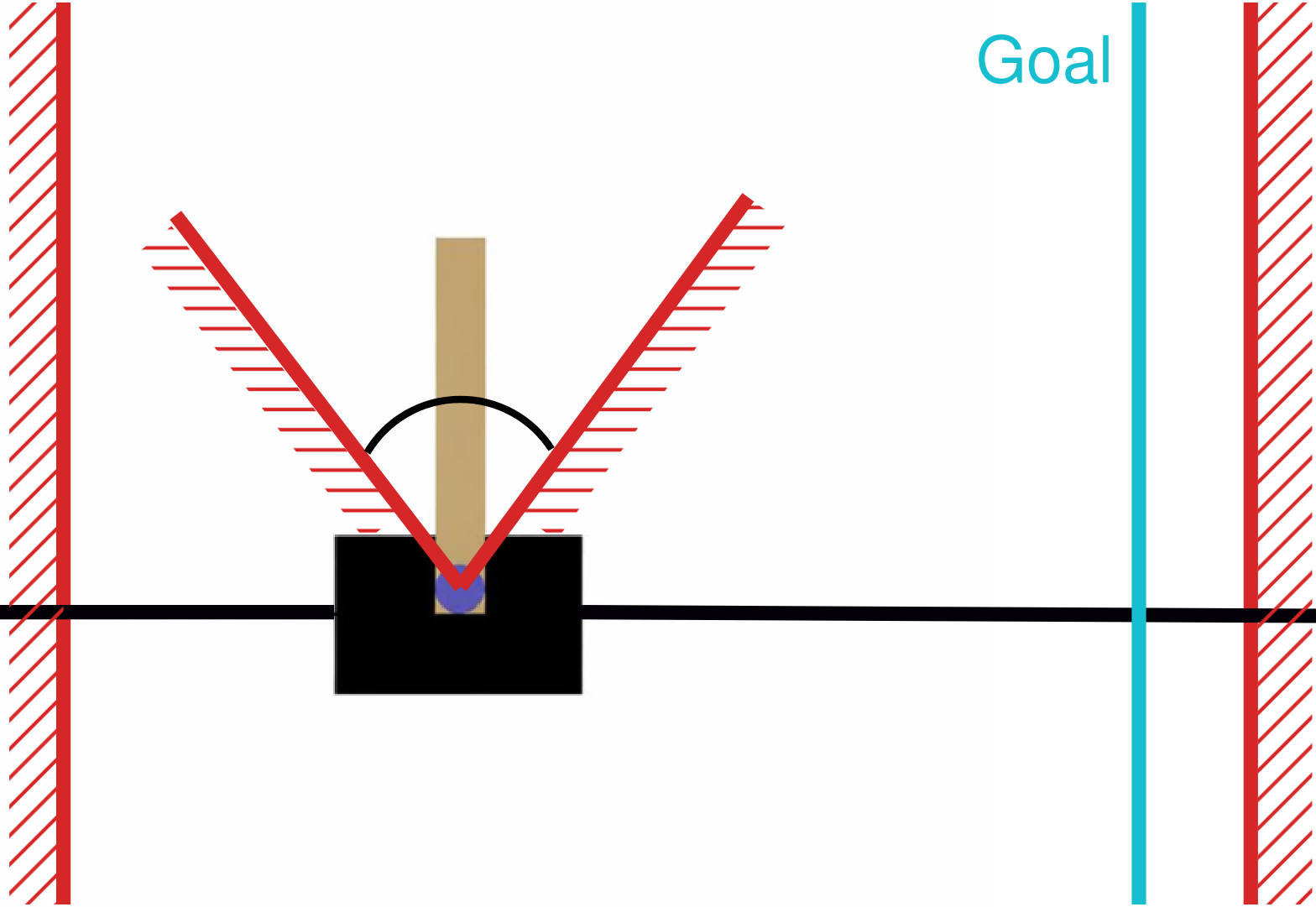
Figure 3: Depiction of the goal-reaching CartPole setup with explicit unsafe regions (red) and target goal (blue).
DYNASAUR demonstrated two primary outcomes:
- Control Performance: Matches or slightly outperforms strong model-free safe RL methods (PPO-Lagrangian [Ray2019SafeExploration], DH-RL [black-box-lavankul]) on both domains, and reaches competitive asymptotes compared to unconstrained, safety-agnostic model-based RL (Infoprop-Dyna).
- Training-Time Failures: Reduces safety violations by at least two orders of magnitude compared to other scalable safe RL baselines. The safety filter leads to near-elimination of catastrophic failures throughout the control training phases, a claim verified under multiple random seeds on both tasks.
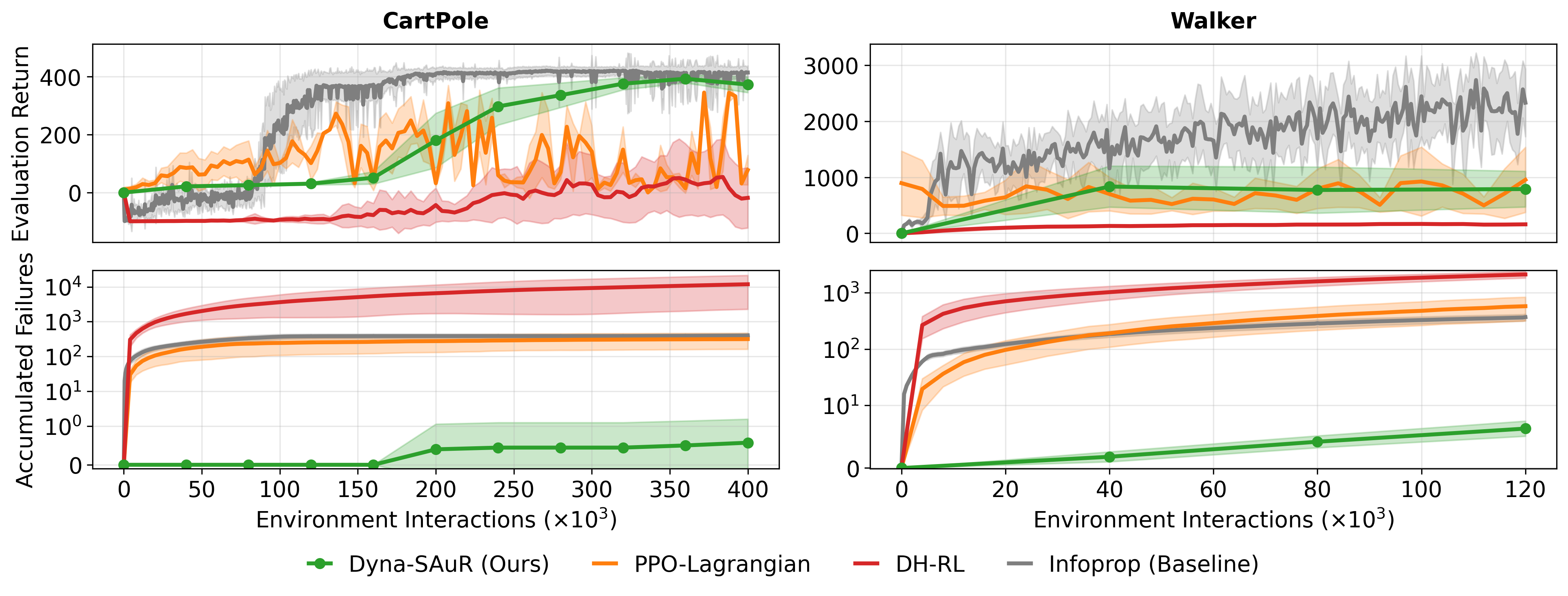
Figure 4: Learning curves—control return (top) and log-scaled accumulated failures (bottom); DYNASAUR (green) achieves strong return with two orders of magnitude fewer failures than baselines.
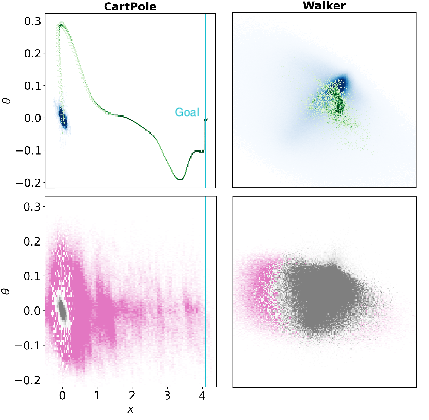
Figure 5: Distributional shift in explored states—initial model data (blue) vs. final filtered policy coverage (green); DYNASAUR effectively expands safe/certain coverage over training.
Ablation and Design Insights
Additional ablation on CartPole reveals critical dependence on the proposed hyperplane action space and sampling strategies:
Analysis of the final safety filter reveals expected structure—the filter admits a wide viable set near the goal and upright pole configurations but becomes sharply restrictive near boundaries or at large velocities.
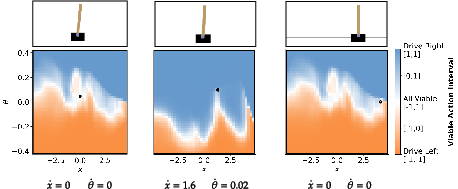
Figure 7: Visualization of state-conditioned safety filter—regions of white (pass-through actions) shrink as the agent approaches high-risk state-space edges.
Theoretical and Practical Implications
This work establishes that viability-based safety can be scaled to high-dimensional deep RL with learned models, with no need for explicit domain dynamics, prior safe sets, or terminal state design. The filter parametrization admits stable, expressive neural RL, unlike previous formulations. Empirical results show safety and return are compatible in model-based RL, contradicting some prior findings which reported substantial trade-offs or sample inefficiency.
Practically, DYNASAUR opens the door to safe RL in hardware-closed-loop settings (e.g., robotics, nonlinear process control, autonomous vehicles) with only minimal expert input (knowledge of failure states and initial data), avoiding the prohibitive manual engineering or computational detours of Hamilton–Jacobi, CBF, or reachability analyses. Theoretically, it demonstrates that RL-based safety filter learning can be robustified via uncertainty-aware models and principled action-space design, even under epistemic uncertainty.
Limitations and Future Directions
While DYNASAUR scales well on moderately high-dimensional tasks (MuJoCo Walker), exploration and expansion of the certain set E become less efficient with increasing task complexity or dimensionality. Further advances in uncertainty quantification, targeted model learning, and efficient coverage of rare but critical state-action regions are required for more complex systems. Integrations with additional model-based planning, improved epistemic uncertainty metrics, or adaptive filter learning objectives are promising avenues.
Conclusion
DYNASAUR provides a unified, scalable solution for safe RL with hard constraints during both training and deployment, leveraging joint uncertainty-aware modeling and principled safety filter learning. It achieves practical and theoretical safety performance with strong sample efficiency and minimal prior knowledge, making it a compelling candidate for real-world safe RL deployments and further AI safety research.