- The paper demonstrates that explicit cue-guided interaction significantly improves context-dependent multimodal understanding, leading to notable F1 score gains.
- It employs a three-stage architecture with structure encoding, global-local cue construction, and adaptive cross-modal interaction to interpret implicit sentiments.
- Empirical evaluations on datasets like MUStARD and CMU-MOSEI validate CUCI-Net’s effectiveness in discerning non-literal intents such as sarcasm and humor.
Cue-Guided Interaction for Context-Dependent Conversational Multimodal Understanding
Motivation and Problem Setting
Conversational multimodal understanding remains a central challenge, particularly because the meaning or affective function of an utterance is frequently disambiguated only in light of preceding conversational context and multimodal signals (text, acoustics, vision). The paper "Beyond Isolated Utterances: Cue-Guided Interaction for Context-Dependent Conversational Multimodal Understanding" (2604.25618) critiques existing approaches for their reliance on holistic context fusion or enhancement, arguing that they rarely distill context-utterance dependencies into explicit cues that structure subsequent multimodal reasoning. Instead, the authors formulate a framework where context-utterance structural information is first preserved, then abstracted into distinct interpretation cues, and ultimately injected as guidance for late-stage multimodal interaction.
The authors focus on scenarios where utterances cannot be reliably interpreted in isolation (e.g., sarcasm, humor), as illustrated in (Figure 1).
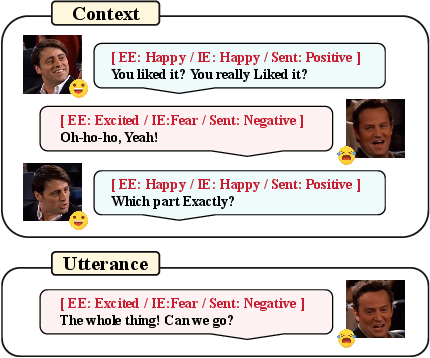
Figure 1: The interpretation of the current utterance requires integrating explicit/implicit emotion and sentiment from the preceding context.
CUCI-Net: Model Architecture
The proposed model, CUCI-Net (Context-Utterance and Cue-guided Interaction Network), is instantiated as a three-stage architecture—each stage designed to systematically preserve and exploit the context-utterance dependency:
- Context-Utterance Structure Encoding: Two parallel branches (primary, structure-preserving) encode the inputs. Text is encoded by ALBERT; acoustic and visual representations are handled by relation-guided, dual-expert Transformers. Explicit context/utterance indicators are preserved via segment IDs, and text-anchored relation representations are computed.
- Global-Local Interpretation Cue Construction: Structural representations inform both local and global evidence aggregation. Local cues summarize utterance-centered, pairwise cross-modal relations (e.g., text-audio, text-visual), while the global branch draws on contextual text for a discourse-level guidance vector. These local and global cues are concatenated to form the interpretation cue.
- Interpretation-Cue-Guided Multimodal Interaction: The interpretation cue is projected to guide a hierarchical stack of multimodal interaction layers. Each modality is iteratively updated through guidance-conditioned attention, and adaptive cross-modal integration is performed to yield a final prediction representation.
The overall conceptual flow is depicted in (Figure 2).
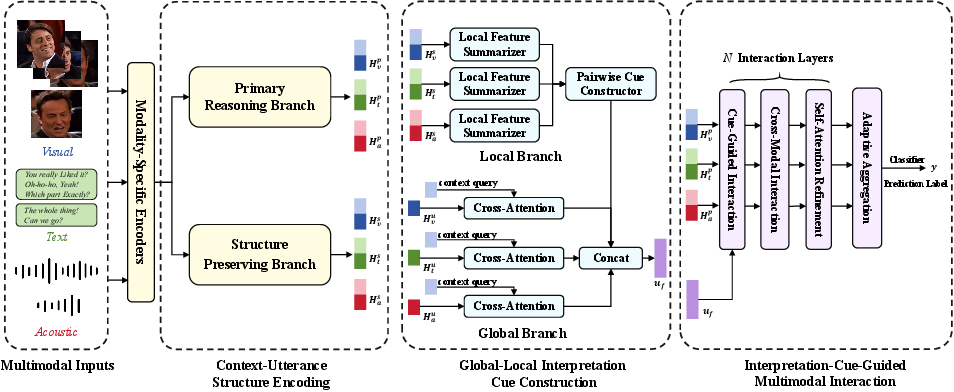
Figure 2: CUCI-Net’s three-stage architecture for explicit preservation of context-utterance structure, construction of global-local cues, and guided multimodal interaction.
The local pairwise cue construction for multimodal alignment (particularly illustrated for text-visual) is shown in (Figure 3).
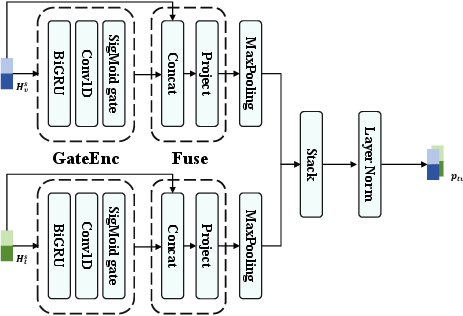
Figure 3: Detailed scheme for text-visual (and analogously for other modality pairs) feature summarization and local cue construction.
Empirical Evaluation
Experimental Setting
CUCI-Net is evaluated on key context-dependent affective understanding datasets—MUStARD and MUStARD++ (for sarcasm and implicit emotion recognition), and is further validated on UR-FUNNY, CMU-MOSI, CMU-MOSEI (sentiment, humor). Various strong baselines are considered, including Tensor Fusion Network (TFN), Multimodal Transformer (MulT), DLF, MFMB-Net, MISA, and others.
The authors provide a thorough ablation study to evaluate each architectural component, testing both the importance of structure-preserving encodings and the unique contribution of the cue-guided interaction layers.
Main Results
CUCI-Net demonstrates consistent gains across all major metrics (Precision, Recall, F1). On the MUStARD dataset, for example, the model delivers an F1 score of 64.37% (Entire Set), outstripping the prior best by nearly 6 points. On the more diverse MUStARD++ (substantially harder), CUCI-Net achieves an F1 of 28.50% versus prior bests of 24–25%. Results are robust across dataset subsets stratified for sarcastic and non-sarcastic examples.
These improvements validate the hypothesis that explicit construction and injection of interpretation cues drive meaningful gains over simple fusion or context-enhanced models. Performance is also competitive on sentiment and humor benchmarks (CMU-MOSEI, CMU-MOSI, UR-FUNNY), showing generalization beyond sarcasm.
Analysis and Diagnostic Evaluation
Layer and Routing Sensitivity
A layer sensitivity analysis (Figure 4) reveals that model performance follows a non-monotonic relationship with respect to interaction depth: moderate depths optimize cross-modal contextualization, while excessive stacking degrades representation stability and discriminative power.
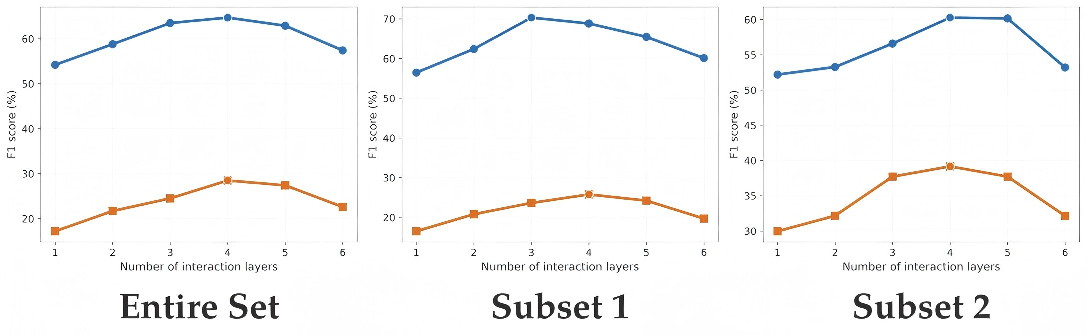
Figure 4: F1 performance trends for all and stratified sets under varying interaction depths on MUStARD and MUStARD++.
Visualization of router heatmaps and expert consistency scores (Figure 5) confirms that CUCI-Net’s dual-expert routing mechanism allocates expert attention in a label-sensitive and specialization-progressive manner—sarcastic/consistent and non-sarcastic/discrepant branches are differentially activated as needed.

Figure 5: Left: Expert routing heatmaps highlighting context-dependent routing specialization; Right: Visual branch expert consistency across layer hierarchy.
Representation Structure
t-SNE visualizations (Figure 6) of learned feature spaces show that CUCI-Net induces well-structured, class-separable representations on both MUStARD (sarcasm) and UR-FUNNY (humor), confirming that the injected cues lead to better organization of multimodal features.
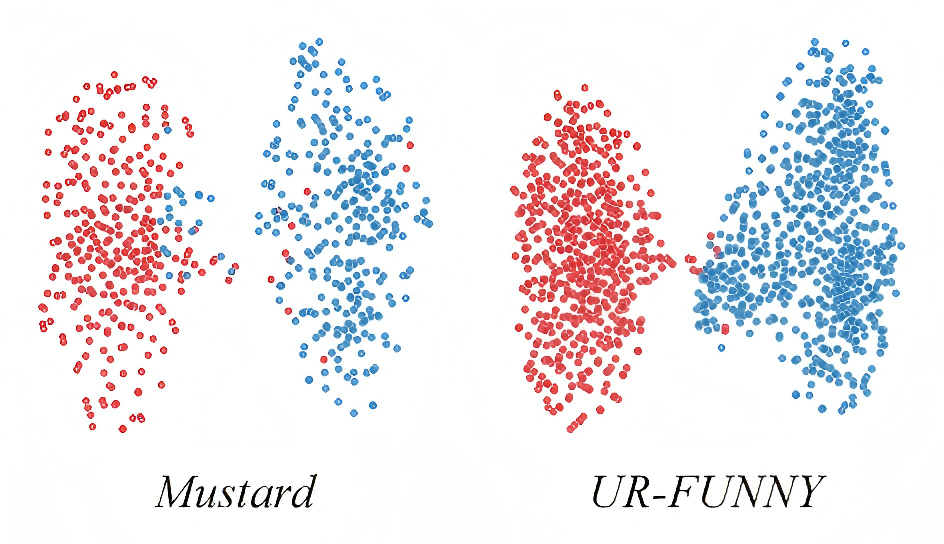
Figure 6: t-SNE plots illustrate that sarcastic/funny and non-sarcastic/non-funny samples are well separated in the learned space.
Theoretical and Practical Implications
This work carefully interrogates the prevailing strategy of surface-level context fusion and demonstrates the value of explicit, architectural encoding of context-utterance dependencies as actionable cues. The three-stage decomposition—structure preservation, cue abstraction, guided interaction—suggests design principles for future multimodal reasoning architectures, particularly in cases (e.g., non-literal intent detection, affect shift) where context-conditioned semantic inversion is the norm rather than the exception.
Practically, CUCI-Net delivers substantial accuracy gains on challenging multimodal dialogue tasks, showing increased reliability in nontrivial cases and robustness to annotation diversity. The design insights could inform next-generation dialogue agents, conversational AI, and human-computer interaction systems, where context-sensitive intent recognition is critical.
Conclusion
CUCI-Net systematically advances conversational multimodal understanding by architecturally separating and exploiting context-utterance dependencies as explicit cues for downstream reasoning. The framework’s validated improvements, interpretability of interaction mechanisms, and diagnostic robustness analyses position it as a reference model for multimodal dialogue systems where reasoning about pragmatic intent and affect shift is required. The approach offers a promising foundation for future research in fine-grained, context-aware, multimodal representation learning and interaction (2604.25618).